
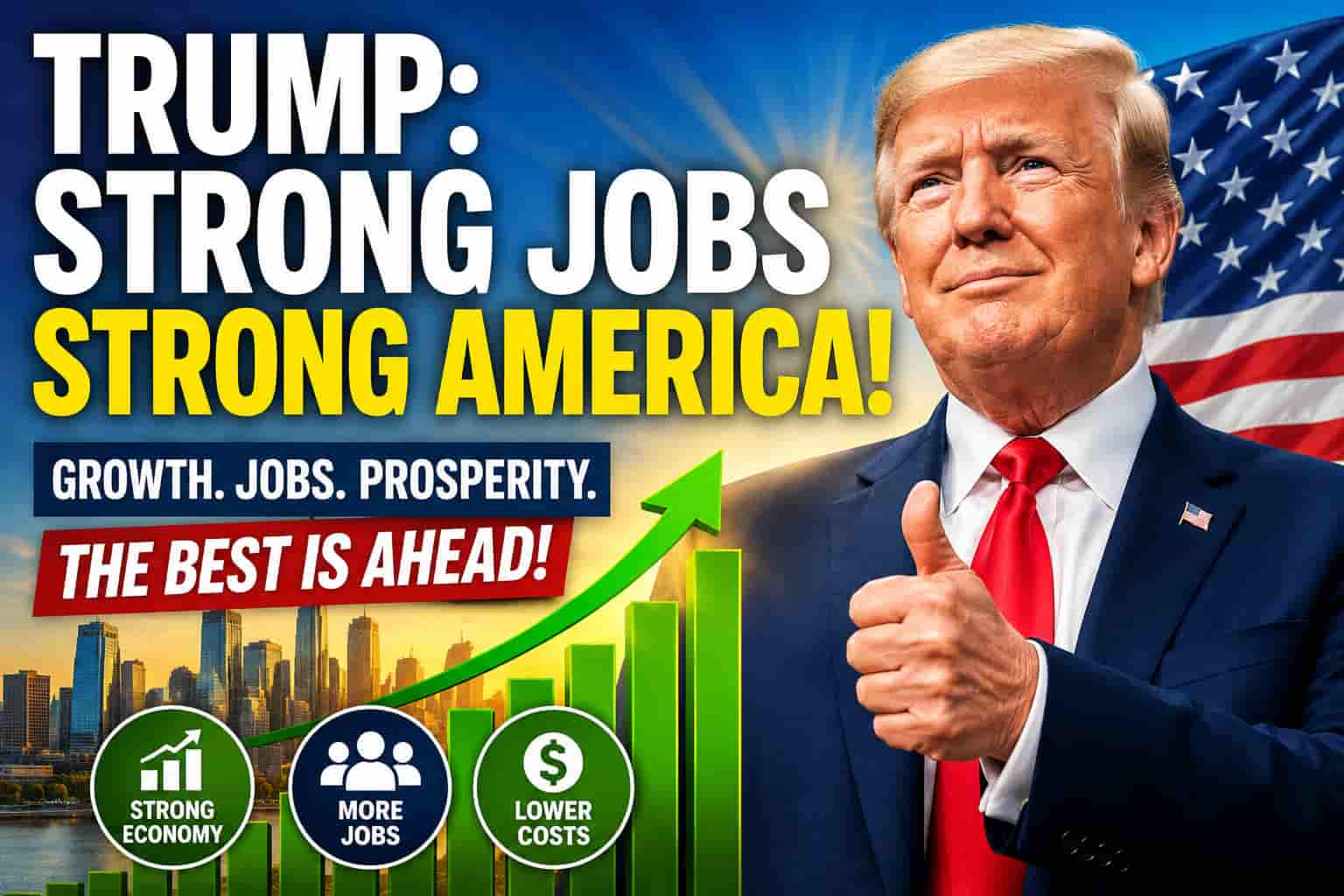
President Donald J. Trump used a June 5, 2026 press gaggle aboard Air Force One to push back against the market’s reaction to a strong U.S. jobs report, arguing that Wall Street and the Federal Reserve are still treating economic growth as a warning sign instead of a national advantage.
Speaking to reporters while traveling to Chippewa Falls, Wisconsin, Trump said the latest employment numbers were “fantastic” and “far better than even anticipated.” The Bureau of Labor Statistics reported that the U.S. unemployment rate held at 4.3 percent in May 2026, while nonfarm payroll employment increased by 172,000 jobs, according to the official Employment Situation release.
The President’s central message was that strong job growth does not automatically mean inflation. “You don’t have to have inflation by having growth,” Trump told reporters, adding that the country can have what he called “anti-inflation growth.” In his view, the market’s decline reflected an outdated Wall Street assumption: when the economy performs well, investors fear the Federal Reserve will keep rates higher or even raise them.
The press gaggle came as markets fell sharply. MarketWatch reported that the Dow Jones Industrial Average dropped 695 points, while the S&P 500 and Nasdaq also ended sharply lower, with the selloff driven in part by technology-sector losses and rising Treasury yields.
Trump repeatedly returned to interest rates, saying he wants lower rates because every percentage point matters for federal borrowing costs. “I’d like to see lower interest rates,” he said, arguing that each point represents hundreds of billions of dollars in savings. The Federal Reserve’s 2026 calendar shows upcoming meetings on June 16–17, July 28–29, September 15–16, October 27–28, and December 8–9.
Reporters also pressed Trump on several other issues, including artificial intelligence, U.S. energy policy, oil prices, Taiwan arms sales, Ukraine-Russia negotiations, the Kennedy Center, Fannie Mae and Freddie Mac, Major League Baseball salary caps, college sports, and personnel decisions involving the Office of the Director of National Intelligence.
One of the most notable exchanges came on artificial intelligence. Trump said his administration is looking at whether the American public could benefit directly from major AI companies through some form of public-private partnership or equity stake. He referenced the administration’s earlier Intel deal and said AI may become “the biggest industry maybe that we’ve ever seen.”
On energy, Trump argued that the United States has vast oil, gas, coal, and related energy resources, and he claimed that oil prices remained far below the extreme levels some had feared. He tied lower future energy prices to resolving international conflict and increasing supply.
On Ukraine, Trump said he believes Russia and Ukraine are getting closer to a resolution, repeating that the war “should have never happened” and saying the United States wants the conflict ended. He also contrasted his policy with the Biden administration’s approach, saying Ukraine is now buying from the United States at full price rather than receiving the same level of direct support.
The broader political message was clear: Trump framed the jobs report as proof of economic strength, while blaming market weakness on fears about Federal Reserve policy and inflation. His argument was that America should not “stifle the growth” when factories, auto plants, and jobs are expanding.
For Trump, the market drop was not a sign that the economy is weak. It was, in his telling, evidence that financial markets and central bankers have not yet adjusted to a pro-growth economic environment.
- U.S. Bureau of Labor Statistics — Employment Situation Summary, May 2026
- U.S. Bureau of Labor Statistics — Employment Situation Release Schedule
- Federal Reserve — FOMC Meeting Calendar 2026
- The White House — Live Events and Official Video
Midtown Tribune Independent USA news from New York
Ask Midtown Tribune about this story
Answers are grounded first in this article. Search all Midtown Tribune reporting from the main AI Search page.
AI-generated summary. Verify important details in the linked original articles.