
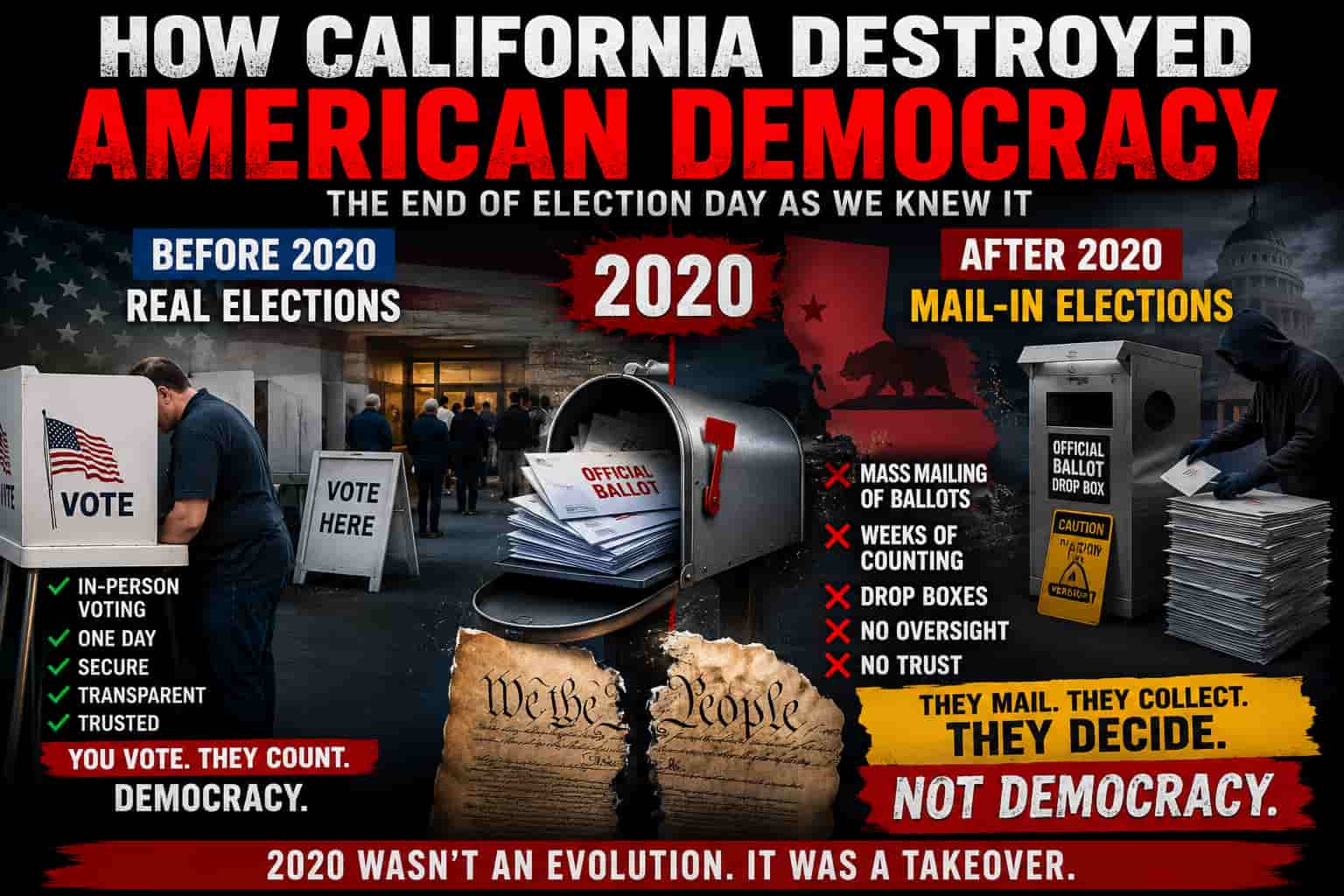
The Spencer Pratt–Nithya Raman controversy is not just a Los Angeles story. It is a warning about what happened when California replaced traditional Election Day with a mass mail-in ballot machine.
In 2020, under the cover of COVID-19, California radically changed the meaning of American elections. The state began mailing ballots to every active registered voter. What had once been an exception — absentee voting for people who truly could not appear at the polls — became a mass political system.
That was the real turning point.
The old American model of Election Day was simple, public, and easy to understand: a citizen personally appears at a polling place, confirms his or her right to vote, enters a private booth, marks a secret ballot, and casts that ballot in a controlled election environment.
That model protected not only the vote itself, but public trust in the vote.
California broke that model.
A ballot no longer had to remain tied to the polling place. It could now travel through mailboxes, apartments, campaign environments, drop boxes, ballot collection systems, signature verification, cure procedures, and days or weeks of post-election counting.
Supporters call it “access.” Critics call it the end of Election Day.
The scandal surrounding Spencer Pratt and Nithya Raman in the Los Angeles mayoral race shows why this issue matters. The public saw one candidate appear strong early, then watched late-counted ballots change the political picture. Whether or not a specific fraud case is proven, the system itself creates suspicion.
And a democracy cannot survive on suspicion.
What Happened in 2020
The key law was AB 860.
In June 2020, California Governor Gavin Newsom signed AB 860. The law required county elections officials to mail a vote-by-mail ballot to every active registered voter for the November 3, 2020 general election.
The bill was authored by Democratic Assemblymember Marc Berman of Menlo Park. Democratic Senator Tom Umberg of Santa Ana was a joint author.
This was not a small administrative adjustment. It was a fundamental change in the philosophy of elections.
Before this shift, absentee voting was understood by many Americans as an exception. If you were in the military, elderly, sick, out of state, traveling, or otherwise unable to appear at the polls, you could request an absentee ballot.
The underlying principle was clear: if you can vote in person, you vote in person.
In 2020, California reversed that principle.
Instead of the citizen requesting an absentee ballot for a real reason, the state automatically mailed ballots to everyone on the active voter list.
That is not traditional Election Day. That is a mass mail-in ballot system.
A Temporary Emergency Became a Permanent Political System
If California had treated 2020 as a one-time emergency, the argument would be different. The state could have said: pandemic, emergency, temporary rule.
But that is not what happened.
In 2021, Governor Gavin Newsom signed AB 37, making the mass mailing of vote-by-mail ballots permanent for every active registered voter in California.
That is the real scandal.
A policy sold as a pandemic necessity became a permanent election system. A temporary emergency became a new political architecture.
This raises an obvious question: if mass mail-in balloting was justified only by COVID-19, why did it remain after the emergency?
Why was the classic American model of in-person voting replaced by a permanent vote-by-mail structure?
Why did the state stop treating personal voting at the polling place as the civic norm?
What Election Observers Were Taught
Anyone who has served as an election observer understands how strict the traditional rules were supposed to be.
The voter must be free.
The voter must not be pressured.
The voter must not be coached.
The voter must not be pushed toward a particular method of voting.
The ballot must be protected from outside influence.
As someone who served as an election observer in the United States and took the required training, I remember how seriously these rules were presented. It was strictly understood that the voter’s personal act of voting had to remain independent, private, and protected.
You were not supposed to interfere with the voter. You were not supposed to pressure people into voting a certain way. You were not supposed to turn the ballot into a political object handled by campaigns, organizers, or third parties.
But mass mail-in voting changes the entire environment.
The ballot leaves the polling place. It enters homes, apartment buildings, nursing homes, shelters, political networks, collection systems, mail routes, drop boxes, and bureaucratic processing centers.
That is not the same level of protection as a voter personally entering a booth and casting a ballot in a controlled polling place.
Drop Boxes: The Infrastructure of the New System
Once the state mails ballots to millions of people, it needs places where those ballots can be returned. That is where ballot drop boxes enter the system.
Drop boxes are not a minor detail. They are the physical infrastructure of mass mail-in voting.
Instead of voting being centered on the polling place, voting becomes spread across mailboxes, outdoor boxes, collection points, and processing centers.
Supporters say this is convenient.
But elections are not supposed to be designed like package delivery.
An election is an act of constitutional self-government. The process must be secure, visible, trusted, and difficult to manipulate.
When a ballot is cast in person at a polling place, the public can understand the chain of custody. When a ballot moves through homes, mail routes, outside boxes, collection systems, and delayed verification, the public is asked to trust an administrative machine it cannot see.
That is the problem.
Why Mass Mail-In Ballots Are Politically Dangerous
The danger is not only proven fraud. The danger is that the system creates conditions that look ready for abuse.
Mass automatic ballot mailing creates several obvious risks.
First, ballots leave the controlled polling environment.
Second, ballots arrive in homes where voters may be pressured by relatives, activists, employers, political organizers, or others.
Third, third-party ballot collection becomes possible.
Fourth, the system becomes highly dependent on the accuracy of voter rolls. If voter lists are outdated, ballots can be mailed to old addresses, inactive voters, people who moved, or voters who should no longer be on the rolls.
Fifth, results no longer feel like the result of Election Day. They become the result of a long administrative process.
Election officials may insist that everything is legal. But the public sees something else: late ballots, changing numbers, delayed results, and candidates suddenly overtaking others days after the polls closed.
That is why trust collapses.
The Pratt–Raman Controversy
The Los Angeles mayoral race between Karen Bass, Nithya Raman, Spencer Pratt, and other candidates became a national controversy because it fit this pattern perfectly.
In the June 8, 2026 video from The Officer Tatum, the host described the race as a “rigged election” and a “dirty election.” He argued that late ballot drops helped Nithya Raman overtake Spencer Pratt and pushed Pratt out of the runoff.
Even if one does not accept every claim in the video as proven fact, the political concern is real.
The official numbers showed Raman ahead of Pratt after continued counting. The dispute is not merely about one candidate losing. The dispute is about a system in which late-counted ballots can change the outcome after Election Day.
That is exactly what critics warned would happen when states abandoned the traditional Election Day model.
The Core Question
The central question is not only: was this one race fraudulent?
The deeper question is: why did California create an election system that millions of citizens no longer trust?
A legitimate election system must not merely be legal. It must be publicly credible.
It must look clean.
It must be fast.
It must be observable.
It must be understandable.
It must not require citizens to blindly trust bureaucrats for days or weeks after Election Day.
California’s system fails that test.
The End of Election Day
Election Day used to mean something.
It meant citizens voted. Polls closed. Ballots were counted. The public knew the result.
Now, in California, Election Day is no longer really Election Day. It is the beginning of a prolonged counting process.
Ballots are mailed out. Ballots are returned. Ballots are dropped into boxes. Ballots are processed. Signatures are checked. Some ballots are cured. Updates are released. Candidates move up and down. Public confidence erodes.
This is not how a healthy republic should conduct elections.
The country should not normalize a process where the winner is not clear because ballots are still moving through an administrative pipeline after the public has already voted.
Political Responsibility
The political responsibility in California is clear.
In 2020, Governor Gavin Newsom signed AB 860, which required ballots to be mailed to every active registered voter for the November election. The bill was authored by Democratic Assemblymember Marc Berman, with Democratic Senator Tom Umberg as a joint author.
In 2021, Newsom signed AB 37, making this mass vote-by-mail system permanent.
This was a Democratic Party policy choice in California.
The pandemic was used as the opening. The permanent system followed.
What Must Be Restored
America must restore Election Day.
In-person voting at a polling place should again be the norm.
Absentee voting should return to its proper role: a limited exception for military voters, the elderly, the sick, people traveling, people out of state, and those with a real inability to appear in person.
Mass automatic ballot mailing should be ended.
Outdoor ballot drop boxes should not become permanent substitutes for polling places.
Voter rolls must be cleaned and verified.
Ballot counting must be fast, transparent, and observable.
The public should know the result on Election Night or as soon as reasonably possible after polls close — not days or weeks later.
Conclusion
In 2020, California did not merely change election procedure. It changed the nature of elections.
AB 860 opened the door to mass ballot mailing. AB 37 made it permanent. Drop boxes became the infrastructure of the new system. Election Day became a drawn-out bureaucratic process. Personal voting in a private booth was pushed away from the center of American civic life.
The Spencer Pratt–Nithya Raman controversy shows the result: late-counted ballots, changing numbers, public suspicion, and millions of voters asking whether the system can still be trusted.
A specific act of fraud may still require specific proof. But the broader political verdict is already clear.
California built an election system that destroys confidence by design.
And a democracy without trust in elections is no longer a healthy democracy. It is a bureaucratic process that asks citizens to accept the result on faith.
Official Sources and Documents
- California Secretary of State — Governor Newsom Signs AB 860 for November 3, 2020 General Election
- California Legislative Information — AB 860: Elections, Vote by Mail Ballots
- Governor of California — AB 37 Makes Vote-by-Mail Ballots Permanent for Every Registered Voter
- California Legislative Information — AB 37 Bill Text
- California Secretary of State — Elections and Voter Information
- California Secretary of State — Vote by Mail
- California Secretary of State — Vote-by-Mail Ballot Drop Boxes and Drop-Off Locations Regulations
- Los Angeles County Registrar-Recorder/County Clerk — Official Election Results, June 2, 2026
- Los Angeles County Registrar-Recorder/County Clerk — Certifying Results and Canvass
Midtown Tribune Independent USA news from New York
Ask Midtown Tribune about this story
Answers are grounded first in this article. Search all Midtown Tribune reporting from the main AI Search page.
AI-generated summary. Verify important details in the linked original articles.