
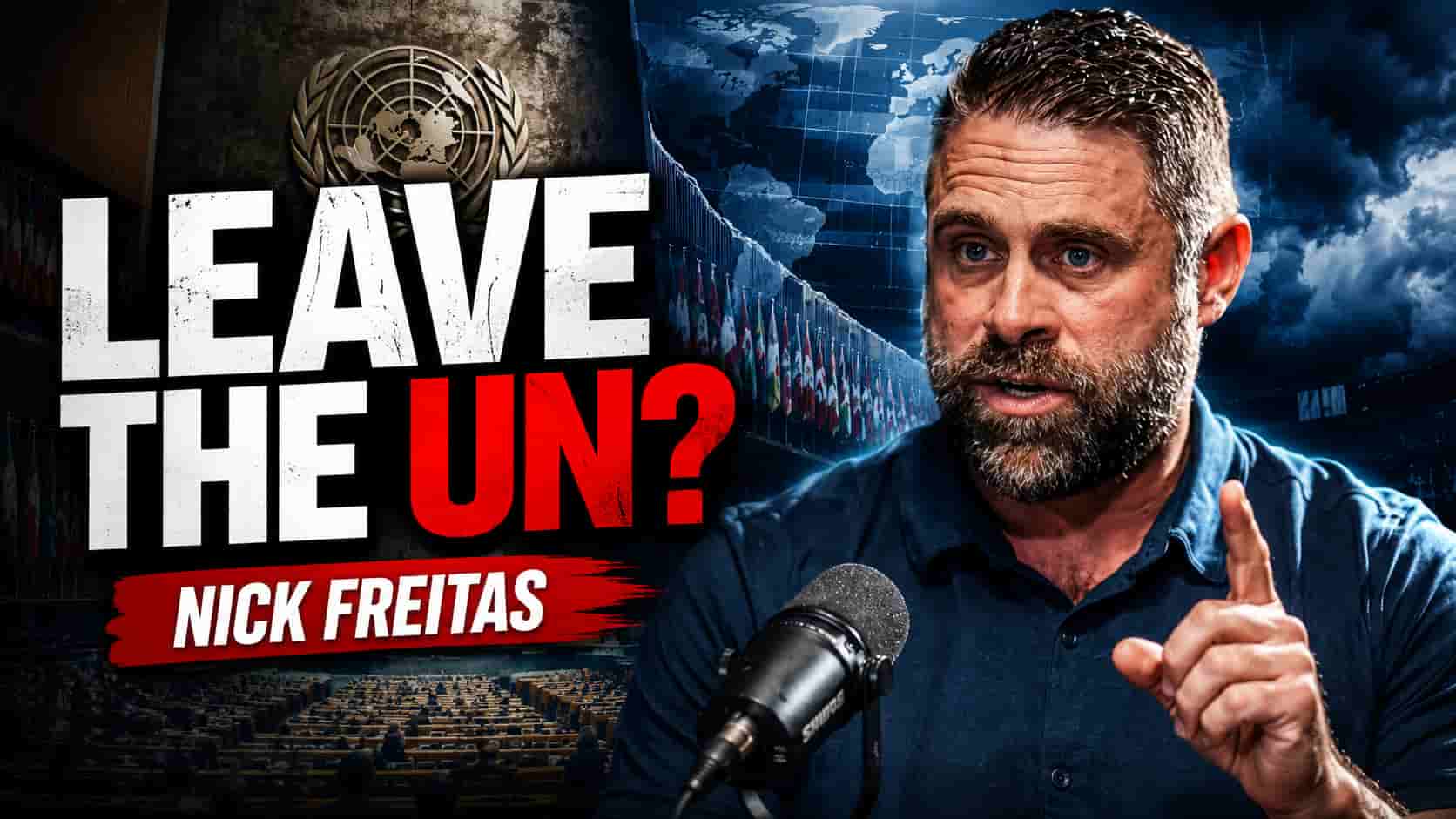
A blunt warning from Nick Freitas
In a sharp and unapologetic interview on The Winston Marshall Show, former U.S. Army Green Beret and former Virginia legislator Nick Freitas argued that the United Nations has become a symbol of institutional failure rather than global order.
Freitas’ central claim is simple: the UN has little real power because it has no military force of its own. What it does possess, he argues, is “propagandist power” — the ability to confer legitimacy, shape narratives and create the appearance of international consensus. In the interview transcript, Freitas says the UN gives legitimacy to rogue regimes while doing too little to defend the values it claims to represent.
His most direct line came early in the discussion: “If I was in charge, we’d be out of the United Nations tomorrow.”
Why Freitas says the UN is broken
Freitas does not deny that some UN agencies and programs can provide humanitarian relief after disasters or help displaced people. But he argues that any good work is overshadowed by fraud, waste, bureaucracy and political contradictions.
The criticism goes beyond money. Freitas says the deeper problem is legitimacy. In his view, international bodies become absurd when governments with poor human-rights records are allowed to sit on committees that claim to defend human rights, women’s rights or liberal democratic norms.
That argument taps into a broader American conservative critique: U.S. taxpayers fund global institutions that often oppose U.S. values, U.S. sovereignty and U.S. interests. The UN’s own Committee on Contributions lists member-state assessments for the regular UN budget, showing how funding obligations are formally distributed among member states.
UN vs. NATO: Freitas draws a line
Freitas makes an important distinction: he is far more skeptical of the UN than of NATO.
He says NATO still has strategic value, but its value has diminished because many European nations have relied too heavily on American military power while simultaneously criticizing the United States as reckless, unsophisticated or overly forceful.
This is one of the strongest themes of the interview: Freitas argues that Europe cannot mock American hard power for decades and then demand that same hard power when Russian tanks cross borders.
NATO itself describes the alliance as a political and military organization whose mission is to guarantee the freedom and security of its members through political and military means. But Freitas’ point is that an alliance cannot work if the burdens are permanently unequal.
Ukraine, Russia and the limits of European soft power
The conversation then turns to Russia’s war against Ukraine. Freitas argues that Europe has enough population, wealth and industrial capacity to become a far more serious military actor. His view is not that Russia is harmless. Rather, he argues that Russia’s battlefield performance in Ukraine shows that Moscow is not capable of simply rolling across Europe if Europe itself becomes serious about defense.
Freitas frames the Ukraine war as a test of Western seriousness. If Europe wants American support, it must also rebuild its own military capacity, defense culture and national confidence.
That argument is highly relevant because NATO defense spending has become one of the defining issues in transatlantic politics. According to NATO’s own 2025 defense-spending materials, all NATO allies met or exceeded the previous 2% of GDP defense-spending target in 2025, a major change from earlier years.
Trump, Germany and Russian energy
Freitas also references Donald Trump’s earlier warnings that Germany had become dangerously dependent on Russian energy. For years, Trump’s comments were mocked by European officials and media voices. But after Russia’s full-scale invasion of Ukraine in 2022, the energy issue became a central strategic vulnerability for Europe.
In Freitas’ telling, this is an example of a larger pattern: American hard-power warnings are dismissed as crude or unsophisticated — until events prove that hard power, energy security and military deterrence still matter.
JD Vance’s Munich message: What are Europeans willing to defend?
The interview also references JD Vance’s 2025 speech at the Munich Security Conference, where Vance challenged European leaders on democracy, free speech and political legitimacy. The official transcript shows that Vance framed his remarks around “shared values” and warned Europe that internal threats to liberty and democratic legitimacy mattered as much as external military threats.
Freitas highlights one core idea from that debate: before governments ask citizens to fight, they must convince those citizens that their civilization, nation and freedoms are worth defending.
In other words, military power is not just tanks, ships and aircraft. It also depends on morale, culture and national purpose.
Britain’s military decline and the memory of imperial power
Freitas gives special attention to the United Kingdom. He says he served with British troops and respects the historic strength of the Royal Navy, Royal Marines, British Army and SAS. But he argues that Britain has allowed its military strength to decline dangerously.
This section of the interview is not anti-British. It is almost nostalgic. Freitas says he wants Britain to recover pride in its history and maintain the capacity to defend itself without total dependence on U.S. military power.
That point fits into the larger theme of the conversation: the West cannot survive on institutions, summits and slogans alone. It must have real military capability and a serious civic culture behind it.
The sovereignty question
At the heart of Freitas’ argument is sovereignty.
He believes the UN often acts as if national sovereignty is an obstacle to global governance. He sees that as especially dangerous for the United States, where constitutional self-government is supposed to place power in the hands of citizens, states and elected representatives — not unelected international committees.
His critique is not isolationist in the traditional sense. Freitas explicitly says he is not an isolationist. He supports alliances and understands the importance of international coordination. But he wants cooperation between sovereign nations, not submission to global institutions that, in his view, dilute accountability.
Why this interview matters
The Freitas interview matters because it captures a growing shift in American foreign-policy debate.
For decades, the default assumption in Washington was that the United States should fund, defend and stabilize much of the international order. That consensus is now under pressure from both economic reality and political backlash.
Americans see a national debt measured in tens of trillions of dollars, domestic crises at home and allies abroad that often expect U.S. protection while criticizing U.S. power. Freitas’ argument speaks directly to that frustration.
His message is clear: the West must stop outsourcing responsibility. The United States should reassess the UN. Europe should rebuild its own defenses. Britain should recover military seriousness. NATO should remain useful only if the burden is shared. And Ukraine’s survival should be a wake-up call that history has not ended.
Conclusion
Nick Freitas’ appearance on The Winston Marshall Show is not just a conversation about the United Nations. It is a broader indictment of post-Cold War complacency.
His argument is that Western elites placed too much faith in process, institutions and soft power — while adversaries continued to think in terms of territory, force, energy and national interest.
Whether one agrees with Freitas or not, the debate is now unavoidable: Can the West defend itself materially, culturally and politically? Or has it built institutions that speak in the language of values while weakening the nations that must actually defend them?
For Freitas, the answer begins with sovereignty — and, if necessary, walking away from the United Nations.
Sources and Further Reading
-
The Winston Marshall Show — Nick Freitas Interview
YouTube video: “I’d Leave The UN Tomorrow” — Nick Freitas discusses the United Nations, NATO, Ukraine, Russia, Europe’s defense burden, and American sovereignty.
Watch on YouTube -
United Nations — Committee on Contributions
Official UN page showing member-state assessments and contributions for the UN regular budget.
UN Committee on Contributions -
NATO — What Is NATO?
Official NATO explanation of the alliance’s mission, membership and political-military purpose.
NATO Official Website -
NATO — Defence Expenditures and NATO’s Spending Commitments
Official NATO information on defense spending, including the 2% GDP benchmark and updated alliance commitments.
NATO Defence Expenditures -
JD Vance — Munich Security Conference Remarks
Transcript of Vice President JD Vance’s February 14, 2025 speech at the Munich Security Conference.
Read the Transcript -
Virginia House of Delegates History — Nicholas J. “Nick” Freitas
Official Virginia legislative history page for Nick Freitas.
Virginia House of Delegates History
Ask Midtown Tribune about this story
Answers are grounded first in this article. Search all Midtown Tribune reporting from the main AI Search page.
AI-generated summary. Verify important details in the linked original articles.