
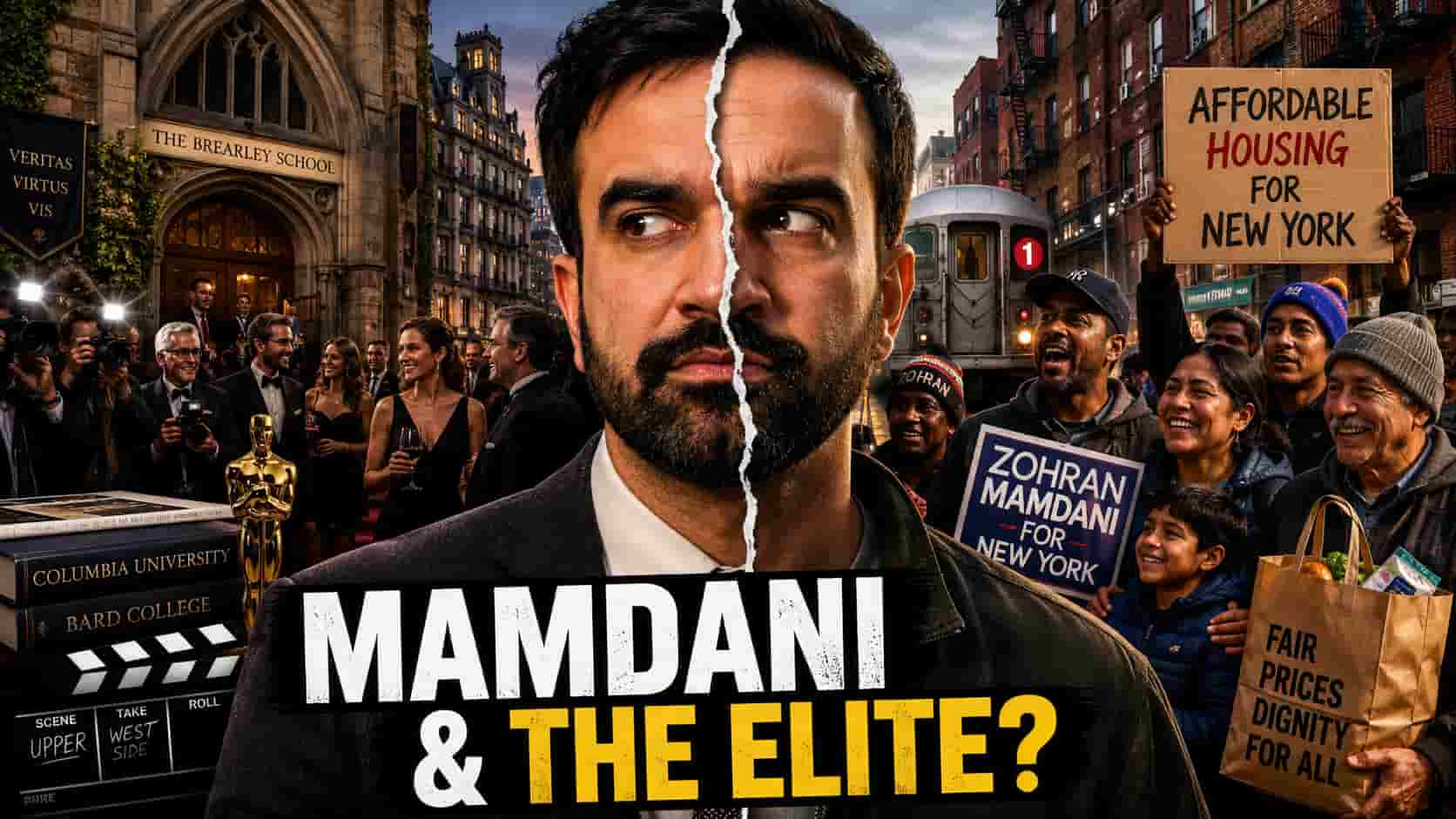
Mamdani and the Elite: Privilege, Taxes, Teachers Unions, and the School Choice Question in New York
There is a new political genre in New York City: the luxury-class revolution.
It arrives with perfect lighting, union applause, campaign slogans about affordability, and a promise to fight the rich — preferably after the press conference, before the fundraiser, and not too close to anyone’s family biography.
A viral video from William Reports News, titled “Mamdani CAUGHT Living Like The Elite He Taxes… $66,000 Private School And A Hollywood Mom,” takes aim at the central contradiction in Zohran Mamdani’s public image: a politician who speaks the language of working-class struggle while coming from a world of academic prestige, international film culture, and elite New York networks.
The video’s most explosive claim centers on private-school privilege. That specific school-history claim should be treated carefully and independently verified. But the broader question the video raises is harder to dismiss:
Can a politician built by elite institutions credibly campaign as the enemy of elite privilege?
That is not a small question. In New York, it may be the whole election.
The Revolution Has Very Good Connections
Mamdani’s political brand is simple and powerful: freeze the rent, lower childcare costs, build public grocery stores, tax the wealthy, challenge the system, defend working people.
It is a strong message because New York is an expensive city where millions of people are tired, overcharged, underpaid, and one rent increase away from disaster.
But satire begins where the campaign poster ends.
Mamdani is not exactly a forgotten child of the outer-borough wilderness. His father, Mahmood Mamdani, is a prominent academic. His mother, Mira Nair, is an internationally celebrated filmmaker whose work belongs to the world of festivals, premieres, critics, grants, universities, and cultural power.
Again, this is not a crime. Having accomplished parents is not a scandal. Growing up around education and art is not a moral failure.
But when the campaign becomes a sermon against privilege, the biography becomes relevant. New Yorkers are entitled to ask whether this is a working-class movement — or a well-produced performance about one.
Tax the Rich, Then Call Mom
Mamdani’s platform depends heavily on a familiar New York promise: make the wealthy pay more.
That line always works in this city. It has rhythm. It has applause. It gives a crowd something to cheer before returning to apartments where the rent has once again discovered a new ceiling.
But in Mamdani’s case, the phrase “tax the elite” has an unusual echo. His own family story is not separate from elite cultural life; it is part of it. The world of global cinema, Ivy League academia, international recognition, and high-status New York institutions is not exactly a tenant meeting in a basement.
This is the comedy of modern progressive politics: the people most fluent in attacking privilege often speak with the accent of privilege.
It is not hypocrisy to come from a successful family. It becomes hypocrisy only when success is repackaged as outsider authenticity and sold back to struggling families as moral authority.
The School Choice Problem
The sharpest part of the debate is not about film festivals. It is about children.
Mamdani received the endorsement of the United Federation of Teachers, one of the most powerful political forces in New York City education. That endorsement matters. It tells voters where the institutional power is lining up.
At the same time, Mamdani has been described as a strong opponent of charter schools. For many families in the Bronx, Brooklyn, Harlem, Queens, and other neighborhoods, charter schools are not an abstract ideological project. They are a lottery ticket out of a school that is not working for their child.
The elite have always had school choice. They call it “moving to a better district,” “private school,” “test prep,” “legacy connections,” “a family decision,” or “doing what is best for our child.”
Working-class parents are often told to be patient.
Patient with failing schools.
Patient with bureaucracy.
Patient with union politics.
Patient with reform plans.
Patient with committees.
Patient with leaders who already had options.
That is the moral tension at the center of the Mamdani story.
If educational choice is good enough for the privileged, why is it suspicious when poor families want it?
A Public System for Your Children, Options for Mine
New York’s ruling class has perfected a beautiful ritual.
First, it praises public systems.
Then, it quietly buys alternatives.
Then, it returns to the microphone and lectures everyone else about solidarity.
The result is a two-tier city wrapped in one-tier language.
For the well-connected, there is choice.
For the working class, there is policy.
For elites, there are options.
For everyone else, there is a waiting list and a speech about democracy.
Mamdani may sincerely believe in public schools. He may sincerely believe in unions. He may sincerely believe that the city should spend more on education, childcare, transit, and housing.
But sincerity does not erase contradiction.
A politician can be sincere and still be wrong.
A movement can be moral and still be captured by institutions.
A campaign can speak for the poor while quietly protecting the choices of the rich.
The New York Question
The question is not whether Mamdani is “allowed” to have an elite background. Of course he is.
The question is whether New Yorkers are allowed to notice it.
Are voters allowed to ask why the man campaigning against privilege emerged from a world full of it?
Are parents allowed to ask why school choice is celebrated when elites exercise it, but treated as dangerous when working-class families demand it?
Are taxpayers allowed to ask whether “tax the rich” is a serious fiscal plan or just another political song with a catchy chorus?
And are journalists allowed to ask whether the working-class costume fits, or whether the sleeves are tailored a little too well?
The Satirical Bottom Line
Mamdani’s political story is powerful because it gives frustrated New Yorkers a villain: the elite.
The problem is that his own biography keeps walking into the room.
It stands near the podium.
It smiles during the applause.
It waits politely while the speech attacks privilege.
Then it whispers the uncomfortable line:
But this is your world too.
That is why the William Reports News video landed. Not because every claim in a viral headline should be accepted without verification. It should not. But because the contradiction is real enough to make voters look twice.
Mamdani wants to fight the elite.
New York may now ask whether this is a revolution — or a mirror.
Sources and Related Links
- William Reports News — “Mamdani CAUGHT Living Like The Elite He Taxes…” video
- United Federation of Teachers — Union backs Mamdani for mayor
- ABC7 New York — Mamdani picks up UFT endorsement
- NYC Public Schools — Enroll in charter schools
- New York State Education Department — Facts about charter schools
- Collegiate School — Admissions FAQ and tuition information
- Columbia University — Mahmood Mamdani official profile
- Mirabai Films — official Mira Nair / Mirabai Films website
Editor’s note: Some claims discussed in viral political videos require independent verification. This article treats the video as commentary and uses official or primary sources for context.
Ask Midtown Tribune about this story
Answers are grounded first in this article. Search all Midtown Tribune reporting from the main AI Search page.
AI-generated summary. Verify important details in the linked original articles.