
Nixon, Trump and the End of the Kissinger Doctrine: Susan Kokinda’s Monday Brief
Susan Kokinda’s June 29 Monday Brief argues that JD Vance’s Nixon Library remarks point to a deeper fight between America’s peace-through-development tradition and Henry Kissinger’s balance-of-power foreign policy.
From Nixon Library to the Middle East: A Debate Over War, Peace and Power
In her June 29, 2026 edition of The Monday Brief, Susan Kokinda of Promethean Action uses Vice President JD Vance’s recent remarks at the Nixon Library as the starting point for a sweeping argument about U.S. foreign policy, the legacy of Henry Kissinger, and the Trump administration’s current strategic direction.
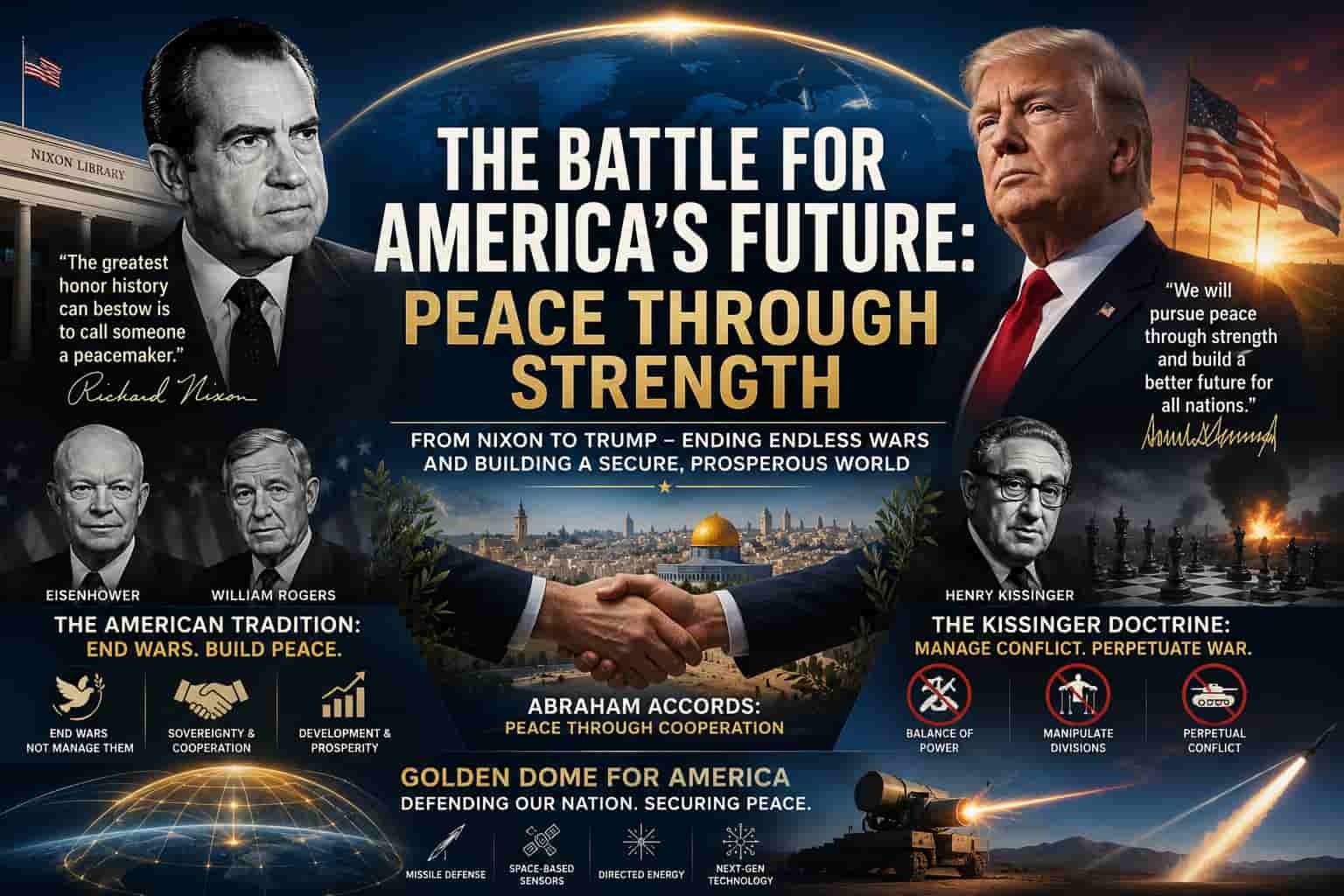
The video’s central claim is provocative: Vance’s comments about Richard Nixon, Donald Trump and the “deep state” are not merely about Watergate or partisan politics. Kokinda argues they point to a deeper historical conflict between two foreign-policy traditions — one that seeks to end wars through sovereign development, and another that manages conflict through “balance of power” geopolitics.
Vance did, in fact, speak at the Richard Nixon Presidential Library on June 25, 2026. In the available transcript, he described Nixon’s historical legacy as undergoing “a bit of a renaissance” and said that “the Deep State took down Richard Nixon,” comparing it to what he said the same institutions tried to do to Donald Trump during Trump’s first administration.
Kokinda focuses especially on the Nixon memorial phrase quoted in the video: “The greatest honor history can bestow is to call someone a peacemaker.” From that point, she builds a larger thesis: American presidents who try to end imperial-style conflicts are attacked because peace threatens entrenched systems of power.
The American Tradition: Eisenhower, Nixon, Rogers and Trump
Kokinda places Nixon in a line of Republican presidents and officials who, in her view, tried to end wars rather than manage them indefinitely. She cites Dwight Eisenhower ending the Korean War, blocking the 1956 Suez invasion by Britain, France and Israel, and later promoting the idea of development in the Middle East through water, power and nuclear technology.
She then turns to William Rogers, Nixon’s first Secretary of State, whose post–Six-Day War peace initiative sought a comprehensive Arab-Israeli settlement. In Kokinda’s telling, the Rogers Plan represented an American alternative to permanent crisis management: solve the conflict, develop the region and create conditions for sovereignty.
The video links that tradition to Donald Trump’s Abraham Accords, arguing that the accords revived an older American approach: peace through economic development, sovereign cooperation and regional prosperity, rather than endless diplomatic manipulation.
This is the key contrast in Kokinda’s argument. The “American system,” as she describes it, is not simply military strength. It is development — manufacturing, infrastructure, technology, energy and productive cooperation among nations.
Kissinger as the Symbol of Managed Conflict
The villain of Kokinda’s narrative is Henry Kissinger. She portrays Kissinger not merely as a controversial national security adviser and secretary of state, but as the symbol of a British-style “balance of power” doctrine.
The argument is that Kissinger’s approach did not aim to resolve conflicts. It aimed to manage them. In this framework, nations are balanced against each other, conflicts are contained but not solved, and regional instability becomes a permanent instrument of power.
Kokinda claims that the Rogers peace approach was pushed aside as Watergate weakened Nixon. Rogers left office in 1973, Kissinger became Secretary of State, the Yom Kippur War followed, and the possibility of a comprehensive peace plan faded.
The video then turns to Lebanon. Kokinda argues that Lebanon became one of the early victims of this Kissinger-era strategy. She describes the country’s descent into civil war in the mid-1970s as part of a broader system in which outside powers manipulated regional divisions rather than building durable peace.
This is a political interpretation, not a settled historical verdict. But it is the organizing idea of the video: Kissinger’s legacy was not peace, but the professional management of wars that never truly ended.
Rubio, Israel, Lebanon and a New Framework
The most current part of the video concerns the June 2026 U.S.-brokered Israel-Lebanon framework. Kokinda presents it as evidence that the Trump administration is attempting to reverse decades of conflict management and move toward a real settlement.
On June 26, 2026, Secretary of State Marco Rubio announced a framework agreement involving the United States, Israel and Lebanon. The State Department described it as a path out of “endless conflict,” while Reuters reported that the framework sets up a process for disarming Hezbollah and restoring Lebanese sovereignty, with Israel withdrawing once security threats are addressed.
At the same time, the agreement is already facing serious resistance. Reuters reported that Lebanese Parliament Speaker Nabih Berri criticized the deal and warned that it may not be implemented, while analysts questioned whether Hezbollah’s disarmament is realistic under current conditions.
That tension matters. Kokinda frames the agreement as a historic turn toward peace. Critics see a fragile document that could collapse under Lebanese internal politics, Hezbollah’s opposition and unresolved Israeli security demands. The agreement may be a breakthrough, but it is not yet peace.
Golden Dome and the Reversal of MAD
The second major theme of the video is strategic defense.
Kokinda argues that the Trump administration’s “Golden Dome” missile defense initiative represents a break with the Cold War doctrine of Mutual Assured Destruction, or MAD. Under MAD, nuclear deterrence depended on the horrifying assumption that both sides remained vulnerable to annihilation. In Kokinda’s view, that logic was reinforced by the 1972 Anti-Ballistic Missile Treaty, associated with the Nixon-Kissinger era.
The Trump White House announced on January 27, 2025 that Executive Order 14186 directed the creation of a next-generation missile defense shield for the United States against ballistic, hypersonic and advanced cruise missile attacks. The White House fact sheet said the system would include space-based sensors, interceptors, non-kinetic capabilities and other layers of defense.
The Department of Defense later described Golden Dome as a “system of systems” designed to protect the homeland from a range of global missile threats, emphasizing space-based sensors, interceptors and integration of next-generation technologies.
Kokinda connects this to recent directed-energy weapons activity. Reports from June 2026 said Defense Secretary Pete Hegseth and Pentagon technology officials observed laser and microwave weapons demonstrations at White Sands Missile Range in New Mexico, including several high-energy systems aimed at counter-drone and air-defense missions.
For Kokinda, this is not simply a weapons test. It is a sign of doctrine change: from assured retaliation to assured defense.
Industrial Revival as Foreign Policy
One of the strongest parts of Kokinda’s argument is her insistence that defense is not only military. It is industrial.
A missile shield, drone defense network or directed-energy arsenal cannot exist as a press release. It requires factories, supply chains, engineers, energy systems, skilled labor and a national commitment to production.
That is why Kokinda links Golden Dome to the rebuilding of the American defense industrial base. In her view, the strategic shift away from MAD is inseparable from a broader economic shift away from financial speculation and toward manufacturing, science and national development.
This is where the video’s historical arc comes full circle. Eisenhower’s “atoms for peace,” Rogers’ Middle East development vision, Reagan’s Strategic Defense Initiative and Trump’s Golden Dome are all treated as parts of one tradition: technology in the service of peace.
The Real Debate
The video is not neutral commentary. It is a sharp political argument. It portrays Kissinger’s foreign policy as imperial conflict management, Nixon and Trump as threatened peacemakers, and the current administration as dismantling a century-old war system.
Readers do not have to accept every part of that thesis to recognize the importance of the debate.
The key question is real: should American foreign policy manage conflicts indefinitely, or should it try to end them through sovereignty, development and enforceable security arrangements?
In the Middle East, that question now runs through Israel, Lebanon, Hezbollah and U.S. diplomacy. In strategic defense, it runs through Golden Dome, directed-energy weapons and the future of nuclear deterrence. In the American economy, it runs through whether the United States can still build the industrial base required for serious national defense.
Kokinda’s Monday Brief argues that history’s highest honor belongs not to the clever manager of endless wars, but to the leader who ends them.
That is the debate now returning from the Nixon Library to Washington — and from Washington to the world.
Official Government Sources
- The White House: Executive Order 14186 / Missile Defense Shield for America
- U.S. Department of Defense: Secretary of Defense Statement on Golden Dome for America
- U.S. Department of Defense: Golden Dome, Shipbuilding and Nuclear Deterrence Budget Priorities
- U.S. Department of State: The United States, Israel and Lebanon Sign the Trilateral Framework
- U.S. Department of State: Trilateral Framework Between the United States, Israel and Lebanon
- U.S. Department of State: Secretary Rubio at Israel-Lebanon Trilateral Framework Signing Ceremony
- Richard Nixon Presidential Library and Museum
Midtown Tribune Independent USA news from New York
Ask Midtown Tribune about this story
Answers are grounded first in this article. Search all Midtown Tribune reporting from the main AI Search page.
AI-generated summary. Verify important details in the linked original articles.