
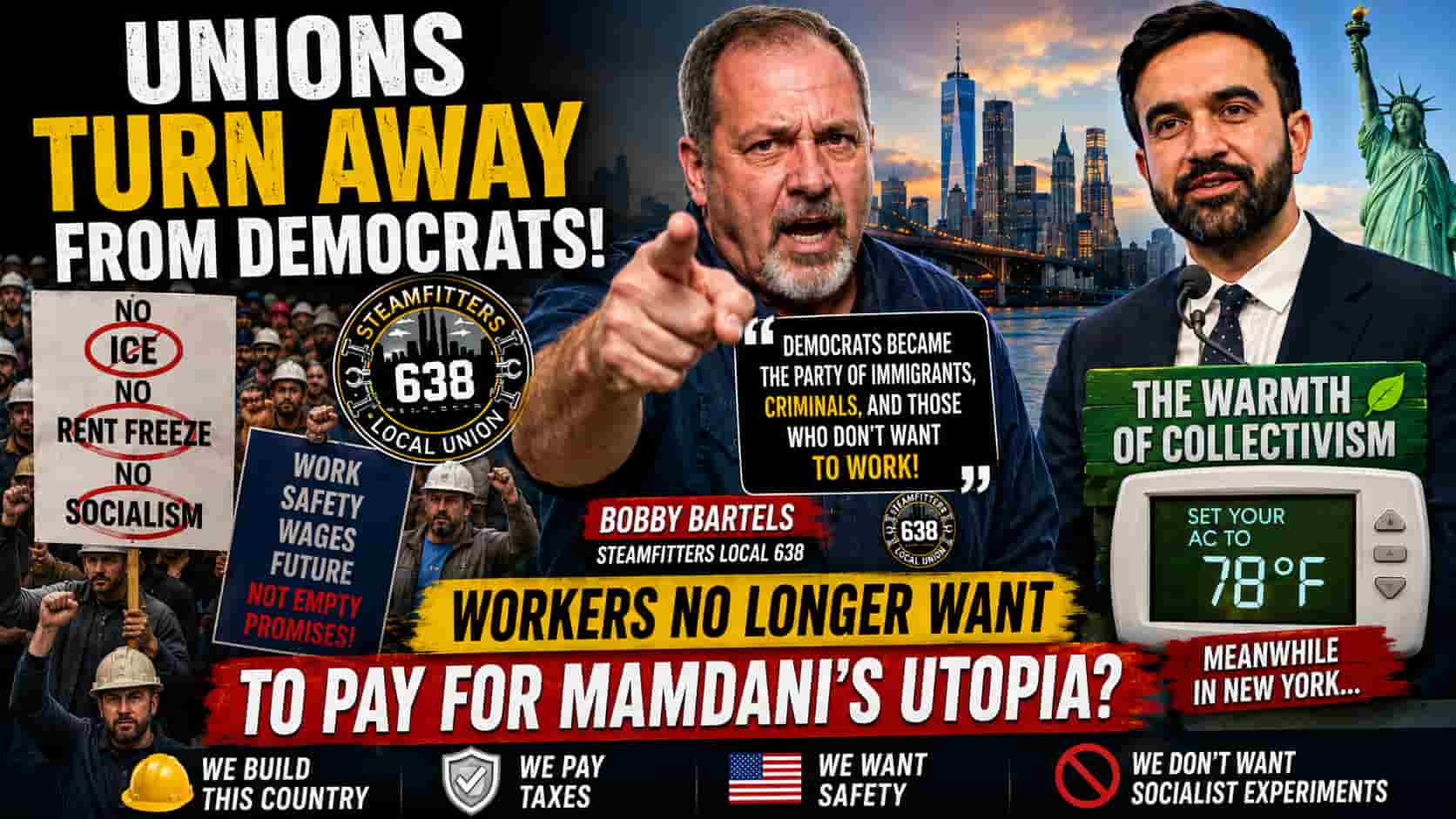
For years, Democrats treated union workers like a family heirloom: always displayed proudly, always mentioned in speeches, and always assumed to be safely locked in the party’s political china cabinet.
Then came New York’s new socialist moment — and suddenly some of those workers started looking for the exit door.
A viral segment from The Trish Regan Show focused on Robert “Bobby” Bartels Jr., the business manager of Steamfitters Local 638 in New York. That is not exactly a knitting club in a Brooklyn coffee shop. Local 638 represents the kind of workers who keep buildings, pipes, heating, cooling, and the physical machinery of New York running. On the union’s official leadership page, Bartels is listed as Business Manager. In other words, this is a man from the world of actual work — not the world of academic slogans printed on tote bags.
In the video transcript, Bartels delivers a political warning that should make Democratic consultants spill their oat milk. He says the Democratic Party has gone “so far left” and no longer looks like the party of working people. He says his members want their taxes to serve American citizens, not an endless menu of open-border promises, anti-police rhetoric, and benefits for people who do not work. Whether one agrees with every word or not, the message is simple: some blue-collar union workers are tired of being treated like an automatic voting machine with a hard hat.
And this is where the problem becomes bigger than one TV clip.
New York’s Democratic Socialists are not hiding their agenda. NYC-DSA officially promotes candidates who campaign on ideas such as abolishing ICE, confronting capitalism, and expanding socialist power through the Democratic Party. Their own candidate page describes Claire Valdez as a “proud democratic socialist” and presents Darializa Avila Chevalier as running for Congress to “abolish ICE.” This is not a Republican attack ad. This is the sales brochure.
Mayor Zohran Mamdani has become the face of this new left-wing New York. In his official inaugural address, Mamdani promised to replace the “frigidity of rugged individualism” with the “warmth of collectivism.” It is a beautiful phrase if you are writing a socialist Valentine’s Day card. It is less beautiful if you are a taxpayer, a contractor, a small business owner, or a union worker wondering who will be handed the bill after the poetry ends.
Then came the July heat wave.
As temperatures climbed, City Hall urged New Yorkers to set their air conditioners to 78 degrees, turn off lights, unplug electronics, and reduce energy use to protect the power grid. The city also expanded cooling centers and emergency heat measures. There is a serious public-safety reason behind energy conservation during extreme heat. But politically, the optics were almost too perfect: first New Yorkers were promised the “warmth of collectivism,” then they were asked to experience it at 78 degrees Fahrenheit.
For working New Yorkers, the joke writes itself: “Comrade, you will be cooled collectively — but only during approved grid conditions.”
This is why the union backlash matters. The conflict is not just left versus right. It is real work versus ideological theater. Steamfitters, electricians, plumbers, cops, construction workers, sanitation workers, and small contractors understand something that political activists often forget: cities do not run on slogans. They run on pipes, wires, power plants, trucks, permits, fuel, maintenance, discipline, and people who show up on time.
You cannot “organize” your way around physics. You cannot “equity” a blackout into becoming a light bulb. And you cannot ask workers to build the city while telling them their values are outdated, their taxes are unlimited, their police are the problem, and their standard of living should be adjusted downward for the greater ideological good.
That is why Bartels’ comments hit a nerve. He is saying out loud what many working-class voters have been thinking quietly: the Democratic Party keeps speaking in the name of workers, but increasingly speaks the language of activists, nonprofits, open-border politics, and socialist experiments. The worker is still invited to the rally — but mainly to pay for the sound system.
To be fair, it would be inaccurate to say that all unions have abandoned Democrats. National labor politics is still complicated. Many major union organizations have supported Democratic candidates in recent elections, and union households are not a single political block. But the old automatic relationship is cracking. When major union voices begin saying, “We do not align with this anymore,” Democrats should hear an alarm bell — not dismiss it as another cable-news argument.
The deeper problem for Democrats is cultural. They once spoke to workers about wages, jobs, safety, industry, retirement, and dignity. Now too often the message sounds like this: accept less comfort, pay more taxes, tolerate more disorder, support more bureaucracy, and please clap for the word “collectivism.”
That may work in a faculty lounge. It may work at a DSA meeting. It may even work in a district where the loudest political debate is whether the coffee shop should switch from oat milk to unionized oat milk.
But it is a harder sell to a steamfitter.
A man who works around boilers, chillers, valves, and pressure systems has a very practical understanding of reality. If pressure builds too much, something bursts. That is true in a mechanical room, and it is true in politics.
New York’s working class is not asking for a utopia. It is asking for safety, jobs, affordable energy, legal order, and respect for people who actually keep the city alive. If the new Democratic message is that those workers must pay more, sweat more, and complain less in the name of someone else’s socialist dream, then the party should not be shocked when the hard hats start turning away.
The question is no longer whether Democrats can still claim to be the party of labor.
The question is whether labor still recognizes the party.
Sources and Primary References
-
The Trish Regan Show — “UNIONS ABANDON DEMS! Union Leader Tells Members to WALK AWAY From Dem Party”
Original video discussed in this article, published July 3, 2026. -
Steamfitters Local 638 — Official Leadership Page
Official Local 638 leadership page listing Robert J. Bartels, Jr. as Business Manager. -
Steamfitters Local 638 — Official Website
Official website of New York Steamfitters Local 638. -
NYC Democratic Socialists of America — Endorsed Candidates
Official NYC-DSA page describing its endorsed candidates and political platform. -
NYC Mayor’s Office — Mayor Zohran Mamdani Inaugural Address
Official transcript of Mayor Mamdani’s inaugural address, including the “warmth of collectivism” line. -
NYC Mayor’s Office — Mayor Mamdani Expands Emergency Heat Measures
Official City Hall release on emergency heat measures, cooling centers, and the request to set thermostats to 78°F. -
NYC Emergency Management — Extreme Heat Safety
Official NYC guidance on extreme heat safety, including air-conditioning recommendations. -
International Brotherhood of Teamsters — Presidential Endorsement Polling Data
Official Teamsters release showing rank-and-file presidential endorsement polling data from 2024. -
International Brotherhood of Teamsters — No Endorsement for U.S. President
Official Teamsters statement explaining the union’s 2024 decision not to endorse a presidential candidate. -
AFL-CIO — Official Endorsement of Kamala Harris for President
Official AFL-CIO release showing that major national labor organizations did not uniformly abandon Democrats.
Ask Midtown Tribune about this story
Answers are grounded first in this article. Search all Midtown Tribune reporting from the main AI Search page.
AI-generated summary. Verify important details in the linked original articles.