
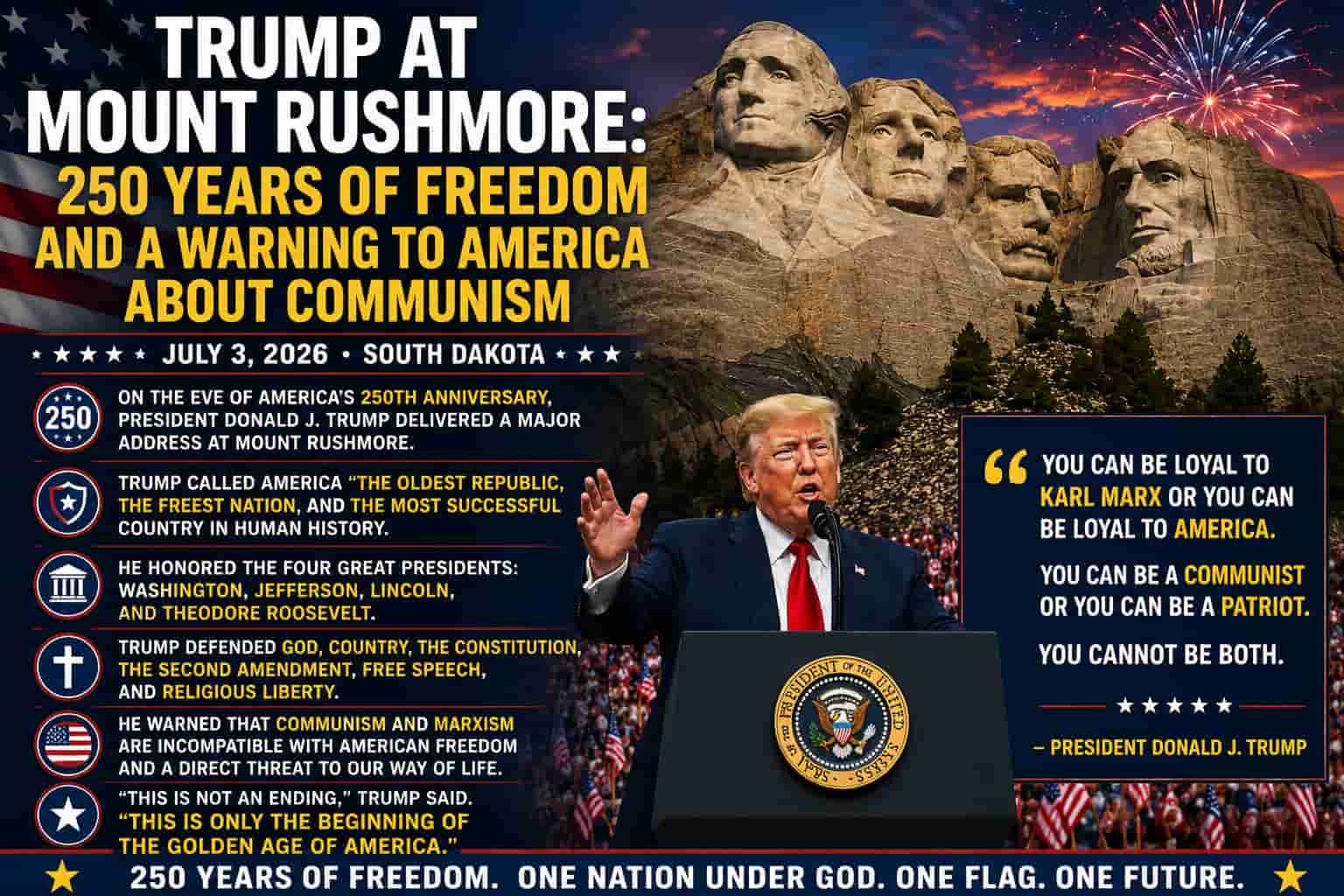
On July 3, 2026, something bigger than a political speech happened at Mount Rushmore. America turned on the lights, raised the flag, looked up at the four granite faces of its history — Washington, Jefferson, Lincoln, and Theodore Roosevelt — and calmly reminded everyone who has been writing its obituary: gentlemen, the funeral has been canceled.
Against the backdrop of Mount Rushmore, fireworks, military flyovers, American flags, and a crowd that clearly did not come to apologize for loving its country, President Donald J. Trump delivered a speech on the eve of America’s 250th Independence Day. And anyone hoping for a tired bureaucratic lecture about “complicated history” and “problematic heritage” had a very disappointing evening.
Trump opened with the main point: America is entering its 250th year as the oldest republic on earth, the freest nation on earth, and, in his words, the most successful and exceptional country in human history. That message must have been deeply upsetting to those who wake up every morning convinced that America is guilty simply because it exists. But at Mount Rushmore, the evening was not about guilt. It was about builders, founders, fighters, liberators, and the people who kept freedom alive.
The president reminded the crowd that July 4, 1776, was not just a date on a calendar. It was an earthquake under the old world order — the world of kings, empires, aristocrats, ruling classes, and officials who believed ordinary people existed mainly to obey, pay, and bow. The Americans of 1776 answered with a revolutionary phrase that still terrifies every control freak on earth: thank you, we will govern ourselves.
That “we will govern ourselves” built a country that helped give the world railroads, skyscrapers, electricity, aviation, mass production, the microchip, the internet, GPS, smartphones, Hollywood, jazz, rock and roll, baseball, basketball, the moon landing — and air conditioning, which is especially useful in July for people writing anti-American manifestos on American technology.
The four presidents carved into Mount Rushmore gave the speech its historical spine. Washington was the father of the country. Jefferson was the author of the Declaration of Independence. Lincoln saved the Union and ended slavery. Theodore Roosevelt helped turn America into a global power. These are not merely faces on a mountain. They are a granite instruction manual: freedom must be declared, defended, preserved, and strengthened.
But the most important part of the speech was not about the past. It was about the future.
Trump said something many politicians are too nervous to say out loud: the Constitution does not defend itself. Paper does not wake up in the morning, raise children, vote, protect borders, build factories, or teach young people to love liberty. Freedom survives only where there is a people who understand that liberty is not free Wi-Fi from the government. It is responsibility, character, culture, and courage.
“There is no American freedom without American culture,” Trump said. That line went straight to the center of today’s national argument. America’s enemies have learned that if they cannot defeat the United States with tanks, they can try to defeat it with textbooks, slogans, university departments, activist grants, and endless lectures about why America is not a nation of freedom but one giant historical crime scene.
Trump’s answer was simple: no.
America is not the sum of its mistakes. Mistakes make us human. Achievements make us American. That may have been one of the strongest ideas of the night. A country that can admit its errors without being forced to hate its victories is still a living nation.
Then Trump turned to communism — and at that moment, the evening became especially difficult for lovers of red flags and government bread lines.
The president called communism a mortal threat to American liberty, the Constitution, religion, private property, and the very meaning of July 4, 1776. He reminded the country that communism brought the world death, control, lies, hunger, camps, and mass murder. Of course, every generation still produces new geniuses who insist: “That was not real communism. But this time, in Brooklyn, with better branding, it will definitely work.”
Trump gave no room for that fantasy. You can be loyal to Karl Marx, he said, or you can be loyal to America. You can be a communist, or you can be a patriot. You cannot be both.
That was more than an applause line. It was a political dividing line. America was founded on rights from God, private property, freedom of speech, freedom of religion, the right to keep and bear arms, self-government, and equality before the law. Communism always begins with songs about justice and ends with bread lines, neighbors informing on neighbors, and a giant portrait of the leader on the side of a building.
In that sense, the Mount Rushmore speech was not dark. It was optimistic. Trump was not saying, “America is dying.” He was saying the opposite: America is alive, powerful, successful, and beginning a new golden age. Its enemies can rewrite history, tear down statues, invent new grievances, and declare patriotism outdated. But as long as the country still has memory, a flag, a Constitution, and citizens who are not embarrassed to say “I love America,” the American experiment continues.
The ending sounded like a promise. Trump said the 250th anniversary is not the end of the story. It is the beginning. After two and a half centuries, America is not leaving the stage. It is preparing to become bigger, stronger, and better than ever before. Judging by the crowd, that is exactly what millions of Americans wanted to hear: not another apology for their country, but a clear reminder that freedom must be celebrated, defended, and passed on.
So what happened at Mount Rushmore on July 3 was simple and historic: America looked into the mirror of its own history and did not flinch. It did not see “systemic guilt,” “oppression theory,” or a cartoon from a Marxist pamphlet. It saw a country that has spent 250 years proving that free people can build more than any ministry of equality, committee of justice, or revolutionary club funded by someone else’s money.
And America’s enemies? They are left with the usual assignment: complain under fireworks they did not create, stare at a mountain they did not carve, use the internet they did not invent, and explain to one another why the country they have been “exposing” for decades is still standing, still celebrating, and still smiling.
Official Sources and Reference Materials
- The White House: President Trump Delivers Remarks at Mount Rushmore, July 3, 2026 — official White House video of President Donald J. Trump’s remarks at Mount Rushmore.
- The White House: Freedom 250 — official White House page dedicated to the 250th anniversary of American independence.
- Freedom 250: President Trump to Headline Mount Rushmore Celebration — official announcement of President Trump’s July 3, 2026 Mount Rushmore celebration.
- National Park Service: Independence Day Fireworks Return to Mount Rushmore — official National Park Service announcement about the July 3, 2026 fireworks event for America’s 250th anniversary.
- National Park Service: Independence Day at Mount Rushmore — official visitor information for the July 3, 2026 Independence Day event at Mount Rushmore.
- National Park Service: 250th Anniversary of American Independence — official NPS page on the national commemoration of America’s 250th anniversary.
- National Archives: Declaration of Independence — official text of the 1776 Declaration of Independence.
- National Archives: Constitution of the United States — official text of the United States Constitution.
- National Park Service: Mount Rushmore National Memorial — official page of Mount Rushmore National Memorial.
Ask Midtown Tribune about this story
Answers are grounded first in this article. Search all Midtown Tribune reporting from the main AI Search page.
AI-generated summary. Verify important details in the linked original articles.