
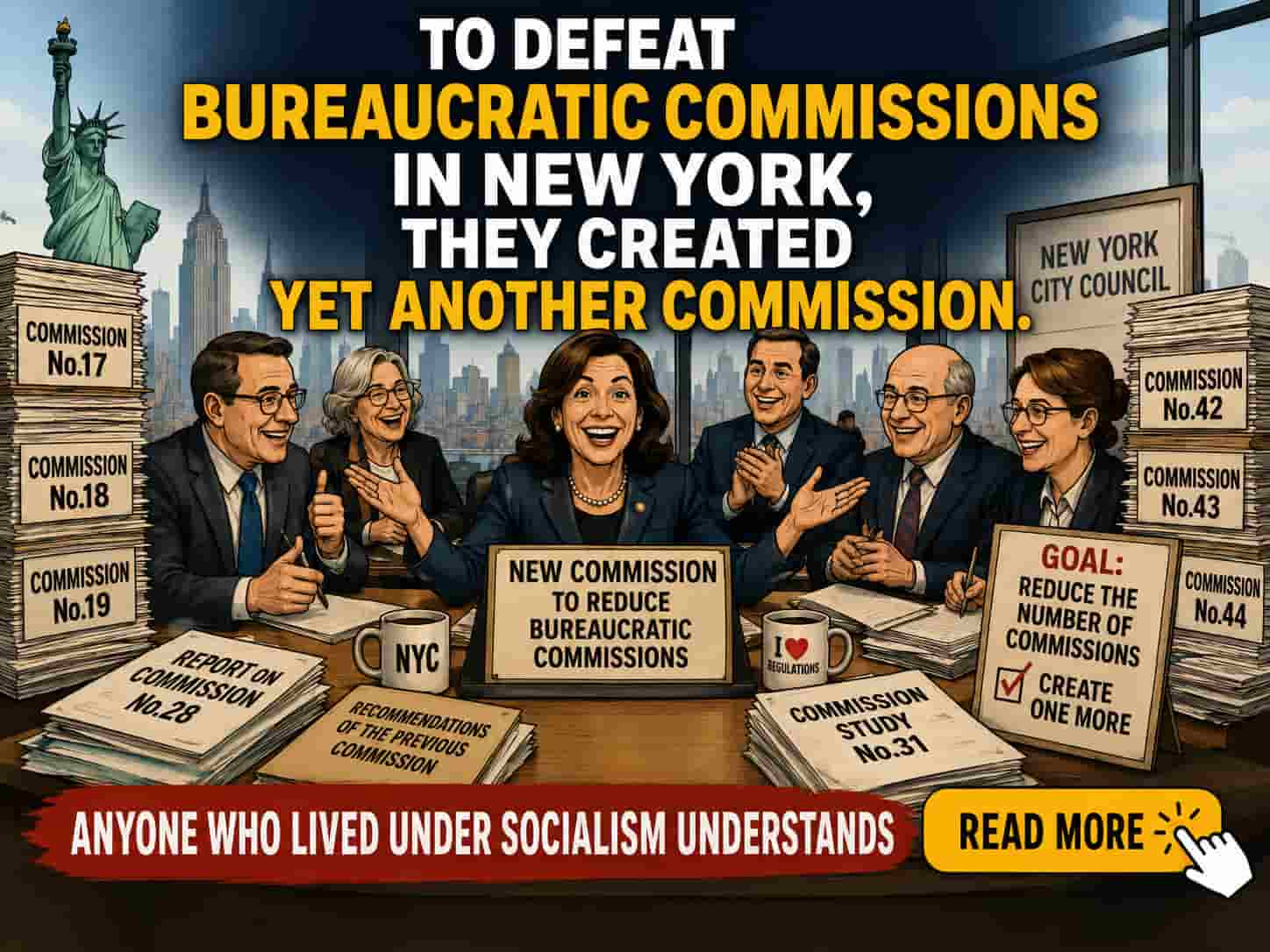
New York City officials have unveiled a new campaign to help small businesses escape excessive regulation, delayed inspections, licensing obstacles and municipal fines.
The solution includes better coordination among existing agencies — and the creation of another government commission.
For New Yorkers who once lived under socialist administrative systems, the formula may sound familiar: when bureaucracy becomes too large and complicated, appoint a new body to study the bureaucracy and prepare a report about how it might eventually be reduced.
That is the satirical summary. The legal details, however, require an important clarification.
The proposed commission is not technically a commission created to eliminate other commissions. It is intended to review business regulations, permits, licenses, inspections, fees and penalties. No existing city commission is identified for abolition.
Still, the political irony remains difficult to miss: New York City proposes to reduce administrative complexity by establishing a new administrative body.
Two Separate Proposals
On July 13, 2026, City Council Speaker Julie Menin, Council Member Susan Zhuang and small-business representatives announced two related pieces of legislation.
The first, known as the Red Tape Relief Act, would require the mayor to establish an interagency program coordinating inspections and plan reviews. The objective is to reduce the time required for new businesses to open.
The second proposal would establish a Quadrennial Regulatory Review Commission to study the regulatory framework governing businesses and recommend changes involving permits, licenses, inspections, fines and fees.
The commission proposal was described as a “Preconsidered Introduction,” meaning it was announced before its formal introduction at the Council’s July 16 stated meeting. The Council’s official calendar lists both the stated meeting and a Small Business Committee vote concerning the coordination of inspections for new businesses.
What the New Commission Would Do
According to the Council’s official announcement, the Quadrennial Regulatory Review Commission would be chaired by a representative of the small-business community.
Its membership would also include appointees from the City Council and city agencies.
The commission would review the regulatory structure affecting businesses and issue recommendations concerning:
- permitting;
- licensing;
- inspections;
- fines;
- government fees.
The published announcement does not yet identify a specific number of rules that would be repealed, penalties that would be reduced or fees that would be eliminated.
It also does not say that any existing commission, department or municipal office would be dissolved.
At this stage, the commission would study the problem and issue recommendations.
No City Taxes Are Reduced by the Proposal
The legislation was promoted under the language of reducing fines and supporting small businesses, but the announced package does not reduce any specific New York City tax.
Fees, fines and taxes are not the same thing.
A tax is generally imposed to raise public revenue. A fee is typically charged for a license, permit, application, inspection or government service. A civil penalty is imposed for violating a law or regulation.
The Council announcement discusses possible reductions in fines and fees, not reductions in business income taxes, property taxes, sales taxes or other city taxes.
Therefore, based on the official documents available at the time of publication:
Number of specified city taxes reduced: zero.
Number of existing commissions scheduled for elimination: zero.
Number of specific fines already reduced by the commission proposal: zero.
The proposal creates a process for making future recommendations. It does not itself contain a completed list of reductions.
The More Practical Part: Coordinating Inspections
The Red Tape Relief Act may have more immediate practical significance than the commission.
It would require the mayor to establish a program coordinating inspections and reviews performed by different city agencies. The Council says the program is modeled on the Bloomberg-era New Business Acceleration Team.
Restaurants, stores, child-care providers and other businesses frequently require approvals from several agencies. Depending on the establishment, these can include the Department of Buildings, Fire Department, Department of Health and Mental Hygiene, Department of Consumer and Worker Protection and other regulators.
When those agencies operate independently, a business may wait for one inspection before it can request another. During the delay, the owner may continue paying rent, insurance, utilities and financing costs without being legally permitted to open.
Coordinated inspections could therefore produce real savings if the program reduces duplicated reviews and administrative waiting periods.
But the proposal should be judged by measurable results: how many days are removed from the opening process, how many inspections are consolidated and how much money businesses actually save.
City Agencies Were Already Ordered to Study the Same Problem
The new Council initiative arrives after Mayor Zohran Mamdani issued Executive Order 11 on January 14, 2026.
That order directed seven major regulatory agencies to prepare a comprehensive inventory of initial business fees and civil penalties.
The agencies named in the order were:
- Department of Buildings;
- Department of Consumer and Worker Protection;
- Department of Environmental Protection;
- Fire Department;
- Department of Health and Mental Hygiene;
- Department of Sanitation;
- Department of Transportation.
The order required the agencies to determine whether fees and penalties could be reduced through administrative rulemaking, City Council legislation or action by the New York State Legislature.
The Department of Small Business Services was also directed to assess how long it takes to obtain the permits, licenses and approvals needed to establish a business and to propose ways to shorten those timeframes.
By July 13, the administration was supposed to provide the mayor with legislative recommendations identifying additional fees and civil penalties that could be eliminated or reduced.
In other words, city agencies had already been ordered to inventory and analyze many of the same fees, penalties and approval procedures that the proposed Council commission would examine.
That overlap does not necessarily make the commission useless. A commission containing business representatives and Council appointees could provide independent pressure or broader public scrutiny.
But it raises an obvious question: why is another government entity required before the city can act on information its agencies have already been ordered to collect?
New York Has Tried This Before
The city has repeatedly announced programs intended to reduce red tape for businesses.
In 2022, the Adams administration created the Small Business Forward initiative, directing six agencies to review compliance costs and recommend changes that would reduce fines or provide warning periods for first-time violations.
The agencies reviewed 232 regulations that had generated violations in 2019. Exactly half were recommended for reform.
However, an April 2026 review by City Comptroller Mark Levine found that the program failed to produce meaningful, verifiable change for small businesses.
The comptroller identified several problems:
- an unclear definition of what qualified as a small business;
- weak interagency participation;
- inadequate benchmarks;
- insufficient data for measuring whether penalties had actually been reduced.
The review did not claim that every reform failed or that no business received relief. It found that the city lacked the definitions and performance data needed to demonstrate meaningful overall results.
That history matters because the new commission could repeat the same pattern: meetings, reports and recommendations without measurable implementation.
A Commission Is Not Automatically Reform
Commissions can serve legitimate purposes. They can collect testimony, compare agency rules, identify conflicting requirements and propose legislative changes that individual departments may be reluctant to recommend themselves.
But creating a commission is not the same as reducing regulation.
A serious reform program should eventually provide the public with concrete numbers:
- How many regulations were repealed?
- How many permit requirements were consolidated?
- How many fees were eliminated?
- Which penalties were reduced?
- How much did affected businesses save?
- How many days were removed from the process of opening a business?
- How much will the commission itself cost?
Until those figures exist, City Hall is announcing a review process rather than delivering completed regulatory relief.
The Political Headline Is Ahead of the Legislation
The official announcement uses the appealing promise of cutting red tape and reducing fines.
But the current documents describe institutional mechanisms: an interagency coordination program and a commission authorized to study regulations and recommend changes.
They do not yet provide a final schedule of repealed rules, reduced penalties or eliminated fees.
They do not lower any identified tax.
They do not abolish another commission.
The fairest description is therefore this:
New York City is considering a potentially useful inspection-coordination program while also creating another commission to study whether its regulatory structure can be simplified.
Whether this becomes genuine reform will depend on what happens after the press conference.
Anyone Who Lived Under Socialism Understands
The satirical comparison with socialism is not a claim that New York City has become a socialist state.
It describes a recognizable bureaucratic habit found in many large administrative systems: when government procedures fail, officials respond by adding another committee, reporting requirement or supervisory body.
People who lived in the Soviet Union or other centrally administered systems remember the cycle well:
A department fails to solve a problem.
A commission is appointed to investigate the department.
The commission produces recommendations.
A new office is needed to coordinate implementation.
Another report is then required to evaluate the new office.
New York’s proposal has not yet reached that level of absurdity. The inspection-coordination program could be valuable, and the regulatory commission could identify legitimate reforms.
But residents and business owners should demand something more substantial than another report.
They should demand deadlines, public metrics and actual repeal of unnecessary requirements.
Otherwise, the city may discover that its effort to reduce bureaucracy has simply added one more layer to it.
Official Sources
-
New York City Council: New Legislation to Cut Red Tape, Reduce Fines, and Support Small Businesses
Official July 13, 2026 announcement describing the Red Tape Relief Act and the proposed Quadrennial Regulatory Review Commission. -
New York City Council Legislative Database: Introduction 955-A
Official legislative record for the Red Tape Relief Act, which would establish an interagency program to coordinate inspections and plan reviews for new businesses. -
New York City Council Legislative Database
Official database for bill texts, sponsors, committee actions, amendments, hearings, and voting records. Search for “Introduction 955-A” and “Quadrennial Regulatory Review Commission.” -
New York City Council Legislative Calendar
Official calendar containing stated meetings, committee hearings, agendas, minutes, and legislative documents. -
Executive Order 11: Reducing Fees and Civil Penalties for Small Business
Full official text directing seven city agencies to inventory business fees and civil penalties and identify which may be reduced or eliminated. -
Mayor’s Office: Executive Order to Inventory and Cut Small-Business Fines and Fees
Official January 14, 2026 announcement explaining the executive order, its deadlines, and the responsibilities assigned to city agencies. -
NYC Comptroller: Review of the Small Business Forward Initiative
Full official audit examining whether the city’s earlier regulatory-reform program produced measurable reductions in violations and financial penalties. -
NYC Comptroller: Small Business Forward Failed to Produce Meaningful, Verifiable Reform
Official April 8, 2026 summary identifying vague definitions, inadequate benchmarks, weak interagency participation, and limited fiscal impact. -
New York City Council: Local Law 151 of 2023
Official description of an earlier law that reduced certain penalties, created cure opportunities, and eliminated selected regulatory requirements for commercial establishments. -
Mayor’s Office: Launch of the Small Business Forward Initiative
Official January 4, 2022 announcement directing six agencies to review business regulations, reduce fine schedules, and expand warnings or cure periods for first-time violations. -
NYC Comptroller: Red Tape Commission — 60 Ways to Help Small Businesses
Official 2016 report showing that New York City has previously created a commission to study delays, permits, agency coordination, and regulatory burdens.
Editor’s note: The announced Regulatory Review Commission is intended to examine business regulations, permits, licenses, inspections, fines, and fees. It is not formally described as a commission created to abolish other commissions. As of the announcement, no specific city tax was reduced and no existing commission was identified for elimination.
Ask Midtown Tribune about this story
Answers are grounded first in this article. Search all Midtown Tribune reporting from the main AI Search page.
AI-generated summary. Verify important details in the linked original articles.