
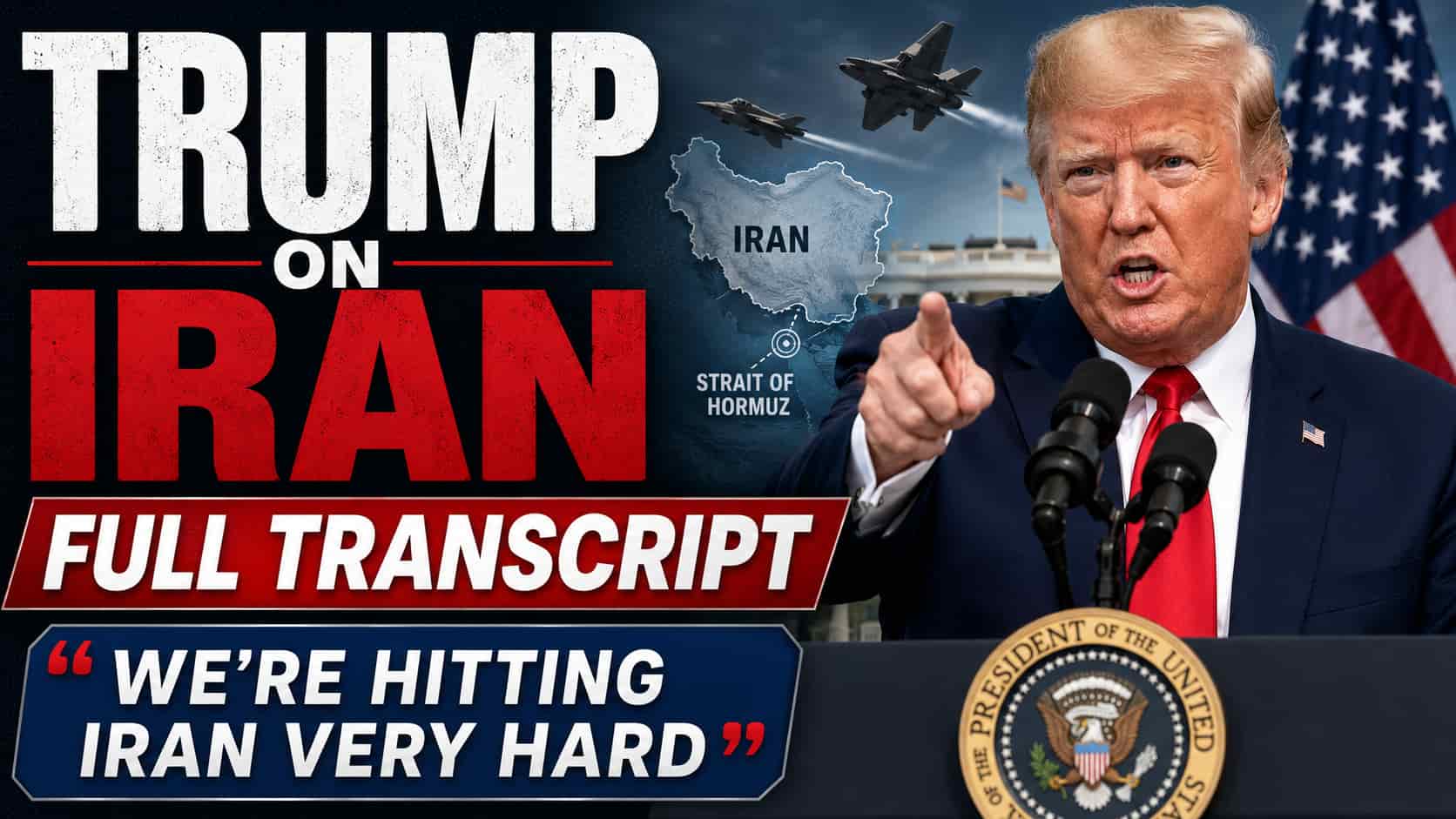
President Donald Trump said the United States was “hitting Iran very hard,” destroying Iranian offensive capabilities and restoring a blockade directed at commerce with Tehran during an extended exchange with reporters on July 13, 2026.
The discussion followed a White House event with Utah officials concerning the boundaries of the Bears Ears and Grand Staircase-Escalante national monuments. After signing the documents, Trump answered questions about Iran, the Strait of Hormuz, negotiations with Tehran, Iranian drones, U.S. military operations, and the scale of damage he said had been inflicted on Iran’s armed forces.
“We’re hitting them very heavy tonight … and we’re knocking out all of their offensive capability,” Trump said.
Trump did not use the exact phrase “the response will not be proportional” in this transcript. However, he repeatedly described an overwhelming military response, saying the United States had demolished Iran’s military, eliminated its navy and air force, and destroyed most of its missile and drone-production capacity.
Editor’s note: This is an unofficial cleaned transcript prepared from caption text accompanying an official White House video. Timestamps and interface text were removed, speaker labels were standardized, and obvious caption-spacing errors were corrected. No substantive statements were intentionally omitted. The transcript does not independently verify factual claims made by any speaker.
Key statements on Iran
- Trump said the United States had “demolished” Iran’s military and was continuing major strikes.
- He said U.S. forces were targeting Iran’s capabilities connected to the Strait of Hormuz.
- He announced the restoration of a blockade aimed at Iran and entities doing business with Tehran.
- He said negotiations remained possible despite Iran’s alleged withdrawal from a proposed agreement.
- He claimed the United States had destroyed Iran’s navy, air force, most of its missiles and drones, and large portions of its production capacity.
Full cleaned transcript
Katharine MacGregor: I'll just say, the Antiquities Act is 120 years old, but the first monument that was created was only 1,200 acres. So if you think about it, since then, President Clinton, President Obama and President Biden have increased the acreage in the state of Utah and locked those acres up, over million acres.
The President: For nobody to use, right? You can't do anything. You can't go hunting. You can't go fishing. You can't do anything. You can virtually not even walk on it.
Katharine MacGregor: That's exactly right, sir. So you are remedying that today.
The President: I remember now. I do remember. I have a great memory.
Spencer Cox: And Mr. President, I know, Senator Lee —
The President: And this is actually better than the first time, what we're doing.
Spencer Cox: It is better. Yes, Senator Lee has been very involved, I know, in conversing with you.
The President: Good. That's true. Mike, go ahead.
Mike Lee: Smallest area compatible with the objects to be protected. That's always been the standard under the Antiquities Act. President Biden, President Clinton and President Obama overlooked that standard. President Trump is fixing it today.
The President: You had — thanks, Mike. You had something to say, I thought that was very important.
Unidentified: Celeste, please.
Celeste Maloy: Well, I think it's worth noting for the press in the room, that both of these monuments were created over the unanimous opposition of Utah's federal delegation, our governors —
Unidentified: County commissioners.
Celeste Maloy: County commissioners, the locals who are worried about losing multiple uses on these federal lands. Um, and we're standing here with the governor, the speaker of the Utah House, the entire Utah federal delegation, supporting a president listening to the people of Utah and saying, we know you value this land, you want it used for multiple use and not locked up uh, and so this is a very different process than how the monuments were created.
The President: Well, they took the land away from the people, quite honestly. It was ridiculous. And I remember Orrin Hatch before he passed away. He was a great guy. He was a friend of mine. And he felt so strongly about this. And we signed and then they terminated it after they got in office, which was crazy. And we're putting it back, but we're actually giving more than we did the first time, back to the people of Utah. Please go ahead.
Unidentified: Couldn't have said it better than Representative Maloy. May I point something out.
The President: Yeah, please.
Unidentified: I think people don't understand, Utah is over two thirds owned by the federal government. These counties where these monuments are at are over 90 percent federal land. When people make decisions about this 2,000 miles away, you can see how that steps on the local people who only control about five or 10 percent of the land with local government. So not only do you have all these dynamics, you have an economy, you can't pave roads, you can't build schools, you can't pay fire people police department because of this dynamic of 95 percent federal lands. The other part of that is Utahans will tell you, they love these lands they manage them better than people 2,000 miles away. So if this is about good management, it really should be done in Utah by people who have demonstrated over decades and decades and decades and generations that they're good managers of this land.
The President: Great job. Well said. Anybody? You're leaving? I can't believe it. I can't believe it. You're excited? Where are you going from here?
Unidentified: Well, can I say this? First of all we sat down with the previous administration and said, why don't we just work this out so we don't have to keep going back and forth, just work with us. And we promised [inaudible] that we once we have the power, we're going to make sure that the people's voices are heard. So thank you for helping us keep our promise. And, unfortunately, the last administration did not understand that this would happen one day, so thank you so much.
The President: Great honor. Let's sign. This is very nice. I'm very happy about this, and better than the first time. OK. Here's number one. OK. Number two. Here you go. Almost three million acres going to be well taken care of now. OK. A pen, who should I give this to? Huh? Maybe the governor's representative, right? And, Mike, how about taking one, right? So we've done something that was, I think, very desperately needed. It was very unfair to the people of Utah. And now fairness has been brought back. It's going to be better taken care of and they'll be able to use it a little bit. So there's something very nice about that. OK? Do you have any questions about this? First of all, most importantly, anybody want to talk about this? Yeah, Jeff, go ahead.
The Press: I've got one on Iran — I've got one on Iran too but I'll start with this. Just, you said that 70 percent of the land was federal. Was there any other way to turn this around? How is it that that — I guess my question is how did it get there, if it's a state.
The President: Go ahead. You want to discuss that, please.
Mike Lee: The land ownership is what it is but under the Antiquities Act, the 120 years ago, Congress made the decision to give presidents the power to designate by executive proclamation certain land as monument. It was supposed to be the smallest area compatible with the objects to be protected in connection with that. Now, initially, as the deputy secretary of the interior explained a minute ago, that meant a few hundred, maybe 1,000 or 2,000 acres at the most. These are three million acres. As I explained to President Biden, that's two Delawares. Uh, it's been abused and so it was done by executive action. President Trump is right-sizing it to bring it in compliance with what the law says.
The Press: And, Mr. President, just on Iran, you have said now to Congress that we are back at war. How long do you expect this to take and what's the legal basis —
The President: Take what?
The Press: The war.
The President: Well, I think it's going very fast. We've demolished their military. We're hitting them very hard and we had a deal yesterday or the day before yesterday, it was all done and then they broke up that deal immediately because they found out there was something in the deal they didn't like. And they're wired differently and we're not going to put up with it. We are just going forward. We're attacking them tonight and we're taking out all of their capability for anything having to do with the strait, with the Hormuz Strait. And I think in the end, we will end up just controlling the whole thing. And what they're doing is being very foolish, very stupid and they've treated people horribly. They've killed 52,000 protesters so far, that we can determine. It might be more than that, but 52,000 protesters have been killed. And it's really terrible situation. But we'll have it — we'll have it under control very quickly. Yeah.
The Press: You mentioned that you're going to — one quick follow up. You mentioned —
The President: Wait a minute. Wait. Please. Just hold on one second. Go ahead, Jeff. Be nice. Be nice, Jeff. Go ahead, please. Have to teach him to be nice.
The Press: Thank you, Mr. President. On your presidency, so a lot of us here actually witnessed a miracle two years ago today, as we were on the ground covering your rally in Butler, Pennsylvania. You said a lot of times that you believe that God has saved your life. Has there been a moment throughout your presidency so far where you thought, this is why God kept you here?
The President: Well, we're doing a lot. You know, we have a country that — I use the expression Make America Great Again and we've done far more than anyone thought possible, including maybe even me. We've done things that are unreal, $19.2 trillion. The money being invested in our country is more than any country has ever had by many times. We have trillions of dollars coming in because of the tariffs and the proper use of tariffs, because all of the things. I think because of the election, November 5th was a very important day when you look at the military, we have the strongest military in the world. We rebuilt it largely during my first term. And we have recruitment now, we're setting records and recruitment. We had, if you go back to the campaign, when I used to talk about it, the last administration, they couldn't recruit soldiers. We needed soldiers in every single branch of our military, and that included police and firemen. Nobody wanted to do anything having to do with the uniform in this country because they weren't proud of the country. And now the people are very, very proud to be an American. Our country is doing phenomenally well. We're respected all over the world. If I go — no matter where I go, we just got back from NATO, and I think you saw the response, it was like a very beautiful thing, actually. It was a total — total response, totally positive response. No matter where we go, we're respected again, maybe respected more than ever before. So I appreciate the question, but that's pretty much it.
The Press: Mr. President, thank you. Cameron Arcand with Town Hall. I was curious about, there are reports about Iranian drones in Cuba. There are concerns about that. Where does the relationship with the US stand there and is military intervention still on the table there?
The President: Well, if they do have that, and they might very well have that, we'll take care of it. Marco's just in the other room and if they do have that, we'll take care of it in short order. We're not going to have a problem. We're not going to allow that to happen. So it could be that they're storing some. We're looking into it now. It could be so and it maybe isn't, but we'll figure it out fast.
The Press: And what are you expected to speak about on Thursday evening?
The President: I'm going to speak on Thursday. We were thinking one of the nights, but this has been such a busy news day today with all that's happening, a lot of very positive things have happened, including the Indy — we're going to have an Indy race, as you know, in 41 days and that's going to be incredible around the capital, around down Pennsylvania Avenue. It's going to be something. They have 250,000 tickets ordered. It'll be like UFC, which set every record in the book for that business, which is the business of fighting. Uh, so we have the Indy cars coming and it's going to be great. And I just — while we're talking, I have to pay — and on behalf of Mike and myself, and I think everybody standing behind me very strongly, I want to pay my respects to Lindsay, who was our friend. He was a friend of all of us. He was a great guy. He was a great politician, actually, and it's hard to believe he's gone. He spoke to me just before he passed away, just to say hello. He got back, he felt fine. He was a little tired and then this whole thing happened, and it's, boy, it's tough. So the flags are at half-mast until Saturday evening, which is an extended period of time, you know, generally speaking. But I think he deserves it. And he is a — he's a fantastic person. He was just he was a fantastic man. He was actually a great politician. He got along with almost everybody. And when he didn't get along, they knew it. He was — he was tough, but he was a — he was a good man he was very much in favor of the SAVE America Act. He called me about that. We were talking about that. And some other things, but he just felt tired and but he felt fine, and then this horrible thing happened just a short time afterwards, so it was terrible. I just want to pay our respects.
The Press: Mr. President, you mentioned that Iran has agreed to a deal and then walked away from it. Have you reached the conclusion that a negotiated settlement won't be able to happen?
The President: No, I never reached that conclusion, but we're hitting them very heavy tonight, as you know. We're hitting them. We have tremendous amounts of ammunition. We have numbers that we haven't had in years, and we're hitting them very hard and it'll continue and we'll see what happens but — and we're knocking out all of their offensive capability. And we're controlling the straits. We're putting the blockade back and it's a blockade, not for anybody but Iran. In other words, anybody doing business with Iran can't go through. Everyone else will be able to go through. So it's a blockade. It's a very strong blockade. The blockade was probably more effective even than hitting them. But I think the combination is the thing that — that really does it.
The Press: But do you think a deal is still possible? Do you think they'll return to that?
The President: Yeah, I think a deal is possible. Sure, I do.
The Press: But, Mr. President, you noted the United States is bombing Iran again. I mean, you've been bombing Iran for months now. Is this just the new normal for the American people?
The President: No. Well, you know, we're in Vietnam for 19 years, we're here for four months, so I think we've done a lot. We've knocked out their Navy in a period of one month. We knocked out their air force. Their air force is nonexistent. We knocked out most of their missiles most of their drones. We knocked out their drone manufacturing capability about 92 percent. Their missile capability for manufacturing, we knocked out 89 percent. minutesUh, and they have a little capability, but they don't have any capability for us. This is almost a military skirmish. Now, with all of that being said, you have to get people that want to make something. We had to deal with them two days ago and then they said, oh, we can't make that deal. We have to negotiate it further. And this is what they've done for 47 years. The difference is nobody negotiated like I do and this should have been done by Bush and Obama and Biden and people before them, frankly. It's 47 years they've been ripping off everybody and really hurting and killing thousands of people. So they killed 52,000 protesters, but they killed many, many people with Soleimani, who I killed in the first term. Soleimani killed many people, many, many people and not only killed. When you see a young former soldier walking around with no legs, no arms, a face that's been horribly, horribly hurt that was done by Iran. minutes, 1 secondThat was done by Soleimani, who was a person that was very evil. He was an evil genius. He was looking to take out a lot of our military installations in Iraq and Iran. And I got him before he got us. So we have to do what we're doing. And the strait is open. It will be open. We've cut down their capability very substantially. But, you know, they're going to fight for a while. Uh, our military has done a fantastic job. And you know the bottom line though, and I say it to everybody and I say it as much as they want to listen, Iran will not have a nuclear weapon. If we didn't bomb them with the B-2 bombers, that plane right there, if we didn't bomb them, they would have had a nuclear weapon long ago, one month, within one month from the day we bombed them, they would have had — if we didn't do it, they would have had a nuclear weapon. If they had a nuclear weapon, Israel would no longer be with us, and the Middle East probably would no longer be with us, because you saw, they sent missiles to five different countries that never even knew they were involved, because they're stone-cold crazy. They are crazy. And we're not going to put it up. Yeah, I want to be reimbursed because we're protecting a very rich portion of the world. We're spending money. And so what we've done is we are going to be reimbursed for protection. We're protecting by the countries that we're helping. For instance, you look at the five countries, you have Saudi Arabia, you have UAE, you have Qatar or Qatar, as I always say. You have Qatar, Bahrain, and by the way, you have others. You have Kuwait and you have others, and they will do very well, but we think it's appropriate that — we don't need them. You know, we have more oil than any other country in the world. When you add Venezuela, which has been amazing, when you — which has tremendous amounts of oil that we control. When you add Venezuela and everything else, we have more than 50 percent of the world's supply. We don't need it, but we need it from the standpoint of protecting allies, etc., etc., including Israel, including Saudi Arabia, including Qatar, including UAE. We're protecting all of them and we've done a very effective job. So four months ago, these people had military that was very strong, by far, the strongest, probably in the Middle East. They were called the bully of the Middle East. Now they don't have a Navy. They have 159 ships underwater. They had a total of 159 ships. Now every one of them is underwater. They had 230 airplanes, attack planes. They're all gone. They're all — they're gone. They had tremendous radar, it's all gone. They had tremendous anti-aircraft, it's all gone. Sadly, their leadership is all gone. They had — their first tier leaders are all dead. Their second tier leaders are all dead. Their third tier leaders, who we're dealing with more or less some of them are already gone. Uh, and then you read fake news like your — your network, CNN, which is fake news, you read them — you have them say, well, actually, aren't they doing quite well? Let me just tell you, they have now inflation of over 300 percent. Four months ago, that inflation of five percent. Now they're at over 300, could be 350 percent. Uh, they made a deal. They broke it probably ten times, and they killed a lot of people. They killed our people. But the protesters, what they've done to the protesters, 52,000. Have you ever seen any of the burial lots where they're doing — where they're burying the protesters? They killed 52,000 protesters and, on my watch, they can't do any of that. So we have them in a position that they don't have any military. There's not a thing they can do about it. All they have is fake news because they have — the fake news would rather see us lose the war than win the war, which is really treasonous, which is really treasonous in a certain way. So we're doing another very major attack tonight. They want to make a deal. They came back. We made a deal two days ago, and they want to make a deal. They've been negotiating for 47 years, but nobody's ever hit them militarily. We're hitting them very hard. Thank you very much, everybody. Thank you very much. (background chatter)
The President: We're talking about it. We're talking about it. We'll decide very soon on that.
Source: Official White House video, July 13, 2026. Transcript cleaned for readability by Midtown Tribune.
Official Sources and Documents
The following links lead to the official White House video, U.S. Central Command statements, and U.S. government records concerning President Donald Trump’s July 13, 2026 remarks, military operations against Iran, and the Strait of Hormuz.
President Trump’s Official Remarks
- The White House: President Trump Signs an Executive Order, July 13, 2026 — the official White House video containing President Trump’s remarks with Utah officials and his subsequent answers to reporters about Iran, U.S. military strikes, negotiations and the Strait of Hormuz.
- The White House Video Library — the official archive of White House speeches, press exchanges, executive-order signings and other presidential video recordings.
Official CENTCOM Statements on the July Strikes
- CENTCOM: U.S. Forces Complete New Strikes on Iranian Military Targets — the official statement reporting that the latest wave of strikes ended at 10:15 p.m. ET on July 13, 2026, following a five-hour mission against Iranian military targets.
- CENTCOM Public Releases — the official chronological archive of U.S. Central Command statements concerning military operations, Iranian attacks, retaliatory strikes and maritime enforcement.
- CENTCOM Official Media Center — official press releases, operational photographs, videos and other military media materials.
- CENTCOM Official Video Gallery — official footage of U.S. military operations, including strikes against Iranian naval, missile, drone and military-support facilities.
The Strait of Hormuz and the Naval Blockade
- U.S. Central Command Official Website — CENTCOM’s official homepage, including current releases concerning the naval blockade, freedom of navigation and enforcement actions involving vessels entering or leaving Iranian ports.
- The White House: President Trump’s Leadership, Iran and the Strait of Hormuz — an official White House statement describing the administration’s policy toward Iranian aggression, freedom of navigation and the U.S. naval blockade.
- The White House: President Trump’s Iran Agreement Is America First in Action — an official White House release concerning negotiations with Iran, its nuclear program and the reopening of the Strait of Hormuz.
Background on U.S. Policy Toward Iran
- White House Fact Sheet: President Trump Addresses Threats from Iran — an official summary of the administration’s policy toward Iran, its nuclear program, regional military threats and U.S. deterrence.
- CENTCOM 2026 Posture Statement — an official assessment of the regional security environment, Iranian military capabilities and the scale of U.S. operations.
- U.S. Department of Defense — the official Department of Defense website containing statements, briefings, transcripts and reports relating to U.S. military policy and operations in the Middle East.
Editor’s note: The transcript published by Midtown Tribune was prepared from caption text accompanying the official White House video. Timestamps and interface text were removed, speaker labels were standardized, and obvious caption-spacing errors were corrected. The White House has not published a separate verbatim written transcript of the complete event at the time of publication.
White House official video on the top of the page.
Midtown Tribune Independent USA news from New York
Ask Midtown Tribune about this story
Answers are grounded first in this article. Search all Midtown Tribune reporting from the main AI Search page.
AI-generated summary. Verify important details in the linked original articles.