
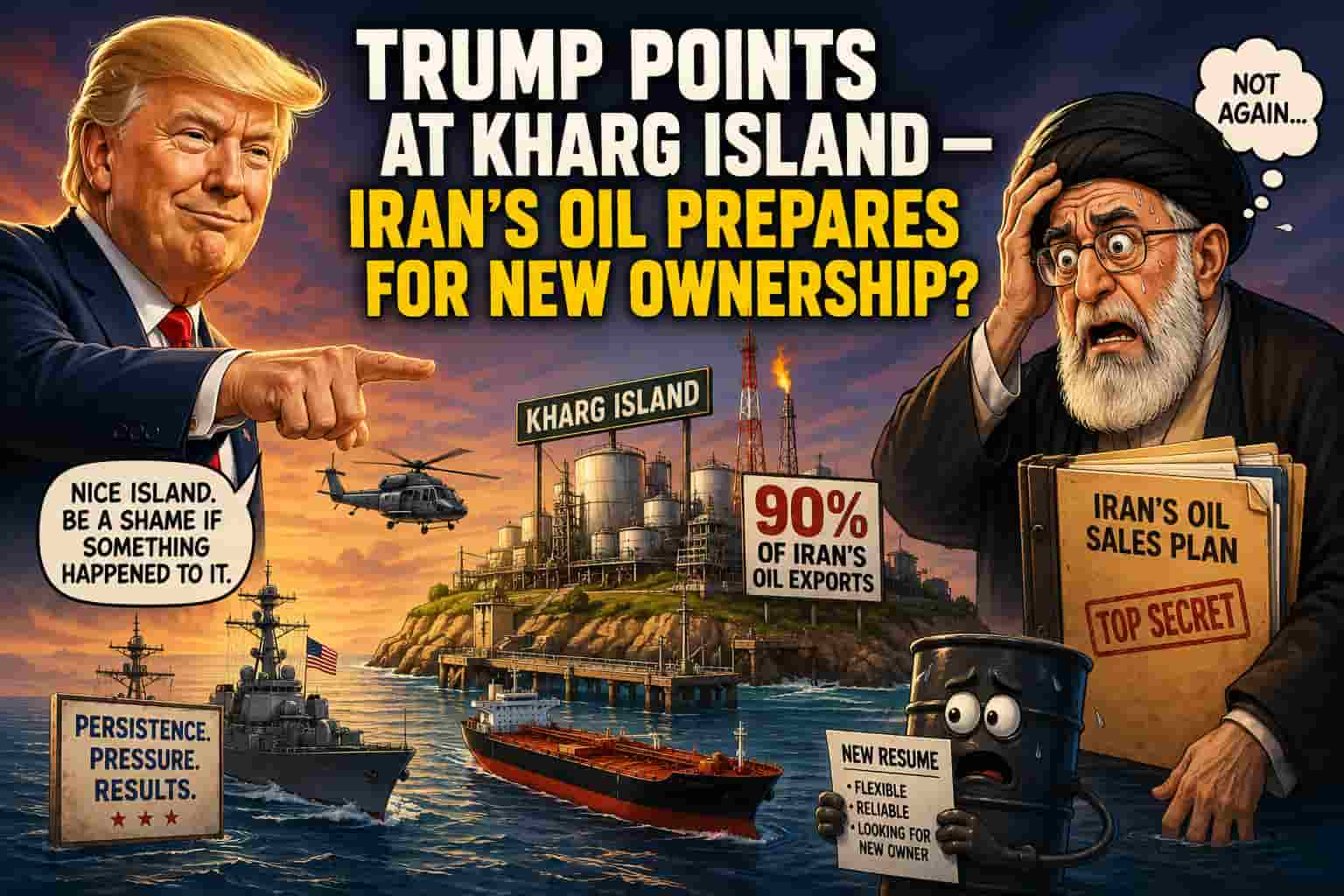
Iran’s government has spent decades perfecting a highly sophisticated military strategy:
First, threaten the United States.
Second, threaten every American base in the Middle East.
Third, threaten every oil tanker in the Persian Gulf.
And finally, act completely shocked when Donald Trump looks at a map and says, “What about that island right there?”
That island is Kharg Island, Iran’s main crude-oil export hub. Roughly 90 percent of the country’s oil exports pass through it.
Not 90 percent of all the oil physically located in Iran. That would be an incredible island. You would not need a refinery. You could just put a straw in the ground.
But Kharg is still enormously important. It is essentially Iran’s national cash register, except the cash register is sitting on a small island, surrounded by water, within range of the United States military.
Which is not the ideal place to store your economy while repeatedly shouting, “Death to America.”
Trump Did Not Announce an Invasion
Despite the dramatic video headlines, Trump did not officially announce that American Marines were boarding landing craft and preparing to install a Trump International Oil Terminal.
When asked whether he intended to seize Kharg Island, Trump declined to reveal his plans. He said publicly announcing a military operation in advance would be foolish.
This is correct.
Even by Washington standards, sending Iran a calendar invitation titled “Kharg Island Invasion — Please Confirm Attendance” would be poor operational security.
Trump also did not rule out a limited ground operation. He suggested that taking the island could become an option if Iran’s military capabilities were degraded far enough.
That is not an invasion order.
It is strategic ambiguity: the diplomatic art of leaving a loaded possibility on the table and allowing the other side to stare at it all night.
Trump’s message was basically:
“I’m not saying we’re taking the island. I’m also not saying you should make long-term decorating plans.”
Iran Responds With Its Favorite Weapon: A Press Release
Iranian officials responded as they usually do: by threatening to destroy American bases, close the Strait of Hormuz, attack shipping and create problems for everybody in the neighborhood.
This is Tehran’s version of customer service.
“Your call is very important to us. Please remain on the line while we threaten Bahrain.”
The Iranian regime’s strategy appears to be that if Iran cannot export oil safely, nobody else should be allowed to export oil safely either.
It is a kind of petroleum socialism:
From each country according to its oil reserves, to nobody according to Iran’s mood.
Imagine a man being removed from a restaurant because he keeps setting napkins on fire. As security approaches, he announces:
“If I cannot finish dinner, I will burn down the entire food court.”
That does not prove he is winning the argument.
It proves the food court needs better security.
Kharg Island Is Not an “End War” Button
Taking Kharg Island would be a serious blow to Iran’s economy. It could sharply restrict oil exports, reduce government revenue and give Washington enormous leverage in negotiations.
But it would not automatically end the war.
Kharg is located close to Iran’s coastline. Even after losing control of the island, Tehran could attempt to strike it with missiles, drones or artillery from the mainland.
Capturing the island could be easier than holding it.
History is full of military operations that began with officials saying, “This will be quick,” which is usually history’s way of introducing a very long chapter.
A seizure of Kharg could pressure Iran into negotiations.
It could also expand the conflict, increase attacks on regional targets and send global oil markets into cardiac arrest.
So no, the island is not a giant red button labeled:
PRESS HERE TO END MIDDLE EASTERN CONFLICTS.
If such a button existed, someone would have accidentally leaned on it during a United Nations meeting by now.
America Already Hit Military Targets on the Island
The United States has already struck military infrastructure on Kharg Island, including missile-related facilities, mine storage sites and other military positions.
The key detail is that American forces initially avoided destroying the core oil infrastructure.
That creates an awkward problem for Iranian propaganda.
For years, the regime has claimed that America’s real goal is to steal Iran’s oil.
Then the United States attacked military targets surrounding the oil facilities while deliberately leaving much of the oil infrastructure intact to avoid damaging the global economy.
Somewhere in Tehran, a government employee had to revise the poster:
AMERICA WANTS TO STEAL OUR OIL
became
AMERICA HAS TEMPORARILY DECLINED TO DESTROY OUR OIL FOR COMPLICATED MACROECONOMIC REASONS.
Not as catchy.
The “Mother of All Bombs” Enters the Chat
The video also discusses the possible use of the GBU-43/B MOAB, commonly known as the “Mother of All Bombs.”
The weapon is real. It is enormous. It was designed to produce both physical destruction and psychological shock.
But there has been no publicly confirmed Pentagon announcement that a MOAB strike on Iran is imminent.
At the moment, the MOAB serves mostly as the shark fin in the movie trailer.
You see it briefly.
The music gets louder.
A television host says, “This could happen in the coming days.”
And suddenly everyone behaves as though the bomb has already left the aircraft.
“Could happen” is one of cable news’s most useful phrases.
A MOAB could be used.
A ground operation could happen.
Kharg Island could be seized.
Iran could agree to negotiations.
I could become the starting quarterback for the New York Giants.
Some possibilities deserve slightly different levels of confidence.
Iran Still Has Weapons — Just Not a Convincing Exit Strategy
It would be inaccurate to say Iran has no cards left.
The regime still has missiles, drones, naval mines, proxy forces and the ability to disrupt commercial shipping. It can continue causing serious damage throughout the region.
But Iran’s remaining strategy increasingly resembles a poker player who has a weak hand and responds by threatening to set the casino on fire.
That is leverage, technically.
It is just not the kind of leverage that attracts many investors.
Tehran may no longer be able to defeat the United States militarily. Its goal appears to be making any American victory expensive enough, dangerous enough and economically disruptive enough that Washington accepts a negotiated settlement.
That is not the same as winning.
It is closer to being carried out of a nightclub while yelling, “You haven’t seen the last of me,” and then realizing your car has been towed.
Trump’s Real Advantage Is That Iran Believes He Might Do It
Trump does not need to seize Kharg Island tomorrow for the threat to matter.
He only needs Tehran to believe that he might.
That is the difference between strategic pressure and presidential fan fiction.
Trump’s critics often complain that he is unpredictable. In this situation, unpredictability is not necessarily a defect. It is the mechanism.
Iranian leaders must now calculate whether Trump is bluffing, negotiating or genuinely considering an operation against the country’s most important oil-export terminal.
And Trump is unlikely to resolve that uncertainty by releasing a detailed PowerPoint presentation.
That means Iran must spend resources defending Kharg, protecting coastal infrastructure, dispersing weapons and preparing for several different American options at once.
In military terms, that creates pressure.
In business terms, Iran has been informed that its lease may not be renewed.
The Bottom Line
The viral headline claiming that Trump announced a plan to take over Kharg Island goes further than the known facts.
Trump has not announced an invasion.
He has not declared the island American territory.
There is no confirmed timetable for a ground operation.
But he has refused to rule out taking the island, and that possibility is credible enough to make Iran’s leadership deeply uncomfortable.
The situation can therefore be summarized accurately:
Trump pointed at Iran’s most important oil-export hub.
Iran responded by threatening half the region.
The oil market became nervous.
And Kharg Island quietly opened LinkedIn and selected:
“Open to new management opportunities.”
Official Sources and Further Reading
The following U.S. government sources provide official information about Kharg Island, Iran’s oil-export infrastructure, U.S. military operations, the Strait of Hormuz, and the GBU-43/B MOAB.
-
CENTCOM: U.S. Precision Strike on Kharg Island — March 13, 2026
U.S. Central Command reports that American forces struck more than 90 Iranian military targets on Kharg Island, including naval-mine storage facilities and missile bunkers, while preserving the island’s oil infrastructure. -
CENTCOM: Official Operation Epic Fury Page
Official operational updates, photographs, videos and public statements from U.S. Central Command concerning military action against Iranian forces. -
CENTCOM: U.S. Forces Stop Tanker Heading Toward Kharg Island
CENTCOM’s official account of the June 2, 2026 operation that disabled an unladen tanker after its crew repeatedly ignored U.S. warnings while sailing toward Kharg Island. -
CENTCOM: U.S. Strikes Iranian Military Sites Near the Strait of Hormuz
Official information about precision strikes against Iranian air-defense, surveillance and ground-control facilities following attacks on U.S. forces and international commercial shipping. -
U.S. Energy Information Administration: Iran’s Oil Industry and Export Terminals
The EIA’s official background report explains the role of Kharg and Iran’s other Persian Gulf terminals in handling the country’s crude-oil exports. -
The White House: President Trump’s Stated Objectives Regarding Iran
The administration’s official explanation of its objectives concerning Iran’s missile capabilities, naval forces, nuclear program and support for terrorist organizations. -
U.S. Air Force: Official Background on the GBU-43/B MOAB
The U.S. Air Force describes the Massive Ordnance Air Blast bomb as a 21,600-pound, GPS-guided conventional munition developed for physical destruction and psychological pressure. -
U.S. Air Force: Official Report on the 2017 Combat Use of the MOAB
The official account of the GBU-43/B’s combat use against an ISIS-K tunnel complex in Afghanistan. This source confirms the weapon’s capabilities, but does not confirm that its use against Iran has been ordered.
Fact-checking note: The official materials confirm U.S. strikes on military targets at Kharg Island and the island’s strategic importance. They should not be interpreted as an official announcement that the United States has decided to seize or occupy the island.
Ask Midtown Tribune about this story
Answers are grounded first in this article. Search all Midtown Tribune reporting from the main AI Search page.
AI-generated summary. Verify important details in the linked original articles.