
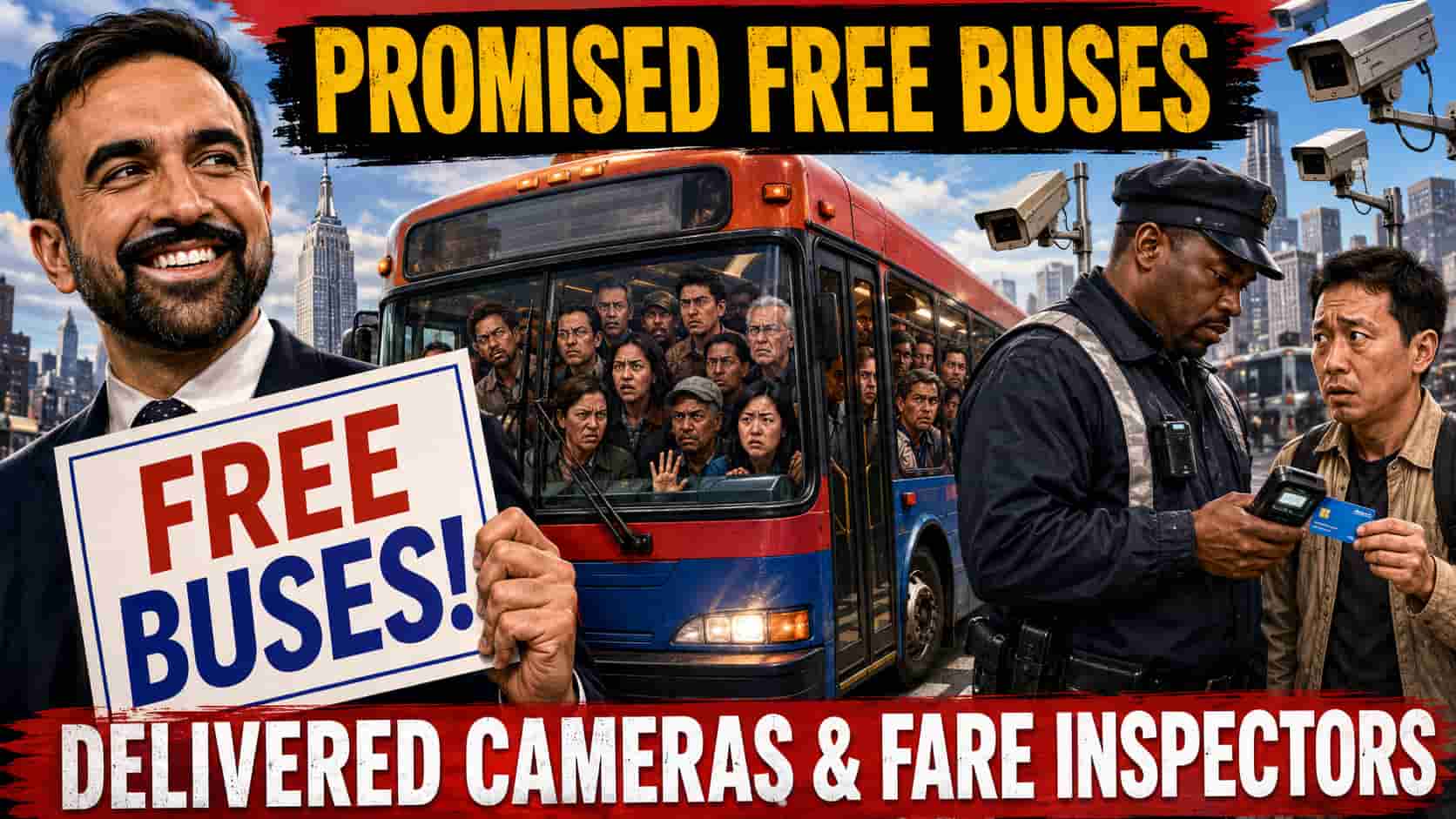
The mayor’s “fast and free” bus promise has produced an $882 million speed plan, more automated enforcement and inspectors checking whether passengers paid for the bus that was supposed to become free
Zohran Mamdani promised New Yorkers buses that would be fast and free.
The buses are not free.
It is also too early to determine whether they will become substantially faster. But the cameras, enforcement plans and paid fare inspectors are already much easier to locate than the promised free ride.
In a new video, YouTube commentator Cash Jordan examines Mayor Mamdani and Governor Kathy Hochul’s bus initiative, officially titled “Next Stop: Fast Buses, Better Service.”
The title sounds reassuring. It contains the words “fast,” “buses” and “better.”
The only word missing is “free.”
Apparently, that word missed the bus.
Mamdani promised “free.” Government started with “fee.”
On July 8, 2026, Mamdani and Hochul announced an extensive plan covering 50 priority bus corridors and five proposed rapid-transit routes:
- Tremont/Cross Bronx;
- Northern Boulevard;
- Flatbush Avenue;
- Utica Avenue;
- Kensington–JFK.
According to the official City Hall announcement, New York City has committed:
- $254 million in expense funding;
- $628 million in capital funding;
- a combined $882 million over five fiscal years.
The plan promises dedicated bus lanes, upgraded stops, shelters, seating, transit-priority signals and thousands of replacement buses.
Some of those investments may be useful. New York’s bus service is frequently slow, unreliable and unpredictable.
But none of them make the bus free.
During the official presentation, Mamdani acknowledged the missing half of his campaign promise:
“I’ve been very clear that my commitment is to make buses fast and free. Today, we stand together on how we deliver the fast.”
That is a magnificent sentence.
Translated from City Hall into ordinary English, it means:
“We promised two things. Today, we are announcing a plan that may eventually deliver one of them.”
Free buses remain a future aspiration. The $882 million bill is ready now.
Nearly $900 million to save “up to” six minutes
City Hall says the program could increase bus speeds by 20 percent and shorten some trips by up to six minutes each way.
The phrase “up to” is doing a great deal of municipal work.
It does not mean every passenger will save six minutes. Actual savings will depend on the route, distance traveled, traffic, service frequency and whether the bus arrives at all.
Perhaps six minutes will be saved on a full eight-mile trip. Perhaps the average rider will save less. Perhaps a passenger will save three minutes on the bus and then spend five additional minutes walking to a relocated or consolidated stop.
Before holding a six-minute victory parade, taxpayers deserve more precise measurements:
- average time saved on an ordinary trip;
- cost per minute saved;
- number of additional scheduled trips;
- percentage of completed trips;
- effect on nearby streets;
- effect on seniors and passengers with limited mobility;
- number of erroneous camera violations.
Mamdani used a stopwatch during his announcement to demonstrate the value of six minutes.
Now taxpayers need another stopwatch to measure how quickly $882 million disappears.
Drivers get cameras. Passengers get inspectors.
The most concrete part of the plan is not free transportation. It is enforcement.
Official documents say the city and MTA intend to:
- add Automated Camera Enforcement to 25 additional bus routes annually in 2026 and 2027;
- install 200 additional stationary bus-lane cameras by 2027;
- expand targeted NYPD bus-lane enforcement from 14 to 20 corridors;
- introduce all-door boarding beginning in 2027.
Officials say the cameras will identify vehicles illegally blocking bus lanes. Cars and trucks blocking buses are a genuine problem, and keeping lanes clear can improve service.
But automated systems are not infallible.
A driver may briefly enter a lane to turn, avoid an obstruction, pick up a passenger or comply with another traffic condition. If the camera misunderstands what happened, the machine does not spend its afternoon contesting the violation.
The driver does.
This creates a wonderfully balanced government program:
One passenger may save six minutes while one driver spends six hours challenging a questionable ticket.
The government calls that efficiency because only the citizen’s time was wasted.
Why are fare inspectors necessary if the driver already sees passengers pay?
Under the traditional boarding system, most passengers enter through the front door and pay near the driver.
The new plan calls for all-door boarding. The official justification is that allowing passengers to enter through multiple doors reduces the time buses remain stopped.
Once passengers begin entering through the rear doors, however, the driver can no longer observe every payment. That requires a proof-of-payment enforcement system.
According to official MTA committee documents, EAGLE Team inspectors will be able to board buses and scan riders’ payment cards to verify fare compliance.
The new system therefore works like this:
- Remove the driver from direct fare verification.
- Allow passengers to enter through multiple doors.
- Create a separate inspection operation.
- Equip inspectors with electronic scanners.
- Pay them to determine whether riders paid for the bus Mamdani promised would be free.
Only government could transform one driver watching one farebox into an entire mobile compliance operation and call it simplification.
Instead of more frequent buses, riders get more frequent inspections
The most obvious way to improve bus service is not mysterious.
Put more buses on overcrowded routes. Reduce waiting times. Maintain dependable intervals. Complete scheduled trips. Stop allowing two or three late buses to arrive together after passengers have waited for twenty minutes.
The official plan promises frequent all-day service on the five proposed rapid-transit corridors. It also says the MTA’s capital program will purchase approximately 2,500 new buses.
However, those vehicles are expected to replace roughly 40 percent of the aging fleet. Replacement is necessary, but a replacement bus is not automatically an additional bus providing an additional trip.
The plan does not give every struggling route a simple, enforceable guarantee such as:
“A bus will arrive every five minutes.”
Instead, riders receive aspirational targets, future performance reports, cameras, scanners and inspectors.
New Yorkers need buses that arrive on schedule. Mamdani’s transportation system may provide something else: an inspector who arrives promptly to verify that you paid for the bus that did not.
All-door boarding could become all-door confusion
All-door boarding can work when equipment is reliable, passengers understand the rules and people entering do not block those trying to exit.
Now picture the same idea inside a crowded New York City bus.
Passengers attempt to exit through the rear door. Other passengers push inside through the same door. Someone searches for the validator. Someone else does not know whether the payment registered. A stroller is stuck between both streams. An elderly rider cannot reach the machine.
Then the fare inspectors arrive.
The city may have invented a transportation system in which the bus saves thirty seconds at the stop and loses five minutes during the argument over whose card worked.
The burden will fall especially heavily on:
- seniors;
- passengers with disabilities;
- parents traveling with children;
- people carrying luggage;
- tourists;
- immigrants unfamiliar with OMNY;
- passengers whose cards or phones do not work correctly.
A transportation system should treat paying passengers as customers. A poorly designed proof-of-payment system can treat every passenger as a suspected violator awaiting electronic clearance.
When the machine fails, the passenger becomes the problem
Electronic payment systems can fail.
A bank may decline a transaction. A phone may lose power. A card may not scan. A validator may malfunction. A payment may not immediately appear in the inspection system.
What happens then?
Will the inspector see evidence of an attempted payment? Will a passenger be permitted to pay without receiving a citation? What happens when an elderly rider cannot explain the technical problem? How does someone appeal an erroneous accusation?
These questions matter because government technology has a familiar operating principle:
If the machine works, the government receives the money. If the machine fails, the citizen receives the problem.
This is where routine enforcement risks becoming administrative harassment.
The phrase is an opinion, not an official description of the program. But a passenger publicly stopped, scanned and questioned because of a technical error may not appreciate the distinction.
Mamdani promised to liberate riders from bus fares. Instead, riders may have to prove to a government employee that they paid one.
An imported proof-of-payment system—with New York characteristics
Proof-of-payment systems and roving fare inspections are used in parts of Europe and elsewhere around the world.
Supporters argue that the model speeds boarding because passengers do not need to form one line at the front door. Critics point to uncomfortable encounters, uneven enforcement and the possibility of treating ordinary riders like suspects.
New York appears ready to import the inspection model while adding familiar local ingredients:
- crowded buses;
- unreliable service;
- malfunctioning equipment;
- complicated rules;
- aggressive confrontations;
- an appeals process nobody wants to use.
Europe may have roving fare inspectors. New York will give them attitude, congestion and a validator displaying an unexplained error message.
Why build a larger fare-enforcement system if buses are going to become free?
This is the central contradiction.
If Mamdani truly expects to eliminate bus fares, why expand the expensive infrastructure needed to verify payments?
There are two possibilities.
First, fare-free buses remain politically distant, so the MTA expects to continue collecting fares for the foreseeable future.
Second, taxpayers will finance inspectors, scanners and enforcement systems that could become unnecessary if the mayor eventually fulfills his promise.
Either way, New Yorkers deserve specific answers:
- When will buses become free?
- How much will fare elimination cost annually?
- Who will replace the lost revenue?
- What will happen to fare inspectors afterward?
- How much will the temporary enforcement system cost?
- What protections will exist for passengers wrongly accused of evasion?
- What passenger information will the scanners access and retain?
The schedule for free buses remains unclear.
The schedule for more cameras and inspections is considerably easier to find.
The utopia is coming later. The enforcement operation can begin now.
Did Mamdani end NYPD bus patrols while gangs “took over”?
Cash Jordan’s video carries the dramatic title:
“Mamdani ENDS NYPD Bus Patrols as GANGS TAKE OVER.”
That specific claim is not supported by the official documents reviewed for this article.
The Mamdani–Hochul plan actually calls for targeted NYPD bus-lane enforcement to expand from 14 to 20 corridors. The city’s published documents do not establish that Mamdani abolished bus patrols, nor do official NYPD statistics prove that gangs have “taken over” the entire bus system.
Crime, fare evasion and attacks on transit workers are legitimate concerns. The NYPD publishes dedicated transit and bus crime reports. But a citywide gang takeover is a political characterization, not a verified finding in the available government records.
The confirmed facts are strange enough without exaggeration:
A socialist mayor promised free buses, kept the fare and celebrated a system containing more cameras and electronic fare inspections.
Satire does not need to miss its stop when reality is already riding the same route.
New York needs reliable buses—not another compliance theater production
The bus system genuinely needs improvement.
According to the New York City Comptroller’s official analysis:
- buses averaged approximately 8.17 miles per hour in 2024;
- buses failed to arrive on schedule roughly 30 percent of the time;
- more than half of frequent routes suffered enough bunching to produce extended waits;
- the city repeatedly fell short of its own bus-lane construction goals.
Dedicated lanes, better signals, reliable maintenance and accessible stops may help.
But riders also need something far less glamorous: buses that arrive when scheduled and run often enough that missing one does not destroy the morning commute.
That would be a measurable accomplishment.
A press conference, a rendering and a five-year spending plan are not yet accomplishments. They are promises wearing business attire.
Welcome aboard the Mamdani bus of the future
Mamdani campaigned on “fast and free.”
The emerging system looks closer to pay, scan and prove:
- taxpayers pay for the program;
- passengers continue paying the fare;
- drivers risk automated tickets;
- fare inspectors are paid to check passengers;
- passengers must prove that their payment registered;
- officials declare the plan historic before the results exist.
The bus may still be late.
The camera will be watching.
The validator may not work.
The inspector is already walking toward you.
And somewhere at City Hall, a stopwatch is celebrating the six minutes you might eventually save.
Welcome aboard the Mamdani bus of the future: the free ride remains a campaign promise, but the paid enforcement is becoming a government program.
Video
Cash Jordan: “NO MORE ARRESTS”… Mamdani ENDS NYPD Bus Patrols as GANGS TAKE OVER
Official sources
- NYC Mayor’s Office: Next Stop—Fast Buses, Better Service
- Official transcript of the Mamdani–Hochul announcement
- NYC DOT: Complete Next Stop bus plan
- MTA: Official announcement of the joint bus initiative
- MTA committee document addressing proof-of-payment inspections
- NYC Comptroller: Behind Schedule—How New York City’s Bus System Slow Rolls Riders
- NYPD transit and bus crime reports
This is a satirical opinion column. Descriptions such as “administrative harassment” reflect the author’s interpretation; factual claims regarding funding, cameras, inspections and planned service changes are based on the official documents linked above.
Ask Midtown Tribune about this story
Answers are grounded first in this article. Search all Midtown Tribune reporting from the main AI Search page.
AI-generated summary. Verify important details in the linked original articles.