
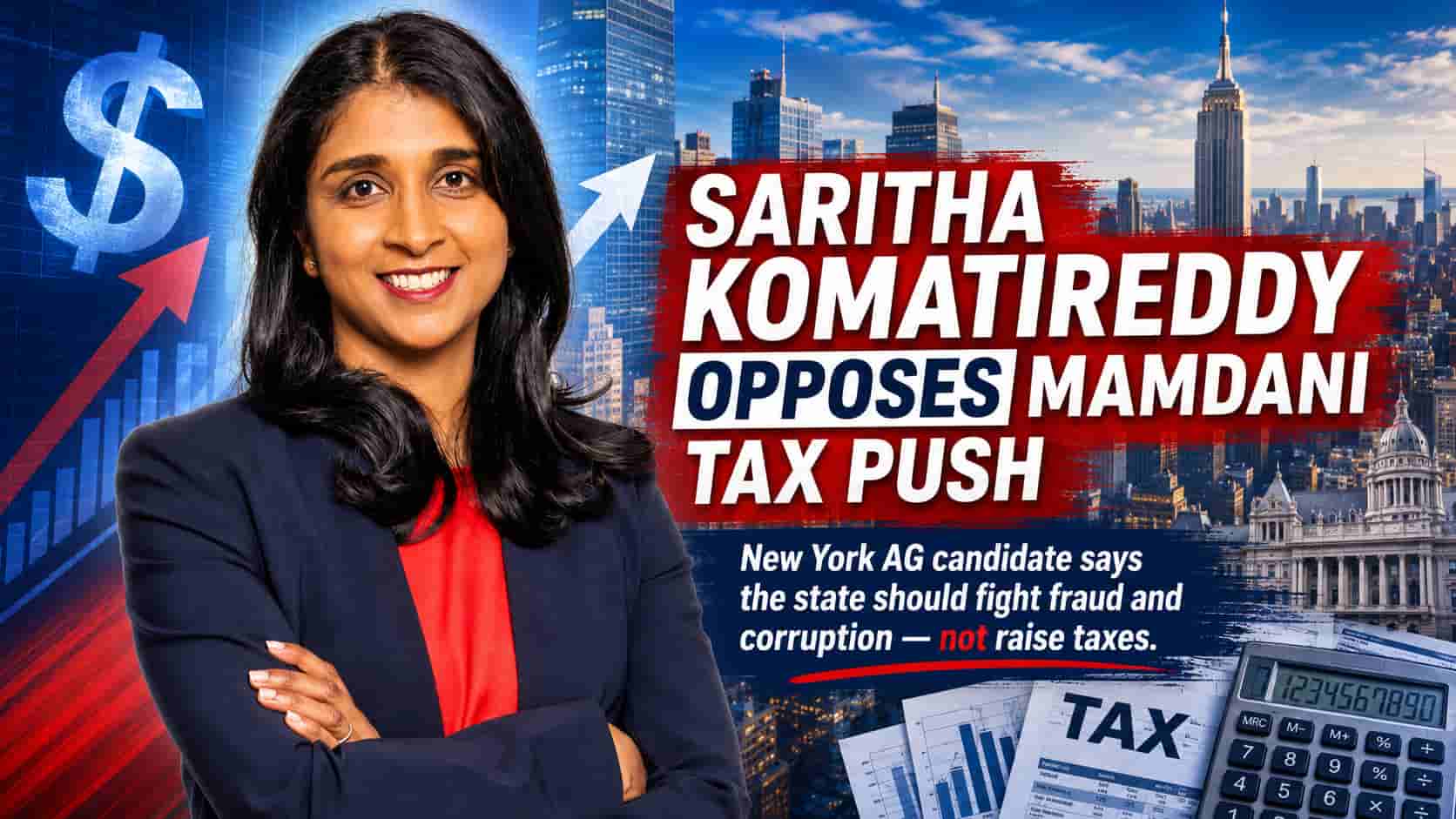
Republican attorney general candidate Saritha Komatireddy says New York’s government should pursue money lost to fraud, corruption and misuse of public funds before asking residents to pay higher taxes. Her statement draws a sharp contrast with Mayor Zohran Mamdani’s revenue agenda and Attorney General Letitia James’ record.
New York attorney general candidate Saritha Komatireddy has offered Mayor Zohran Mamdani a blunt piece of advice: before demanding more money from taxpayers, recover the public funds already lost to fraud and corruption.
In a July 24 campaign statement, Komatireddy argued that New Yorkers are being asked to absorb additional taxes while billions of dollars are allegedly lost through fraud, government waste and criminal activity.
“Beleaguered New York State taxpayers are robbed of billions of dollars every year through endemic fraud and corruption,” Komatireddy said. She accused political leaders of preferring another round of tax increases to aggressive enforcement and recovery of stolen funds.
Her central message was straightforward: New York should exhaust its ability to prosecute fraud, recover taxpayer money and improve oversight before increasing the financial burden on residents and businesses.
Komatireddy responds to Mamdani’s tax agenda
Mamdani has argued that New York City requires additional revenue to protect public services and stabilize its finances.
His administration has promoted higher taxes on wealthy residents and owners of high-value secondary properties. In April, Mamdani and Gov. Kathy Hochul announced New York’s first pied-à-terre tax, targeting certain expensive New York City homes whose owners maintain a separate primary residence.
The city initially estimated that the measure could generate approximately $500 million annually. An analysis by the New York City comptroller found that annual revenue could reach as much as $510 million, although design, enforcement and implementation issues could reduce the amount to between $340 million and $380 million.
In July, the Mamdani administration began notifying potentially affected property owners about the new surcharge, marking the first stage of implementation.
Komatireddy rejected the broader philosophy behind the mayor’s campaign for additional revenue.
She said higher income taxes would add pressure to households already struggling with New York’s cost of living. She also warned that property-tax increases could eventually affect renters when building owners pass higher expenses on through rents and other charges.
Her argument is not that the city has no fiscal challenges. Instead, she contends that government officials are looking to taxpayers for additional money without first demonstrating that existing public funds are being adequately protected.
“Return the money to the taxpayers”
Komatireddy promised that recovering public money would become a central priority of the attorney general’s office under her leadership.
“If you steal from taxpayers, you will be arrested and prosecuted, and what was stolen will be returned to the victims — the taxpayers,” she said in the campaign statement.
That promise combines several responsibilities of the attorney general’s office, including investigating financial crimes, prosecuting Medicaid fraud, pursuing public-corruption cases and seeking restitution through civil and criminal proceedings.
The office’s Criminal Justice Division includes the Criminal Enforcement and Financial Crimes Bureau, the Medicaid Fraud Control Unit, the Organized Crime Task Force and the Public Integrity Bureau. Its investigators assist with both criminal prosecutions and civil enforcement actions.
However, the attorney general does not have unlimited authority to prosecute every crime committed in New York. Many ordinary criminal cases remain under the jurisdiction of local district attorneys.
Komatireddy would therefore have to identify the categories of fraud that fall within the office’s jurisdiction, explain how enforcement would be expanded and establish how much money could realistically be recovered.
Sharp criticism of Letitia James
Komatireddy’s statement was also a direct attack on incumbent Democratic Attorney General Letitia James.
She accused James of devoting state resources to politically prominent litigation while failing to deliver sufficient results against corruption, fraud and crime.
“For seven years, James has used our taxpayer money to chase headlines and settle political scores,” Komatireddy said.
James’ office disputes that characterization and points to hundreds of millions of dollars recovered through investigations conducted by its Medicaid Fraud Control Unit.
According to the attorney general’s office, the unit recovered more than $627 million for Medicaid through criminal and civil investigations and prosecutions during federal fiscal years 2019 through 2025.
The office has also announced several major recent cases. In June, James reported a $36.5 million recovery from CVS over alleged Medicaid overbilling involving insulin prescriptions.
Later that month, James and State Comptroller Thomas DiNapoli announced the indictment of a New York City businessman accused of operating an alleged $9 million Medicaid fraud scheme through eye-care clinics. The accusations in that case remain allegations unless proven in court.
Those cases demonstrate that the office continues to conduct fraud investigations. They do not fully resolve the political dispute over whether enforcement is adequate compared with the scale and cost of New York’s Medicaid program.
Komatireddy argues that the relevant question is not simply whether money has been recovered, but whether the attorney general is pursuing fraud aggressively enough to protect taxpayers from preventable losses.
The “invisible crime tax”
Komatireddy described fraud and crime as an indirect tax imposed on residents even when lawmakers do not formally raise tax rates.
Her statement pointed to retail theft, automobile theft, insurance costs, fare evasion and spending on homelessness programs as expenses that eventually reach consumers and taxpayers.
The campaign called this burden an “invisible crime tax.”
The phrase is political rhetoric rather than a recognized government accounting category. Nevertheless, it expresses a familiar economic argument: losses from theft, fraud and weak oversight can be transferred to the public through higher prices, insurance premiums, transit costs and taxes.
Retail businesses may raise prices to offset theft. Insurers may increase premiums in response to claims. Government agencies may demand additional appropriations when funds are lost or programs fail to produce expected results.
Komatireddy is seeking to connect these indirect costs to the formal tax increases supported by Mamdani.
Her message is that taxpayers may be charged twice: first through losses caused by fraud and crime, and again through new taxes intended to replace the missing revenue.
Mamdani says new revenue is necessary
Mamdani has presented a different analysis of the city’s finances.
He has said that New York City cannot close its budget deficit through savings alone and needs new revenue to avoid deep reductions in public services.
His administration’s fiscal program has emphasized taxes aimed at wealthy residents, corporations and owners of luxury second homes rather than broad-based increases on working families.
In May, Mamdani released a $124.7 billion executive budget that his administration said balanced the city’s finances through savings, state cooperation and higher taxes on wealthy taxpayers, without an across-the-board property-tax increase.
The administration therefore rejects the suggestion that it is simply demanding more money from ordinary New Yorkers. It argues that higher contributions from those with the greatest ability to pay are necessary to maintain city programs.
Komatireddy’s response challenges that premise from an enforcement perspective. She says elected officials should demonstrate that they have recovered stolen money and eliminated waste before seeking any additional revenue, even from affluent taxpayers.
Two competing approaches to New York’s finances
The dispute reflects two fundamentally different approaches to government finance.
Mamdani’s position is that New York’s structural expenses and public-service obligations require additional revenue, with the greatest burden placed on wealthy residents and owners of valuable secondary homes.
Komatireddy’s position is that calls for higher taxes conceal a failure of enforcement and oversight. She argues that the government should first recover money lost to fraud, prosecute those responsible and require agencies and nonprofit contractors to prove that public spending produces measurable results.
It is unlikely that fraud recoveries alone could permanently finance every city service or eliminate New York’s long-term budget pressures. Recoveries may vary significantly from year to year and cannot always be treated as recurring revenue.
Still, Komatireddy’s argument gives her campaign a clear political message:
Before government asks New Yorkers for more money, it should prove that it can protect the money taxpayers have already provided.
A defining issue in the attorney general race
Komatireddy, a former federal prosecutor and national-security official, is the Republican candidate challenging James in the November 2026 election. Her campaign describes her as a former prosecutor focused on public safety, financial fraud and the rule of law.
James, who has served as attorney general since 2019, is seeking another term and is emphasizing her office’s consumer-protection cases, Medicaid recoveries, corporate enforcement actions and litigation involving the federal government.
The debate over Mamdani’s tax agenda allows Komatireddy to tie the statewide attorney general contest to one of the most important concerns facing New York voters: the cost of living.
Her challenge to Mamdani and James can be summarized in one sentence:
Recover the stolen taxpayer money before asking New Yorkers to pay higher taxes.
Whether the attorney general’s office could recover enough money to significantly reduce the need for new revenue remains an open question. But as a campaign argument, it creates a direct contrast between higher taxation and stronger enforcement — and that contrast is likely to remain central to the race.
Original Campaign Statement.
Official Sources and Further Reading
- Saritha for New York: Statement on Mayor Mamdani’s Tax-Hike Campaign
- New York City Mayor’s Office: Mayor Mamdani and Governor Hochul Announce Proposed Pied-à-Terre Tax
- New York City Comptroller: The Pied-à-Terre Tax and Its Potential Revenues
- New York State Attorney General: Criminal Justice Division
- New York State Attorney General: Medicaid Fraud Control Unit Recoveries Since 2019
- New York State Attorney General: $36.5 Million CVS Medicaid Settlement
- New York State Attorney General: Charges Announced in Alleged $9 Million Medicaid Fraud Scheme
Campaign statements reflect the positions of their authors. Criminal charges and allegations described in official releases have not been proven unless established in court.
Midtown Tribune Independent USA news from New York
Ask Midtown Tribune about this story
Answers are grounded first in this article. Search all Midtown Tribune reporting from the main AI Search page.
AI-generated summary. Verify important details in the linked original articles.