
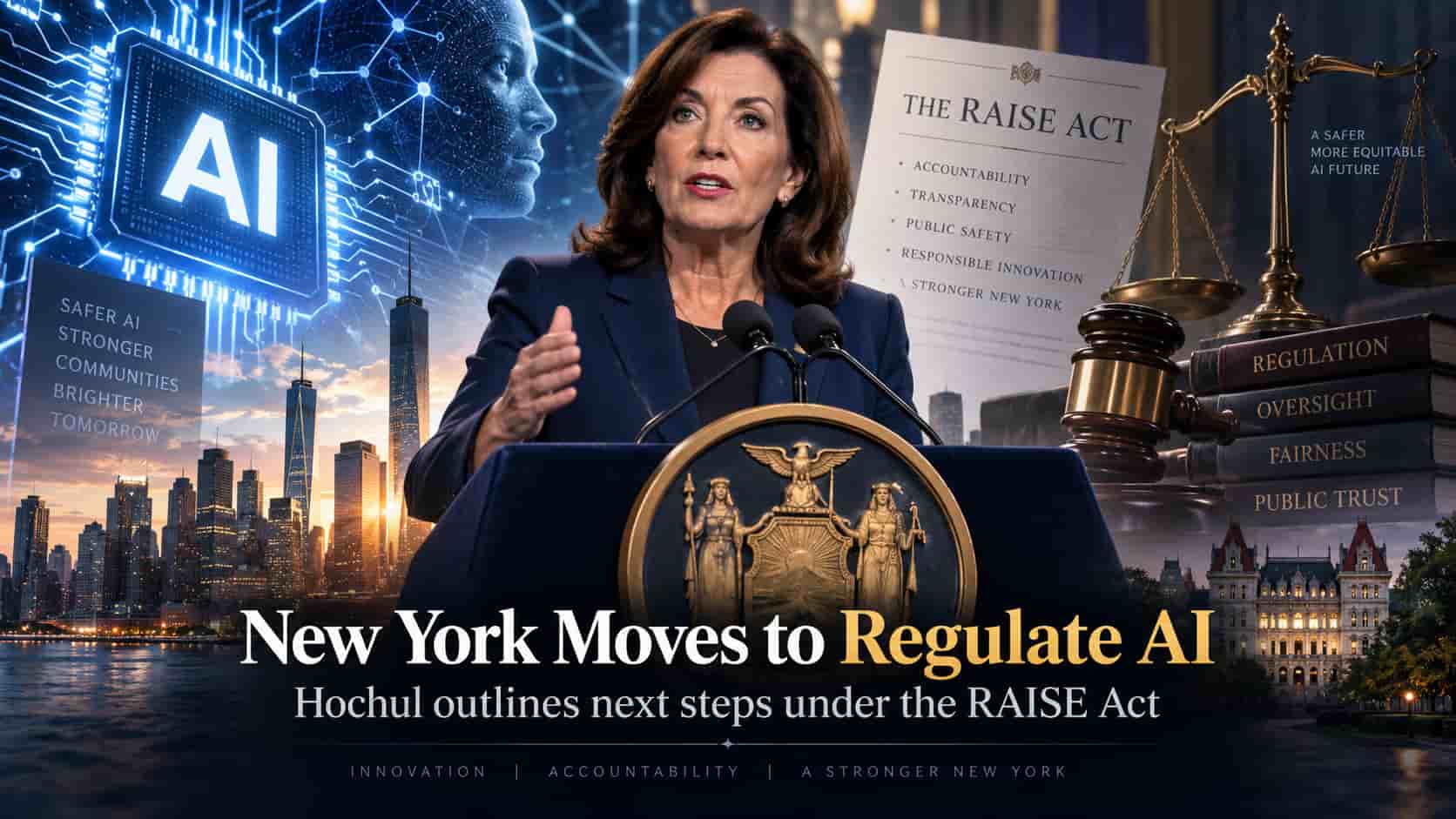
Governor Kathy Hochul says New York will register and police the nation’s largest frontier AI developers, promises to fight anticipated lawsuits and is even studying possible “AI kill switches.” The existing law is narrower than that rhetoric — but the constitutional and economic fight over who gets to govern American AI is becoming much larger.
New York City — September 23, 2026. Governor Kathy Hochul’s September 21 announcement was presented as an AI-safety initiative. But listen to the full press conference rather than only the headline, and a broader policy position emerges.
New York is asserting that, in the absence of a federal regulatory system it considers adequate, the state should be able to establish operating rules for the companies developing some of the most powerful artificial-intelligence systems in the world.
Hochul said New York would begin directing major frontier-AI developers to register with the state in November, ahead of the January 1, 2027 effective date of the Responsible AI Safety and Education Act, or RAISE Act. She said companies would have to publish safety protocols and report critical safety incidents, and warned that violators could face civil penalties.
But one of the most consequential moments came immediately afterward.
Hochul described New York as the new regulatory “sheriff” for frontier AI, announced the role of the new Office of Digital Innovation, Governance, Integrity and Trust — DIGIT — and said the state would consider further safeguards, potentially including AI “kill switches.”
Then she addressed the possibility that technology companies would sue.
“Bring it on.”
Hochul said New York would fight those companies in court.
That exchange may ultimately prove more important than the registration announcement itself. It frames the emerging dispute not simply as AI safety versus unsafe AI, but as a fight over which level of American government has the authority to set the operating conditions for a technology that does not remain within state borders.
What the RAISE Act actually regulates
The statutory text is considerably more limited than the phrase “regulating AI” might suggest.
New York General Business Law Article 44-B defines a “frontier model” using a computational threshold greater than integer or floating-point operations. A “large frontier developer” is generally a covered frontier developer whose combined annual gross revenue with affiliates exceeded $500 million in the preceding year.
That means the principal requirements are not aimed at the ordinary New York startup building an application with an existing API, nor at an individual running ChatGPT, Claude, Gemini or another AI service.
They are aimed principally at the organizations developing exceptionally large foundation models.
Beginning January 1, those developers will face a substantial disclosure-and-compliance regime. The law requires large frontier developers to write, implement and publicly post a frontier-AI framework describing how they identify catastrophic risks, apply mitigations, use outside evaluators, protect model weights, respond to safety incidents and govern their internal systems. Developers also have to publish transparency information when deploying new or substantially modified frontier models.
The law permits redactions necessary to protect trade secrets, cybersecurity, public safety and national security, although developers must generally explain the character and justification of those redactions.
The 72-hour rule — and a 24-hour rule that receives less attention
The statute requires a frontier developer to report a qualifying “critical safety incident” to New York within 72 hours after determining that an incident occurred or learning enough facts to reasonably believe one occurred.
If the incident poses an imminent risk of death or serious physical injury, however, the law requires disclosure within 24 hours to an appropriate law-enforcement or public-safety authority. Large developers also must periodically submit summaries of assessments involving catastrophic risks from internal model use.
The statutory definition of catastrophic risk is also narrower than ordinary AI harms. It includes certain foreseeable risks involving more than 50 deaths or serious injuries, more than $1 billion in property damage, assistance creating chemical, biological, radiological or nuclear weapons, certain autonomous criminal conduct, or a model evading control.
That distinction matters. The RAISE Act is not, on its face, a general truthfulness law for chatbots or a statute allowing the state to police every controversial answer generated by an AI model.
Registration is more than filling out a form
Section 1428 goes further than simply requesting safety reports.
It says that a large frontier developer may not develop, deploy or operate a covered frontier model, in whole or in part in New York, without a current disclosure statement filed with the state and payment of its required assessment.
The filing includes corporate identity, principal place of business, New York offices, specified ownership information and designated contacts for government inquiries. Large developers are also assessed pro rata to cover the state’s costs of administering the regulatory system.
Failure to maintain the disclosure can trigger an additional penalty of $1,000 per day, while other violations of Article 44-B can expose a large frontier developer to penalties of up to $1 million for a first violation and $3 million for subsequent violations.
This is therefore a licensing-like regulatory structure in practical effect, although the statute calls the required filing a disclosure statement rather than a license.
The law does not currently contain an AI “kill switch”
This is a crucial distinction between Hochul’s speech and existing New York law.
During her prepared remarks, Hochul said New York might explore safeguards such as AI “kill switches” if they were found feasible and in the state’s interest.
A reporter later pressed her about what that meant. Hochul responded that all options were being examined but said there was “no commitment” to a kill-switch proposal at this time.
Nothing in the current Article 44-B provisions reviewed by Midtown Tribune gives DIGIT a general statutory power to remotely shut down an AI model.
That makes the distinction important for both supporters and critics of the governor. The RAISE Act taking effect in January is one issue. Any future government-controlled mechanism capable of halting or disabling AI systems would raise a significantly different set of technical, economic, security and legal questions.
The law was already narrowed once
There is another important piece of context.
The RAISE Act originally passed in 2025 did not simply become effective unchanged.
New York subsequently enacted a negotiated chapter amendment, S.8828/A.9449, which repealed the original Article 44-B and replaced it with the current regulatory structure. The Legislature described the replacement as a regime focused on standardized transparency and safety reporting.
That history matters when discussing constitutional objections written against the earlier version.
For example, NetChoice argued in a 2025 veto request that the legislation could chill AI development and raised First Amendment objections to compelled disclosures concerning AI risks. But those comments addressed S.6953B before the final 2026 chapter amendments, so they should not automatically be treated as a legal analysis of every provision in the law that takes effect January 1.
Is this an attack on freedom of business?
That question requires more precision than the political rhetoric on either side.
There is no general constitutional rule saying businesses have a right to operate free of safety regulation. States routinely regulate industries ranging from banking and insurance to pharmaceuticals, construction and restaurants — a point Hochul herself emphasized during the event.
But AI creates a harder jurisdictional problem because a frontier model developed in California or elsewhere can instantaneously serve users in New York, Texas, Florida and every other state.
New York’s statute says Article 44-B applies when a frontier model is “developed, deployed, or operating in whole or in part in New York state.”
The economic question therefore becomes whether large developers can realistically maintain one New York compliance regime, another California regime and potentially dozens of additional state regimes — or whether the rules of the most restrictive large state will effectively become national operating standards.
Even New York technology-industry group Tech:NYC, while saying it looked forward to working with Hochul and DIGIT, called for a strong, consistent national standard because AI crosses state borders.
That is the more substantial competition question than whether one registration form is burdensome.
The Commerce Clause question
There is already a direct conflict between Albany’s approach and the Trump administration’s federal AI policy.
President Trump’s December 2025 Executive Order 14365 directs the Justice Department’s AI Litigation Task Force to consider challenges to state AI laws that allegedly regulate interstate commerce, are preempted by federal law or otherwise violate federal law. The order specifically directs federal officials to examine state requirements that may compel AI developers to disclose information in violation of the First Amendment.
The White House subsequently recommended that Congress establish a national framework and preempt state regulation of AI development in areas it considers inherently interstate.
But a presidential executive order does not by itself establish that the New York RAISE Act is unconstitutional.
The Supreme Court has also made a broad Commerce Clause attack less straightforward than critics sometimes suggest. In National Pork Producers Council v. Ross, the Court rejected the argument that a state law becomes virtually automatically unconstitutional simply because it creates significant economic effects outside the state’s borders. The Court emphasized that discrimination against interstate commerce and economic protectionism remain central concerns of dormant Commerce Clause doctrine.
RAISE, on its face, does not give New York AI developers preferential treatment over California or Texas developers. It regulates covered models operating in New York.
A future constitutional challenge would therefore depend heavily on the precise provision attacked, how New York implements it, and what burdens it actually imposes on interstate commerce.
A First Amendment question is more plausible than “New York is censoring AI”
The current statute does not generally order an AI system to give New York-approved answers, and it does not prohibit New Yorkers from asking AI particular questions.
So describing Article 44-B itself as direct censorship of citizens would go beyond what the enacted text presently supports.
There is, however, a narrower First Amendment issue.
The state is compelling frontier developers to publish information about their safety frameworks, risk assessments, intended uses, restrictions and compliance practices.
Businesses can have First Amendment rights, including protection against certain forms of compelled speech.
At the same time, the Supreme Court has long allowed governments more latitude to require factual disclosures in commercial contexts. Under cases including Zauderer, factual commercial disclosure requirements can receive substantially less demanding scrutiny than compelled ideological speech.
So the serious legal question is not simply:
“Does the law compel speech?”
It plainly requires disclosures.
The harder question is whether those disclosures are properly treated as factual regulatory reporting connected to legitimate safety oversight, or whether particular requirements compel companies to articulate state-imposed judgments about contested risks in a manner protected by the First Amendment.
That is the kind of question courts may ultimately have to answer if litigation materializes.
Hochul appears to expect that litigation
What makes the September 21 event unusual is that the governor herself raised the prospect of legal confrontation.
She said some AI developers were probably already speaking to lawyers about suing New York and answered them with “Bring it on.”
Attorney General Letitia James followed with an enforcement message of her own. Days earlier, her office had invited AI-industry workers with information about potentially unlawful conduct involving cybersecurity, privacy, fraud or other risks to submit confidential whistleblower complaints.
During the event James said her office would use its enforcement powers when companies violated their obligations under the new law.
Hochul later added another form of leverage: reputation.
Asked whether monetary penalties might be trivial for the world’s richest technology companies, she said New York could reconsider the amounts and said she would publicly identify what she called “good actors” and “bad actors.”
That makes the regulatory structure broader in practice than the statutory fine schedule alone.
What about competition with China?
A reporter asked Hochul directly whether aggressive state regulation could slow American AI development relative to China.
She rejected that concern, pointing to New York’s technology economy and arguing that responsible development was itself a competitive advantage. Her answer was essentially that the objective should not simply be to win a speed race, but to develop AI correctly.
That is a legitimate policy position.
The opposing position, articulated by the Trump administration and some technology-industry advocates, is that fragmented state-by-state regulation raises compliance costs, can discourage investment and could slow U.S. companies relative to foreign competitors operating under a more unified national framework.
Neither proposition can yet be treated as an established economic result of RAISE. The principal provisions do not take effect until January 1, 2027, so there is not yet an empirical record showing whether the law will materially reduce New York AI investment or whether developers will absorb the requirements with little effect on innovation.
There is also a second New York AI restriction
The RAISE Act does not exist in isolation.
In July, Hochul issued Executive Order 62 establishing a one-year statewide moratorium on new hyperscale data centers while New York develops a new regulatory framework for such facilities. The administration says the purpose is to address power-grid costs, water, noise, infrastructure and community impacts.
During the September 21 event, Hochul expressly connected that moratorium with the state’s broader AI strategy.
For companies deciding where to locate future AI infrastructure, the relevant policy signal therefore comes from both measures: greater oversight of the models themselves and greater state control over the enormous computing facilities needed to build and run them.
The real debate is larger than RAISE
The most important takeaway from Hochul’s speech is therefore not simply that New York will require AI companies to file reports.
The deeper question is whether the United States will develop one national market for frontier AI with principally federal rules, or a system in which California, New York and other large states establish their own conditions for building and deploying general-purpose models.
New York argues that federal inaction makes state intervention necessary. Hochul called on Washington and other governments to adopt similar rules and ultimately create uniform standards.
The Trump administration argues almost the reverse: that a patchwork of state AI laws itself threatens innovation and interstate commerce and that Congress should create a minimally burdensome national framework.
Those positions are now on a collision course.
For New Yorkers concerned about constitutional freedom, the distinction is important. The existing RAISE Act does not give Albany general authority to control what residents may ask AI systems, and it does not currently contain an AI kill switch.
But it does establish something significant: a state regulatory apparatus with compulsory corporate disclosures, recurring government reporting, registration-like requirements, industry-funded oversight and potentially multimillion-dollar enforcement.
And the governor has made clear that, from her perspective, this is a beginning rather than an endpoint.
That — more than the phrase “AI safety” — is the central policy meaning of the September 21 announcement.
Primary documents: New York’s current General Business Law Article 44-B — RAISE Act is available through the New York State Senate. Read the current RAISE Act The 2026 chapter amendment that replaced the original version is S.8828/A.9449. Read S.8828 and legislative history President Trump’s competing federal policy appears in Executive Order 14365, Ensuring a National Policy Framework for Artificial Intelligence. Read Executive Order 14365 The New York Attorney General‘s September 17 AI whistleblower notice is also available from the AG’s office. Read the Attorney General’s AI industry alert
Video: Governor Kathy Hochul, Governor Hochul Announces Next Steps to Regulate Major AI Developers and Protect New Yorkers, streamed September 21, 2026. Watch the full Governor Hochul press conference on YouTube
Ask Midtown Tribune about this story
Answers are grounded first in this article. Search all Midtown Tribune reporting from the main AI Search page.
AI-generated summary. Verify important details in the linked original articles.