
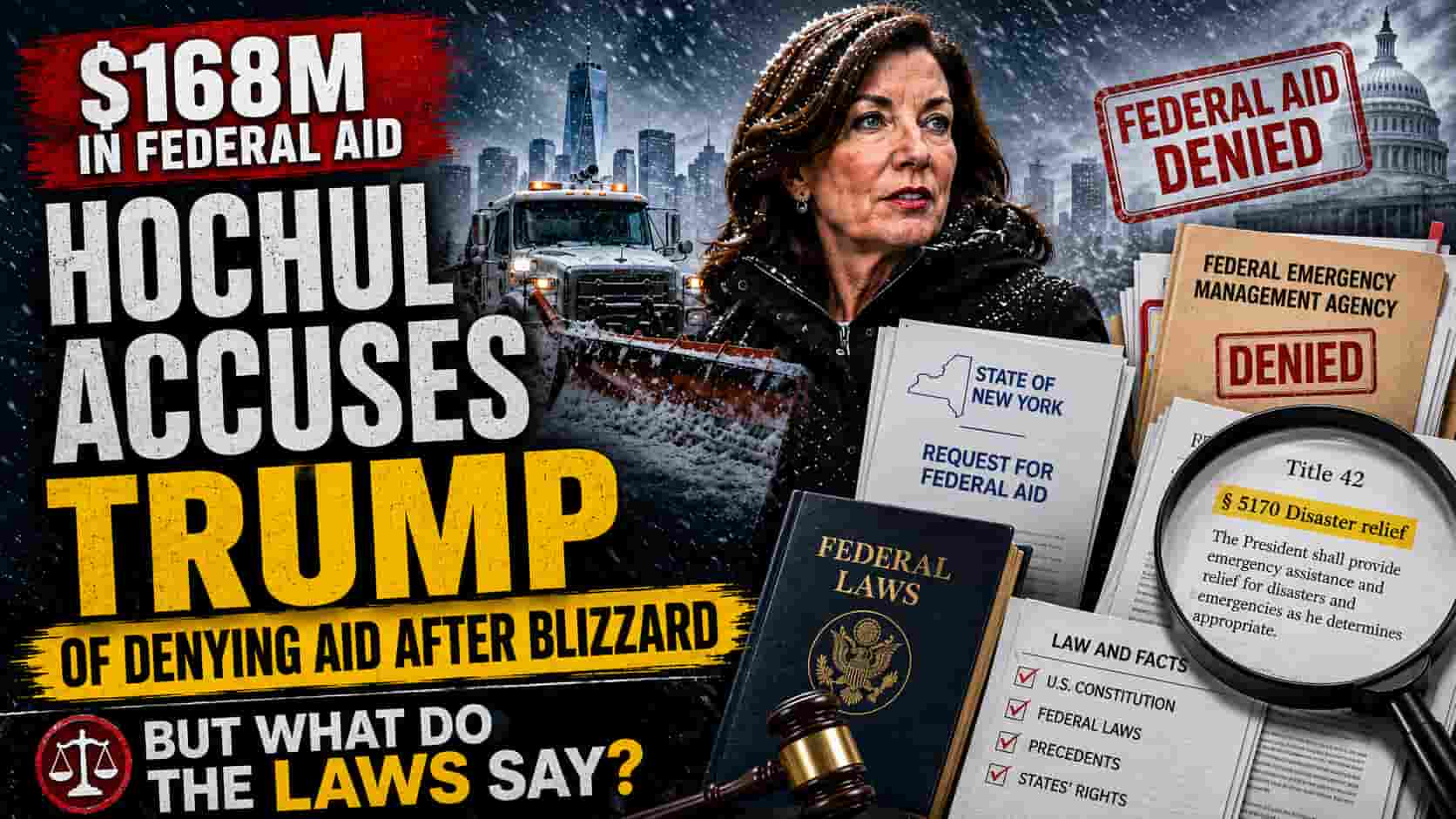
New York says communities documented more than $168 million in storm-related costs after the February 2026 blizzard. But federal disaster law does not make aid automatic—and the public record still lacks a detailed federal explanation for the denial.
Governor Kathy Hochul announced on July 31 that New York had formally appealed the Trump administration’s rejection of the state’s request for federal disaster assistance following the February 22–23, 2026 blizzard.
In a social-media post, Hochul wrote that New York had followed federal rules, documented more than $168 million in damages and nevertheless received a denial “without explanation.”
Her statement raises two separate questions: What did New York actually request, and does meeting FEMA’s financial indicators legally require the president to approve federal assistance?
The official record supports important parts of Hochul’s argument—but it also requires several qualifications.
What Hochul said
Hochul said the February blizzard caused more than $168 million in documented damage and emergency expenses in communities that urgently need assistance.
She also accused the Trump administration of rejecting New York’s request without explaining why, framing the dispute as a question of whether disaster assistance is being applied equally to Republican-led and Democratic-led states.
On July 31, the governor’s office announced that Hochul had formally appealed the denial and sent a letter asking President Donald Trump to reverse the decision.
The governor’s political argument is clear: New York complied with the process, presented extensive storm costs and should not be denied assistance because of partisan considerations.
However, the official documents published so far do not establish that political affiliation was the reason for the denial.
What New York originally requested
On March 26, Hochul asked the president to issue a Major Disaster Declaration for the February 22–23 blizzard.
The request was intended to make federal recovery funding available for eligible state agencies, local governments and certain nonprofit organizations. It included requests for Public Assistance, snow-removal reimbursement and statewide hazard-mitigation funding.
This distinction matters.
The request was not primarily for automatic compensation checks to every resident affected by the storm. FEMA Public Assistance generally concerns eligible government and public-infrastructure expenses, including emergency protective measures, debris or snow removal and restoration of qualifying public facilities.
New York’s U.S. senators also publicly urged approval of the declaration, describing record snowfall, high winds and coastal flooding across the affected region.
Was the storm serious enough to justify a federal request?
The state’s official account describes a major regional emergency.
According to the governor’s March announcement, parts of Nassau and Suffolk counties received nearly three feet of snow. The storm disrupted transportation, closed schools, caused power outages and required extensive emergency and snow-removal operations.
That supports Hochul’s description of the event as a destructive blizzard rather than an ordinary winter storm.
It does not, by itself, settle whether the disaster legally required a presidential declaration.
What does the $168 million figure mean?
Hochul says state and local authorities documented more than $168 million in storm-related costs and damage.
That figure represents the total submitted or identified by New York and affected communities. It should not automatically be interpreted as an amount already approved by FEMA for reimbursement.
The governor’s appeal reportedly distinguishes between the broader amount submitted by state and local authorities and a smaller portion that had already undergone federal verification.
That means two statements can be true at the same time:
New York may have documented and submitted more than $168 million in costs, while FEMA may not yet have accepted every dollar as eligible federal disaster damage.
For accurate reporting, the $168 million figure should therefore be described as the amount documented or claimed by New York—not necessarily the final amount federally validated for reimbursement.
Does exceeding FEMA’s financial indicator guarantee approval?
No.
Federal regulations identify several factors FEMA considers when evaluating a governor’s request for a Major Disaster Declaration. These include the amount and concentration of damage, insurance coverage, the fiscal capacity of state and local governments, recent disaster history and other circumstances affecting the need for supplemental federal assistance.
A statewide per-capita financial indicator can be important evidence. But it is not an automatic entitlement to federal funding.
The regulation states that FEMA uses the listed factors when making a recommendation to the president and may also consider other relevant information.
Therefore, even when damage exceeds a financial benchmark, FEMA and the president retain discretion to determine whether the incident is of sufficient severity and magnitude to warrant a Major Disaster Declaration.
Was the request denied “without explanation”?
On July 2, Hochul’s office announced that President Trump had denied the request after several months of waiting.
The denial was not necessarily issued with literally no words of explanation. According to the state’s account, the federal response used a general formulation indicating that additional federal assistance under the Stafford Act was not warranted.
That is technically a stated conclusion.
However, such language does not provide a detailed factual explanation. It does not tell the public:
- which submitted expenses FEMA rejected;
- whether FEMA disputed the state’s financial calculations;
- which declaration criteria New York allegedly failed to satisfy;
- what recommendation FEMA made to the president;
- or why the verified costs were considered insufficient.
For that reason, the most precise description is that the request was denied without a detailed public explanation, rather than without any explanation whatsoever.
Was Trump legally required to approve the declaration?
No.
Under 42 U.S.C. § 5170, a governor must request a Major Disaster Declaration and must find that the incident is beyond the capabilities of the state and affected local governments.
The statute then says the president may declare that a major disaster exists. It does not state that approval becomes mandatory whenever a state exceeds a specific damage figure.
Federal law defines a major disaster as an event that, in the president’s determination, causes damage of sufficient severity and magnitude to justify federal assistance supplementing state and local resources.
That gives the president substantial discretion.
But discretion is not the same as transparency. The administration may possess legal authority to reject the request while still facing legitimate questions about how the decision was reached and whether comparable cases are being treated consistently.
What Hochul’s statement gets right
The official record confirms that New York followed the formal process by submitting a gubernatorial request for a Major Disaster Declaration.
It also confirms that the February blizzard produced severe conditions, major public costs and significant disruption across New York City, Long Island and parts of the lower Hudson Valley.
The state then waited months before receiving a denial and has now exercised its right to appeal.
Hochul is therefore justified in asking the administration to provide a more substantive explanation.
What requires qualification
Hochul’s public statement may leave readers with the impression that documenting $168 million in damage should automatically compel FEMA and the president to approve the request.
Federal law does not establish such an automatic rule.
The $168 million figure also should not be presented as though FEMA had already approved every submitted expense. It represents New York’s documented or claimed total, while federal eligibility review may produce a different number.
Finally, no publicly released official document currently proves that New York was denied assistance because it is a Democratic-led or “blue” state.
That is a political allegation, not an established fact.
The documents the public still needs to see
A complete independent assessment would require publication of the full record, including:
- New York’s original declaration request and supporting exhibits;
- preliminary damage-assessment tables;
- the complete FEMA denial letter;
- FEMA’s recommendation to the president;
- the governor’s full appeal and supporting documentation;
- and the federal government’s eventual response to the appeal.
Until those materials are available together, neither side’s political framing should substitute for the documentary record.
Bottom line
Hochul is correct that New York submitted a formal disaster request after a serious blizzard and that the administration denied it without providing a detailed public justification.
But the governor’s statement needs context.
More than $168 million in documented or submitted costs does not necessarily mean FEMA accepted the entire amount. Exceeding a financial indicator does not automatically require approval. And the Stafford Act leaves the final declaration decision to the president.
The central unanswered question is therefore not whether the administration possessed discretion to deny the request. It did.
The unanswered question is how that discretion was applied—and why New York’s evidence was deemed insufficient.
That is the explanation New Yorkers are entitled to receive.
Official Sources and Documents
- Office of Governor Kathy Hochul — Appeal of the Denial of New York’s Disaster-Relief Request
- Office of Governor Kathy Hochul — Original Request for a Major Disaster Declaration Following the February 22–23 Blizzard
- Office of Governor Kathy Hochul — July 2 Statement Announcing the Federal Denial
- U.S. Senator Kirsten Gillibrand — Gillibrand and Schumer Urge Approval of New York’s Disaster Declaration Request
- Official Senate Letter to President Trump Supporting New York’s Major Disaster Declaration Request
- U.S. Senator Kirsten Gillibrand — Statement on FEMA’s Denial of the Declaration Request
- FEMA — How a Presidential Disaster Declaration Is Requested and Approved
- FEMA — Official Request for Presidential Disaster Declaration Form and Requirements
- Electronic Code of Federal Regulations — 44 CFR § 206.48, Factors Considered in Evaluating Disaster Requests
- United States Code — 42 U.S.C. § 5170, Presidential Major Disaster Declarations
Editor’s note: All links above lead to official New York State, United States Senate, FEMA, or federal legal sources.
Ask Midtown Tribune about this story
Answers are grounded first in this article. Search all Midtown Tribune reporting from the main AI Search page.
AI-generated summary. Verify important details in the linked original articles.