
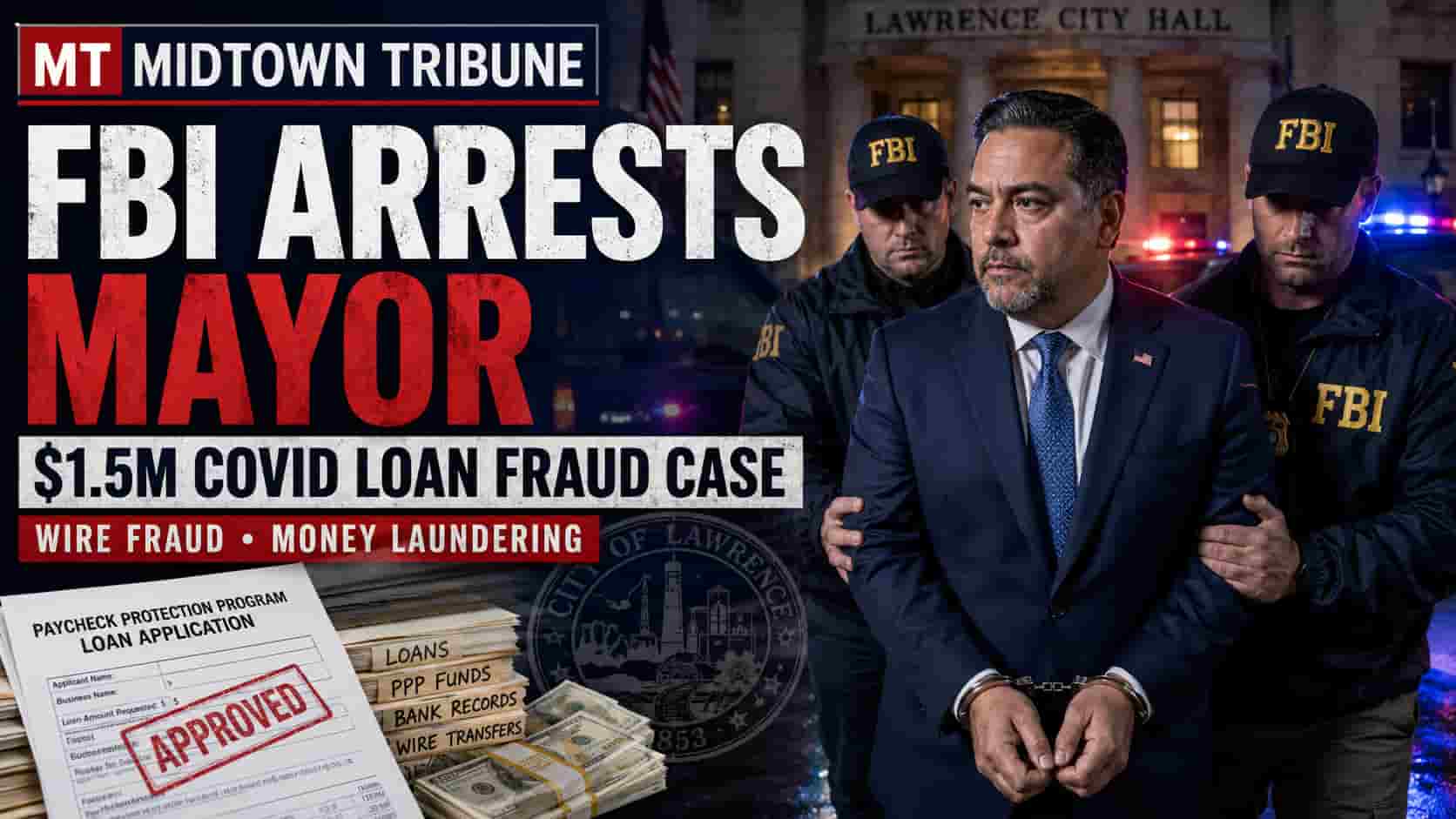
Federal prosecutors allege that the Massachusetts mayor diverted taxpayer-backed pandemic relief money into his political campaign, personal tax payments and more than $883,000 in high-interest mortgage debt.
BOSTON — Lawrence, Massachusetts Mayor Brian DePeña was arrested by the FBI on August 14, 2026, and charged in federal court with wire fraud and money laundering in a case involving more than $1.5 million in COVID-era Economic Injury Disaster Loan funds, according to the U.S. Attorney’s Office for the District of Massachusetts.
The federal allegations are unusually detailed.
Prosecutors say DePeña obtained government-backed loans through the Small Business Administration for Tenares Tire Services Inc., his Lawrence tire and automotive business, but later diverted substantial portions of the money for purposes the program did not permit.
According to the federal complaint, those alleged uses included:
- $85,000 toward DePeña’s personal federal tax liabilities;
- approximately $132,000 traceable to EIDL funds directed toward his mayoral campaign over several transactions; and
- $883,293 used to pay off two high-interest loans secured by properties he owned.
DePeña, 61, faces one count of wire fraud and one count of money laundering.
He has not been convicted. The Justice Department emphasizes that the allegations contained in the complaint are accusations and that DePeña is presumed innocent unless proven guilty beyond a reasonable doubt.
FBI: Pandemic Aid Was Not a “Personal ATM”
The allegations center on the federal Economic Injury Disaster Loan program, or EIDL, which provided low-interest government loans to businesses suffering economic disruption during the COVID-19 pandemic.
The loans carried a 3.75 percent interest rate and were intended to provide working capital for businesses harmed by the pandemic.
They were not supposed to finance a political campaign, pay an owner’s personal tax debt or refinance existing mortgages.
Federal investigators allege that DePeña initially received a $150,000 EIDL in June 2020 for Tenares Tire Services and largely used that original amount for legitimate business purposes.
The government’s case focuses primarily on what happened afterward.
By early 2021, according to the complaint, DePeña was facing several financial pressures.
His mayoral campaign allegedly needed money.
He owed federal back taxes.
And he owed nearly $900,000 to two private lenders charging interest rates of 12 percent and 8 percent on loans secured by Lawrence properties.
At the same time, the federal EIDL loan carried a much lower 3.75 percent interest rate.
Prosecutors allege that this disparity became central to what followed.
From $150,000 to More Than $1.65 Million
In April 2021, DePeña allegedly sought an increase in the EIDL available to Tenares Tire.
The SBA approved an additional $350,000, increasing the total loan to $500,000.
According to prosecutors, approximately $350,000 was deposited into the business account on August 16, 2021.
Before that deposit, the account reportedly contained just $20.23.
Within days, investigators allege, DePeña used $85,000 of the relief money to pay his personal federal tax liabilities.
He then allegedly transferred EIDL money through personal accounts and ultimately directed approximately $90,000 into the Committee to Elect Brian DePeña during September and October 2021.
The complaint says those transfers were later characterized in campaign-finance reporting as candidate loans.
But federal investigators allege that the underlying source was taxpayer-backed EIDL money.
Another $1.15 Million Arrives
The government says DePeña sought another major increase in October 2021.
On October 27, the SBA approved an additional $1,154,400, bringing the total Tenares Tire EIDL to approximately $1.654 million.
On November 30, approximately $1,154,188 was deposited into the Tenares Tire business account.
Federal investigators allege DePeña transferred essentially that entire amount into one of his personal accounts the same day.
The personal account allegedly contained only about $1,401 before the transfer.
Prosecutors say another $42,112.96 traceable to EIDL funds subsequently went into DePeña’s political campaign.
That would bring the alleged campaign-related use of EIDL money described in the complaint to roughly $132,000.
$883,293 in Mortgage Debt
The largest alleged diversion involved DePeña’s real-estate debt.
According to the criminal complaint, he used:
$538,109.03 to pay one lender on December 9, 2021,
and
$345,184.13 to pay another lender on December 18.
Combined: $883,293.16.
The SBA, according to investigators, would not have approved the EIDL had officials known the money would be used to refinance those loans.
Federal prosecutors say refinancing existing debt was a prohibited use of the program.
That distinction is significant.
The government is not merely alleging that DePeña spent borrowed money unwisely.
The allegation is that he obtained money under certifications limiting its use to qualifying pandemic-related business expenses and then intentionally directed substantial amounts to purposes the SBA would not have approved.
Only 16 Payments, Government Says
One of the most striking numbers appears near the end of the federal complaint.
As of August 5, 2026, investigators say DePeña had made only 16 payments totaling approximately $130,160 on the Tenares Tire EIDL.
According to the complaint, all of those payments had been applied to accrued interest.
The outstanding principal balance remained approximately $1,654,420.
That means that nearly five years after the final large EIDL disbursement, prosecutors allege that essentially the entire principal remained outstanding.
The FBI Arrest
The Justice Department specifically states that the FBI arrested DePeña on August 14.
Ted E. Docks, Special Agent in Charge of the FBI’s Boston Division, said investigators allege that the mayor exploited an emergency program designed to help struggling businesses and instead used the funds for personal taxes, his political campaign and real-estate debt.
The investigation involved the FBI, IRS Criminal Investigation, the Massachusetts Inspector General’s Office and the Department of Labor Office of Inspector General.
Assistant U.S. Attorneys from the District of Massachusetts Public Corruption Unit are prosecuting the case.
Who Is Brian DePeña?
DePeña was elected mayor of Lawrence in November 2021 and reelected in November 2025.
Before becoming mayor, he served on the Lawrence City Council from 2016 through 2021. The City of Lawrence website continued to identify him as mayor as of August 14.
Lawrence municipal elections are conducted on a nonpartisan basis, which is worth noting because online political commentary surrounding the arrest has frequently emphasized DePeña’s Democratic affiliation.
DePeña has been publicly identified as a Democrat, but “Democratic rising star” is political characterization rather than a description contained in the federal charging documents.
For that reason, Midtown Tribune is not presenting the “rising star” label as an established fact.
What Benny Johnson’s Video Gets Right — and What Requires Caution
Conservative commentator Benny Johnson highlighted the DePeña arrest in an August 14 video devoted to a series of recent criminal cases.
Johnson describes the mayor as having been arrested for allegedly misusing roughly $1.5 million in COVID relief money, including money connected to his campaign, taxes and mortgages. Those central allegations are supported by the federal complaint.
But some of the language in the video is commentary rather than language from prosecutors.
For example, the federal documents do not establish that DePeña has committed a crime; they establish probable cause sufficient for the charges and arrest.
Likewise, descriptions such as “evil crimes,” “rising star,” or other political characterizations should not be confused with findings of a court.
What the official documents establish is already serious enough without embellishment:
an incumbent mayor was arrested by the FBI and accused by federal prosecutors of obtaining more than $1.5 million in taxpayer-backed pandemic loans and diverting substantial portions toward his campaign, personal taxes and privately held real-estate debt.
Potential Penalties
A wire-fraud conviction can carry a maximum sentence of 20 years in federal prison, up to three years of supervised release and a fine of up to $250,000.
The money-laundering charge carries a maximum of 10 years, up to three years of supervised release and a fine of up to $250,000.
Those are statutory maximums, not predictions of an actual sentence. Any sentence would be determined by a federal judge under applicable statutes and the U.S. Sentencing Guidelines.
Midtown Tribune Analysis: Pandemic Relief and Public Trust
The DePeña prosecution raises a broader question that extends well beyond one Massachusetts mayor.
During the pandemic, Washington moved enormous amounts of emergency money into the economy at extraordinary speed.
Speed was considered essential because businesses were closing and jobs were disappearing.
But speed also created opportunities for fraud.
In this case, the allegation is particularly serious because the defendant is not merely a business owner accused of misusing government aid.
He is an elected official.
The federal complaint alleges that taxpayer-backed emergency money was routed into the very political campaign that helped place him in public office, while other portions went toward personal taxes and private real-estate debt.
Those remain allegations.
But if prosecutors prove them, the case would represent more than pandemic-loan fraud. It would represent a direct collision between taxpayer assistance, private financial interests and political power.
There is also a question the public deserves to ask about government controls.
The complaint says the loan ultimately reached approximately $1.65 million, even after DePeña allegedly had significant private debts and after the first increased tranche was allegedly diverted toward personal taxes and campaign expenditures.
How effective were SBA controls at detecting prohibited uses?
What information was available to the government when the second, much larger loan increase was approved?
And why, according to prosecutors, did approximately $1.65 million in principal remain outstanding almost five years later?
Those questions do not determine DePeña’s guilt.
They do, however, concern stewardship of taxpayer money — and they deserve answers regardless of the defendant’s political affiliation.
Public officials are entitled to the same presumption of innocence as every other American. They should also be subject to the same laws governing the use of public money.
Original Video
Benny Johnson — Democrat Rising Star ARRESTED By FBI in Stunning Raid, Dragged Away in HANDCUFFS For EVIL Crimes…
Watch the original Benny Johnson video on YouTubeOfficial Government Sources
- U.S. Department of Justice — Massachusetts Mayor Charged with Pandemic Loan Fraud and Money Laundering, August 14, 2026
- U.S. District Court / Department of Justice — Criminal Complaint, United States v. Brian DePena
- City of Lawrence, Massachusetts — Office of Mayor Brian A. DePeña
- City of Lawrence — Current Elected Officials
- Massachusetts Office of Campaign and Political Finance — Mayoral Campaign Reports
Legal note: The criminal complaint contains allegations. Brian DePeña is presumed innocent unless and until the government proves guilt beyond a reasonable doubt in a court of law.
Ask Midtown Tribune about this story
Answers are grounded first in this article. Search all Midtown Tribune reporting from the main AI Search page.
AI-generated summary. Verify important details in the linked original articles.