
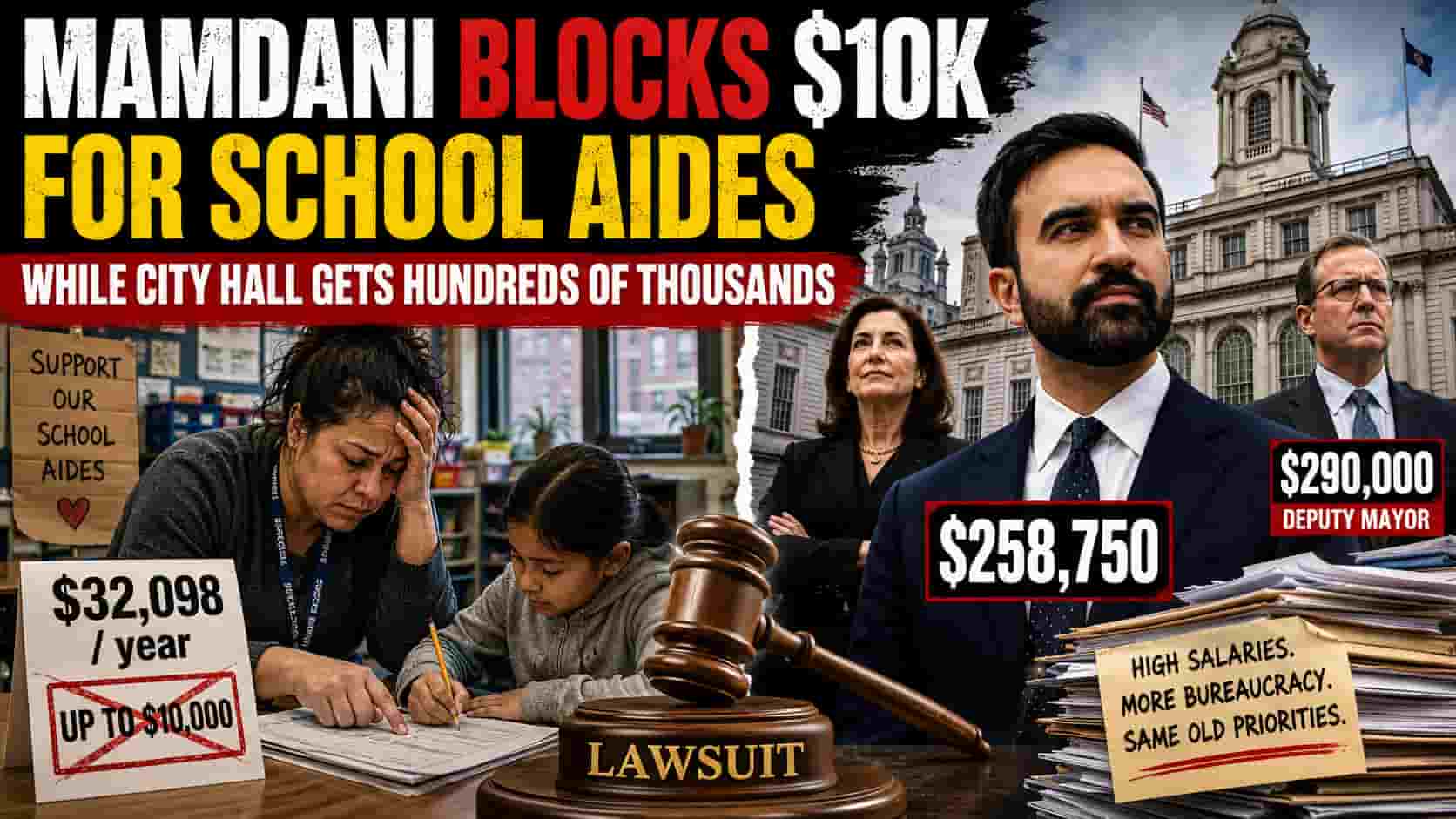
NEW YORK — Mayor Zohran Mamdani built his political message around affordability, economic justice and helping working New Yorkers. But his administration is now fighting a law that would provide up to $10,000 to some of the lowest-paid workers in New York City public schools — while senior members of his own City Hall administration receive taxpayer-funded salaries of more than $250,000 a year.
The controversy centers on the RESPECT Check Act, legislation requiring workforce-stabilization payments for eligible school paraprofessionals during the 2026–2027 school year.
These workers are not regular classroom teachers. Paraprofessionals often work directly with students with disabilities, including children who require one-on-one assistance throughout the school day.
The New York City Council says approximately 26,000 paraprofessionals work in the school system and that starting pay can be only about $32,000 a year. The Council says the city also faces a serious shortage of these workers.
NYC Council — official July 16 statement on the RESPECT Check Act
The City Council Approved Up to $10,000 for Paraprofessionals
The RESPECT Check Act — Intro. 692-A — requires the Department of Education to provide eligible paraprofessionals with workforce-stabilization payments totaling up to $10,000 for work performed during the 2026–2027 school year.
The payments are to be distributed in installments and prorated according to how long an employee was on payroll during the applicable periods.
Official NYC Council legislative record — Intro. 692-2026
The Council approved the legislation in July, and the official legislative record shows that it was enacted as Local Law 129 of 2026 on August 18, 2026.
Council Leaders: Mamdani Is Suing to Stop the Law
On August 19, Council Speaker Julie Menin and Council Member Carmen De La Rosa responded to the Mamdani administration’s lawsuit challenging the RESPECT Check Act.
They said the Council had supported the measure unanimously and on a bipartisan basis because paraprofessionals performing some of the school system’s most demanding work can earn only about $32,000 per year.
Menin and De La Rosa also argued that the payments are fiscally responsible because understaffing contributes to the city’s enormous special-education costs.
The Council has estimated that New York now spends approximately $1.5 billion annually on Carter cases, which can involve city payments when the school system fails to provide legally required special-education services. Speaker Menin has argued that retaining more paraprofessionals could help reduce those costs.
The Council leaders declared:
“The Council will vigorously defend this law.”
Why Is Mamdani Opposing the Payments?
The mayor’s legal argument is important.
Mamdani has not said paraprofessionals are paid too much.
He has publicly called their work “incredible and critical.”
But he argues that employee compensation should be decided through collective bargaining rather than directly by the City Council.
Asked about the RESPECT payments, Mamdani said:
“conversations around compensation are better left at the bargaining table”
and said the legal analysis provided to him concluded that the legislation violates New York’s Taylor Law.
NYC Mayor’s Office — official transcript of Mamdani’s Taylor Law comments
He had expressed the same position earlier in July, saying the issue was “best treated at the bargaining table.”
NYC Mayor’s Office — July 2026 transcript
That may become a legitimate question for the courts.
But politically, the result is much easier to understand:
An elected City Council approved additional money for workers earning roughly $32,000, and the mayor’s administration is using the courts to challenge that payment.
Meanwhile, Mamdani’s Own City Hall Has Six-Figure Salaries
That is where the controversy becomes especially uncomfortable for an administration that repeatedly presents itself as a champion of working people.
Official New York City personnel records list Mayor Mamdani’s annual salary at:
$258,750
NYC City Record — Zohran Mamdani personnel record
And Deputy Mayor for Operations Julia Kerson, appointed under the Mamdani administration, is listed at:
$290,000 per year
NYC City Record — Julia Kerson personnel record
There is nothing inherently improper about senior city officials earning high salaries. Managing the government of the largest city in the United States carries substantial responsibility.
But the numbers become politically relevant when City Hall is simultaneously fighting a $10,000 payment to workers at the bottom of the public-school pay scale.
$32,000 Versus $290,000
The contrast is difficult to miss:
| Position | Annual Pay / Payment |
|---|---|
| Entry-level school paraprofessional cited by Council | about $32,000 |
| Maximum RESPECT Check | $10,000 |
| Mayor Zohran Mamdani | $258,750 |
| Deputy Mayor Julia Kerson | $290,000 |
A $10,000 payment represents roughly 31% of a $32,000 annual salary.
For someone earning $290,000, the same $10,000 represents only about 3.4% of annual pay.
A paraprofessional earning $32,000 would have to work roughly nine years at that salary to earn what a $290,000 City Hall official receives in one year.
No one is arguing that the jobs are identical or should receive identical compensation.
The comparison raises a different question:
What does City Hall consider affordable when it comes to its own senior administration — and what does it consider legally unacceptable when the money goes directly to low-paid school workers?
The Union Is Not Even the Simple Explanation
The Taylor Law complicates the dispute because public-employee compensation is ordinarily negotiated through collective bargaining.
But this is not simply a case of Mamdani siding with the teachers union against the City Council.
At an official press conference, a reporter reminded Mamdani that the UFT president had threatened an “all-out war” if the mayor did not back the bonuses.
Mamdani nevertheless defended his position that compensation belongs at the bargaining table.
That means the administration is defending the collective-bargaining process itself, even though the immediate result could prevent workers from receiving money supported by the Council and sought by union advocates.
Mamdani Defends Workers Elsewhere
The political contrast is even sharper because Mamdani has been highly vocal about protecting workers in the private sector.
On August 10, for example, the mayor backed the Delivery Protection Act, accusing companies such as Amazon of using subcontracting structures that allow corporations to avoid responsibility for working conditions.
His administration said the legislation would strengthen worker protections and hold large corporations accountable.
NYC Mayor’s Office — Mamdani backs Delivery Protection Act
Ten days later, Mamdani announced another initiative described by City Hall as delivering “economic justice” by combating wage theft and other abuses against workers.
NYC Mayor’s Office — Economic Justice initiative, August 20
Those initiatives make the paraprofessional dispute particularly noteworthy.
When the employer accused of underpaying or mistreating workers is a private corporation, Mamdani argues aggressively for government intervention.
When the employer is effectively the City of New York and the City Council orders additional compensation for low-paid workers, his administration argues that the Council has exceeded its authority.
A Question of Priorities
There may be a legitimate Taylor Law question about whether the Council had the legal authority to structure the RESPECT payments this way.
The courts will determine that issue.
But the legal argument does not eliminate the political contradiction.
Mamdani presents himself as a mayor for working people.
His own administration pays senior officials more than a quarter-million dollars annually.
At the same time, some paraprofessionals assisting New York City schoolchildren begin at roughly $32,000.
The elected City Council approved up to $10,000 in additional compensation for them.
The Mamdani administration went to court.
That leaves New Yorkers with a straightforward question:
If City Hall can afford hundreds of thousands of dollars for its own senior appointees, why is a $10,000 payment to some of the city’s lowest-paid school workers the payment that must be fought in court?
Official Sources
New York City Council — RESPECT Check Act, paraprofessional compensation, vacancies and Carter-case costs
NYC Council, July 16, 2026
Official legislative history — Intro. 692-2026 / Local Law 129 of 2026
NYC Council Legistar
Mayor Mamdani — Taylor Law and collective-bargaining position
NYC Mayor’s Office
Mayor Mamdani — earlier statement that compensation belongs “at the bargaining table”
NYC Mayor’s Office
Zohran Mamdani — official personnel record, $258,750
NYC City Record
Julia Kerson — official personnel record, $290,000
NYC City Record
Mamdani Administration — Delivery Protection Act
NYC Mayor’s Office
Midtown Tribune | New York City | August 23, 2026
Ask Midtown Tribune about this story
Answers are grounded first in this article. Search all Midtown Tribune reporting from the main AI Search page.
AI-generated summary. Verify important details in the linked original articles.