
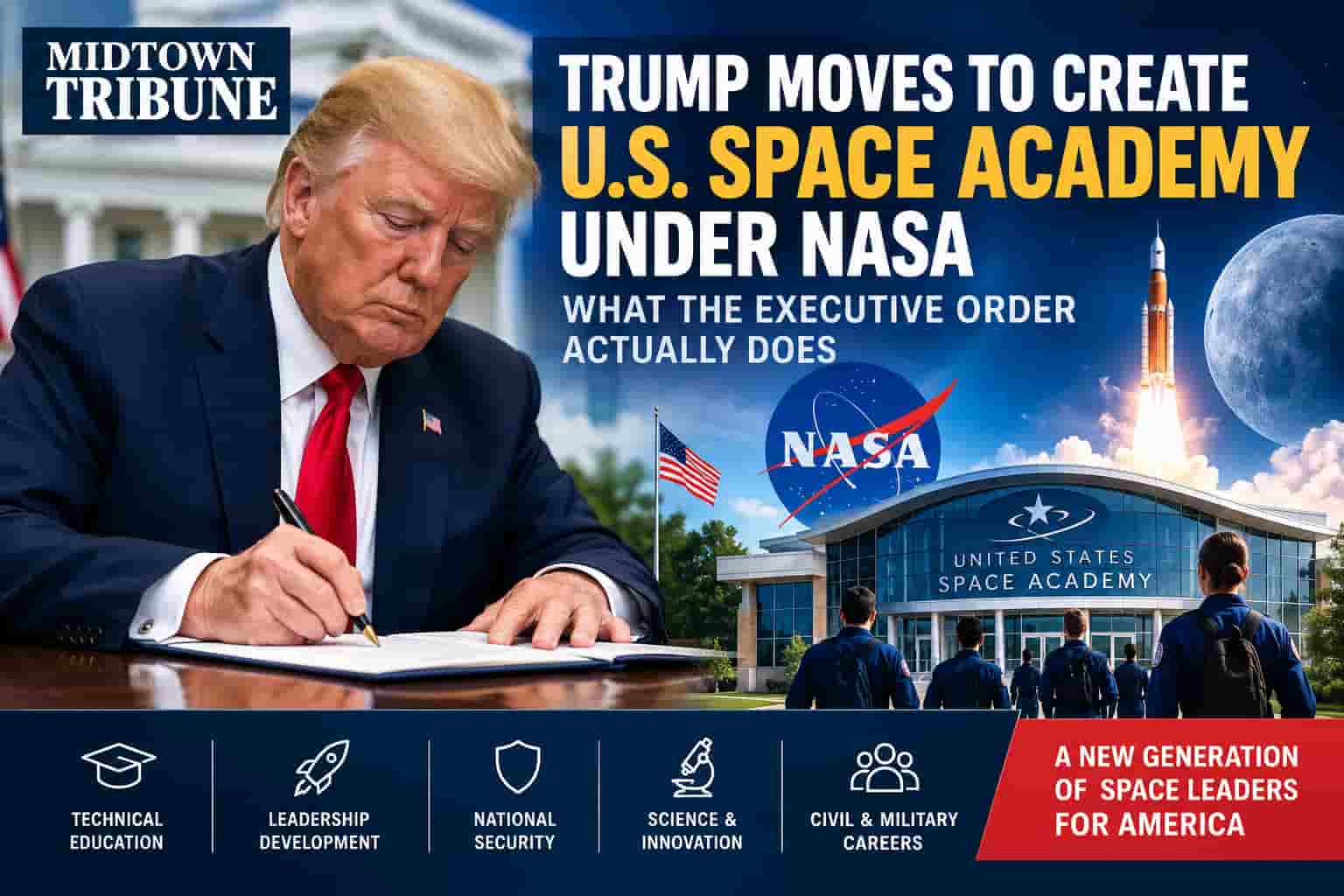
President Donald Trump signed an executive order on August 28, 2026, creating a presidential commission to design a proposed United States Space Academy — a NASA-led federal academy intended to train future leaders for America’s civil, military, scientific, and commercial space sectors.
The key distinction is important: the academy itself has not yet been formally established as an operating school. The executive order creates the Presidential Commission on the United States Space Academy, which must develop the framework and recommendations needed to launch it.
Read the Executive Order at the White House
Read the White House Fact Sheet
Key Facts
- President Trump signed the executive order on August 28, 2026.
- The order establishes the Presidential Commission on the United States Space Academy.
- The commission is chaired by the NASA Administrator.
- The proposed academy would be a NASA-led federal academy.
- Its mission would combine advanced technical education with leadership development, discipline, and public service.
- Graduates could serve in the military, federal civilian agencies, NASA, and the broader American space enterprise.
- The commission must submit recommendations to the president within 120 days.
- The academy’s location, admissions standards, curriculum, budget, class size, and opening date have not yet been finalized.
What the Executive Order Actually Does
The order does not immediately create a fully functioning university or service academy.
Instead, it establishes a presidential commission charged with designing the proposed institution.
The commission must address questions including:
- governance;
- curriculum;
- degree programs;
- admissions requirements;
- service obligations for graduates;
- security-clearance requirements;
- military or civilian status of students;
- pilot programs and partnerships;
- selection of a permanent campus;
- legislative requirements;
- implementation strategy.
The administration is also considering whether the academy should be formally housed within NASA.
Not Just an Academy for Astronauts
The White House describes a much broader mission than astronaut training alone.
The proposed academy is intended to prepare:
- astronauts;
- scientists;
- engineers;
- operators;
- entrepreneurs;
- civil servants;
- warfighters.
That makes the concept potentially different from both a traditional university and an existing U.S. military service academy.
The administration says the school would combine technical education with leadership development and a long-term commitment to public service.
Graduates Could Have Service Obligations
One of the most significant provisions concerns what students may be required to do after graduation.
The commission is explicitly directed to recommend possible service obligations.
Those obligations could include service in:
- the U.S. Armed Forces;
- NASA;
- other federal agencies;
- civilian government roles connected to the space enterprise.
If adopted, that model would resemble aspects of existing federal service academies, where education is tied to a government service commitment.
However, the final structure has not yet been approved.
The Commission Has 120 Days
The commission must submit its recommendations to President Trump within 120 days of the executive order.
That report is expected to address both the academic model and the practical mechanics of creating the institution.
Among the unresolved issues are:
- where the academy will be located;
- how much it will cost;
- whether tuition will be covered;
- how many students it will admit;
- whether cadets will hold federal or military status;
- how long graduates may be required to serve;
- when the first class could begin.
Some parts of the plan may require approval and funding from Congress.
The executive order states that implementation will depend on applicable law and available fiscal resources.
Why the Administration Says It Is Needed
The White House argues that American superiority in space depends not only on launch systems, satellites, and spacecraft, but also on the people trained to design, operate, defend, and commercialize those systems.
The administration describes space as a critical domain for:
- national security;
- economic growth;
- scientific discovery;
- technological innovation.
The Fact Sheet also argues that the United States needs more graduates in advanced technical fields to compete effectively as international and commercial space activity expands.
Part of a Broader Trump Space Policy
The Space Academy proposal is part of a broader push by the Trump administration to expand U.S. space capability.
In August 2026, the administration also announced a new national space transportation policy aimed at dramatically increasing launch and reentry capacity.
The policy sets a goal of supporting more than 1,000 launches and reentries annually on U.S. soil by 2030.
National Space Transportation Policy
White House Fact Sheet: Golden Age of Space Transportation
Artemis II and the Return to Deep-Space Human Flight
The administration also points to the Artemis program as evidence of renewed U.S. momentum in human spaceflight.
NASA launched Artemis II on April 1, 2026, sending four astronauts on a crewed mission around the Moon.
NASA described it as the first crewed lunar mission in more than 50 years.
NASA: Artemis II Historic Moon Mission
The broader Artemis program is intended to return astronauts to the lunar surface and establish a sustained U.S. presence in and around the Moon.
How the Space Academy Would Differ From Space Force
The proposed United States Space Academy should not be confused with the U.S. Space Force.
Space Force is an armed service responsible for military space operations.
The proposed Space Academy would be an educational institution.
Its graduates could eventually support military operations, NASA missions, federal science and technology programs, and the private space industry.
Confirmed
The following points are confirmed by official White House documents:
- Trump signed the executive order.
- The presidential commission has been created.
- The NASA Administrator will chair it.
- The commission has a 120-day deadline.
- A NASA-led federal academy is under formal consideration.
- Service obligations for graduates are being considered.
- Some implementation steps may require congressional action.
Still Unknown
The following details are not yet established:
- permanent location;
- campus size;
- cost;
- tuition structure;
- student population;
- opening date;
- admissions standards;
- exact degree programs;
- length of required service;
- final legal structure.
Analysis
The most consequential aspect of the proposal is that the administration is treating space workforce development as a federal strategic issue rather than simply an education-policy question.
If the academy is ultimately created in the form envisioned by the White House, it could become a pipeline connecting NASA, national security agencies, the military, federal science programs, and private aerospace companies.
That could give the United States a dedicated institution for building the human capital needed for a more competitive and militarized space environment.
But the proposal remains at the design stage.
The next major milestone will be the commission’s report to the president.
Sources
- The White House — Establishing the United States Space Academy
- The White House — Fact Sheet: President Donald J. Trump Establishes a Commission to Design the United States Space Academy
- The White House — National Space Transportation Policy
- The White House — Golden Age of Space Transportation
- NASA — Artemis II Historic Moon Mission
Ask Midtown Tribune about this story
Answers are grounded first in this article. Search all Midtown Tribune reporting from the main AI Search page.
AI-generated summary. Verify important details in the linked original articles.