
MEDIA ACCOUNTABILITY | INVESTIGATION | OCTOBER 9, 2026
Midtown Tribune examines how Radio Free Europe/Radio Liberty presented President Trump’s October 8 Iran statement, the editorial choices behind the coverage, and the federal journalism standards applicable to U.S.-funded international broadcasters.
NEW YORK, October 9, 2026 — Midtown Tribune Investigation
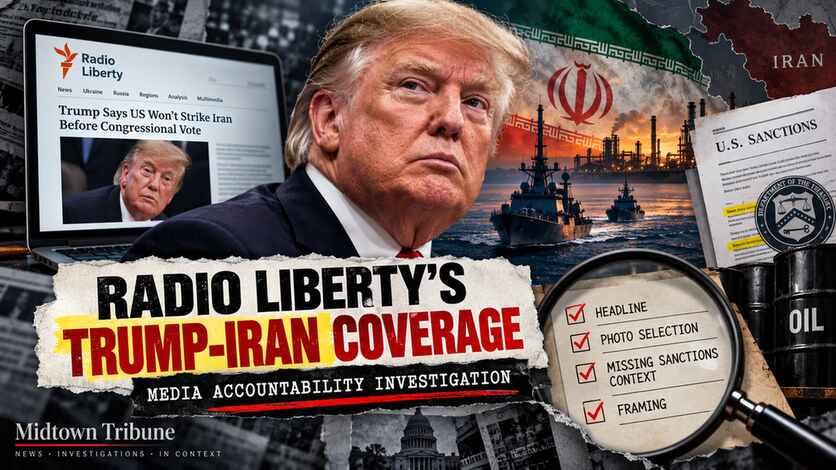
When President Donald Trump announced that the United States would not attack Iran before the November 3 congressional elections, Radio Free Europe/Radio Liberty’s Russian-language service published a report emphasizing the president’s promise.
The headline accurately reflected Trump’s public statement. But its presentation raises broader questions about media framing, photographic choices, missing government context and the responsibilities of publicly funded international journalism.
A Midtown Tribune review of the original Radio Liberty article, the president’s statement, official U.S. Treasury documents and federal broadcasting standards reveals an important distinction between accurately reporting individual facts and providing a comprehensive picture of American foreign policy.
The evidence does not establish fabrication or deliberate political manipulation. It does, however, identify editorial decisions that deserve closer examination.
What Did Trump Actually Say About Iran?
On October 8, 2026, President Donald Trump published a statement on Truth Social announcing that the United States would not attack Iran before the November 3 midterm elections.
Trump also described discussions between Washington and Tehran as productive and reiterated that the American blockade remained in place.
Primary source: President Donald Trump’s October 8, 2026 statement.
The distinction between a presidential declaration and an operational military order is essential.
A public statement establishes the president’s announced position. It does not independently reveal classified military plans, establish a permanent ceasefire or prove that the Pentagon received an unconditional prohibition against military operations.
Presidential communications can serve several purposes simultaneously, including diplomacy, public reassurance and strategic signaling.
Whether this particular statement was intended to mislead Iranian decision-makers is unknown. There is no publicly established evidence supporting such a conclusion.
Radio Liberty’s Headline: Accurate Words, Different Emphasis
On October 8, the Russian-language service of Radio Free Europe/Radio Liberty published an article entitled:
“Трамп пообещал не атаковать Иран до выборов в Конгресс в ноябре.”
Translated into English: “Trump Promised Not to Attack Iran Before the November Congressional Elections.”
Original report: Radio Liberty, October 8, 2026.
The headline is not a demonstrated fabrication. Trump’s public statement supports the central claim.
The more significant question concerns the way the report organizes information.
After describing the president’s announcement, Radio Liberty discusses additional American military deployments, including the aircraft carrier USS Theodore Roosevelt, previous diplomatic difficulties and instability surrounding the Strait of Hormuz.
Such information is relevant. But its editorial placement may encourage readers to focus primarily on the reliability of Trump’s promise rather than the administration’s wider strategy.
This is a question of media framing: the selection and arrangement of factual information to emphasize one interpretation over another.
What Was Missing? U.S. Treasury Announced New Iran Sanctions the Same Day
On October 8, the U.S. Department of the Treasury announced additional sanctions under Operation Economic Outcast, targeting Iran’s remaining shadow fleet and its international support network.
The official government announcement identified 17 vessels involved, according to Treasury, in transporting Iranian petroleum and petrochemical products.
Treasury Secretary Scott Bessent emphasized the administration’s continuing efforts to restrict financial resources available to Iran’s government.
The Treasury Department also referred directly to the effectiveness of the ongoing American military blockade.
Official federal documentation:
- U.S. Treasury — Operation Economic Outcast Neutralizes Iranian Regime’s Remaining Shadow Fleet Network, October 8, 2026
- Office of Foreign Assets Control — Iran Sanctions Program
This information changes the breadth of the picture.
Trump’s statement did not necessarily indicate a retreat from pressure against Iran. The administration was simultaneously pursuing negotiations, continuing a blockade and expanding financial restrictions.
Radio Liberty’s article mentioned the blockade but did not report the new Treasury sanctions announcement.
That omission leaves out an important development. However, without confirming that the Treasury document was available before Radio Liberty finalized its article, it would be inappropriate to characterize the omission as intentional suppression.
Verified finding: The October 8 Treasury announcement provides important additional strategic context not included in the examined Radio Liberty article.
How the Photograph May Influence Readers’ Perceptions
Radio Liberty selected an AFP photograph depicting Trump in a close-up composition, with his head angled and a serious facial expression.
The picture itself is not evidence of manipulation.
Nevertheless, photographs contribute to the interpretation of political news. Editorial choices concerning facial expression, camera angle, cropping and image placement can influence the impression created before a reader examines the text.
When a promise-focused headline appears alongside a particular presidential portrait, the two elements create a combined editorial presentation.
Midtown Tribune therefore considers the photograph a legitimate subject of media-framing analysis.
But a single photograph cannot establish systematic anti-Trump bias. That would require comparisons across many stories, photographers, editorial contexts and political figures.
The appropriate question is whether comparable editorial standards are applied consistently, regardless of which political leader is being covered.
What Is Media Framing? Two Ways to Present the Same Trump Statement
Media framing describes how headlines, images, background information and story structure highlight particular aspects of an event.
Frame One: A Presidential Promise
Trump Promises Not to Attack Iran Before November Elections.
This presentation focuses on Trump’s personal commitment and the election calendar.
Frame Two: A Continuing Pressure Strategy
Trump Rules Out Pre-Election Iran Strikes as U.S. Maintains Blockade and Expands Oil Sanctions.
The second version emphasizes the administration’s simultaneous use of diplomacy and economic pressure.
Both approaches can be supported by factual information. Yet they direct readers toward different interpretations.
Framing is a normal part of news production. The professional question is whether the resulting presentation is accurate, fair and sufficiently comprehensive.
Why U.S. Government Funding Makes Journalism Standards Relevant
Radio Free Europe/Radio Liberty is a private nonprofit international broadcasting organization supported through the U.S. international broadcasting framework.
The governing legislation contains specific requirements for professional journalism.
Under 22 U.S.C. § 6202, U.S. international broadcasting standards call for consistently reliable, accurate, objective and comprehensive news.
These principles are explained on the official website of the U.S. Agency for Global Media (USAGM).
- USAGM — Editorial Independence and Firewall
- U.S. Code — 22 U.S.C. § 6202, Broadcasting Standards and Principles
- U.S. Agency for Global Media — Official Website
Importantly, these standards do not require favorable coverage of the president.
Federal law also protects the professional independence and integrity of international broadcasters. Editorial decisions should not be dictated by the White House, political appointees or funding authorities.
Government funding creates an important public accountability interest, but not a requirement of political loyalty.
The relevant standard is independent, accurate, objective and comprehensive journalism — regardless of whether an article supports or criticizes the administration.
Could Trump’s Iran Statement Have Been Strategic Deception?
Public presidential statements can serve as signals to adversaries, allies, financial markets and domestic audiences.
A president may communicate diplomatic intentions without disclosing classified military contingency plans.
That possibility does not establish deception.
In this case, Trump announced a temporary period without American attacks while publicly reaffirming the continuing blockade.
The combination is compatible with a broader strategy of maintaining economic and military leverage while pursuing discussions with Tehran.
Whether the administration intended any additional undisclosed military action remains unknown from these public sources.
Responsible journalism must distinguish established policy statements from speculative claims about classified intentions.
Why the November 3, 2026 Midterm Elections Matter
The November 3 congressional elections are a genuine component of Trump’s statement.
During the midterms, voters elect all 435 members of the House of Representatives and approximately one-third of the Senate.
Election results determine the composition of Congress for the next two years and can affect the legislative environment facing the president.
Official government source: USAGov — Congressional and Midterm Elections.
Radio Liberty did not invent the electoral deadline. It came from the president’s own statement.
The political and strategic reasons for choosing that date remain matters for analysis rather than established fact.
Midtown Tribune Investigation: Five Key Findings
- Trump’s statement was real. Radio Liberty accurately reported the central announcement concerning attacks before November 3.
- The headline selected a promise-oriented frame. That emphasis was factually defensible but not the only possible way to explain the event.
- Photographic presentation deserves scrutiny. The selected portrait contributes to the article’s visual presentation, but one image does not establish systematic political bias.
- Important sanctions context was absent. The October 8 Treasury announcement concerning 17 vessels provides additional evidence of the administration’s continuing pressure campaign.
- Federal broadcasting standards provide a meaningful benchmark. RFE/RL’s editorial performance can be evaluated for accuracy, objectivity and comprehensiveness while respecting its legal independence.
Conclusion: A True Headline Can Still Leave Important Questions Unanswered
The central finding of this investigation is not that Radio Liberty fabricated Trump’s remarks.
It did not.
Rather, the question is how the broadcaster packaged a presidential statement for its Russian-speaking audience.
A headline emphasizing a promise, a particular photograph and a sequence of military developments can make one interpretation more prominent than another without introducing a demonstrably false assertion.
Meanwhile, official U.S. Treasury documents show that Washington continued expanding economic pressure against Tehran on the same day the president publicly ruled out attacks before the election.
Accurate reporting and comprehensive reporting are related standards, but they are not identical.
A publicly funded international broadcaster should be evaluated according to professional journalistic principles, not according to whether its reporting is favorable to a particular president.
Midtown Tribune will continue examining media framing, headline selection, photographic presentation and the use of primary government sources in politically sensitive reporting.
Frequently Asked Questions
Did Donald Trump promise not to attack Iran before the 2026 midterms?
Yes. On October 8, Trump publicly announced that the United States would not attack Iran before the November 3 congressional elections.
Did Trump announce a permanent peace agreement with Iran?
No permanent peace agreement is established by the October 8 public statement alone.
Did the United States announce new Iran sanctions on October 8?
Yes. The Treasury Department announced measures targeting 17 shadow fleet vessels associated with Iranian petroleum and petrochemical transportation.
Is Radio Free Europe/Radio Liberty funded by the United States?
RFE/RL is a private nonprofit international broadcaster supported through the U.S. international broadcasting system, with legal protections for editorial independence.
Did Radio Liberty publish a fabricated Trump headline?
The examined headline accurately reflects the central presidential statement. Fabrication was not established.
Can one photograph prove political bias?
No. Systematic bias requires a broader comparative analysis of editorial practices across many publications.
Official Sources and Original Documents
- Donald Trump — Public Statement, October 8, 2026
- U.S. Department of the Treasury — Operation Economic Outcast, October 8, 2026
- U.S. Treasury OFAC — Iran Sanctions
- USAGM — Editorial Independence and Firewall
- U.S. Code — 22 U.S.C. § 6202
- USAGov — Congressional and Midterm Elections
- Radio Liberty — Original Russian-Language Article, October 8, 2026
Midtown Tribune Independent USA news from New York
Ask Midtown Tribune about this story
Answers are grounded first in this article. Search all Midtown Tribune reporting from the main AI Search page.
AI-generated summary. Verify important details in the linked original articles.