
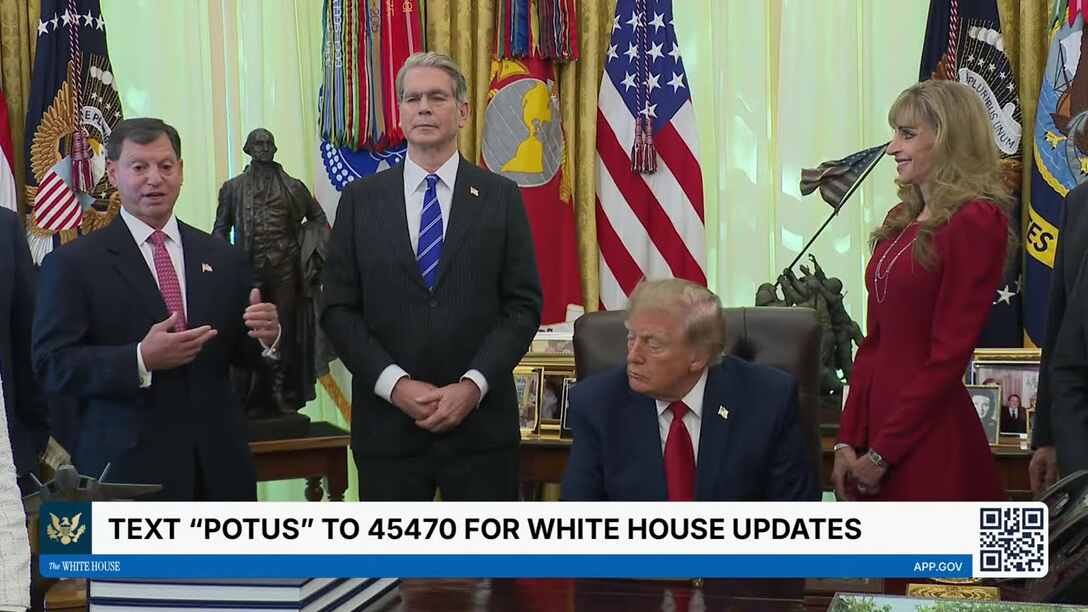
WASHINGTON, October 7, 2026 — President Donald Trump announced Wednesday that nearly 70 million investment accounts have been established for American children under the Trump Accounts initiative, marking a major expansion of a federal program designed to introduce young Americans to long-term investing and financial ownership.
The announcement, delivered at the White House on October 7, followed the program’s July 4 launch and included new details about automatic enrollment, billions of dollars in deposits, corporate contributions, and a $6.25 billion philanthropic commitment from Michael and Susan Dell.
According to the White House announcement, more than 60 million accounts were created through automatic enrollment, bringing the total to nearly 70 million accounts for eligible children under age 18 with valid Social Security numbers.
President Trump appeared alongside Treasury Secretary Scott Bessent, IRS CEO Frank Bisignano, Senator Ted Cruz, Michael and Susan Dell, investor Brad Gerstner, and children participating in the program.
Nearly 70 Million Accounts: What Trump Announced
The central announcement was a significant change in the scale of enrollment.
Previously, families could elect to establish accounts for eligible children through IRS Form 4547. The administration now reports that automatic enrollment has created accounts for more than 60 million additional children.
Trump said the objective is to provide children with investment assets that can grow over time and become part of their financial future when they reach adulthood.
| Program Indicator | White House Reported Figure |
|---|---|
| Total children’s accounts created | Nearly 70 million |
| Deposits reported since July 4 | More than $4.5 billion |
| Michael and Susan Dell commitment | $6.25 billion |
| Participating companies | More than 70 |
The White House provided a breakdown of deposits already recorded under the initiative: approximately $1.3 billion in federal seed contributions, more than $600 million from families and friends, and $2.6 billion in philanthropic contributions.
These figures distinguish money already deposited from larger future commitments. They are administration-reported figures rather than an independent audit of account balances.
Official source: White House — A Financial Stake in the Future for Nearly 70 Million American Children.
Who Qualifies for the Federal $1,000 Contribution?
Although nearly 70 million children may have accounts established in their names, federal seed money is subject to narrower eligibility requirements.
Under Section 530A and related provisions of the Internal Revenue Code, Trump Accounts are a new category of tax-advantaged individual retirement account for minors.
A child generally qualifies for an account if the child has a valid Social Security number and meets the age requirements.
The one-time $1,000 Treasury contribution is available only to qualifying children who are U.S. citizens, have valid Social Security numbers, and were born between January 1, 2025, and December 31, 2028.
The $1,000 is not an annual government payment, and it does not automatically apply to every child under age 18.
| Feature | Rule |
|---|---|
| Account eligibility | Eligible children under age 18 with a valid Social Security number |
| Federal seed contribution | One-time $1,000 for qualifying U.S. citizen children born from 2025 through 2028 |
| General annual contribution limit | $5,000, subject to statutory exceptions |
| Employer contributions | Up to $2,500 annually under qualifying arrangements, counted toward the general limit |
| Permitted investments during childhood | Qualifying U.S. equity index funds |
| Access to funds | Generally restricted during childhood, with applicable IRA rules after the growth period |
Trump Accounts are not ordinary bank savings accounts. They are investment vehicles whose balances can rise or fall depending on financial market performance.
The Internal Revenue Service describes the program as tax-advantaged rather than universally tax-free. Contributions, distributions, and subsequent taxation are governed by federal tax law.
Official sources: IRS — Trump Accounts and IRS — Form 4547 Instructions.
Michael and Susan Dell Commit $6.25 Billion for 25 Million Children
One of the most substantial announcements involved Dell Technologies founder Michael Dell and his wife, Susan.
During the ceremony, Michael Dell reaffirmed the couple’s commitment to provide $6.25 billion, allocating $250 to each of 25 million children’s Trump Accounts.
Dell said 10 million accounts had already received their contributions and that the couple expected funding to reach 25 million accounts by the end of the week.
At $250 per account, the commitment represents a substantial philanthropic initiative associated with the new program.
Dell recalled establishing his technology company with $1,000 and described the investment accounts as a means of giving children an early financial foundation.
Susan Dell emphasized that the initiative was intended to support children’s long-term aspirations, including education, entrepreneurship, scientific careers, and other professional opportunities.
The $250 contributions are philanthropic funding, not the same as the federal government’s $1,000 pilot contribution. Eligibility for a Dell-funded payment depends on the donor program’s allocation criteria.
The administration expects contributions from additional philanthropists, employers, and community organizations to complement federal funding.
Source: White House — October 7 Trump Accounts Announcement.
Treasury Secretary Scott Bessent: A New Model of Financial Ownership
Treasury Secretary Scott Bessent framed the initiative as an opportunity to broaden participation in American capital markets.
His argument was that children should begin learning about investing, compounding, and financial ownership before reaching adulthood.
Unlike a traditional government cash benefit intended for immediate spending, Trump Accounts are designed to build assets over an extended period.
The Treasury Department’s strategy relies on three sources of potential funding: government seed contributions for qualifying newborns, voluntary contributions from families and employers, and philanthropic donations.
During the account’s growth period, federal rules generally limit investments to qualifying low-cost funds tracking the S&P 500 or other eligible indexes composed primarily of U.S. equities.
This creates exposure to the American stock market without requiring parents to select individual stocks.
It also means the investments are exposed to market downturns. The federal government does not guarantee a particular return or a specific account balance at age 18.
Official reference: IRS — Internal Revenue Bulletin 2026-38.
How Parents Can Claim Their Children’s Accounts
For families, the immediate question is how to access an account created through automatic enrollment.
The administration says parents and guardians can use the official Trump Accounts application to claim their children’s accounts and begin managing eligible contributions.
The IRS also provides a process through its Individual Online Account.
- Visit the official Trump Accounts website or the IRS Trump Accounts page.
- Sign in using the official government identification process.
- Complete or review IRS Form 4547 where required.
- Confirm the child’s Social Security number, date of birth, and other identifying information.
- Request the federal contribution if the child satisfies the applicable requirements.
- Review the account status before arranging additional contributions.
Families should use official government enrollment channels rather than links received through unsolicited messages requesting Social Security numbers or banking details.
Official guidance: Instructions for Form 4547.
Will Every Child Become Wealthy by Age 18?
During Wednesday’s event, Trump suggested that participating children could accumulate substantial wealth over time.
Senator Ted Cruz emphasized the potential for long-term compounding, while investor Brad Gerstner described broader investment ownership as a significant change in the relationship between American families and the financial system.
These statements describe the program’s intended long-term impact, not a guaranteed financial outcome.
The actual amount available to a child will depend on initial contributions, additional deposits, investment performance, fees, taxes, and the number of years the money remains invested.
A child receiving a $1,000 federal contribution will not necessarily accumulate enough money for college or homeownership without additional contributions and investment growth.
Furthermore, Trump Accounts are not designed as unrestricted cash accounts that beneficiaries can withdraw from without tax consequences upon turning 18.
Under IRS guidance, traditional IRA rules generally begin applying in the calendar year the beneficiary turns 18. Withdrawals may be subject to income tax and an additional 10% early-distribution tax unless an applicable exception is available.
This distinction is particularly important for parents comparing Trump Accounts with 529 education savings plans, custodial brokerage accounts, and other long-term financial arrangements.
Official source: IRS — Trump Account Distribution Rules.
Corporate America Joins the Program
Trump said more than 70 companies have committed to supporting Trump Accounts through employee benefits or other contributions.
He specifically mentioned Uber, Intel, Nvidia, and Steak ‘n Shake.
The administration is encouraging employers to contribute to accounts for employees’ children, with qualifying employer contributions receiving preferential federal tax treatment within specified statutory limits.
Under the law, an employer may contribute up to $2,500 per year through an eligible program without that contribution being included in an employee’s taxable income.
These contributions generally count toward the overall $5,000 annual contribution limit.
Employer participation is voluntary. Workers should check the eligibility rules and benefits offered by their own companies.
Official guidance: IRS — Treasury and IRS Issue Guidance on Trump Accounts.
Trump Reopens the Debate Over Social Security and Market Investing
The October 7 event also included a discussion of retirement policy.
Trump argued that greater investment exposure could have generated substantial financial benefits if adopted more broadly during his first administration.
He revisited his interest in linking Social Security more closely to financial markets, suggesting that stock market gains could have strengthened retirement finances.
That statement concerned a hypothetical alternative policy, not an announcement that Social Security benefits are being transferred into Trump Accounts or that the existing retirement system has been replaced.
Social Security operates primarily as a social insurance system, while Trump Accounts are individually owned investment accounts exposed to financial market risk.
The administration has framed Trump Accounts as a means of expanding investment participation among families that might otherwise lack access to financial assets.
The White House estimates that approximately 80% of existing accounts are associated with families earning less than $200,000 annually.
Nevertheless, the eventual distribution of benefits will depend partly on families’ capacity to make additional contributions.
Higher-income households may be better positioned to contribute the maximum annual amount consistently. Federal seed payments and philanthropic gifts can help qualifying children whose families cannot regularly contribute additional funds.
Trump Addresses FBI Investigations and Allegations Involving His Family
Following the account announcement, President Trump took questions about federal investigations conducted during the Biden administration.
A reporter asked about allegations that investigators tracked members of Trump’s family, including First Lady Melania Trump and his then-minor son Barron Trump.
Trump accused the previous Justice Department leadership of abusing government authority and criticized former Attorney General Merrick Garland and former Special Counsel Jack Smith.
His comments followed ongoing congressional scrutiny of federal investigative practices.
However, the president’s allegations must be distinguished from final judicial findings. Whether surveillance or investigative activity violated federal law depends on the underlying records, applicable legal authority, and judicial review.
Congressional reference: U.S. Senate Judiciary Committee — Arctic Frost Investigation.
Russian Laboratory Death Raises Questions About Public Health Transparency
Trump was also asked whether reports concerning a suspected plague-related incident involving a Russian laboratory could indicate biological weapons activity.
The president responded that his administration did not believe that was the case, while acknowledging that further information was needed.
When asked whether Russia was providing sufficient information, Trump said U.S. officials were receiving some details but expected greater transparency.
The remarks did not constitute an official U.S. determination that a biological weapon had been involved.
The World Health Organization separately requested additional information concerning reports of a laboratory employee’s death following severe pneumonia in Irkutsk, Russia.
At the time, the specific cause of the illness had not been established in the publicly available WHO statement.
Official source: WHO — Director-General’s Remarks, October 7, 2026.
November Midterm Elections and the Possibility of Another Impeachment
Trump warned that a Democratic majority in the House of Representatives could lead to another impeachment effort following the November 3 midterm elections.
He criticized the previous impeachment proceedings against him and questioned the grounds for any new effort.
Under the U.S. Constitution, the House of Representatives holds the power to impeach federal officials by a majority vote.
Conviction and removal from office require a two-thirds vote of senators present.
Trump’s warning was a political assessment, not confirmation that Congress had adopted a new impeachment resolution.
Official source: Congressional Constitution Annotated — Impeachment Trial and Conviction.
Mortgage Rates and the Federal Reserve
A reporter cited a mortgage rate of 7.49% and asked Trump about rising borrowing costs.
The president criticized the Federal Reserve and argued that U.S. interest rates should be lower.
Treasury Secretary Scott Bessent attributed pressure on long-term borrowing costs partly to economic growth, inflation, and energy market disruptions.
A reported mortgage rate should be evaluated by loan product, lender, and measurement date.
Federal Reserve policy affects financing conditions, but mortgage rates are also influenced by Treasury yields, inflation expectations, and lending spreads.
Official references: Federal Reserve and Freddie Mac — Primary Mortgage Market Survey.
Trump Discusses a Presidential Retreat at His Florida Golf Club
Trump also discussed a proposal to make part of Trump International Golf Club in West Palm Beach available as a retreat for future U.S. presidents, drawing a comparison with Camp David.
He said security considerations and proximity to an airport made the property attractive.
The proposal was presented as a possibility, not a completed federal acquisition or formally established presidential residence.
The potential use of a privately owned facility for official presidential purposes would also raise questions about government expenditures, security arrangements, property rights, and conflicts of interest.
Trade, Tariffs and Relations With Canada
During the final questions, Trump addressed U.S. trade relations, including disagreements with Canada.
He argued that tariffs were encouraging domestic manufacturing investment and criticized the U.S. trade deficit with Canada.
The administration has repeatedly linked tariff policy to reshoring manufacturing, expanding domestic production, and reducing dependence on foreign suppliers.
However, a bilateral trade deficit does not by itself establish whether a trading relationship produces a net economic benefit or loss.
Such an assessment also requires examination of prices, employment, investment, supply chains, and consumer welfare.
Official economic data: U.S. Bureau of Economic Analysis and U.S. Census Bureau — Foreign Trade Statistics.
What the October 7 Announcement Means for American Families
The significance of Wednesday’s announcement extends beyond the creation of additional investment accounts.
Trump Accounts introduce a financial asset for millions of children who may never have owned an investment account before.
The program creates a platform for federal seed payments, employer benefits, charitable contributions, and financial education.
But the long-term outcome remains dependent on economic conditions and household behavior.
The immediate government commitment is defined by law: qualifying children born from 2025 through 2028 may receive a one-time $1,000 federal contribution.
The wider account infrastructure is available to eligible minors with Social Security numbers, with additional deposits dependent on applicable contributions and program rules.
For households, the practical next step is to verify the child’s account through the official enrollment system and determine whether the child qualifies for federal or philanthropic funding.
For policymakers, the longer-term test will be whether widespread access to investment accounts translates into durable increases in household financial security, particularly for children from families with limited savings.
The October 7 announcement establishes a new scale of participation. Whether it ultimately produces meaningful wealth for American families will depend on deposits, market returns, account management, and the financial opportunities available to children as adults.
Watch: President Trump’s October 7, 2026 Announcement
The original White House event included the Trump Accounts announcement, remarks from government officials and philanthropic partners, and an extended question-and-answer session with reporters.
Watch the full presidential announcement on YouTube.
Official Sources and Primary Documents
- White House — A Financial Stake in the Future for Nearly 70 Million American Children, October 7, 2026
- Internal Revenue Service — Trump Accounts: Eligibility and Enrollment
- IRS — Instructions for Form 4547
- Treasury and IRS — Guidance on Trump Accounts
- IRS — Internal Revenue Bulletin 2026-38
- IRS — Internal Revenue Bulletin 2026-37
- IRS — Safe Harbor for Certain Trump Account Contributions
- U.S. Government — Official Trump Accounts Portal
- U.S. Senate Judiciary Committee — Arctic Frost Investigation
- World Health Organization — Director-General’s Remarks, October 7, 2026
- U.S. Congress — Constitutional Provisions on Impeachment
- Freddie Mac — Primary Mortgage Market Survey
- U.S. Bureau of Economic Analysis
- Original Video — President Trump Makes an Announcement, October 7, 2026
Editorial methodology: This article is based on President Donald Trump’s October 7, 2026 announcement, the event transcript, official White House materials, and published federal agency guidance. Administration-reported enrollment figures and forward-looking statements are attributed to their sources. Investment returns are not guaranteed. Political allegations discussed during the press conference are distinguished from judicial findings and independently established facts.
Ask Midtown Tribune about this story
Answers are grounded first in this article. Search all Midtown Tribune reporting from the main AI Search page.
AI-generated summary. Verify important details in the linked original articles.