
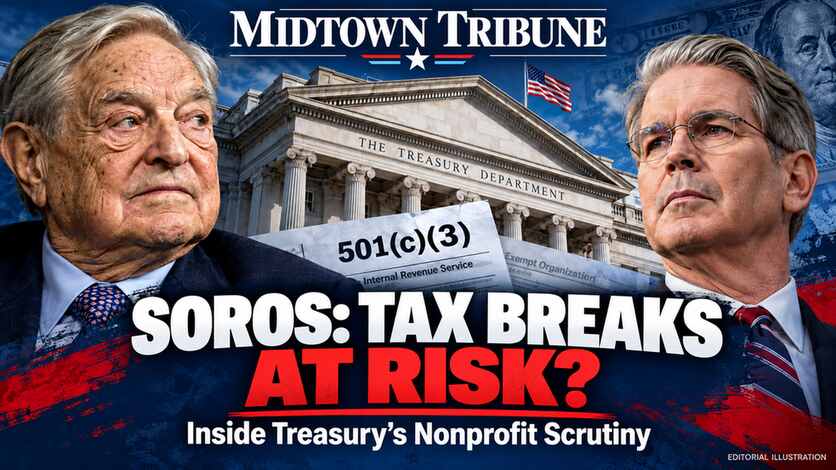
The Trump administration is stepping up scrutiny of nonprofits suspected of financing unlawful activity. Reports have identified George Soros’ Open Society Foundations, the Southern Poverty Law Center and CAIR as potential targets. But the widely circulated claim that these organizations “avoided $165 million in taxes” needs context.
Midtown Tribune | October 22, 2026
Tax-exempt status provides significant benefits to American charitable organizations. It also comes with restrictions: a nonprofit designation does not authorize financing violence, and organizations operating under Section 501(c)(3) cannot campaign for or against political candidates.
The Trump administration’s stated objective is to investigate whether charitable structures are being used to support unlawful activity. What remains unresolved is whether that effort will produce findings sufficient to revoke the exemptions of the organizations named in press reports.
What Trump Directed
On September 25, 2025, President Donald Trump signed National Security Presidential Memorandum 7, “Countering Domestic Terrorism and Organized Political Violence.”
Section 2(j) directs the IRS commissioner to take action to ensure that tax-exempt entities are not directly or indirectly financing political violence or domestic terrorism. Where applicable, the IRS is instructed to refer organizations and their officers or employees to the Justice Department for investigation and possible prosecution.
The memorandum does not itself revoke any organization’s exemption. It does not name Open Society Foundations, the Southern Poverty Law Center or the Council on American-Islamic Relations. www.whitehouse.gov
What Bessent Confirmed
In official remarks delivered July 16, 2026, Treasury Secretary Scott Bessent said his department was expanding efforts to identify organizations abusing charitable and nonprofit structures as vehicles for illicit finance.
He described investigations into exploitation of tax-exempt status, financial channels for foreign influence and the enabling of violence.
Bessent also stated an important limitation: Treasury would act on suspected unlawful conduct, rather than organizations’ beliefs or ideologies. His remarks announced an enforcement effort; they did not establish violations by the three organizations discussed here. home.treasury.gov
Why Soros, SPLC and CAIR Are Being Named
An August 27, 2026, New York Post report cited sources describing Treasury discussions about potentially revoking exemptions held by Open Society Foundations, SPLC and CAIR.
That reporting concerns a possible enforcement plan. No published final IRS determination revoking the exemptions of the named organizations was located in the official materials reviewed for this article. That finding does not rule out confidential examinations.
The $165 Million Claim
The figure circulating on social media comes from a hypothetical New York Post calculation of what the organizations might have owed for 2024 under a 21% corporate income-tax rate. The newspaper attributed approximately $163.6 million of the estimate to the Soros network.
It is a newspaper estimate—not an IRS assessment of unpaid taxes or a finding of tax evasion. The total also covers multiple organizations, rather than a single Soros foundation. nypost.com
Federal law applies the 21% corporate rate to taxable income. Applying that percentage automatically to donations, total receipts or assets does not establish a valid tax liability. Confirming an actual amount would require examining the relevant returns and applicable tax adjustments. www.govinfo.gov
Could Back Taxes Follow?
Potentially. IRS Publication 557 explains that revocation can be retroactive under specified circumstances, including material misrepresentations or operations materially different from those originally described.
But retroactive taxation and penalties require applicable legal grounds and individual determinations. They do not follow automatically from a presidential memorandum or an announcement of scrutiny. www.irs.gov
Where the Legal Line Falls
Under IRS requirements for 501(c)(3) organizations, candidate campaign intervention is prohibited, while lobbying is restricted. Public-policy advocacy is permitted within the applicable rules.
Criticizing immigration enforcement, challenging government decisions in court or advocating controversial policies does not, by itself, establish a violation of those requirements. www.irs.gov
The official record supports a clear conclusion: the administration has directed stronger scrutiny of potentially unlawful nonprofit financing. Claims that these organizations have already lost their exemptions—or have been proven to owe $165 million—go beyond the evidence reviewed.
Sources
- White House: Presidential Memorandum NSPM-7
- U.S. Treasury: Secretary Bessent’s July 16, 2026, remarks
- IRS: Exemption requirements for 501(c)(3) organizations
- IRS: Lobbying rules
- IRS: Publication 557
- New York Post: Report underlying the proposed crackdown and tax estimate
Ask Midtown Tribune about this story
Answers are grounded first in this article. Search all Midtown Tribune reporting from the main AI Search page.
AI-generated summary. Verify important details in the linked original articles.