
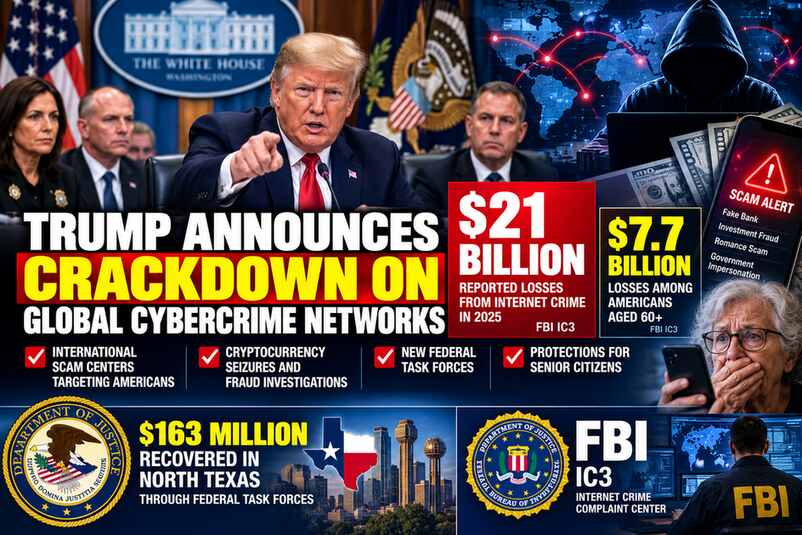
White House cybercrime roundtable highlights international scam centers, asset seizures, federal investigations, and new protections for senior citizens.
October 25, 2026 — Midtown Tribune
President Donald Trump brought together senior federal law enforcement and national security officials for a White House roundtable on October 21, outlining his administration’s efforts to dismantle international cybercrime networks responsible for stealing billions of dollars from Americans.
The White House released a video highlighting the discussion on October 25 under the title President Trump Hosts Cyber Crime Roundtable.
The meeting focused on overseas fraud operations, cryptocurrency-related crimes, online extortion, and financial schemes targeting older Americans.
According to the FBI’s 2025 Internet Crime Report, Americans reported nearly $21 billion in losses from internet crime, including approximately $7.7 billion reported by people aged 60 and older.
Nearly $21 Billion in Reported Internet Crime Losses
The FBI’s Internet Crime Complaint Center (IC3) received 1,008,597 complaints in 2025, compared with 859,532 in 2024.
The bureau reported that investment fraud, phishing, impersonation, and extortion remained major categories of internet crime.
Among the most significant findings:
| FBI 2025 reporting category | Reported figure |
|---|---|
| Total internet crime losses | Nearly $21 billion |
| Complaints received | 1,008,597 |
| Losses reported by adults aged 60+ | Approximately $7.7 billion |
| Cyber-enabled fraud losses | More than $17.7 billion |
| Cryptocurrency-related complaint losses | More than $11 billion |
These figures represent reported losses, not necessarily the total economic damage caused by cybercrime. Some victims never file complaints, and certain reporting categories overlap.
The scale of the losses underscores why financial fraud has become a major national law enforcement priority.
Trump Reports New Federal Enforcement Results
During the roundtable, Trump described several results attributed to the administration’s coordinated campaign against cybercrime.
According to the president, federal law enforcement agencies have:
- Warned more than 10,000 Americans identified as potential fraud victims.
- Prevented at least $1.6 billion in financial losses during 2026.
- Frozen nearly $1 billion in cryptocurrency connected to foreign scammers.
- Shut down more than 500 fraudulent websites.
- Worked with international partners to arrest hundreds of suspected scammers.
These are administration-reported enforcement figures. Independent assessment requires additional information about how prevented losses were calculated, how assets were restrained, and what portion has been returned to victims.
New Authority to Disrupt Overseas Cybercriminal Organizations
The administration’s efforts extend beyond traditional investigations.
On August 12, 2026, Trump signed a National Security Presidential Memorandum expanding federal capabilities to combat transnational cyber-enabled criminal organizations.
The memorandum authorizes a federally supervised program involving qualified American private-sector companies that can assist with cyber operations against foreign criminal networks.
The Department of Justice and Department of Homeland Security are assigned joint oversight responsibilities.
The policy establishes procedures for operational authorization, legal review, private-sector vetting, and compliance with U.S. law.
The administration argues that overseas cybercriminal groups increasingly require a coordinated response involving government intelligence, federal investigators, and private technology companies.
The memorandum does not give participating businesses unrestricted authority to conduct independent cyberattacks.
Federal Prosecutors Target Entire Criminal Networks
At the White House meeting, Justice Department officials described a strategy designed to prosecute not only individual scammers but also the organizers, financial facilitators, and infrastructure supporting international fraud operations.
Federal investigators are working with prosecutors, Homeland Security Investigations, the FBI, the Secret Service, and other agencies to identify and dismantle these networks.
Some criminal organizations operate large overseas facilities commonly described as scam compounds.
These operations may involve fraudulent cryptocurrency investments, fabricated romantic relationships, impersonation of government officials, and deceptive online financial services.
Investigators also recognize that some workers inside these compounds are trafficking victims who have been coerced into participating in criminal activities.
The distinction between organizers, perpetrators, and trafficking victims is important when assessing international enforcement operations.
$163 Million Reported Recovered in North Texas
One participant in the White House video highlighted work by Homeland Security Task Forces in North Texas, reporting approximately $163 million recovered through coordinated law enforcement activity.
The statement illustrates the administration’s emphasis on cooperation between federal and local authorities.
However, the available remarks do not establish whether the entire amount represents cybercrime proceeds, seized assets, forfeited property, or funds already distributed to victims.
Those categories have different legal meanings.
A seizure does not automatically establish that assets have been permanently forfeited, and forfeiture does not necessarily mean that victims have received restitution.
Why Senior Citizens Are Particularly Vulnerable
Older Americans accounted for approximately $7.7 billion in reported internet crime losses in 2025, according to the FBI.
Criminals frequently target victims through:
- Fraudulent investment and cryptocurrency opportunities.
- Fake bank security alerts.
- Impersonation of federal agents or law enforcement officers.
- Technical support scams.
- Romance and relationship fraud.
- False emergency calls involving family members.
These schemes often rely on fear, urgency, emotional manipulation, or the appearance of government authority.
A victim may be told that a bank account has been compromised, that a relative is in danger, or that immediate payment is necessary to avoid legal consequences.
The FBI advises consumers to verify unexpected communications independently and report suspected internet crimes promptly.
What the White House Initiative Means for New Yorkers
Cybercrime is not limited by state or national borders.
New York residents, small businesses, retirees, and immigrant communities can be targeted by criminal networks operating from anywhere in the world.
Fraudsters may communicate in English or other languages, exploit personal information obtained online, and use payment systems that make stolen funds difficult to recover.
For older New Yorkers, the consequences can be particularly severe when retirement savings or essential living expenses are stolen.
The federal strategy therefore has implications for both national security and everyday financial protection.
What Has Been Confirmed — and What Still Needs Verification
Confirmed through official federal records:
The FBI documented nearly $21 billion in reported internet crime losses for 2025.
The White House issued an August 2026 memorandum expanding federally supervised cyber operations against transnational criminal organizations.
The administration has established a framework for cooperation among federal law enforcement agencies and vetted private-sector participants.
Figures requiring further documentation:
The precise methodology behind the administration’s $1.6 billion estimate of prevented losses.
The legal status and final disposition of cryptocurrency assets described as frozen or seized.
The breakdown of the $163 million reported recovered in North Texas.
The amounts ultimately paid back to individual fraud victims.
How Americans Can Report Internet Fraud
Anyone who believes they have been targeted by an internet scam should preserve relevant evidence, including emails, transaction records, cryptocurrency wallet addresses, and communications with suspected criminals.
Victims should contact their financial institutions immediately if money has been transferred.
Reports can be submitted directly to the FBI’s Internet Crime Complaint Center at:
Prompt reporting may improve investigators’ ability to trace funds and identify criminal networks, although recovery is not guaranteed.
The Broader Significance
The White House roundtable signals an expansion of the administration’s approach to cybercrime, combining criminal prosecutions, international cooperation, financial asset tracing, and federally supervised cyber operations.
The FBI’s annual statistics establish the scale of the problem. The administration’s enforcement announcements describe its intended response.
The next measure of effectiveness will be the number of criminal networks dismantled, successful prosecutions, demonstrably prevented losses, and funds actually returned to victims.
For American families, especially retirees, those outcomes matter more than enforcement announcements alone.
Official Sources
- The White House — President Trump Hosts Cyber Crime Roundtable, October 25, 2026
- The White House — Fact Sheet: Expanding Capabilities to Combat Transnational Cyber-Enabled Crime, August 12, 2026
- The White House — National Security Presidential Memorandum, August 12, 2026
- FBI — Internet Crime Complaint Center
- FBI — Official News and Reports
- The White House — Official YouTube Video
Midtown Tribune — Independent New York News
Midtown Tribune Independent USA news from New York
Ask Midtown Tribune about this story
Answers are grounded first in this article. Search all Midtown Tribune reporting from the main AI Search page.
AI-generated summary. Verify important details in the linked original articles.