
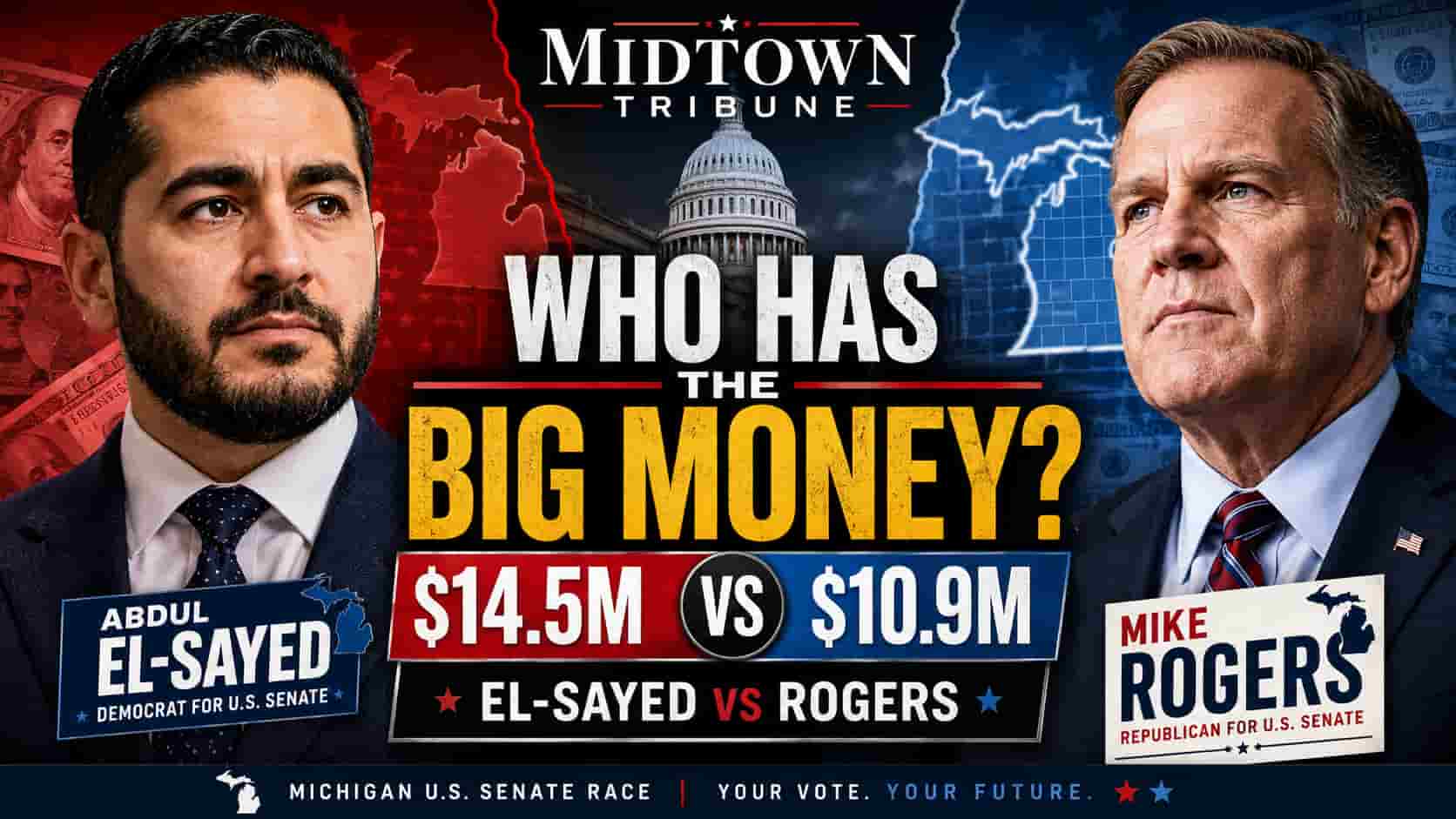
The Michigan Democrat has accused Republican Mike Rogers of benefiting from corporate money and Washington connections. Federal records show another striking number: El-Sayed’s own Senate campaign has raised substantially more money than Rogers’ campaign.
Michigan’s U.S. Senate race is becoming a fight not only over policy, but over who is financed by whom — and what “big money” actually means in federal politics.
Democrat Abdul El-Sayed recently attacked Republican former Congressman Mike Rogers, accusing Rogers of benefiting from corporate interests during his years in Washington and profiting from political connections after leaving Congress.
The accusation is politically potent.
But Federal Election Commission records raise an obvious question for voters:
If the size and source of political fundraising are grounds for scrutiny, shouldn’t the same standard apply to El-Sayed?
According to the FEC, El-Sayed’s authorized Senate campaign committee reported approximately $14.53 million in total receipts from January 1, 2025 through July 15, 2026.
Rogers’ authorized committees reported approximately $10.90 million during the same reporting period.
That means El-Sayed’s campaign reported roughly $3.63 million more in receipts than Rogers’ campaign as of July 15.
The Numbers Behind El-Sayed’s Campaign
The FEC reports the following for Abdul for U.S. Senate through July 15, 2026:
- Total receipts: $14,528,335.93
- Total contributions: $14,493,903.29
- Individual contributions: $14,408,058.06
- Itemized individual contributions: $10,264,779.21
- Unitemized individual contributions: $4,143,278.85
- Other committee contributions: $71,845.23
- Candidate contributions: $14,000
- Cash on hand: $2,552,762.55
The campaign had already spent approximately $11.98 million by July 15. It also reported $68,392.39 in contribution refunds.
Those refunds do not, by themselves, establish wrongdoing. Campaigns can refund contributions for numerous compliance reasons, including excess contributions or donor errors.
The more significant point is scale: this is a campaign operating with more than $14.5 million in reported receipts.
Rogers Has Raised Less
For the same January 1, 2025–July 15, 2026 period, Rogers’ authorized committees reported:
- Total receipts: $10,898,177.09
- Individual contributions: $6,831,818.66
- Other committee contributions: $787,227.09
- Party committee contributions: $62,000
- Transfers from other authorized committees: $3,166,695.03
- Cash on hand: $4,473,237.49
Rogers reported approximately $6.68 million in total disbursements.
So there is an important distinction.
El-Sayed has raised more overall, while Rogers has received a much larger share of his campaign resources from political committees and transfers between authorized committees.
That distinction is worth discussing.
It is not the same thing as proof of corruption.
What Does “Corporate Money” Actually Mean?
This is where political rhetoric can become misleading.
Federal candidates generally cannot accept direct campaign contributions from corporate treasury funds.
The FEC explicitly states that corporations, labor organizations and national banks are prohibited from contributing treasury funds directly to federal candidate committees.
Corporations may, however, establish separate segregated funds — commonly called corporate PACs — that can legally contribute to candidates within federal limits.
Executives, shareholders and employees may also contribute as individuals using their own money.
That means a statement such as “this candidate received millions from corporations” requires a methodology.
Does it mean:
- corporate PAC contributions?
- donations from executives?
- donations from employees of large corporations?
- contributions routed through other political committees?
- independent expenditures by Super PACs?
Those are legally and financially different categories.
Simply adding them together and labeling the total “corporate money” can give voters a misleading picture.
El-Sayed’s $14.5 Million Is Not His Personal Income
Another distinction is equally important.
The $14.53 million reported by the FEC belongs to El-Sayed’s campaign committee. It is not $14.53 million of personal income received by Abdul El-Sayed.
Federal campaign funds are regulated political funds and cannot simply be treated as a candidate’s personal bank account.
The FEC filing shows El-Sayed himself contributed only $14,000 to his campaign during the reporting period.
Candidates for the U.S. Senate have a separate obligation to file personal financial disclosure reports with the Senate.
The Senate Ethics Committee specifically explains that FEC campaign filings and Senate financial disclosures are different reporting systems covering different information.
Therefore, claims about El-Sayed’s personal wealth or personal income should not be inferred from his campaign’s fundraising total.
The Same Standard Should Apply to Both Candidates
El-Sayed is entitled to question Rogers’ donors, his political relationships and his post-congressional career.
Those are legitimate subjects of public scrutiny.
But the standard cannot reasonably stop with Rogers.
When a candidate whose campaign has raised more than $14.5 million makes campaign money a central argument against an opponent, voters have every reason to examine his fundraising operation with the same intensity.
Who gave the money?
How many contributions came from large donors?
Which political committees contributed?
Who is independently spending money to support or defeat each candidate?
And are claims about “corporate money” being applied consistently to both sides?
Those questions do not establish corruption.
They establish transparency.
What Is Confirmed
Federal records confirm that El-Sayed’s campaign reported approximately $14.53 million in receipts through July 15, while Rogers’ committees reported approximately $10.90 million.
Federal law generally prohibits corporations from making direct treasury-funded contributions to candidate committees, although corporate PACs may legally contribute under FEC rules.
The FEC records reviewed by Midtown Tribune do not establish that either candidate committed corruption merely by receiving lawful campaign contributions.
What Is Not Established
Midtown Tribune has not identified an official court judgment, FEC enforcement finding or other government determination establishing that Mike Rogers is corrupt based on the allegations discussed above.
Likewise, the fact that El-Sayed has raised more than $14 million does not establish corruption or illegal fundraising.
Claims connecting El-Sayed personally to illegal foreign financing, extremist organizations or alleged crimes committed by relatives would require separate evidence. A criminal case involving a family member cannot legally or factually be attributed to El-Sayed without evidence of his own involvement.
One More Problem With the Political Narrative
The fundraising numbers expose a broader problem with modern campaign rhetoric.
Candidates increasingly attack “big money” while simultaneously requiring enormous sums of money to compete in statewide races.
El-Sayed’s campaign is no exception.
By mid-July, his committee had received more than $14 million and spent almost $12 million.
That does not make the money illegal.
But it does make the source, structure and rhetoric surrounding that money fair subjects for examination.
If Mike Rogers must explain his donors and political connections, Abdul El-Sayed should be held to exactly the same standard.
That is not an accusation.
It is the transparency both candidates are asking voters to demand from the other side.
Official Sources
FEC — Abdul El-Sayed candidate and campaign financial data
FEC — Mike Rogers candidate and campaign financial data
FEC — Who Can and Can’t Contribute to Federal Candidates
U.S. Senate Select Committee on Ethics — Financial Disclosure Rules
Michigan Department of State — Election Results and Data
Midtown Tribune Editorial Note: Campaign fundraising totals represent money received by regulated political committees, not personal income of the candidates. Allegations are attributed to the individuals making them. Financial figures are based on FEC filings covering activity through July 15, 2026.
Ask Midtown Tribune about this story
Answers are grounded first in this article. Search all Midtown Tribune reporting from the main AI Search page.
AI-generated summary. Verify important details in the linked original articles.