
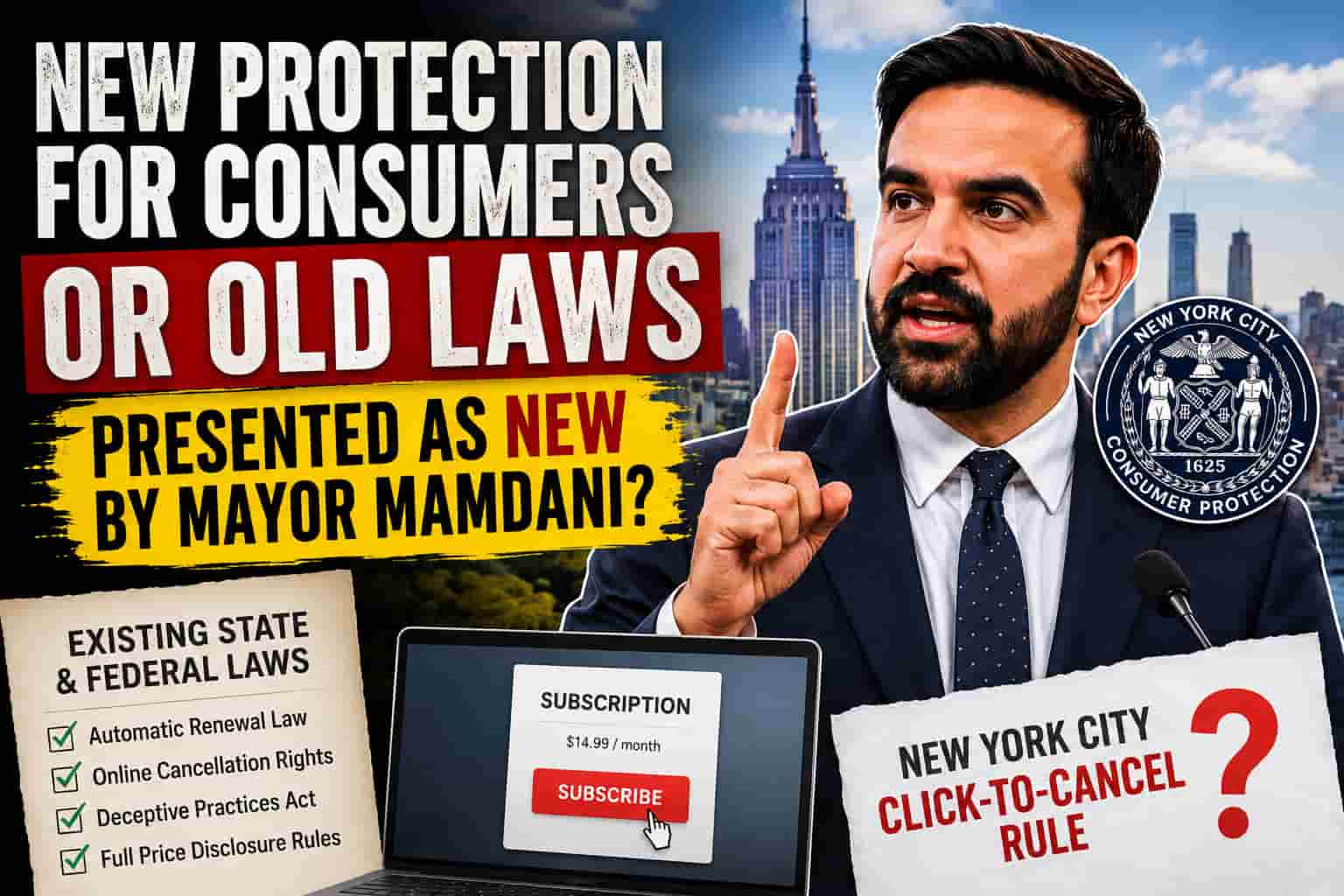
New York City’s new Click-to-Cancel rule has attracted national attention. But many of the consumer protections highlighted at City Hall had already existed under New York State and federal law. So what exactly is new?
NEW YORK — When Mayor Zohran Kwame Mamdani announced New York City’s new consumer protection initiative against subscription traps and hidden fees, the message sounded straightforward: the city was taking action to protect residents from deceptive business practices.
However, a review of existing state and federal laws raises an important question.
How much of this protection is actually new, and how much was already part of the law?
The answer is more nuanced than the press conference suggested.
New York State already regulates automatic renewals
The central announcement was the City’s new Click-to-Cancel rule.
Its basic principle is simple:
If a business allows customers to subscribe easily, it should allow them to cancel just as easily.
That concept, however, is not entirely new.
New York State’s General Business Law §527-a, which governs automatic renewals and continuous service offers, already requires businesses to:
- clearly disclose subscription terms before enrollment;
- obtain the consumer’s affirmative consent;
- provide a cancellation mechanism that is simple and easy to use;
- allow cancellation through the same medium used to enroll;
- avoid obstructing or unreasonably delaying cancellation requests;
- provide online cancellation when consumers enrolled online;
- notify customers about certain renewals, price increases and material changes.
In other words, many of the protections discussed during the City’s announcement have already been part of New York State law.
Federal law has also protected consumers for years
Congress enacted the Restore Online Shoppers’ Confidence Act (ROSCA) in 2010.
ROSCA requires online sellers offering recurring subscriptions to:
- clearly disclose the material terms of the offer;
- obtain informed consent before charging consumers;
- provide a simple mechanism to stop recurring charges.
The Federal Trade Commission has relied on ROSCA for years when pursuing companies accused of deceptive subscription practices. Cases involving Amazon and Adobe were brought under existing federal consumer protection authority, not under any New York City regulation.
Then what did New York City actually add?
This is where the City’s action becomes more significant.
Rather than creating consumer protections from scratch, New York City has created its own municipal enforcement framework.
The City’s rule does several things.
1. It gives DCWP direct enforcement authority
Instead of relying primarily on the Federal Trade Commission or the New York Attorney General, consumers will be able to file complaints directly with the New York City Department of Consumer and Worker Protection.
The agency will have authority to investigate complaints, seek restitution and impose civil penalties beginning at $525 per violation.
2. It creates more detailed local standards
Legal commentators note that the City rule is generally more prescriptive than existing state law.
For example, the municipal rule specifies additional cancellation procedures and expands the situations in which businesses must provide online cancellation mechanisms.
3. It expands local oversight
Businesses operating in New York City will now face enforcement not only from state and federal regulators but also from municipal authorities.
For consumers, this could mean faster complaint handling through local government.
The proposal on hidden “junk fees” is different
The City’s second initiative targets mandatory fees that appear only near the end of a purchase.
Unlike Click-to-Cancel, this proposal goes beyond subscription cancellations.
It would require businesses to advertise the full mandatory price upfront, including required fees, so consumers can compare offers based on the actual amount they will pay.
That proposal is still going through New York City’s rulemaking process and has not yet become a final rule.
Why critics ask whether the announcement overstated the novelty
Some consumer law specialists have pointed out that many of the City’s subscription requirements closely resemble provisions already contained in New York State’s Automatic Renewal Law.
The City’s proposal does not replace state law.
Instead, it builds upon it by providing more detailed municipal regulations and a separate enforcement mechanism.
That distinction is important.
Saying that New Yorkers previously had no legal protection against subscription traps would be inaccurate.
State law already prohibited many of the practices discussed during the press conference.
Why the City may still consider the new rule important
The City’s initiative can still have practical consequences.
Local enforcement often allows complaints to be investigated more quickly than federal actions, which typically focus on larger nationwide cases.
Businesses operating within New York City may also face additional compliance obligations because the municipal rule contains more specific procedural requirements than state law.
In other words, the City is not inventing consumer protection from scratch.
It is creating a stronger local enforcement system and adopting more detailed standards for businesses operating within city limits.
The bottom line
The legal record shows that:
- New York State already regulated automatic renewals and subscription cancellations.
- Federal law has prohibited deceptive online subscription practices since 2010.
- New York City’s Click-to-Cancel rule adds a municipal enforcement system and more detailed compliance requirements.
- The proposed junk-fee regulation remains under public review and has not yet become final.
For consumers, the City’s action could improve enforcement and make complaints easier to pursue locally.
But it would be inaccurate to conclude that these consumer protections did not exist before July 2026.
The better description is that New York City has added another layer of regulation to an area that was already governed by both state and federal law.
Official Sources: What Already Existed and What New York City Added
The following official materials allow readers to compare longstanding federal and New York State consumer protections with New York City’s new municipal Click-to-Cancel rule.
Existing New York State Law
-
New York General Business Law § 527-a — Automatic Renewals and Continuous Service Offers
The state law requires clear disclosure of subscription terms, affirmative consumer consent and a cost-effective, timely and easy-to-use cancellation mechanism. -
New York General Business Law § 527 — Definitions
Defines automatic renewals, continuous service offers and related terms used in New York State’s subscription law. - New York General Business Law § 349 — Deceptive Acts and Practices
- New York General Business Law § 350 — False Advertising
Existing Federal Consumer Protections
-
Restore Online Shoppers’ Confidence Act — Public Law 111-345
Enacted in 2010, ROSCA requires online sellers using negative-option features to disclose material terms, obtain informed consent and provide a simple way to stop recurring charges. - United States Code, Title 15, Chapter 110 — ROSCA
- FTC Enforcement Policy Statement Regarding Negative Option Marketing
-
FTC Announcement of the 2024 Federal Click-to-Cancel Rule
The federal rule was later vacated by a federal appeals court on procedural grounds. - U.S. Court of Appeals for the Eighth Circuit — Decision Vacating the FTC Rule
Existing Federal Rules on Hidden Fees
-
FTC Rule on Unfair or Deceptive Fees — Official Guidance
Effective May 12, 2025, the federal rule requires upfront total-price disclosure for live-event tickets and short-term lodging. - FTC Announcement That the Federal Junk Fees Rule Took Effect
New York City’s Municipal Rule
-
NYC Rules — Cancellation of Subscriptions
Official rulemaking page containing the proposal, public comments and adopted municipal requirements. - Mayor’s Office — April 9, 2026 Announcement of the Proposed Rule
- DCWP — Original Municipal Click-to-Cancel Proposal
- Mayor’s Office — July 10, 2026 Announcement of the Final Rule
- DCWP — Final Click-to-Cancel Rule and Proposed Junk Fees Regulation
- Full July 10, 2026 Consumer Protection Press Conference
Editor’s note: New York State and federal law already regulated automatic renewals, deceptive subscription practices and certain hidden fees before the Mamdani administration’s announcement. New York City’s principal additions are a more detailed municipal cancellation standard and direct local enforcement through the Department of Consumer and Worker Protection. The broader New York City junk-fee regulation remains separate from the adopted Click-to-Cancel rule.
Ask Midtown Tribune about this story
Answers are grounded first in this article. Search all Midtown Tribune reporting from the main AI Search page.
AI-generated summary. Verify important details in the linked original articles.