
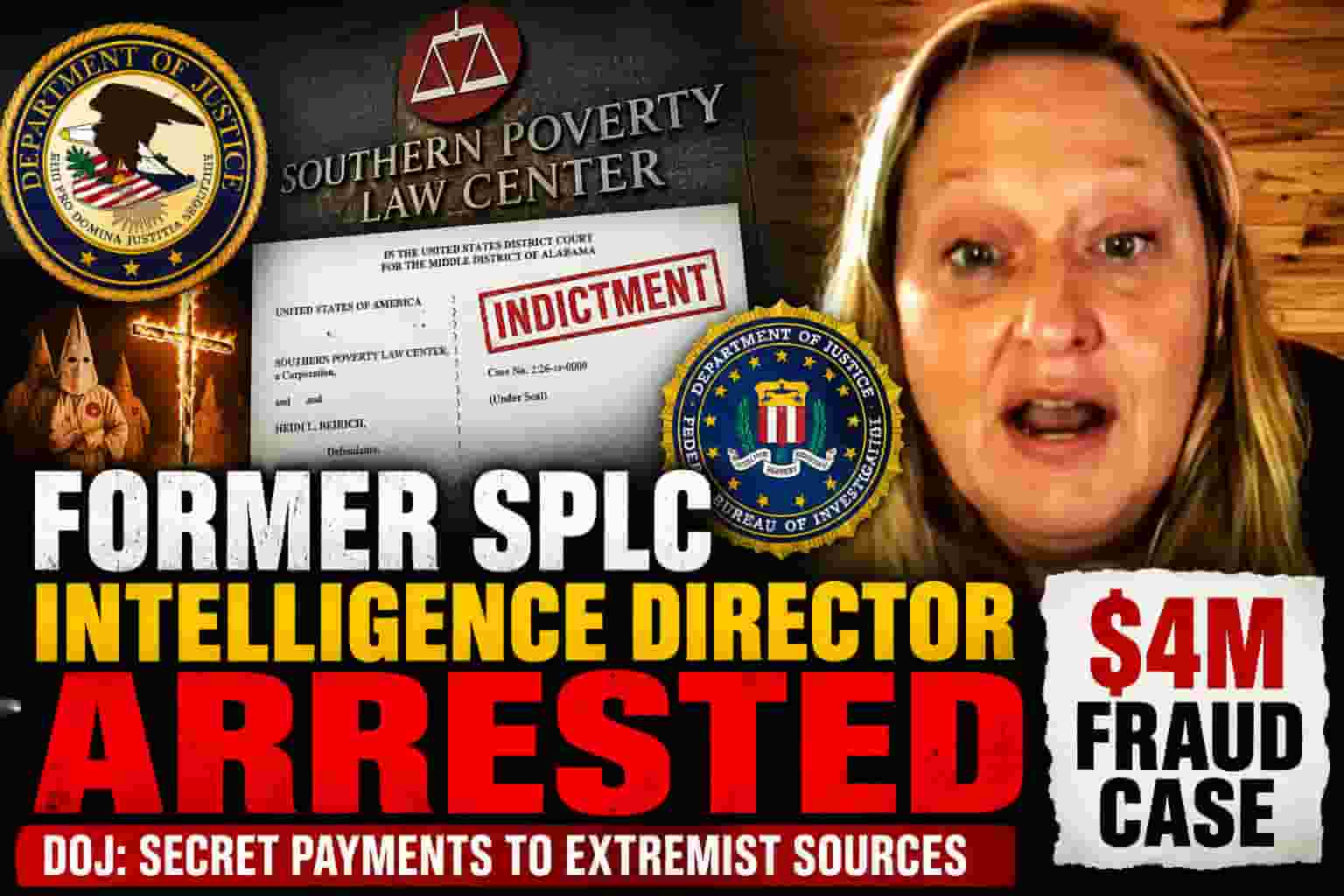
Federal prosecutors allege that more than $4 million in donor money was secretly routed to individuals associated with extremist organizations. A viral Benny Johnson video highlights the case — but some of its most explosive claims go beyond what the federal charging documents currently establish.
WASHINGTON — A former senior Southern Poverty Law Center official has been charged in a widening federal criminal case alleging that donor money intended to combat extremism was secretly routed to individuals associated with the Ku Klux Klan, neo-Nazi organizations and other extremist groups.
On August 11, 2026, a federal grand jury in Montgomery, Alabama, returned a second superseding indictment against the Southern Poverty Law Center, adding Heidi L. Beirich, 59, of Palm Springs, California, as an individual defendant. The indictment was unsealed on August 12.
According to the Justice Department, Beirich was charged with conspiracy to commit wire fraud, conspiracy to submit false statements to a federally insured bank and conspiracy to commit concealment money laundering. Federal authorities served her with an arrest warrant in California.
The DOJ says the expanded indictment alleges that more than $4 million in donated funds were secretly funneled between 2007 and 2023 to individuals associated with violent extremist groups.
The FBI is investigating the case.
The allegations began before Beirich’s arrest
The case did not begin this week.
In April, a federal grand jury charged the Southern Poverty Law Center itself with 11 counts involving wire fraud, false statements to a federally insured bank and conspiracy to commit concealment money laundering. At that stage, prosecutors alleged that more than $3 million between 2014 and 2023 had been secretly paid to individuals associated with organizations including:
- Ku Klux Klan;
- United Klans of America;
- National Alliance;
- National Socialist Movement;
- Aryan Nations-linked groups;
- National Socialist Party of America;
- American Front; and
- people associated with the 2017 Unite the Right gathering in Charlottesville.
The government’s expanded case has since increased the alleged period and amount to more than $4 million from 2007 through 2023.
FBI Director Kash Patel said when the original charges were announced that investigators believed money raised by the SPLC to combat extremist organizations had instead been used to pay people occupying leadership or other positions within those organizations.
Those remain government allegations, not findings of guilt.
What the original federal indictment actually alleges
The April indictment provides considerably more detail than many of the social-media posts circulating about the case.
Federal prosecutors alleged that SPLC operated what it called a network of paid “field sources,” some of whom had infiltrated extremist organizations while others were already associated with them.
According to the indictment, the SPLC secretly paid these sources while publicly seeking donations to help “dismantle” white-supremacist and extremist organizations.
One individual identified as F-37 allegedly participated in an online leadership chat that planned the 2017 Unite the Right event in Charlottesville. Prosecutors allege that F-37 attended at SPLC’s direction, made racist postings while under SPLC supervision and helped coordinate transportation for attendees.
The indictment says SPLC secretly paid F-37 more than $270,000 between 2015 and 2023.
Another source, F-9, was allegedly affiliated with the neo-Nazi National Alliance and served as a source for SPLC for more than 20 years. The indictment alleges that SPLC secretly paid F-9 more than $1 million between 2014 and 2023.
The government further alleges that F-9 illegally entered an extremist organization’s headquarters in 2014 and stole 25 boxes of documents. According to prosecutors, a high-level SPLC employee knew the material had been stolen and later used information from the documents for a Hatewatch article.
Perhaps one of the strangest allegations in the charging document concerns another source, F-39.
Prosecutors allege SPLC paid F-39 approximately $6,000 to falsely take responsibility for the theft.
That allegation is significant — but it also illustrates why descriptions of this case need to be precise.
Cross burnings and KKK robes: what prosecutors allege
The expanded indictment goes further.
According to accounts of the superseding charging document, prosecutors allege that paid sources used donor money while participating in extremist organizations to recruit members, support chapters and activities, attend or host extremist rallies and obtain materials connected with KKK robes and cross-burning ceremonies.
The original indictment separately identifies one paid SPLC source as the reported national president of American Front and a convicted federal felon for participation in a cross burning. SPLC allegedly paid that individual more than $19,000 between 2016 and 2019.
It also alleges that money was indirectly routed through another source to extremist leaders, including a former Grand Wizard of the Knights of the Ku Klux Klan.
These are extraordinary allegations.
But they do not mean prosecutors have proved that SPLC executives themselves personally burned crosses.
That distinction matters.
The alleged shell-company system
At the center of the government’s financial case is an alleged network of fictitious businesses.
According to the indictment, SPLC personnel opened bank accounts using names including:
Center Investigative Agency, Fox Photography, North West Technologies, Tech Writers Group and Rare Books Warehouse.
Prosecutors allege these entities had no genuine employees and conducted no actual business.
The government contends the accounts were used to make money appear to originate from those entities rather than directly from the SPLC.
The indictment alleges false information was supplied to federally insured banks concerning ownership and control of the accounts.
After a bank began investigating some of the accounts in 2020, according to the indictment, SPLC eventually acknowledged in writing that several of the accounts had been opened for SPLC operations and operated under the organization’s authority.
Prosecutors say the payment system subsequently changed, with transactions carrying names intended to obscure their origin.
Beirich and the alleged relationship with an informant
The new case puts Beirich personally at the center of some of these allegations.
According to the superseding indictment as reported after its unsealing, prosecutors allege she was romantically involved with one of SPLC’s informants and shared financial accounts with him.
Approximately $140,000 in donor money allegedly reached joint accounts between 2015 and 2021, with prosecutors contending some of that money was used for personal living expenses.
Beirich denies wrongdoing through her attorney.
One important correction to several viral accounts of the story: Beirich was not principally known as SPLC’s chief financial officer.
Her current organization, the Global Project Against Hate and Extremism, describes her as the former head of the Southern Poverty Law Center’s Intelligence Project, the operation responsible for tracking hate and antigovernment organizations.
SPLC says the informants helped law enforcement
The government’s theory is strongly disputed by the Southern Poverty Law Center.
SPLC argues that paying confidential sources to infiltrate dangerous organizations was a legitimate intelligence-gathering technique and that information obtained from those sources was provided to federal and other law-enforcement agencies.
In a federal court filing, SPLC attorneys said prosecutors had been provided with examples showing that information gathered by its informants had been passed to law enforcement to help disrupt or prosecute dangerous activity.
The organization has pleaded not guilty and argues that the prosecution is politically motivated. Beirich’s attorney has similarly called the charges politically motivated and says she intends to fight them.
A federal judge recently rejected SPLC’s attempt to dismiss the prosecution as vindictive, allowing the criminal case to continue.
Fact-checking the viral Benny Johnson video
Conservative commentator Benny Johnson summarized the case in a viral video under the headline:
“FBI Just ARRESTED Libs Caught Funding The KKK, Burning Crosses and Staging Hate Crime Hoaxes…”
The underlying criminal case is real, but several parts of that formulation require qualification.
“FBI just arrested” — substantially true.
Federal authorities served Beirich with an arrest warrant after the new indictment was unsealed.
“Funding the KKK” — broadly reflects DOJ allegations, but needs attribution.
DOJ explicitly alleges that donor funds were secretly paid to individuals associated with the Ku Klux Klan and other extremist organizations. The FBI has alleged that some recipients were leaders of such organizations. It remains an allegation until proven in court.
“Burning crosses” — partly supported, but the wording is too loose.
Prosecutors allege donor money was used for materials connected with cross-burning activity. That is not the same as proving that Beirich or SPLC officials personally staged cross burnings.
“Staging hate crime hoaxes” — not established by the official material reviewed by Midtown Tribune.
The original indictment does allege that one source was paid approximately $6,000 to falsely claim responsibility for the theft of documents. That alleged deception involved a burglary or theft, however — not a hate-crime hoax.
The video’s suggestion that Patriot Front is an FBI-created organization is also not substantiated by the charging documents in this case.
And the declaration that people involved are “all going to prison” is premature. An indictment is an accusation, not a conviction.
Midtown Tribune Analysis: the question a jury will have to answer
Paying confidential sources is not inherently extraordinary. Federal, state and local law-enforcement agencies routinely use informants inside criminal and extremist organizations.
That is not, by itself, what makes the SPLC case consequential.
The critical question is whether the organization merely paid informants to obtain intelligence — as SPLC maintains — or whether donor money was concealed, donors and banks were deceived, and payments crossed the line into subsidizing the operation, recruitment or criminal activities of organizations SPLC was publicly promising to combat.
The government’s charging documents contain unusually specific financial allegations: fictitious entities, bank accounts, individual transfers, named categories of extremist organizations and years of payments.
The defense, however, has not conceded the government’s interpretation. It says the informant network helped prevent violence, provided intelligence to law enforcement and was legitimate counter-extremism work.
Those competing versions will ultimately have to be tested with evidence in court.
What can already be said with confidence is narrower — but still remarkable: the federal government has criminally charged the Southern Poverty Law Center and one of its former senior intelligence officials in a multimillion-dollar donor-fraud and money-laundering case involving paid sources embedded in or associated with some of America’s most notorious white-supremacist organizations.
And unlike many viral claims circulating around the story, that statement requires no exaggeration.
Official Sources & Documents
- U.S. Department of Justice — Second Superseding Indictment Adds Defendant and Charges in Southern Poverty Law Center Case, Aug. 12, 2026
- U.S. Department of Justice — Original SPLC Fraud Indictment Announcement, Apr. 21, 2026
- U.S. Department of Justice — Federal Indictment: United States v. Southern Poverty Law Center
- FBI — Director Kash Patel’s Remarks Announcing Federal Charges Against SPLC
- FBI — Federal Grand Jury Charges Southern Poverty Law Center
Editor’s Note: All criminal allegations described in this report remain allegations. Heidi Beirich and the Southern Poverty Law Center are presumed innocent unless and until guilt is proven beyond a reasonable doubt.
Ask Midtown Tribune about this story
Answers are grounded first in this article. Search all Midtown Tribune reporting from the main AI Search page.
AI-generated summary. Verify important details in the linked original articles.