
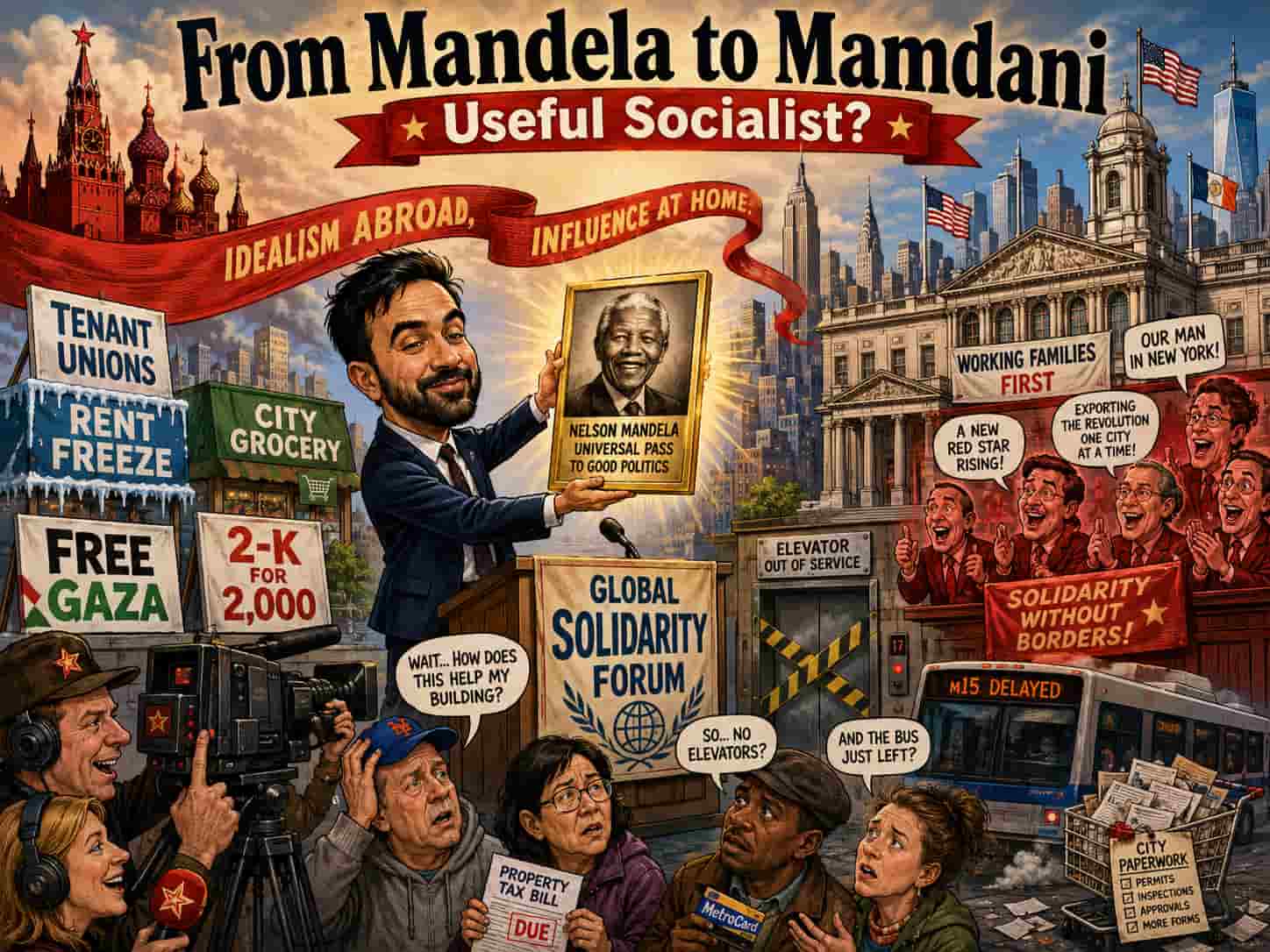
Satirical opinion column for Midtown Tribune
In the official video “Madiba’s Legacy,” New York City Mayor Zohran Mamdani speaks about Nelson Mandela, Palestine, political prisoners, immigrants, labor unions, and global solidarity.
New York City also receives a brief mention.
Mostly because the event happened in New York City.
Mandela Without the Communists, the Weapons, or the Soviet Union
Mamdani describes Mandela’s 1990 televised appearance with Ted Koppel almost as an ambush. In his telling, American journalists tried to portray the South African liberation leader as a terrorist, an extremist, and an obstacle to peace.
But those uncomfortable questions did not come from nowhere.
Mandela helped establish the ANC’s armed wing, Umkhonto we Sizwe, and acknowledged involvement in planning sabotage. The ANC worked closely with the South African Communist Party and received weapons, training, political assistance, and international support from the Soviet Union.
Declassified CIA assessments described the ANC as Moscow’s principal instrument for political change in South Africa. The Soviets also sought to promote the movement as the sole “legitimate representative” of the country’s Black population.
That part of the biography disappears from Mamdani’s speech.
What remains is a politically convenient saint: smiling, peaceful, and fully compatible with the current mayor’s agenda.
This is historical restoration, socialist style: remove the weapons, paint over the Kremlin, and write “global justice” across the top.
The Old Kremlin User Manual
The Soviet formula for political intervention was remarkably simple:
- Find a real injustice.
- Declare one radical movement the only authentic voice of the oppressed.
- Support it with money, weapons, training, and propaganda.
- Brand every opponent an enemy of the people.
- After institutions collapse, blame colonialism and capitalism.
For decades, Moscow used variations of this method while “helping” countries across Africa, Asia, Latin America, and Eastern Europe.
The assistance frequently left behind a party elite, shortages, corruption, and a monument to the liberator roughly the size of the national budget.
Today, tanks are optional.
RT, social media, and a candidate who repeats the right rhetoric voluntarily can do much of the work.
Mamdani and the Moscow Media Chorus
There is no public evidence that the Kremlin controlled Mamdani’s campaign or that Mamdani is a Russian agent.
The available record shows something different: Russia’s state media system quickly recognized him as a politically useful product.
RT portrayed the young socialist favorably—as an opponent of Donald Trump, wealthy interests, Republicans, and the old political establishment. After Mamdani’s victory, Russian communists described him as a possible “partner” and noted similarities between his proposals and their own program.
The sequence is difficult to ignore:
- American socialists promote the candidate.
- Russian state media presents him as a courageous agent of change.
- Russian communists recognize an ideological relative.
- After winning, Mamdani celebrates the leader of a movement the Soviet Union supported for decades.
This may all be a coincidence.
Like a hammer, a sickle, and a red flag accidentally appearing on the same poster.
Free Buses Leave Without the Mayor
During the campaign, Mamdani promised free buses.
The bus now appears to have departed without him.
The idea was never entirely new. New York had experimented with fare-free routes and emergency transportation programs long before the current mayor. Even Michael Bloomberg—originally elected as a Republican—introduced free shuttle services during emergencies without delivering a lecture on world revolution.
The free-bus slogan has now been joined, or replaced, by a more ambitious collection of promises:
- tenant unions;
- rent freezes;
- city-owned grocery stores;
- “Free Gaza” politics;
- new taxes;
- new commissions;
- and new reasons for businesses to consider Florida.
Soon, every apartment building may have a union president, a recording secretary, and a commissioner for international solidarity.
The elevator will still be broken, but the lobby will have formally condemned imperialism.
Free Child Care for the Fortunate Few
Mamdani promised an expansive system of free child care.
The first phase of the 2-K program provides approximately 2,000 seats. For the families who receive them, the benefit is real and valuable.
But in a city of millions, the word “universal” may be arriving slightly ahead of the service.
The system follows a familiar political formula:
Two thousand children receive a seat.
Everyone else receives a press release.
All taxpayers receive the bill.
A Raise for the Leader of the Affordability Revolution
While the administration was fighting New York’s cost-of-living crisis, a city commission recommended increasing the mayor’s salary from $258,750 to $305,800—a raise of roughly $47,000.
Mamdani later declined the increase. That was the right decision and deserves acknowledgment.
But the process itself was magnificent.
A commission was created to determine whether the man leading the struggle for affordability was living comfortably enough.
The commission concluded that he was suffering.
The mayor declined the opportunity to suffer less.
For once, socialism encountered money it did not immediately need.
Mandela as a Political Credit Card
In Mamdani’s speech, Mandela’s name is used to finance nearly every modern progressive cause.
Palestine? Mandela would approve.
Labor unions? Mandela would approve.
Immigration activists? Absolutely.
A campaign against wealth and private power? Historically authorized.
Mandela becomes a universal political credit card.
No PIN is required because the cardholder is no longer available to dispute the charges.
That is the great advantage of a historical symbol: he never asks to see the budget.
The Kremlin Does Not Need an Agent. It Needs an Outcome.
Modern influence operations do not always require secret meetings, coded messages, or suitcases full of cash.
The Kremlin can benefit simply by amplifying political forces that:
- deepen internal conflict in the United States;
- turn social groups against one another;
- attack markets and private property;
- transform municipal government into a platform for international revolution;
- and promise free services whose costs will be paid by someone else.
Mamdani may sincerely believe every part of his program.
That may be precisely what makes him useful to Russian propaganda.
The most convenient instrument is the one that regards itself as fully independent.
Different Eras, Same Packaging
The Soviet Union assisted the ANC with weapons, training, political support, and propaganda.
Modern Russia supports useful political narratives through media amplification.
Then, there was Mandela.
Today, Russian state media has found Mamdani interesting.
Then, the promise was to liberate South Africa.
Now, the promise is to make New York “affordable” through city-owned stores, rent controls, tenant unions, taxation, and global solidarity.
Different decades.
Different cities.
The same slogans.
And the same old Kremlin dream: that America will dismantle its own institutions by itself—democratically, ceremonially, and preferably at the taxpayers’ expense.
Sources and Primary Documents
Mamdani’s Mandela Speech
- NYC Mayor’s Office — “Madiba’s Legacy” Official Video
- NYC Mayor’s Office — Mayor Mamdani’s Nelson Mandela Global Leadership Forum Address
Mandela, the ANC and Soviet Support
- South African National Archives — Rivonia Trial Records
- South African National Archives — Rivonia Indictment and Prosecution’s Opening Address
- CIA Reading Room — The African National Congress of South Africa
- CIA Reading Room — The Soviet “Legitimate Representative” Strategy in South Africa
- South African Truth and Reconciliation Commission — Final Report, Volume Two
Official U.S. Records on Russian Influence Operations
- U.S. Treasury — RT Executives and Russian Foreign Influence Operations
- U.S. Treasury — Kremlin-Directed Malign Influence Campaigns
- U.S. Treasury — Russian Election-Influence Networks, RT and Doppelgänger
- U.S. Treasury — TV-Novosti, the Russian State-Funded Organization Controlling RT
Russian State Media Coverage of Mamdani
- RT Commentary — “What Does a ‘Socialist’ in Charge of New York Really Mean?”
- RT — Russian Communists Call Mamdani a Potential “Partner”
- RT — Socialist Zohran Mamdani Elected Mayor of New York City
- RT — Mamdani Promises a Democratic Socialist “New Era”
Mamdani’s Socialist Political Support
- NYC Democratic Socialists of America — Zohran Mamdani for Mayor
- NYC-DSA — “Socialism Wins” Statement on Mamdani’s Victory
Editorial note: Declassified CIA documents reflect U.S. intelligence assessments from the period in which they were written. RT links are included as primary evidence of how Russian state media presented Mamdani, not as independent verification of its claims. Favorable Russian coverage does not by itself prove that the Kremlin controlled Mamdani or his campaign.
Ask Midtown Tribune about this story
Answers are grounded first in this article. Search all Midtown Tribune reporting from the main AI Search page.
AI-generated summary. Verify important details in the linked original articles.