
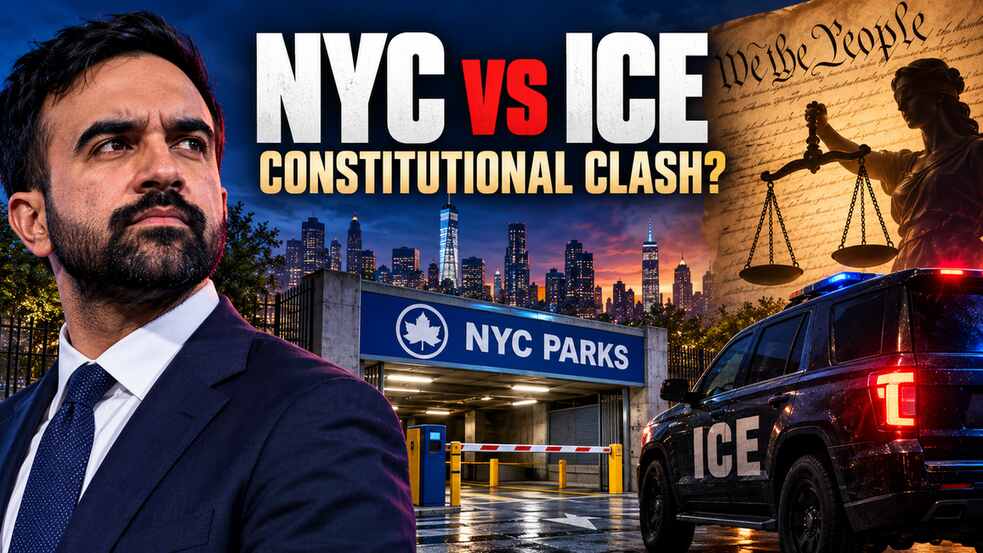
NEW YORK, Nov. 2, 2026 — Mayor Zohran Mamdani has warned the Department of Homeland Security that New York City may sue if Immigration and Customs Enforcement (ICE) continues using city-owned parking lots to stage operations. The demand raises a consequential constitutional question: Can a city bar federal immigration officers from public property, or would such a restriction interfere with federal authority?
The answer is not as simple as either side may suggest. New York City has substantial power to manage its own property and decline voluntary assistance to federal immigration enforcement. But the Constitution also prevents state and local officials from directly regulating or discriminating against lawful federal operations. Whether a city rule crosses that line depends on the text of the restriction, the kind of property involved and how the city enforces it.
What Mayor Mamdani announced
In a Nov. 2 statement, the Mayor’s Office said ICE personnel had reportedly used unstaffed city lots, including a location in Van Cortlandt Park in the Bronx and lots along 111th Street beside Flushing Meadows Corona Park in Queens. The city said it had not authorized those operations. Its letter to DHS Secretary Markwayne Mullin and ICE officials demanded instructions barring agents from using city property for staging and threatened litigation if the reported practice continued.
The administration also announced updated procedures for NYC Parks staff responding to non-local law enforcement seeking access to park property. The mayor’s letter and Parks rules are primary documents relevant to the dispute.
The Supremacy Clause: federal law is supreme
Article VI, Clause 2 of the U.S. Constitution makes valid federal law supreme over conflicting state and local measures. Immigration enforcement is an area in which federal law plays a dominant role. In Arizona v. United States (2012), the Supreme Court emphasized federal control of immigration removal decisions. A mayor cannot cancel federal immigration statutes, order ICE to stop enforcing federal law throughout New York City or use local rules to override a valid federal mandate.
A related principle is intergovernmental immunity: local government may not directly control the federal government as a government or single it out for unfavorable treatment because of its federal functions. The Supreme Court applied that principle in United States v. Washington (2022). These doctrines create a possible constitutional challenge to a policy that excludes ICE from facilities otherwise open to comparable users solely because city officials oppose federal immigration policy.
The Tenth Amendment: NYC cannot be forced to help ICE
There is another side to the constitutional balance. The Tenth Amendment and the Supreme Court’s anti-commandeering cases protect state and local government from being compelled to administer federal regulatory programs. In Murphy v. NCAA (2018), the Court reaffirmed that Washington generally cannot command state officers to carry out a federal program.
That means a city may ordinarily refuse to lend municipal employees, equipment or discretionary cooperation to federal civil immigration enforcement, subject to specific federal laws. Refusing to assist is legally different from physically obstructing agents or imposing a discriminatory exclusion from a public facility. The city’s status as property owner does not automatically resolve that distinction.
A court case directly relevant to public facilities
In United States v. King County (2024), the U.S. Court of Appeals for the Ninth Circuit held that a county policy targeting services for ICE deportation flights at a publicly owned airport violated intergovernmental immunity. The court distinguished a local government’s right not to participate in immigration enforcement from using control over a public facility to discriminate against federal operations.
That ruling is not binding precedent in New York, which falls within the Second Circuit. Nor does an airport serving private aviation operators present identical facts to an unstaffed park parking lot. Still, it is a serious warning that public ownership alone may not justify a categorical ICE-only ban. The Justice Department has also relied on similar constitutional arguments in litigation challenging local restrictions on federal immigration activity elsewhere.
Did Mamdani violate the Constitution? What could happen?
No court finding establishes a constitutional violation by Mayor Mamdani in this parking-lot dispute. A demand letter and threatened lawsuit do not, by themselves, prove unconstitutional conduct. The city might have a stronger argument if it is enforcing neutral parking, safety, access-control or property-use rules applicable to everyone, especially in restricted or nonpublic areas. Federal authorities may have a stronger argument if ICE is barred from ordinary public parking areas while similarly situated users remain welcome, or if city officials attempt to interfere with agents performing lawful duties.
If negotiations fail, the city could file suit seeking a declaration of its property rights or an injunction against unauthorized staging. The federal government could respond with a counterclaim or its own lawsuit asserting federal supremacy and intergovernmental immunity. A federal judge could deny relief, narrow a city policy or enjoin enforcement of a restriction found unconstitutional. Appeals could follow. Those are possible civil outcomes, not penalties that follow automatically from the mayor’s announcement.
The constitutional dispute also does not automatically create personal criminal liability for the mayor. That would require distinct conduct meeting the elements of a federal criminal statute—not simply political disagreement or filing a lawsuit. Publicly available material in the Nov. 2 release does not establish such conduct.
What remains unresolved
The key factual questions are whether the lots were truly open to unrestricted public use; whether ICE’s reported activity went beyond ordinary parking into prolonged operational staging; what rules the city applies to comparable law enforcement users; and whether federal law authorizes the particular use in question. A court would need a developed factual record and the actual operative policy, not just competing press statements.
Bottom line: Mamdani can advocate for sanctuary policies and generally withhold voluntary city assistance. He cannot nullify federal immigration law. An ICE-specific ban on otherwise public city facilities could face a substantial Supremacy Clause challenge, but the present announcement alone does not establish that the mayor has violated the Constitution.
Official sources and court records
NYC Mayor’s Office, Nov. 2 announcement · Mayor’s letter to DHS · Ninth Circuit, United States v. King County · Supreme Court, Murphy v. NCAA · Constitution, Supremacy Clause · Constitution, Tenth Amendment.
Legal analysis for public information; not a judicial finding or legal advice.
Ask Midtown Tribune about this story
Answers are grounded first in this article. Search all Midtown Tribune reporting from the main AI Search page.
AI-generated summary. Verify important details in the linked original articles.