
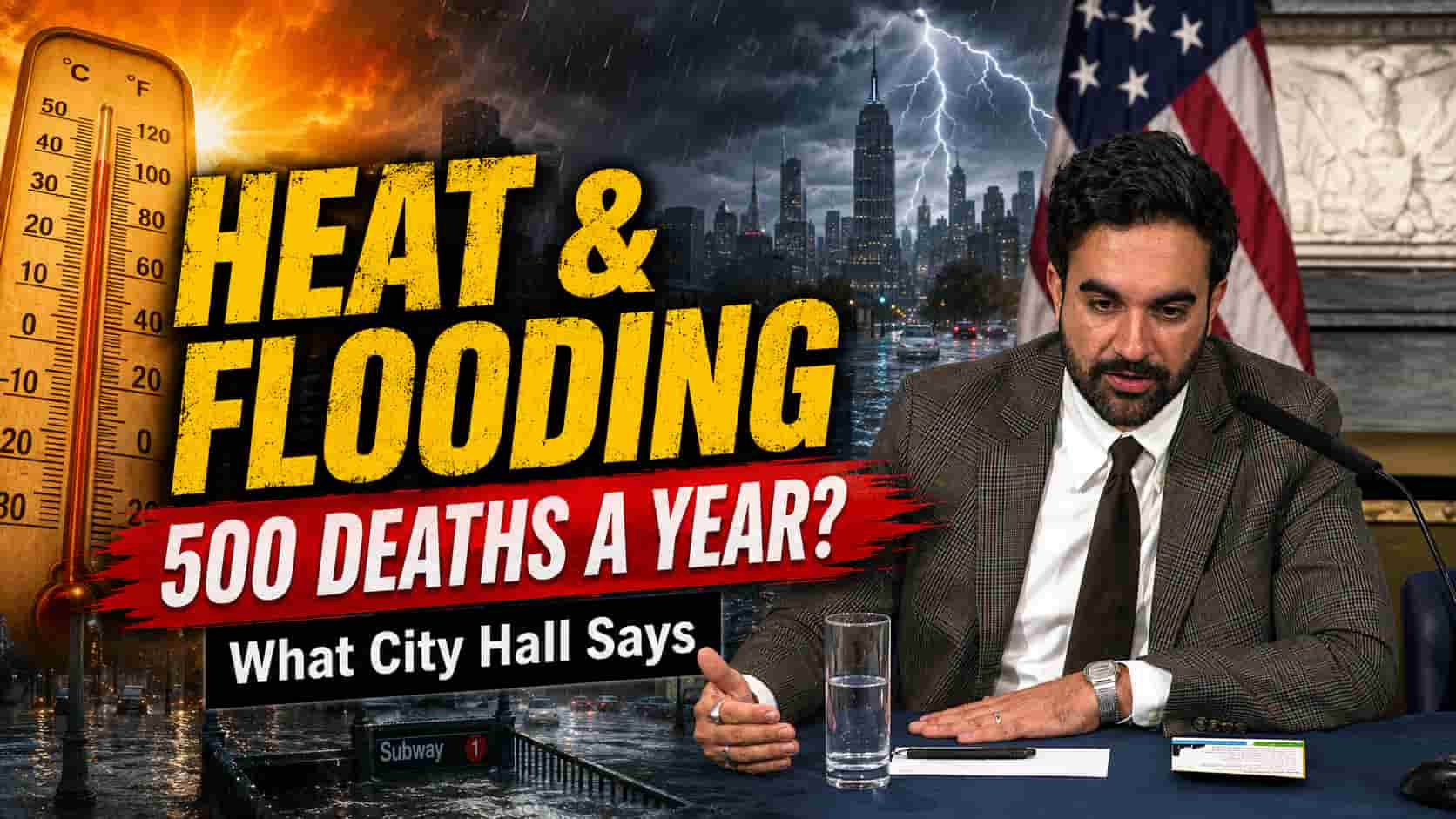
City Hall points to cooling centers, COOL vans, worker protections, flood preparations and multilingual emergency alerts as New York faces heat, flash-flood risks and hurricane season.
NEW YORK — August 7, 2026 — Extreme heat contributes to the premature deaths of approximately 500 New Yorkers every year, city health officials said Friday as Mayor Zohran Kwame Mamdani convened ethnic and community media at City Hall for a wide-ranging briefing on New York’s growing exposure to extreme weather.
The August 7 roundtable, held in the Blue Room at City Hall, came while the city was under a Heat Advisory, with heat-index values around 100 degrees and the possibility of thunderstorms and localized heavy rainfall.
Two days earlier, the Mamdani administration activated both the city’s Heat Emergency Plan and Flash Flood Emergency Plan, opened hundreds of cooling centers and began additional outreach to vulnerable New Yorkers.
But Friday’s discussion went considerably beyond the immediate forecast.
Mamdani and senior administration officials addressed extreme heat, flash flooding, basement apartments, subway disruptions, outdoor workers, coastal resilience, multilingual emergency communications and what the city says it is doing differently as severe weather becomes a recurring part of life in New York.
About 500 Heat-Related Deaths — but the Number Needs Context
One of the most striking figures came from Health Commissioner Dr. Allister Martin, who described heat as New York City’s leading environmental weather emergency.
Approximately 500 New Yorkers die prematurely because of hot weather during an average summer, according to the city’s 2026 Heat-Related Mortality Report.
But there is an important distinction behind that number.
The Health Department estimates an average of only about seven direct heat-stress deaths per year from 2016 through 2025. The much larger number — approximately 490 deaths annually in the latest available analysis — consists of “heat-exacerbated” deaths, in which hot weather worsens an underlying condition such as heart or lung disease.
That distinction matters. Saying that heat “kills 500 New Yorkers” can easily be interpreted to mean 500 people die directly from heat stroke. The city’s own data show a more complicated picture: most of the estimated mortality comes from heat aggravating existing medical conditions.
The same report says heat-related deaths occur disproportionately at home and that lack of access to affordable air conditioning remains an important risk factor.
More Than 600 Cooling Centers and New Health Department Locations
During Friday’s briefing, administration officials said the city has made more than 600 cooling centers available across the five boroughs during heat emergencies.
Libraries, senior facilities, community centers and other air-conditioned public locations can provide temporary refuge for residents who do not have adequate cooling at home.
The administration has also begun using Health Department Neighborhood Health Action Centers as cooling centers — including facilities serving Brownsville, East Harlem and the Bronx.
Martin described an example of an older couple who entered one of the centers simply to escape the heat but were also connected with nutrition services.
The approach reflects an attempt to make cooling sites more than air-conditioned rooms: some locations can also connect vulnerable residents with health and social services.
The city’s current emergency plan also includes 21 Cooling Outreach On-Location, or COOL, vans, which can provide wellness checks, medical assistance, electrolytes, sunscreen, meals and transportation to cooling centers or health facilities.
Thousands of LinkNYC kiosks are also being used to direct pedestrians to cooling centers within walking distance.
Outdoor Workers: Mamdani Says City Is Building New Heat Protections
A reporter asked what protections exist for New Yorkers whose jobs require them to remain outside when the heat index approaches 100 degrees.
Mamdani pointed to an executive order he signed in June directing city agencies to develop heat-illness prevention plans and workplace guidance.
The order requires a multilingual worker-education campaign, directs city agencies to create heat-prevention plans, requires the Department of Buildings to review construction-safety requirements related to heat and calls for better reporting and analysis of heat-related workplace injuries.
The administration has emphasized construction workers, delivery workers, airport baggage handlers and others who may have little ability to simply leave work and enter a cooling center.
During Friday’s roundtable, officials said pop-up cooling stations have also been deployed for outdoor workers, providing water, misting equipment and places to temporarily escape the heat.
However, the June executive order does not itself create a universal enforceable right to water, shade and rest breaks for every private-sector worker.
When Mamdani was asked that question directly when he signed the order, he described it as the beginning of a broader review of existing regulations and potential future protections.
That is an important distinction between the administration’s immediate measures and a comprehensive workplace heat standard.
Flash Flooding: Basement Apartments Remain One of the Biggest Dangers
Heat was only part of Friday’s discussion.
City officials repeatedly emphasized that flash flooding can become dangerous within minutes — particularly for people living in basements and below-grade apartments.
Mamdani acknowledged that previous storms have produced fatalities in such residences and argued that one part of the solution is bringing basement apartments up to legal safety standards.
But emergency officials stressed that regulation and long-term construction cannot substitute for an evacuation plan when water is already rising.
Residents in basement apartments are being urged to know where they can move to higher ground and to sign up for targeted emergency notifications.
That concern is not theoretical.
On July 28, ahead of a potentially life-threatening overnight flash-flood event, the administration opened 51 safe overnight locations — one in each City Council district — at public schools throughout the five boroughs.
The city told residents of basement apartments and previously flooded areas to leave early if they felt unsafe rather than wait for water to enter their homes.
During the roundtable, officials pointed to those 51 locations as an example of a new emergency response tool that can be activated again when dangerous overnight flooding threatens the city.
Mamdani: More Than 71,000 Catch Basins Cleared
Asked about transportation problems during severe storms, including flooded subway stations, Mamdani acknowledged that New York’s aging infrastructure remains a major challenge.
He said his administration is discussing flood resilience with the MTA and argued that New Yorkers should not simply accept repeated subway flooding as inevitable.
Mamdani also said that the city has cleared more than 71,000 catch basins during his first seven months in office, describing drain maintenance as one of the simplest preventive measures available before heavy rainfall.
Blocked catch basins cannot by themselves explain major flooding — New York’s sewer system can also be overwhelmed when rainfall intensity exceeds its capacity — but keeping drains clear can prevent leaves, trash and other debris from making the problem worse.
The administration previously announced a $108 million program to upgrade or replace more than 6,700 catch basins over the next decade, along with the purchase of 40 modernized cleaning trucks.
When the Subway Floods, What About Uber Surge Pricing?
One community-media reporter raised a particularly practical New York question: if severe weather floods subway stations and disrupts public transportation, what happens when residents turn to ride-hailing apps and encounter surge pricing?
Mamdani did not announce a new restriction on Uber or Lyft surge pricing.
Instead, he noted that surge pricing is part of the companies’ business model and reminded New Yorkers that yellow taxis do not use the same dynamic surge-pricing system.
The exchange highlighted a problem that emergency-preparedness announcements do not always address: even when government tells residents to avoid difficult travel conditions, millions of New Yorkers still have to get to work.
Southeast Queens and the Cost of Years of Flooding
Another reporter challenged the administration on the disproportionate effects of extreme heat and flooding in historically underinvested neighborhoods, particularly in the outer boroughs.
Mamdani responded by acknowledging that some communities have spent years “last on the list” — or not on the list at all.
He pointed specifically to major flood-control investments in Southeast Queens and described a combination of infrastructure strategies including porous pavement, bioswales, stormwater projects and “cloudburst” systems designed to temporarily capture large volumes of rain.
The administration has separately committed $95 million to a Cloudburst project in Homecrest, Brooklyn, and $108 million to citywide sewer and catch-basin improvements.
Mamdani also acknowledged that rebuilding public trust will take more than announcing new projects.
He recalled speaking with residents who had dealt with flooding for decades and said homeowners who have watched multiple mayoral administrations come and go have reason to wait for results before believing another promise.
That may be one of the most consequential tests of the administration’s climate policy: not how much money City Hall announces, but whether chronically flooded streets and homes actually experience measurable improvement.
$43.2 Million Expansion of the Bureau of Coastal Resilience
Extreme rainfall is only one part of the city’s risk.
Mamdani also pointed to the expansion of the Department of Environmental Protection’s Bureau of Coastal Resilience, which is responsible for coordinating New York’s growing system of flood walls, gates and other protections against storm surge and rising seas.
The administration announced in July that it is investing $43.2 million across the financial plan to add 69 employees, including engineers, planners, field crews and flood-risk specialists.
The bureau is responsible for a portfolio that includes the East Side Coastal Resiliency system and other major coastal projects.
City officials said the goal is to learn from Hurricane Sandy while ensuring that the billions of dollars already being spent on physical flood protection can actually be operated and maintained when the next major storm arrives.
The Role of Ethnic Media: “No Hierarchy of Information”
Perhaps the most relevant exchange for the purpose of Friday’s roundtable came from a reporter serving an immigrant community in Brooklyn.
The reporter pointed out that many older residents do not use Instagram or other social media, and many do not use English as their primary language. Some also have medical conditions that make extreme heat particularly dangerous.
The question was simple: How will those residents receive an emergency warning?
Mamdani said the city should have “no hierarchy of information based upon what language you speak.”
He told the reporters around the table that ethnic newspapers, television stations and radio outlets are themselves part of the city’s emergency communications infrastructure because many New Yorkers trust those sources more than English-language government messaging.
Emergency Management officials said Notify NYC provides alerts in multiple languages, as well as American Sign Language, and that residents who call 311 can access interpretation services in hundreds of languages.
Recent Notify NYC flood alerts have been distributed in English along with ASL, Arabic, Bengali, Chinese, French, Haitian Creole, Italian, Korean, Polish, Russian, Spanish, Urdu and Yiddish.
That may explain why City Hall convened ethnic and community media for a weather briefing in the first place.
An emergency warning that never reaches the resident at risk is not much of a warning.
Hurricane Season Is Still Ahead
City officials also stressed that this summer has already brought unusually varied weather — extreme heat, wildfire smoke, heavy rain and repeated flash-flood threats — while the most active portion of Atlantic hurricane season is still ahead.
In late July, Mamdani announced a major expansion of the city’s coastal-resilience bureaucracy, noting that approximately 440,000 New Yorkers, 14,500 businesses and about $250 billion in property value are located within the city’s 100-year floodplain.
The current heat emergency shows the other side of the problem.
New York does not need a hurricane to experience deadly weather.
According to the city’s own health data, ordinary hot summer days — not only record-breaking heat waves — contribute substantially to heat-related mortality. The Health Department says the number of New York summer days above 86 degrees has more than doubled over roughly five decades.
Preparedness Is Increasing — but So Is the Test
Friday’s roundtable offered an unusually broad picture of how the Mamdani administration views extreme weather.
The strategy includes immediate measures — cooling centers, COOL vans, worker cooling stations, emergency alerts and safe overnight locations — alongside long-term infrastructure investments in storm sewers, catch basins, cloudburst projects and coastal barriers.
There are also unresolved questions.
Can the city reach elderly and immigrant residents before an emergency rather than after it? Will workplace guidance develop into enforceable protections? Can basement residents evacuate quickly enough when flash flooding arrives overnight? Can investments finally reduce recurring flooding in communities that have heard similar promises for decades?
And perhaps most importantly, can New York’s century-old infrastructure adapt quickly enough to weather conditions that City Hall itself says are becoming more extreme?
For now, the administration’s message is simpler: extreme weather should no longer be treated as an occasional disruption.
It is becoming part of the basic work of running New York City.
Midtown Tribune | New York City
Official Source Check: What NYC Government Records Confirm
Midtown Tribune reviewed official New York City government records to compare the claims made during Mayor Zohran Mamdani’s August 7, 2026 extreme-weather media roundtable with published city data. Most of the major figures cited by the administration are supported by official records, although several require important context.
✅ CONFIRMED — Heat contributes to approximately 500 premature deaths per year.
The NYC Department of Health’s 2026 Heat-Related Mortality Report estimates approximately 500 heat-related deaths during an average warm season.
However, this does not mean roughly 500 New Yorkers die directly from heat stroke.
The report separates the estimate into an average of about 7 direct heat-stress deaths per year and approximately 490 heat-exacerbated deaths, in which heat worsens an underlying illness such as heart disease.
NYC Health — 2026 Heat-Related Mortality Report
NYC Department of Health — Official Release
✅ CONFIRMED, WITH CONTEXT — New York City has operated more than 600 cooling centers during heat emergencies.
NYC Emergency Management announced more than 600 cooling centers for a June 2026 heat event.
The precise number changes depending on the emergency and which facilities are available; other 2026 city announcements describe “hundreds” of cooling centers rather than a fixed 600-plus network operating at all times.
NYC Emergency Management — More Than 600 Cooling Centers
✅ CONFIRMED — The city expanded its COOL van program to 21 vehicles.
City Hall’s July 3 transcript specifically refers to 21 Cooling Outreach On-Location (COOL) vans.
The vans can provide water, electrolytes, medical checks and transportation to cooling centers or health-care facilities.
NYC Mayor’s Office — COOL Van Program
✅ CONFIRMED — Mamdani issued an executive order addressing worker exposure to extreme heat.
Executive Order No. 17, signed June 22, 2026, directs city agencies to develop heat-illness prevention measures, improve worker education, review construction protections and strengthen reporting of heat-related incidents.
Important limitation: the executive order should not be described as creating a universal new statutory right to mandatory water, shade and paid rest breaks for every private-sector worker in New York City. It directs agencies to develop and enforce measures under existing city authority.
NYC Mayor’s Office — Executive Order No. 17
✅ CONFIRMED — The city opened 51 safe overnight locations during the July flash-flood threat.
On July 28, City Hall announced 51 safe overnight locations — one in each City Council district — for residents facing potentially life-threatening overnight flooding, with particular warnings directed at residents of basement apartments and previously flooded areas.
NYC Mayor’s Office — 51 Safe Overnight Locations
✅ CONFIRMED — $108 million for more than 6,700 catch basins, plus 40 new cleaning trucks.
The NYC Department of Environmental Protection announced a $108 million program to replace 6,708 older catch basins over the next decade.
The city also cited a separate $20 million purchase of 40 modernized catch-basin cleaning trucks.
NYC Mayor’s Office — $108 Million Catch Basin Program
NYC DEP — Sewer Performance and Catch Basin Investment
⚠️ NOT YET INDEPENDENTLY VERIFIED — “More than 71,000 catch basins cleared” during Mamdani’s first seven months.
Mayor Mamdani cited this figure during the August 7 roundtable.
Midtown Tribune located official NYC records confirming extensive catch-basin maintenance, a network of more than 150,000 catch basins, new cleaning equipment and major capital investments.
However, we did not locate a separately published NYC government report or data release confirming the specific 71,000 figure.
That does not establish that the number is false; it means the specific figure currently relies on the administration’s statement at the roundtable rather than a separately published dataset located by Midtown Tribune.
✅ CONFIRMED — $95 million Homecrest Cloudburst project.
NYC DEP announced $95 million for a stormwater-management project in Homecrest, Brooklyn.
The project is designed to use porous pavement and underground storage systems to reduce street flooding and is expected to manage approximately 30 million gallons of stormwater annually.
NYC DEP — $95 Million Homecrest Cloudburst Project
✅ CONFIRMED — $43.2 million and 69 additional staff for coastal resilience.
City Hall and DEP announced a $43.2 million expansion of the Bureau of Coastal Resilience, including funding for 69 additional employees such as engineers, planners, field crews and flood specialists.
NYC Mayor’s Office — Bureau of Coastal Resilience Expansion
✅ CONFIRMED — Approximately 440,000 residents, 14,500 businesses and $250 billion in property are within the current 100-year floodplain.
These numbers appear in the city’s July 24 announcement on coastal resilience.
NYC’s FY2027 Climate Budget also states that approximately one-sixth of New York City lies within the present-day 100-year floodplain, representing approximately $250 billion in property value and exposing about 440,000 residents to flood risk.
NYC Mayor’s Office — Floodplain Statistics
✅ CONFIRMED — NYC emergency information is distributed in multiple languages.
Notify NYC publishes emergency information in multiple languages and provides American Sign Language versions of alerts.
The city also requires language-access services across agencies, including free interpretation and materials in designated citywide languages.
Notify NYC — Official Emergency Alert System
NYC Mayor’s Office of Immigrant Affairs — Language Access
📊 RELATED MIDTOWN TRIBUNE RESEARCH — Historic Extreme Temperature Records
For additional historical context, Midtown Tribune previously reviewed extreme temperature records from New York and other major cities around the world.
The article notes that New York City’s historic high-temperature record dates to
July 9, 1936, when 107°F (41.7°C) was recorded, illustrating that extreme heat events are not unique to recent years.
Midtown Tribune — How Historic Temperature Records Challenge the Global Warming Narrative
Bottom line: Official NYC records support most of the major factual claims presented during the extreme-weather roundtable. The most important clarification concerns the often-repeated figure of approximately 500 heat-related deaths: the overwhelming majority are statistically estimated heat-exacerbated deaths, not deaths directly attributed to heat stroke. The specific claim that more than 71,000 catch basins were cleared during the administration’s first seven months could not yet be independently confirmed through a separately published city dataset located by Midtown Tribune.
Ask Midtown Tribune about this story
Answers are grounded first in this article. Search all Midtown Tribune reporting from the main AI Search page.
AI-generated summary. Verify important details in the linked original articles.