
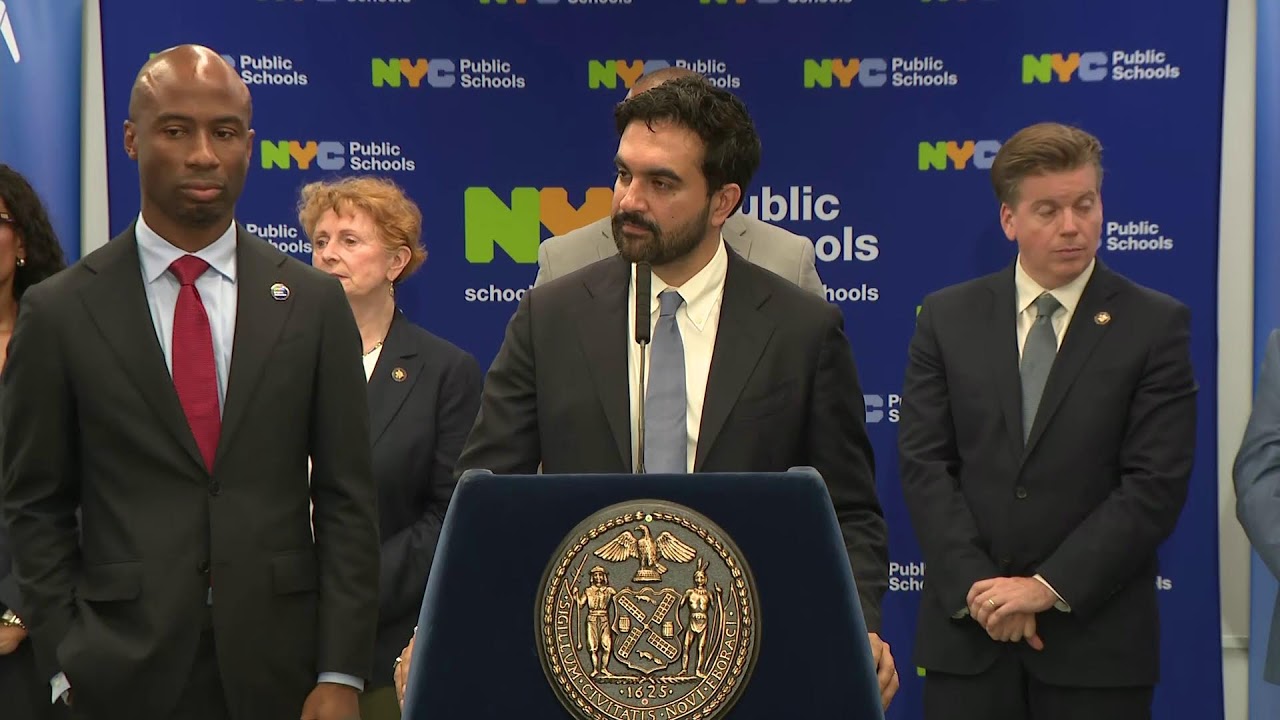
Mamdani administration imposes one-year generative AI moratorium for younger students, shuts down AI features in dozens of school programs and requires AI literacy for high schoolers
NEW YORK — New York City is drawing one of the sharpest lines yet between artificial intelligence and childhood education.
Mayor Zohran Mamdani and Schools Chancellor Kamar Samuels have announced a one-year moratorium on student-facing generative AI for students from 2-K through eighth grade, while allowing tightly controlled AI use for high school students.
The new rules take effect during the 2026–27 school year and will affect nearly 600,000 students — roughly two-thirds of the New York City public school system, according to the Mayor’s Office.
The administration is also ordering schools to disable or discontinue AI functionality in more than 38 educational programs that do not meet the city’s new standards.
At the same time, high school students will not be cut off from AI entirely.
Instead, the city will introduce five approved AI pilots, require AI-literacy instruction and allow supervised AI use in career and technical programs.
The result is not an outright rejection of artificial intelligence.
It is a policy built around a distinction:
younger children should learn primarily from teachers, classmates and direct human interaction; older students should learn how to work with AI before entering an increasingly AI-driven economy.
Watch the full NYC education announcement on YouTube
“Just Because Technology Is Everywhere Doesn’t Mean It Belongs Everywhere”
Speaking at the Brooklyn STEAM Center in the Brooklyn Navy Yard, Mamdani described artificial intelligence as a technology that has moved from science fiction into everyday life within only a few years.
But he argued that its rapid spread does not mean schools should automatically adopt it.
The administration’s stated principle is that children need teachers, relationships with classmates and the experience of struggling with difficult questions themselves.
Mamdani said he had not seen convincing independent evidence that generative AI benefits elementary and middle school students, distinguishing such research from studies funded by companies that stand to profit from educational AI products.
The announcement described the policy as New York City’s first comprehensive AI policy for public schools.
Generative AI Banned for Students From 2-K Through Grade 8
The clearest part of the policy applies to younger students.
For the 2026–27 school year:
| Grade | Student-Facing Generative AI | Individual Screen Time |
|---|---|---|
| 2-K–2 | Banned | No routine 1:1 screen time |
| 3–5 | Banned | Recommended maximum 30 minutes per day |
| 6–8 | Banned | Recommended maximum 45 minutes per day |
| 9–12 | Limited approved use | Depends on school/course |
NYC Public Schools says the restrictions apply specifically to student-facing generative AI — technology capable of creating text, images, audio or other material in response to prompts.
The city argues that such systems can produce false or biased information and can allow children to bypass the cognitive work required for learning.
The restrictions do not mean every computer disappears from elementary and middle school classrooms.
Teacher-led screens, smart boards and other instructional technology can still be used.
Exceptions also exist for assessments, coding, robotics, e-books, remote instruction and other centrally approved educational activities.
ChatGPT and Claude Will Not Become Part of the Curriculum
Mamdani also drew a distinction between the five approved high-school pilots and general-purpose AI chatbots.
He said the pilot program is not an introduction of ChatGPT, Claude or similar open-ended chatbots into the curriculum.
The city says companion chatbots will be prohibited across all grade levels.
The administration’s concern is not merely whether AI produces correct answers.
Officials repeatedly emphasized the danger of allowing a machine to perform the intellectual struggle that they believe students need in order to learn.
Schools Chancellor Kamar Samuels put it in direct terms during the announcement: students need to get problems wrong, try again and eventually solve them rather than outsource the process to an algorithm.
High School Students Will Be Treated Differently
The city’s approach changes substantially once students reach high school.
NYCPS says teenagers are entering a workforce in which artificial intelligence will increasingly be a routine professional tool.
The city therefore plans three major forms of high-school AI use.
1. Required AI Literacy
Every high school student will be required to complete two 45-minute AI literacy modules each year.
The coursework will address:
- how artificial intelligence works;
- misinformation and inaccurate AI output;
- bias;
- data privacy;
- ethical use;
- overreliance on AI;
- AI’s effect on careers and the future workforce.
Students participating in AI pilots or career-readiness programs will receive more extensive instruction.
Chancellor Samuels said the goal is to ensure students understand AI’s risks without allowing the technology to do their critical thinking for them.
Five AI Programs Will Be Piloted
NYC Public Schools has identified five approved high-school pilot programs:
Quill
Edia
Brisk Teaching
Playlab
Intel AI-Ready Schools
Any high school may apply to participate, but applications will be reviewed individually.
The city says a student participating in the pilots will be limited to one program, and most of the tools are designed for relatively short sessions rather than continuous AI use.
NYCPS lists expected weekly use ranging from roughly 15 minutes for Quill to 45 minutes for Playlab, while Intel AI-Ready Schools may be used for one class period per week as part of a scheduled course.
The Mayor’s Office says participation will be limited to no more than 50,000 high school students in general-education classes, representing approximately 5% of the total public-school student population.
AI Will Be Allowed for Career Training
Students enrolled in programs such as Career and Technical Education may also use approved AI tools under teacher supervision.
The rationale is practical.
The administration argues that students preparing for careers in fields where AI is already becoming standard need experience with the technology before graduating.
The difference, according to Chancellor Samuels, is that the technology will be introduced deliberately rather than simply placed in students’ hands without rules or supervision.
More Than 38 Existing AI Programs Are Being Disabled
One of the most consequential parts of the announcement received less attention than the moratorium itself.
Mamdani said the city had identified more than 38 previously permitted educational programs containing AI functionality that failed to meet the administration’s new safety and oversight requirements.
Their AI components will now be disabled or the programs will be removed from schools.
During questioning by reporters, administration officials confirmed that AI functionality embedded in major educational products will also be affected.
A reporter specifically asked about Amira, reading products from HMH, and Google Gemini functionality.
A senior education adviser responded that where AI functionality can be switched off, it will be switched off — including in Amira and HMH products.
If AI cannot be separated from a product, she said, the product will be removed from use entirely.
The administration says it has now catalogued both the programs that will be discontinued and the five programs approved for pilot use.
Teachers Can Still Use AI — But Not for Grading
The moratorium is primarily aimed at student-facing AI.
Teachers will still be allowed to use approved AI products for planning and certain operational tasks.
But Chancellor Samuels said the existing guidance remains in place: teachers may use AI for planning, but not for grading or assessment.
That distinction could become increasingly important as teacher-facing AI tools spread through school software.
Parents Had Already Been Complaining About AI in Classrooms
City Council Member Lincoln Restler said the policy followed complaints from parents about children interacting with AI-based reading programs.
Restler said he received dozens of complaints during the previous school year from families whose children were speaking to AI programs while learning to read.
According to Restler, parents, teachers and principals at some schools opposed the technology even while parts of the education bureaucracy were pushing for its use.
He described the new rules as an effective ban on AI programs for students through eighth grade, with targeted exceptions.
Special-Education and Multilingual Students Get Exceptions
The policy includes exemptions for students whose access to technology is required by an Individualized Education Program (IEP) or 504 Plan.
Officials gave eye-tracking technology as one example.
A student with severe cerebral palsy or ALS could use eye-tracking technology to write, even if that means exceeding ordinary screen-time limits.
Multilingual learners will also retain access to approved translation and communication technologies.
NYCPS stresses that the policy is intended to reduce unnecessary technology use, not eliminate tools required for students to communicate or access instruction.
Why Only a One-Year Moratorium?
Some parent groups had sought a longer restriction.
At the press conference, a Politico reporter asked why the administration selected a one-year moratorium rather than two years.
Mamdani said the administration wanted enough time to evaluate results.
If evidence supports extending the restrictions, the city may extend them.
If the experience shows that changes are needed, the rules can be amended.
The mayor said decisions would be based on results and feedback from teachers, principals and students.
A New Technology in Schools Coalition
The policy is therefore explicitly temporary rather than permanent.
NYCPS is creating a Technology in Schools Coalition composed of students, teachers, parents, elected officials, advocates, union representatives and experts.
The coalition will monitor implementation during the school year and is expected to issue recommendations in April 2027 about what should happen next.
That could mean extending the moratorium, modifying it or expanding carefully controlled AI use.
The Larger Debate: Is AI a Tool — or a Shortcut Around Learning?
New York City’s policy arrives at the center of a much larger education debate.
AI systems can provide immediate explanations, translate text, personalize exercises, generate practice questions and help students with disabilities.
But they can also write essays, solve math problems and generate answers before a student understands the underlying material.
A reporter at the press conference raised exactly this problem: students can simply use generative AI at home to complete assignments.
The city conceded that school rules cannot eliminate outside AI use.
Instead, Chancellor Samuels said schools will continue working with teachers and parents on ways to recognize and respond to inappropriate AI use.
The administration’s philosophical answer is that productive struggle itself is part of education.
Students must sometimes not know the answer.
They must ask questions, make mistakes and learn how to solve difficult problems themselves.
For younger students, City Hall has decided that generative AI currently threatens that process more than it helps it.
A Major Shift From Earlier NYC School AI Policy
The change is especially notable because New York City once reacted to generative AI very differently.
When ChatGPT first exploded into public use, NYC schools temporarily restricted access to it.
The system later moved toward broader experimentation with artificial intelligence.
Now the Mamdani administration is drawing a much sharper age-based boundary.
High school students will be taught AI.
Younger students largely will not be allowed to interact with generative AI at all.
And educational technology vendors will have to demonstrate that their products are actually helping students — rather than simply persuading schools that the newest technology belongs in every classroom.
Mamdani framed the choice explicitly in terms of incentives.
AI companies exist to make a profit, he said.
Public schools exist to educate children.
That tension may become one of the most important education-policy debates of the AI era.
Key Facts
Policy year: 2026–27
2-K through Grade 8: Student-facing generative AI prohibited
Grades 9–12: Limited, supervised use
High-school AI literacy: Two 45-minute modules annually
Approved pilots: Quill, Edia, Brisk Teaching, Playlab and Intel AI-Ready Schools
Maximum general-education pilot participation: 50,000 high-school students
Existing AI programs affected: More than 38
Grades 2-K–2: No routine individual screen time
Grades 3–5: Recommended maximum 30 minutes per day
Grades 6–8: Recommended maximum 45 minutes per day
Exceptions: IEP/504 assistive technology, multilingual learners, approved assessments and career-readiness programs
Review: One-year policy, with recommendations expected in 2027
How New York’s AI Policy Compares With Other Global Cities
New York City’s decision to prohibit student-facing generative AI through eighth grade is notably more restrictive than approaches being adopted in several other major education systems. Under the official NYC Public Schools policy for 2026–27, student-facing generative AI is banned in grades 2-K through 8, while high-school use is limited to approved and vetted programs.
NYC Public Schools — Official AI and Screen Time Policy
Beijing is taking a different approach. The Beijing Municipal Education Commission has established an AI curriculum across primary and secondary schools and explicitly calls for age-appropriate AI education, including AI learning companions, human-AI interaction and project-based learning. In primary school the emphasis is on AI awareness and experience; in middle school, students are expected to learn how AI can support learning and daily life; in high school, the focus shifts toward practical application and innovation. Beijing also instructs schools to teach students to use generative AI scientifically, reasonably and cautiously.
Beijing Municipal Education Commission — AI Education Plan 2025–2027
Russia, including Moscow schools, is also moving AI education into earlier grades. Russia’s Ministry of Education says systematic AI instruction will continue during the 2026–27 school year, covering machine learning, AI applications, limitations and critical evaluation of AI-generated results. Beginning in the second quarter, schools nationwide are also introducing an “Artificial Intelligence and Information Security” course for grades 5–11.
Russian Ministry of Education — Students Will Be Taught to Use AI Responsibly
Russian Ministry of Education — AI and Information Security Course
Tokyo has gone further in direct classroom use. The Tokyo Metropolitan Board of Education introduced its protected Tokyo AI service across all 256 metropolitan schools under its direct administration, serving approximately 140,000 students. The system is designed so prompts are not used to train the underlying AI, inappropriate interactions are filtered, and students can use prepared prompt templates while learning how to work with generative AI.
Tokyo Metropolitan Board of Education — Generative AI Learning in Metropolitan Schools
Tokyo has also produced official generative-AI literacy materials intended to teach students the technology’s characteristics, risks and effective uses.
Tokyo Board of Education — Generative AI Literacy Materials
England, including London schools, does not impose a blanket national prohibition comparable to New York City’s K–8 moratorium. The UK Department for Education allows schools and colleges to make their own decisions about pupil-facing generative AI, including limiting it to particular subjects, age groups or educational stages, provided safeguarding, privacy and other legal requirements are met.
UK Department for Education — Generative AI in Education
The contrast raises a larger policy question: will New York’s one-year moratorium protect younger students’ ability to think independently, or will delaying hands-on AI experience put them behind students in competing global cities?
Read Midtown Tribune analysis: Even Moscow and Beijing Give Students More Room to Learn AI. Why Is Democratic New York Pulling It Out of K–8 Classrooms?
Official Sources
NYC Mayor’s Office — Mayor Mamdani and Chancellor Samuels Announce Generative AI Moratorium
NYC Mayor’s Office — Full Press Conference Transcript
NYC Public Schools — Official AI and Screen Time Guidance
NYC Public Schools — Family Guidance for the 2026–27 School Year
Full video of the announcement
Midtown Tribune reviewed the full press conference transcript, the Mayor’s Office announcement and NYC Public Schools’ formal AI and screen-time guidance for this report.
Ask Midtown Tribune about this story
Answers are grounded first in this article. Search all Midtown Tribune reporting from the main AI Search page.
AI-generated summary. Verify important details in the linked original articles.