
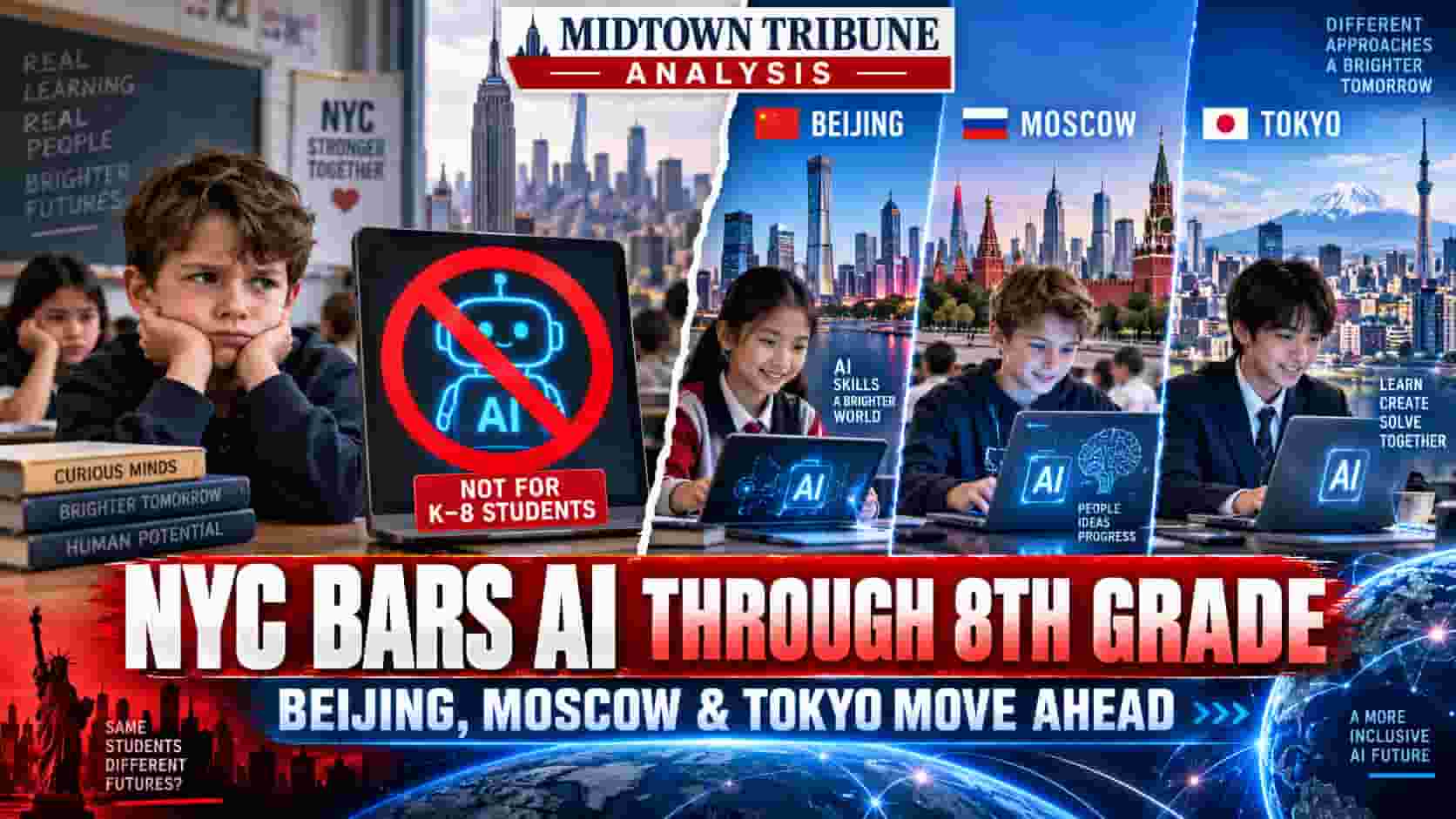
NYC’s new policy deliberately postpones hands-on access to generative AI for younger students. Whether that caution protects children — or creates an educational disadvantage against students overseas — may become one of the city’s most consequential education debates.
NEW YORK — September 2026. At precisely the moment governments around the world are trying to prepare children for an AI-dominated economy, New York City has chosen a remarkably different path.
Mayor Zohran Mamdani’s administration has imposed a one-year moratorium on student-facing generative artificial intelligence from 2-K through eighth grade, affecting nearly 600,000 students. In high school, students will receive only limited access through approved programs, with general-education pilots capped at roughly 50,000 students.
Mamdani ran and was elected as the Democratic candidate for mayor. Official NYC Board of Elections records identify him on the Democratic line.
The administration describes the policy as protection for childhood, critical thinking and the student-teacher relationship.
But compare New York’s approach with what is happening in Beijing, Moscow, Tokyo and England, and a difficult question emerges:
Is New York protecting students from an immature technology — or deliberately delaying their exposure to the most important productivity technology of their generation?
That distinction matters because the first part is unquestionably intentional.
New York City has deliberately decided that students through eighth grade should not directly use generative AI in school.
Whether that produces an actual educational lag is not yet proven.
But the exposure gap itself is policy, not accident.
New York: No Student-Facing Generative AI Through Eighth Grade
NYC Public Schools could hardly make the rule clearer.
For 2026–27:
| Grade | NYC student-facing generative AI policy |
|---|---|
| 2-K–2 | Banned |
| 3–5 | Banned |
| 6–8 | Banned |
| 9–12 | Limited to approved programs and specified uses |
NYCPS says younger students need human interaction and hands-on learning and warns that generative AI can produce inaccurate or biased information and allow students to bypass the intellectual work they need to perform themselves.
Mamdani went further in announcing the policy. He said he had not seen convincing evidence that AI benefits elementary and middle-school students, outside research financed by companies that could profit from selling AI products to schools.
That is a defensible educational argument.
But it is also an extraordinary bet.
Because other major world capitals are making a different one.
Beijing: Teach AI to Every Student
Consider Beijing.
Beginning in fall 2025, every primary and secondary school in Beijing was required to provide general AI education for at least eight class hours each academic year.
The Beijing education plan does not simply teach students that AI exists.
It explicitly calls for:
- AI learning companions;
- human-AI conversational learning;
- personalized adaptive learning;
- AI-supported project-based instruction;
- AI-assisted analysis of student learning;
- laboratories and practical AI experiences;
- AI tools that support independent student learning.
The age progression is deliberate.
Primary-school students receive experiential AI instruction.
Middle-school students are supposed to learn how AI can support their learning and daily life.
High-school students move toward practical application and innovation.
There are important restrictions.
China’s guidance does not give young children unrestricted access to open-ended generative systems. Beijing’s own government information notes that primary-age students are prohibited from independently using open-ended generative-content functions.
So this is not a story about Beijing handing ChatGPT to six-year-olds.
It is something more interesting.
Beijing restricts uncontrolled use while simultaneously requiring children to learn AI. New York restricts the student-facing technology itself through eighth grade.
That is a major philosophical difference.
China’s Goal Is Explicit: Prepare Students for the AI Era
China’s national Ministry of Education has described AI education as a means of developing innovative talent capable of handling future challenges.
Its national guidance calls for AI awareness in lower primary grades, understanding and using AI in later primary and middle school, and project creation and advanced applications in high school.
The Chinese system is highly regulated in ways that Americans would not ordinarily associate with educational freedom.
Yet on this particular question — how early children should begin learning to work with AI — Beijing is giving schools more room to introduce the technology than Democratic-led New York City.
That irony deserves attention.
Moscow: Russian Students Will Study AI Beginning in Grade 5
The Moscow comparison requires more precision because the relevant policy is national rather than a standalone Moscow City rule.
But Moscow schools operate under Russia’s federal education system, and the direction from Moscow’s own national government is clear.
For the 2026–27 academic year, Russia’s Ministry of Education says schools will continue systematically teaching artificial intelligence within computer-science education. Students are expected to learn basic AI concepts, machine learning, applications, limitations and critical evaluation of AI output.
And beginning in the second quarter of the school year, Russia plans to introduce a new course called “Artificial Intelligence and Information Security” for grades 5 through 11 nationwide.
Education Minister Sergey Kravtsov has explicitly said that the objective is to prepare students to use AI consciously and safely, understand its opportunities and risks, and eventually apply digital technologies professionally.
That means a fifth grader in Moscow may be receiving formal AI education while a fifth grader in New York City attends a school system where student-facing generative AI is under a blanket moratorium.
That does not prove Russian students have unrestricted access to ChatGPT-style systems.
The official Russian materials reviewed for this article do not establish such a policy.
But they do establish a meaningful contrast:
Russia is moving AI education downward into middle school while New York is deliberately keeping direct generative-AI use out until high school.
Tokyo Goes Further Still
Tokyo makes the contrast with New York even sharper.
The Tokyo Metropolitan Board of Education announced in 2025 that all 256 metropolitan schools under its direct administration, serving approximately 140,000 students, would begin learning with generative AI through a protected system called Tokyo AI.
The system includes safeguards: prompts are not used to train the model, inappropriate exchanges are filtered and prompt templates help students use the technology safely.
Tokyo’s official examples include using generative AI to explore different perspectives, create material and develop ideas.
In 2026, Tokyo expanded the strategy through an AI Lab program in which students use generative AI and other digital technologies to tackle social and community problems.
Tokyo is not asking whether AI should enter education someday.
It is asking how students can learn to use it properly now.
England Leaves the Decision to Schools
England takes yet another approach.
The UK Department for Education does not impose a blanket national ban comparable to New York City’s.
Instead, schools and colleges are expressly allowed to decide which generative-AI uses are appropriate, provided they follow safeguarding, privacy, age and legal requirements. Schools may allow pupil-facing AI in particular subjects, age groups or key stages.
In practice, English schools remain cautious: a government survey found that only 3% of primary teachers and 19% of secondary teachers reported that pupils were permitted to use generative AI for assigned work.
But that caution comes largely from schools themselves.
The national government has not told every student through eighth grade: you may not use student-facing generative AI.
New York has.
The Democratic Administration’s Argument
To understand the policy fairly, its supporters have a serious case.
Children do not need machines to do everything for them.
A student who asks AI to write an essay may avoid learning to write.
A child who lets a chatbot solve every math problem may never develop mathematical reasoning.
AI can hallucinate facts, reinforce bias and collect sensitive information.
And young children unquestionably benefit from conversation with teachers, play, reading, handwriting, experimentation and social interaction.
NYC Schools Chancellor Kamar Samuels argues that struggling with a difficult problem — getting it wrong and trying again — is itself part of education.
That principle deserves respect.
New York is also not banning AI education entirely.
High-school students must complete two 45-minute AI-literacy modules, career programs may use AI, and carefully vetted high-school pilots will continue.
The Mamdani administration therefore describes its policy as a pause and an experiment rather than a permanent technological prohibition.
But There Is a Major Problem With the “Protect Them Until High School” Model
The strongest criticism is not that children should be allowed to have AI do their homework.
They shouldn’t.
The problem is that using AI and outsourcing thinking to AI are not the same thing.
A calculator can be used to avoid learning arithmetic.
It can also allow a student who already understands arithmetic to solve more complicated problems.
Google can be used to copy an answer.
It can also teach research.
A computer can distract a child.
It can also teach programming.
Generative AI presents the same challenge on a much larger scale.
The educational question should therefore arguably be:
How do we teach children to use AI without letting AI replace their thinking?
Beijing is attempting to answer that question by introducing age-appropriate AI education.
Tokyo is building controlled AI environments.
Russia is introducing AI instruction from grade five.
England leaves substantial discretion to schools.
New York’s answer, at least for one year, is considerably simpler:
don’t let most students directly use generative AI until high school.
Is the Educational Lag Intentional?
Here the terminology matters.
There is no evidence that Mayor Mamdani or NYC Public Schools announced a goal of making New York children less competitive.
It would be wrong to claim otherwise.
But there is an intentional policy of delayed access.
The administration knows AI is transforming the workplace. Mamdani himself said it would be irresponsible not to prepare teenagers for an AI-saturated future.
The disagreement is over when that preparation should begin.
New York says high school.
Beijing says AI education should begin in primary school and become progressively more practical.
Russia is expanding structured AI education from fifth grade.
Tokyo has already deployed generative-AI learning infrastructure across its metropolitan-school system.
So the concern about an educational lag is not imaginary.
It is a testable prediction.
If early supervised exposure produces better AI literacy, better prompting skills, stronger verification habits and greater technological confidence, New York students could spend several formative years behind peers overseas.
If New York’s theory is correct, however, those peers may learn AI tools while New York children develop stronger independent reasoning — and then catch up quickly once AI training begins.
We do not yet know which theory will win.
The Real Risk: AI May Become the New Digital Divide
There is another issue the city should confront.
A school prohibition does not mean affluent New York children will stop using AI.
Parents with resources can provide ChatGPT, Claude, Gemini, coding assistants, private tutors and AI courses at home.
Families immersed in technology may begin teaching children how to build applications and work with AI before middle school.
The students most likely to obey the public-school restriction completely may therefore be the students who rely most heavily on public schools for access to technology.
That creates a potentially perverse result.
A policy designed to protect vulnerable students could produce a new version of the digital divide:
wealthier children learn AI privately; public-school children wait.
The city should measure that possibility carefully during its one-year moratorium.
An Uncomfortable Comparison for New York
For decades, American political rhetoric has treated systems such as Russia and China as more centralized and restrictive than the United States.
That description remains justified in many areas of political and civil life.
But education policy can produce surprising inversions.
On artificial intelligence, Beijing is requiring schools to teach the technology. Russia is expanding AI education. Tokyo is providing students with a government-controlled generative-AI platform. England gives schools discretion.
Meanwhile, America’s largest city has adopted what its own government calls the nation’s broadest student-facing AI moratorium.
That doesn’t automatically make New York wrong.
But it should make New Yorkers ask harder questions.
The Question New York Parents Should Ask
The debate should not be reduced to:
“Should children use ChatGPT to write homework?”
The answer to that is easy.
They should learn to think for themselves.
The much harder question is:
Should an eighth grader in New York be prevented from learning to work directly with generative AI while students in Beijing, Tokyo and increasingly Moscow are being deliberately prepared to use the technology?
That is the question the Mamdani administration will have to answer.
Because in an economy increasingly defined by artificial intelligence, delaying exposure is itself an educational decision.
And if New York discovers several years from now that students elsewhere became fluent in the technology while its own children were being protected from it, the cost of that decision may be difficult to reverse.
Midtown Tribune Analysis
The fact is established: New York is intentionally delaying student-facing generative AI through eighth grade.
The open question is much bigger: will that delay protect children’s ability to think — or leave America’s largest public-school system trying to catch up with Beijing, Tokyo and Moscow?
Official Sources
NYC Mayor’s Office — AI moratorium announcement
NYC Public Schools — AI and screen-time policy
Beijing Municipal Government — AI education plan for primary and secondary schools
China Ministry of Education — AI literacy guidance for schools
Russian Ministry of Education — AI study in the 2026–27 school year
Russian Ministry of Education — New AI and Information Security course
Tokyo Metropolitan Board of Education — Generative AI in metropolitan schools
UK Department for Education — Generative AI in education
Ask Midtown Tribune about this story
Answers are grounded first in this article. Search all Midtown Tribune reporting from the main AI Search page.
AI-generated summary. Verify important details in the linked original articles.