
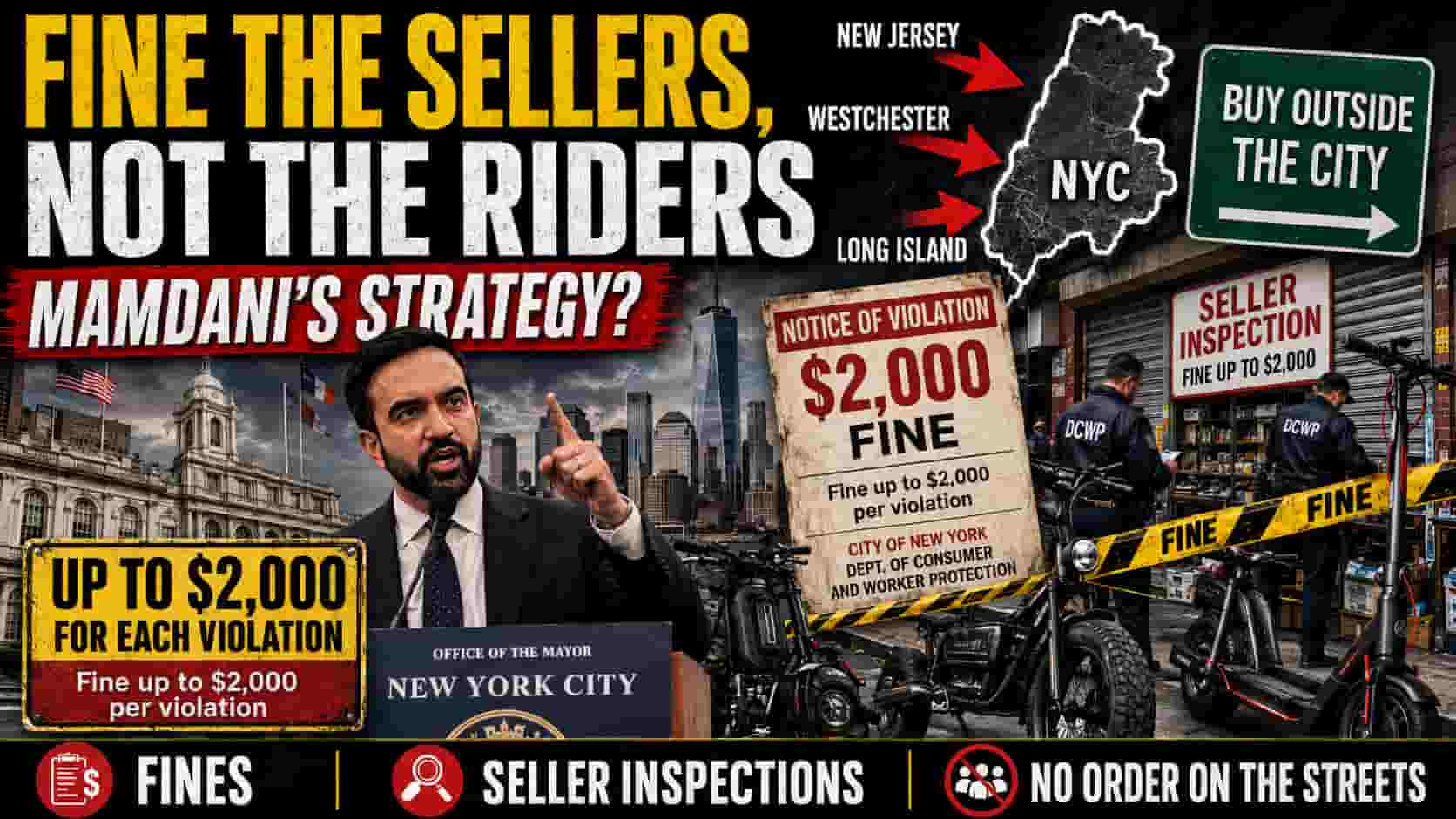
New York City threatens 42 retailers with fines of up to $2,000 per violation—but offers no immediate plan to remove illegal high-speed devices already operating on city streets
By Midtown Tribune Editorial Staff | August 5, 2026
New York City Mayor Zohran Mamdani has unveiled what his administration calls a major street-safety initiative targeting illegal high-speed e-bikes, electric scooters and unregistered electric mopeds.
But the central feature of the new policy is not stronger enforcement against dangerous riding on sidewalks, bike lanes and city streets.
Instead, the administration is targeting the easiest and most financially accessible defendants: established retailers with known addresses, corporate bank accounts and assets that can be fined.
The city has sent cease-and-desist notices to 42 online retailers and marketplaces, including Amazon, Walmart Marketplace, Best Buy, Target, Temu and Wayfair.
The companies have until August 18 to stop selling certain devices to New York City residents and businesses. After that deadline, the city says they could face civil penalties of up to $2,000 for each individual violation, as well as lawsuits and court orders blocking future sales.
The administration presents the move as an attack on illegal vehicles.
In practice, it risks becoming another New York City fine machine aimed at businesses that are easier to locate and punish than the people actually violating traffic laws on the street.
The city chose the most collectible target
There is an obvious reason the Mamdani administration is concentrating on major retailers.
Amazon, Walmart, Best Buy and Target cannot disappear when an inspector approaches. They cannot remove a license plate, change a storefront name overnight or simply ride away.
They have lawyers, corporate offices, payment systems and assets that the city can reach.
That makes them convenient enforcement targets.
A rider operating a high-speed electric motorcycle in a bike lane may be difficult to stop. A business selling products online is much easier to monitor, threaten and fine.
During the press conference, reporters repeatedly asked whether the city would take direct enforcement action against the large number of illegal devices already operating on New York streets.
Mamdani described the retailer campaign as the “first step” and said additional measures would be announced later.
That answer reveals the administration’s priority.
The city is beginning not with the most visible street violations, but with the defendants from whom money and compliance are easiest to extract.
A tragedy becomes the justification for a new enforcement campaign
Mamdani connected the announcement to the death of a 17-year-old boy who was riding a high-speed Deep Power QS7 from Bensonhurst to Manhattan.
According to the mayor, the teenager was traveling to meet with a career counselor and complete summer job applications when he collided with a large SUV near the Manhattan side of the Brooklyn Bridge.
The device was reportedly capable of exceeding 30 miles per hour.
The death is a genuine tragedy, and high-speed electric motorcycles do not belong in bicycle lanes when they are being operated like motor vehicles.
But the press conference did not establish that the device’s maximum advertised speed was the sole or official cause of the collision.
The city did not provide a complete public analysis of the SUV driver’s actions, the design of the roadway, the dangerous turn near the bridge exit or other factors that may have contributed to the crash.
Instead, the tragedy was used to justify a broad enforcement program against retailers.
A serious street-safety policy should examine every relevant cause. It should not reduce a complex fatal collision to the existence of a product listing on a website.
What the city considers illegal
City officials said retailers may be violating the law when they sell:
- e-bikes capable of exceeding 25 miles per hour;
- stand-up electric scooters capable of exceeding 20 miles per hour;
- mopeds without a visible vehicle identification number or license plate;
- devices that exceed applicable motor-power or weight limits.
Transportation Commissioner Mike Flynn said some products advertised as e-bikes are actually electric motorcycles.
That distinction matters.
An ordinary pedal-assisted e-bike is not the same as a heavy electric motorcycle capable of reaching 40 or 50 miles per hour. Such devices should not be falsely marketed as ordinary bicycles or operated without the registration and equipment required for motor vehicles.
But the legal classification system is not always as simple as the administration suggests.
Different rules may apply to a device’s maximum design speed, motor power, weight, registration status, labeling and actual operation on public streets.
The city itself acknowledged that many buyers do not understand those distinctions.
Certified does not necessarily mean street-legal
Many electric devices and batteries sold by established retailers may carry recognized electrical or fire-safety certifications.
That does not automatically make every device legal to operate in a New York City bike lane.
A safety certification generally addresses whether an electrical system, charger or battery has met specified technical standards. It does not necessarily determine whether a vehicle is legally classified as an e-bike, moped or motorcycle.
A device can have a properly tested battery and still require registration, insurance, a license plate or other motor-vehicle compliance.
This distinction is important because the administration’s rhetoric risks creating the impression that every targeted product is inherently defective or counterfeit.
The real dispute may instead concern classification, speed, marketing and legal use on public streets.
Buying a product and legally operating it in a particular location are not always the same thing.
New York City has no customs border
Even if all 42 retailers immediately comply, New York City does not have a sealed border.
A buyer can travel to Nassau County, Westchester, New Jersey or another jurisdiction and purchase a device there. A person can buy a used vehicle through a private transaction. An online seller not included in the initial list may continue offering similar products.
A device may also be lawfully purchased for use on private property, at a race facility or in a jurisdiction with different regulations, even if it cannot legally be operated in a New York City bike lane.
The city may have authority over sales, advertising and deliveries directed into New York City. But it cannot create a physical checkpoint around the five boroughs preventing every high-speed device from entering.
That means retailer enforcement alone cannot solve the street problem.
Real public safety still depends on what happens after the device arrives:
- whether it is registered when registration is required;
- whether it has a visible license plate;
- whether the operator follows speed limits;
- whether it is driven on sidewalks;
- whether it travels against traffic;
- whether it is operated recklessly in a bike lane;
- and whether police consistently enforce those rules.
A cease-and-desist letter to Amazon does not stop a dangerous rider already speeding through Midtown or Lower Manhattan.
Different treatment for riders and businesses
The political contrast is difficult to ignore.
The Mamdani administration has previously presented reduced criminal enforcement against cyclists and delivery workers as protection against an excessively punitive system.
Minor violations can still be handled through civil enforcement, but the administration’s public emphasis has been on preventing workers and riders from becoming entangled in the criminal process.
When the target is a rider, the rhetoric focuses on fairness, education and economic hardship.
When the target is a retailer, the rhetoric shifts to ultimatums, inspections, injunctions and penalties for every individual violation.
That creates an enforcement structure with two standards.
Politically favored groups receive explanations and softer treatment. Traceable businesses receive financial threats.
The issue is not whether retailers should obey the law. They should.
The issue is whether the administration is choosing businesses because they are the principal cause of street disorder—or because they are the easiest parties to sue and fine.
The $2,000 fine could multiply rapidly
A single $2,000 penalty would be insignificant to a corporation the size of Amazon or Walmart.
But the administration emphasized that the amount could apply to each individual violation.
Depending on how the city defines an infraction, penalties involving multiple listings, advertisements, sales or deliveries could accumulate rapidly.
City Corporation Counsel Steve Banks also said the city could seek injunctions to stop advertisements and sales.
New York Attorney General Letitia James suggested that officials may consider whether the current penalty is adequate. She also said authorities are examining the possibility of recalls involving devices that have already been sold.
The announced $2,000 figure may therefore be only the beginning.
The campaign could expand into larger penalties, mandatory returns, product recalls and additional legislation.
Why was the law not enforced for years?
Mamdani said the underlying restrictions have existed for approximately six years.
That raises a question the administration did not adequately answer.
If major retailers were openly violating the law for six years, why did city agencies permit the products to be advertised and delivered throughout New York City for so long?
The mayor asked during the press conference: “What use is a law if it is not being enforced?”
That question applies as much to the city government as it does to retailers.
Businesses should not be excused from complying with applicable law. But the government should also account for its own prolonged failure to provide clear guidance and consistent enforcement.
Allowing an open market to operate for years and then giving sellers two weeks to eliminate disputed products is not evidence of competent regulation.
It is evidence that city agencies waited until after multiple tragedies to act.
Fines are easier than governing
Illegal high-speed electric motorcycles and scooters are a serious safety problem.
They should not be falsely advertised as ordinary bicycles. They should not travel at motorcycle speeds through bike lanes. Unregistered mopeds should not be permitted to operate without required plates and documentation.
But sending legal threats to 42 companies is not the same as restoring order to New York City streets.
That requires regular enforcement against reckless operation, visible license-plate violations, sidewalk riding, excessive speed and dangerous conduct.
It also requires safe street design, clear classifications and understandable rules that consumers and businesses can follow before a tragedy occurs.
The Mamdani administration has instead chosen the most politically and financially convenient opening move: target sellers that can be easily identified, monitored, sued and fined.
The result may produce headlines, court filings and revenue.
It remains far less clear whether it will remove dangerous vehicles from the streets—or simply demonstrate that in New York City, it is easier to fine a business than to enforce order in public.
Ask Midtown Tribune about this story
Answers are grounded first in this article. Search all Midtown Tribune reporting from the main AI Search page.
AI-generated summary. Verify important details in the linked original articles.