
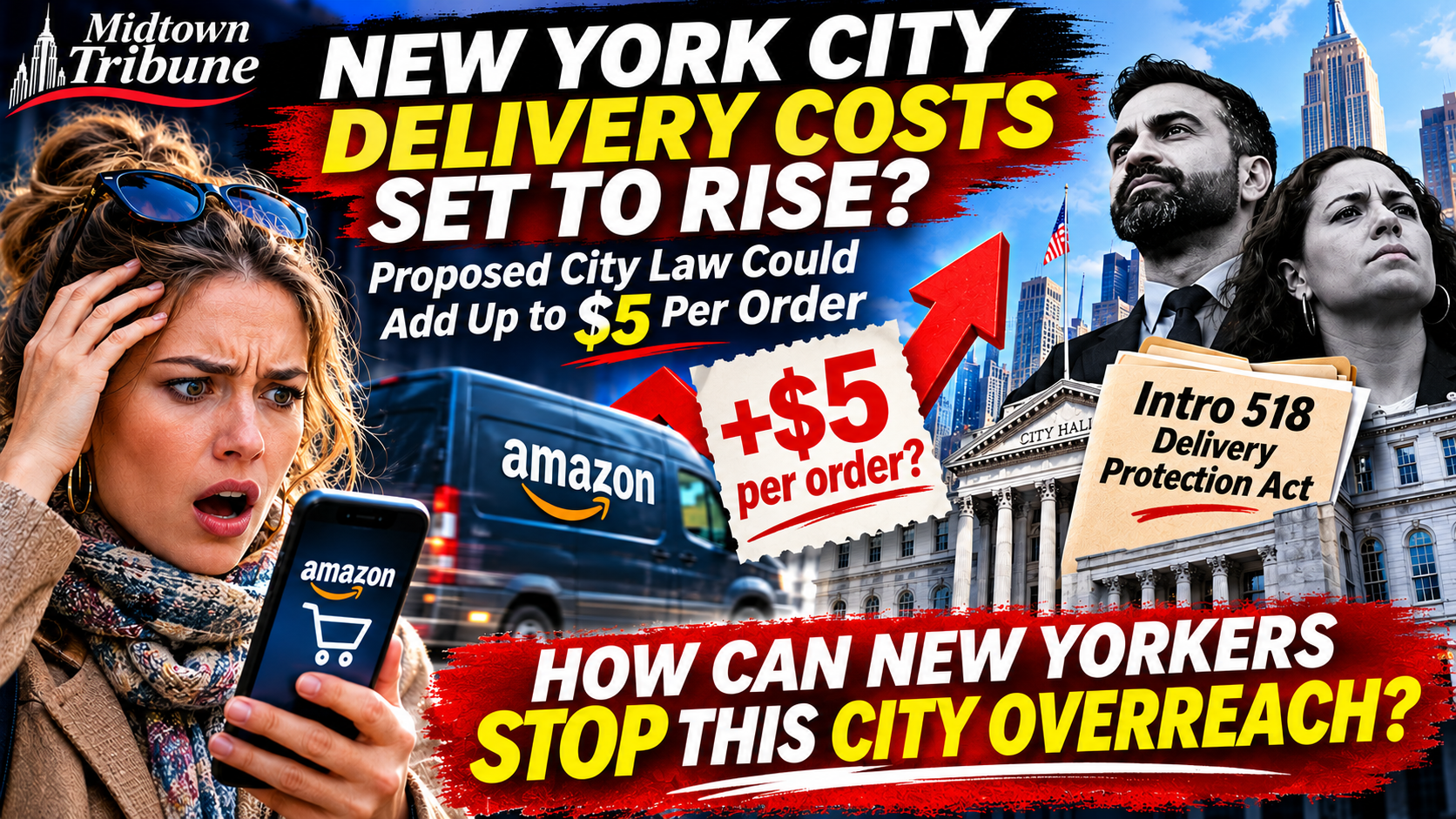
Mayor Zohran Mamdani says the Delivery Protection Act will protect workers and hold Amazon accountable. But critics warn that restricting independent delivery businesses could raise consumer prices, threaten small-business owners, and reshape New York City’s delivery economy.
By Midtown Tribune | November 20, 2026 | New York City
New York City residents already face some of the highest living expenses in America. Between housing, groceries, utilities, transportation, and taxes, household budgets are under constant pressure.
Now another potential expense is drawing attention: up to $5 more per Amazon order.
On November 19, 2026, Amazon warned New York City shoppers that a proposed City Council law, known as the Delivery Protection Act or Intro 518, could increase delivery costs and disrupt the network of independent businesses that currently deliver packages throughout the five boroughs.
The proposed legislation is supported by Mayor Zohran Mamdani, Council Member Tiffany Cabán, and several labor organizations.
Its stated purpose is to improve worker protections, strengthen safety requirements, and hold large delivery companies accountable for conditions at their facilities.
But the proposal raises a broader economic question:
Can the city strengthen workers’ rights without restricting independent entrepreneurship and passing additional business costs on to ordinary New Yorkers?
What Is the NYC Delivery Protection Act?
The Delivery Protection Act, formally known as Introduction 0518-2026, was introduced in the New York City Council on February 12, 2026.
It would require operators of certain last-mile delivery facilities to obtain city licenses and comply with new employment, training, and safety requirements.
One particularly consequential provision would require operators to directly employ workers performing core delivery and warehouse services, subject to specified exceptions.
That would substantially restrict the use of third-party delivery companies for covered operations.
The legislation therefore goes beyond establishing workplace safety standards. It would change how businesses organize their workforce and contract with other companies.
Under today’s system, Amazon relies on independent Delivery Service Partners, or DSPs, that operate delivery businesses employing drivers.
These entrepreneurs manage their own companies while providing services under contracts with Amazon.
Under the proposed rules, operators of covered facilities would generally have to employ core delivery workers directly rather than rely on the existing subcontracting structure.
The distinction matters: delivery drivers employed by contractors are not necessarily independent business owners. The entrepreneurs most directly affected are the owners of the delivery companies whose contracts and operations could be disrupted.
Mayor Mamdani Wants to End the Subcontracting Model
On August 10, 2026, Mayor Mamdani publicly endorsed the legislation.
In an official City Hall announcement titled Mayor Mamdani Backs “Delivery Protection Act” to Rein in Amazon’s Power Over New York City Streets, the administration argued that large corporations exercise substantial control over delivery operations while avoiding direct-employer responsibilities.
City Hall maintains that companies such as Amazon influence delivery schedules, routes, productivity quotas, and working conditions even when drivers are officially employed by subcontractors.
The administration also cited road-safety concerns near last-mile warehouses.
Mamdani described the legislation as a way to make large companies more accountable and improve conditions for delivery workers.
Council Member Tiffany Cabán, the bill’s lead sponsor, similarly argues that the existing contracting model can allow corporations to avoid responsibility for workplace conditions.
Those are legitimate subjects for regulatory scrutiny.
But the administration’s position also raises a fundamental question about economic freedom:
Why must improving labor protections require restricting independent business relationships rather than enforcing workplace standards directly against proven violations?
The answer has major implications for small businesses throughout New York City.
From Business Owners to a System of Direct Employment?
The proposed law does not literally convert delivery-company owners into salaried employees.
Nevertheless, its restrictions could substantially reduce opportunities for independent entrepreneurs to operate delivery businesses serving covered facilities.
For decades, contracting and subcontracting have provided an entry point into entrepreneurship for people who lack the capital necessary to build a large corporation.
An entrepreneur can establish a business, hire workers, acquire equipment, manage operations, and provide services to larger customers.
The Delivery Protection Act challenges part of that structure in New York City’s last-mile delivery industry.
Supporters say that direct employment would close accountability gaps.
Critics argue that it could eliminate a category of small-business opportunities while concentrating more employment relationships within the largest operators.
That creates an economic trade-off worth examining.
A former business owner who loses a major contract does not necessarily gain an equivalent opportunity simply because direct employment becomes available to individual drivers.
Business ownership can offer control over hiring, management, investment, and potential future growth.
Salaried employment can provide stability, statutory protections, and benefits, but it does not provide the same entrepreneurial autonomy.
Neither outcome should be treated as automatically preferable for every individual.
Amazon Warns of a $5 Increase Per Order
Amazon has launched a campaign warning New York City shoppers about the potential consequences of the legislation.
Its November 19 announcement states that Intro 518 could add up to $5 per order.
Amazon also warns that restrictions on its delivery-partner network could force it to reconsider operating arrangements, potentially including moving some delivery operations outside city limits.
These statements are important, but they must be understood accurately.
The Delivery Protection Act does not impose a $5 delivery tax or legally require Amazon to charge customers an additional $5.
The amount is Amazon’s warning about possible cost increases, not a government-approved surcharge or independently verified estimate of what every shopper will pay.
Still, the possibility of higher costs is economically significant.
Businesses facing new operating expenses may respond by absorbing those costs, improving efficiency, renegotiating contracts, reducing margins, changing services, or increasing customer prices.
How those costs are distributed depends on market conditions and corporate decisions.
What Could an Additional $5 Mean for Household Budgets?
If a household were charged an extra $5 on every order, the cumulative expense could be substantial.
| Monthly orders | Potential monthly increase | Potential annual increase |
|---|---|---|
| 4 | $20 | $240 |
| 8 | $40 | $480 |
| 12 | $60 | $720 |
| 20 | $100 | $1,200 |
These figures are hypothetical illustrations using Amazon’s $5 upper-end warning. They are not predictions of actual fees or costs.
For a family ordering household supplies regularly, even modest additional charges could accumulate.
For seniors, people with disabilities, and residents with limited access to transportation, delivery services may be especially important.
For some residents, online delivery provides practical access to groceries and household essentials without the additional costs of traveling to multiple stores.
A reform intended to protect workers should therefore also be evaluated for its effect on consumers who rely on affordable delivery.
What Happens to New York City’s Independent Delivery Businesses?
According to Amazon, its New York City delivery network includes more than 40 independent delivery businesses employing over 5,000 people.
The company argues that the proposed law could threaten these businesses and disrupt existing employment arrangements.
That is a company-reported estimate of the businesses and workers potentially exposed to disruption, not proof that every job would disappear.
The bill contains provisions addressing employment transitions, including requirements designed to protect certain workers affected by the termination of subcontracting relationships.
Nevertheless, questions remain about the long-term role of independent delivery-company owners.
Could those entrepreneurs continue operating under a different business model?
Would major delivery companies bring substantially more delivery operations in-house?
Would facilities or routes move outside New York City?
And how would such changes affect competition, consumer prices, and employment?
These questions deserve detailed economic analysis before lawmakers make permanent changes to the city’s delivery market.
Who Ultimately Pays for Government Regulation?
The political disagreement is often presented as a confrontation between a powerful corporation and vulnerable workers.
But economic consequences rarely stop with those two groups.
A delivery service involves multiple participants: workers, contractors, warehouse operators, retailers, consumers, and investors.
Regulations affecting one part of that network can create adjustments throughout the system.
A company may absorb some additional expense through lower profits. Workers or business partners may bear other costs through changes in compensation or contracts. Consumers may face some costs through higher prices.
The distribution cannot be established simply by pointing to a corporation’s market valuation.
Amazon’s financial strength may affect its ability to absorb costs, but it does not establish whether it would choose to do so.
Similarly, Amazon’s warning does not prove that a $5 increase is unavoidable.
The central public-policy question is not merely whether large corporations can afford new rules. It is who will actually bear the economic burden once those rules are implemented.
Is Restricting Independent Contractors Constitutional?
The legislation also raises questions about the proper limits of municipal authority.
The U.S. Constitution protects property rights and provides safeguards against certain forms of arbitrary government action.
However, American constitutional law also permits substantial regulation of economic activity, employment, and public safety.
A restriction on subcontracting is therefore not automatically unconstitutional.
One potentially relevant issue is federal preemption.
Under 49 U.S.C. § 14501(c), federal law limits certain state and local regulations relating to the prices, routes, and services of motor carriers, subject to statutory exceptions.
Whether particular provisions of Intro 518 conflict with federal law would depend on their precise operation and the businesses affected.
On November 16, City & State New York reported legal objections raised by attorney Derek Sells, who warned that the proposal could conflict with federal and state law.
These objections are not judicial findings.
Nevertheless, they indicate that the legislation could face litigation if enacted.
More broadly, policymakers must consider whether the city’s labor and safety objectives can be achieved through less disruptive regulatory alternatives.
Could New York Protect Workers Without Restricting Entrepreneurship?
Several policy alternatives merit consideration.
The city could examine stronger enforcement of existing wage-and-hour laws, clearer rules assigning responsibility for workplace violations, targeted inspection of unsafe delivery operations, mandatory safety training, and improved accident-reporting requirements.
Lawmakers could also consider measures that preserve legitimate subcontracting while addressing situations where corporations exercise employer-like control without corresponding accountability.
These approaches would not necessarily solve every problem identified by the bill’s supporters.
But comparing their costs, legal implications, and effectiveness would allow a more informed legislative decision.
Protecting workers and preserving business opportunities need not always be mutually exclusive objectives.
Has the Delivery Protection Act Passed?
As of November 20, 2026, Intro 518 had not become law.
The New York City Council’s official legislative record lists it as “Laid Over in Committee” in the Committee on Consumer and Worker Protection.
A public committee hearing was held on April 9, 2026.
The proposal may still be amended, advanced, delayed, or rejected through the legislative process.
That distinction matters because consumers and business owners should not confuse a proposed regulation with an existing legal obligation.
What Can New Yorkers Do?
Residents who want to examine or influence the proposal can review the official bill and contact their elected City Council representatives.
The City Council publishes legislative text, committee information, hearing records, and status updates online.
New Yorkers can also submit questions about the projected economic impact, request information on protections for independent businesses, and participate in public hearings when testimony is accepted.
Useful questions for legislators include:
- What independent evidence supports projections of consumer cost increases or savings?
- How many independent delivery businesses could lose existing contracts?
- What protections would exist for entrepreneurs affected by the transition?
- What alternatives were evaluated before proposing restrictions on subcontracting?
- How would the city measure changes in worker safety, delivery prices, and employment after implementation?
The answers would help residents assess both the potential benefits and costs of the legislation.
The Bigger Question: Worker Protection or Another Cost of Living Increase?
The debate over the Delivery Protection Act reflects a broader challenge facing New York City.
The government has a legitimate interest in ensuring safe workplaces, protecting workers from unlawful treatment, and promoting public safety.
But it also has to consider the economic freedom of small-business owners and the purchasing power of residents.
Amazon says the legislation could increase delivery costs and threaten independent delivery companies.
Mayor Mamdani and the proposal’s supporters argue that stronger accountability and direct employment are necessary to address labor and safety problems.
Both sets of claims require scrutiny.
New Yorkers deserve to know whether the proposed protections will create measurable improvements—and what those improvements may cost households, workers, and independent entrepreneurs.
Until policymakers provide sufficiently transparent evidence, the potential impact on consumer wallets remains one of the most important unanswered questions surrounding Intro 518.
The legislation’s name promises protection.
The public deserves a clear accounting of its consequences.
Official Documents and Sources
- New York City Mayor’s Office — August 10, 2026: Mayor Mamdani Backs Delivery Protection Act to Rein in Amazon’s Power Over New York City Streets
- New York City Council — Intro 518: Official Legislative Text, Sponsors, Committee Status and Hearing Records
- Amazon — November 19, 2026: A Message From Amazon to Customers About New York City Delivery Costs
- United States Code: 49 U.S.C. § 14501 — Federal Authority Over Certain Motor Carrier Regulations
- City & State New York — November 16, 2026: Business Groups Raise Legal Objections to the Delivery Protection Act
Midtown Tribune | New York City Policy, Business and Consumer Affairs
Reader discussion
Discuss the reporting. Links in comments are automatically removed.
Be the first to comment.
To comment, sign in with an enabled social account or sign in / register.
Ask Midtown Tribune about this story
Answers are grounded first in this article. Search all Midtown Tribune reporting from the main AI Search page.
AI-generated summary. Verify important details in the linked original articles.