
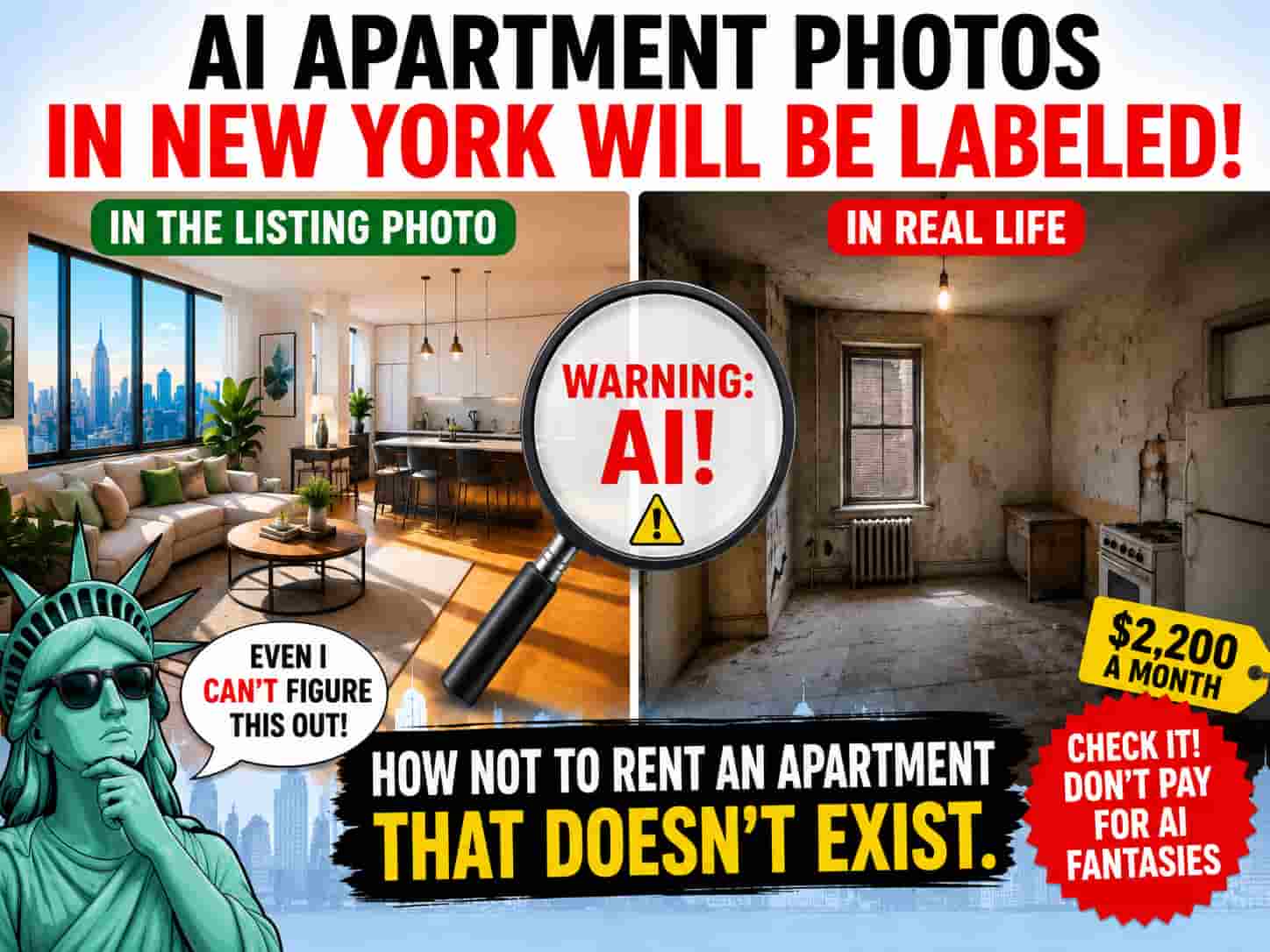
New York renters may soon be told when artificial intelligence has improved a listing by adding sunlight, space, hardwood floors, and occasionally an entirely different apartment.
For decades, New York real estate photography followed a familiar professional tradition.
A photographer stood in the doorway, pressed a wide-angle lens against the wall, turned on every light, and transformed a narrow studio into something resembling an airport terminal.
Then a computer specialist opened Photoshop.
The walls became cleaner. The floor became brighter. The sky outside the window became bluer. The garbage bags quietly left the sidewalk. A radiator disappeared. A second window occasionally entered the witness protection program.
Now artificial intelligence has arrived, and City Hall has discovered that apartment photography may not always be an exact branch of documentary journalism.
On July 16, New York City released its Rental Ripoff Report, a package of housing proposals that includes requiring landlords to disclose when rental-listing images have been altered using artificial intelligence. The city says the broader plan is intended to address deceptive practices, hazardous housing conditions, hidden costs and repeat-offender landlords.
At last, the ancient philosophical question can be addressed:
What Is the Difference Between a Photoshop Expert and AI?
A Photoshop expert removes the mold carefully, one section at a time.
AI removes the mold, replaces the wall, adds a fireplace and asks whether you would also like a Scandinavian breakfast nook.
A Photoshop expert needs skill, experience and at least twenty minutes.
AI needs a sentence:
“Make this affordable basement apartment look like a luxury Manhattan loft with natural light.”
The Photoshop operator knows the room is six feet wide.
AI has never met the room and sees no reason to accept such negativity.
The human editor may feel a small moral hesitation before placing the Empire State Building outside a Queens kitchen window.
AI has no hesitation. It has several alternate Empire State Buildings ready.
In short, Photoshop helped people improve photographs.
AI can improve the underlying reality without the unnecessary inconvenience of changing the actual apartment.
The Listing Photo Versus the Apartment
In the listing, the apartment has:
- floor-to-ceiling windows;
- designer lighting;
- elegant furniture;
- polished hardwood floors;
- generous storage;
- a peaceful city view;
- and enough space for six friends to drink wine around a dining table.
In real life, it has:
- one window facing a wall;
- a lightbulb hanging from a wire;
- a folding chair;
- flooring last polished during the Bloomberg administration;
- a cabinet that cannot open because it hits the refrigerator;
- a view of three air conditioners;
- and enough space for six friends only if four remain in the hallway.
The rent, however, is always rendered with complete photographic accuracy.
What New York Is Actually Proposing
The city’s announcement says landlords will be required to disclose when rental listings have been altered using AI. But renters should not assume that every digitally enhanced image across New York already carries a warning label today.
The report outlines actions the administration intends to pursue through city agencies, policy changes, enforcement, litigation and, where required, legislation.
So the policy direction is official.
The exact warning label is still under construction.
Perhaps it will say:
“This image contains digitally generated sunlight not included in the monthly rent.”
Or:
“The furniture, flooring, windows and emotional sense of possibility may not exist.”
A proper disclosure should explain whether an image was merely brightened or whether the software redesigned the property.
There is a meaningful difference between correcting the color of a wall and inventing another wall.
Removing a vacuum cleaner is editing.
Removing structural damage is marketing theology.
Adding virtual furniture to an empty room may help people understand the space.
Adding a room to the room helps people misunderstand the space.
AI Did Not Invent Real Estate Creativity
To be fair, artificial intelligence did not invent misleading rental advertisements.
It merely industrialized a respected local craft.
Long before generative AI, New Yorkers were already familiar with phrases such as:
“Cozy.”
You can touch both walls without moving.
“Charming.”
Nothing has been replaced since 1948.
“Full of character.”
The floor is not level.
“Sun-drenched.”
Sunlight enters for eleven minutes every April.
“Steps from transportation.”
There are many steps. Transportation eventually appears.
“Flexible two-bedroom.”
The second bedroom is flexible enough to become a closet again.
AI simply gives those descriptions visual support.
Previously, the broker had to describe a dark apartment as “warm and intimate.”
Now the computer can install noon.
Why Renters Should Care
Fake or misleading rental listings are not merely a question of bad aesthetics. Scammers can copy photographs, descriptions and virtual tours from legitimate listings, replace the contact information and demand deposits for properties they do not control. The Federal Trade Commission advises renters to verify the address, inspect the property, research the listing and avoid payment methods that are difficult to reverse.
This matters in New York because a suspicious listing often arrives with manufactured urgency:
“There are twelve other applicants.”
“The owner is overseas.”
“The apartment cannot be shown today.”
“Send the deposit now.”
“The keys will be delivered after payment.”
“The landlord communicates only through an encrypted messaging app because he values privacy.”
At that point, the prospective tenant is no longer renting an apartment.
He is participating in interactive fiction.
How to Avoid Renting a Property That Exists Only in the Cloud
See the apartment in person
Do not send a deposit for a home you have never entered.
A live video tour is better than a prerecorded clip, but it should be genuinely live. Ask the person showing the apartment to open a closet, turn on a faucet, walk into the hallway and show the view from each window.
A stolen video can show a real apartment.
It does not prove that the person requesting money owns it, represents it or has ever been within fifty miles of it.
Search the address
Look for duplicate listings with different prices, phone numbers or supposed owners.
If the same apartment is simultaneously for rent in Brooklyn, for sale in Manhattan and managed by a gentleman currently stationed on an offshore oil rig, further investigation may be appropriate.
Check the broker
New York State provides a public license search for real-estate professionals. A renter can search by name, license number, city or county.
A legitimate broker should not be offended by verification.
A person who says, “My license is under another name because of the new system,” may be testing whether you deserve to keep your deposit.
Examine the geometry
Count windows, doors and visible walls.
Compare the interior photographs with the exterior of the building and the unit’s stated floor.
AI is increasingly good at producing convincing rooms, but it can still create:
- impossible reflections;
- duplicate lamps;
- distorted doorways;
- furniture melting into walls;
- windows inside mirrors;
- stairs leading nowhere;
- kitchens large enough to occupy the neighboring apartment.
Of course, some actual New York renovations also contain these features, so visual analysis is not conclusive.
Do not pay with financial escape hatches
The FTC warns against rental demands involving gift cards, cryptocurrency, wire-transfer services or other difficult-to-reverse payment methods.
A legitimate landlord may embrace new technology.
But a security deposit payable in gift cards is not proptech.
It is a farewell ceremony for your money.
The Real Issue Is Not AI. It Is Disclosure.
Artificial intelligence can be useful in real estate.
It can improve image quality, translate listings, create virtual staging and help prospective renters visualize an empty unit.
The problem begins when software alters facts that affect a renter’s decision and no one says so.
Did the program improve the exposure?
Or did it improve the square footage?
Did it remove a temporary object?
Or did it remove a permanent plumbing problem?
Did it stage an empty bedroom?
Or did it create a bedroom from a section of kitchen that had been feeling underutilized?
That is why clear disclosure matters.
Renters should be told when the image is a representation rather than evidence.
New York’s Next Luxury Amenity: Reality
New Yorkers already understand that rental listings contain optimism.
We do not expect every apartment described as “stunning” to cause temporary loss of vision.
We know that “luxury” may refer to the lobby.
We know that “open concept” sometimes means no doors.
But renters should still be able to distinguish between a flattering photograph and a digitally manufactured property.
The city’s proposal is therefore sensible, even if enforcement will be complicated.
Because whether an apartment was transformed by a Photoshop technician or an AI model is not ultimately the main question.
The main question is whether the transformation was disclosed.
Still, for anyone wondering about the difference:
A Photoshop expert can make your apartment look ten years younger.
AI can give it a childhood in Copenhagen, a degree in architecture and a panoramic view of Central Park.
And neither one will be there when the tenant arrives with the moving truck.
Official Sources and Rental Verification Tools
- NYC Mayor’s Office — Rental Ripoff Report and proposed disclosure of AI-altered rental listings
- NYC Mayor’s Office — Official transcript of the Rental Ripoff Report announcement
- City of New York — Rental Ripoff Hearings and tenant-policy process
- HPD Online — Search housing complaints, violations, litigation and property registration
- NYC Department of Buildings — Find building history, permits, complaints and violations
- Buildings Information System — Search official NYC property and building records
- DOB NOW Public Portal — Search current building filings and property records
- eAccessNY — Verify a New York real-estate broker or salesperson license
- New York Department of State — Official guidance for people buying or renting property
- Federal Trade Commission — How to recognize rental-listing scams
- ReportFraud.ftc.gov — Report suspected rental fraud to the FTC
- NYC 311 — Housing complaints, tenant services and city assistance
Before paying: verify the address, inspect the apartment, check the building’s official record, confirm the broker’s license and identify the person legally authorized to collect the deposit. Do not send real money for an apartment that exists only in a beautifully generated image.
Ask Midtown Tribune about this story
Answers are grounded first in this article. Search all Midtown Tribune reporting from the main AI Search page.
AI-generated summary. Verify important details in the linked original articles.