
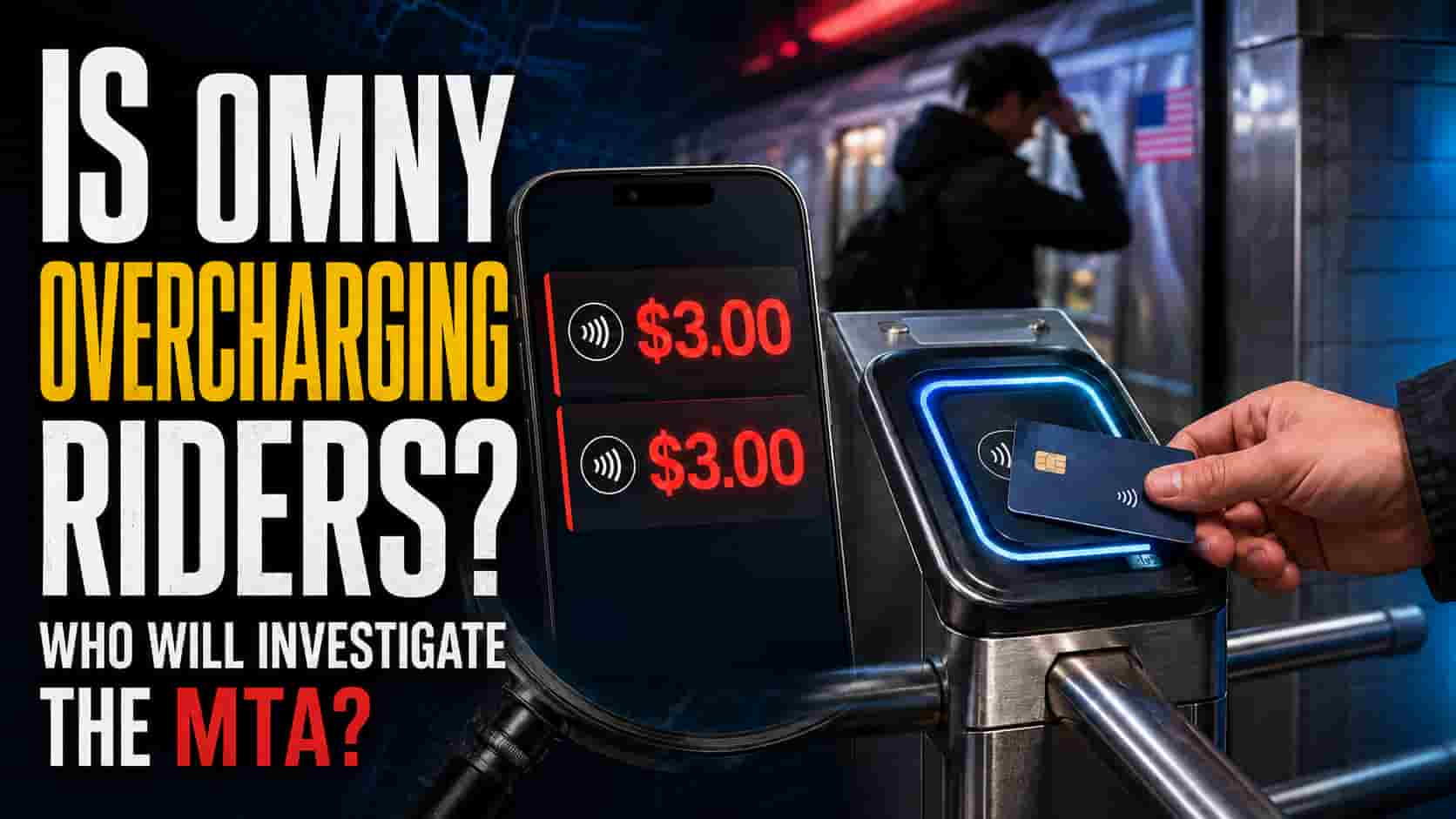
Republican candidate for New York attorney general Saritha Komatireddy is calling for an investigation into allegations of improper OMNY charges, missing fare-cap benefits, and erroneous fare-evasion fines.
The demand follows complaints collected by the passenger advocacy organization Passengers United. Riders reportedly claim that they were charged for trips they did not take, denied free transfers, charged after reaching the weekly fare cap, or fined because fare inspectors could not verify their OMNY payments.
These allegations deserve an independent review. However, as of August 11, 2026, no government audit, court ruling, or regulatory investigation has established that the MTA is deliberately or systematically overcharging passengers.
What Saritha Komatireddy Said
Komatireddy described the controversy as another example of New York’s “crime tax” and argued that Attorney General Letitia James should investigate the OMNY payment system.
“The MTA’s overcharging of subway riders warrants an AG investigation,” Komatireddy said. “It is the Attorney General’s responsibility to hold state agencies accountable and ensure they are not ripping off New Yorkers.”
New York State Board of Elections documents identify Komatireddy as the uncontested Republican and Conservative candidate for attorney general in the 2026 primary election.
Her demand for greater oversight raises legitimate questions, but several claims in her statement require important context.
Have OMNY Overcharges Been Proven?
Passenger complaints are real, and concerns about OMNY transactions have been reported by multiple news organizations. Passengers United says it has collected hundreds of submissions involving disputed charges, lost transfers, fare-cap problems, and allegedly erroneous violations.
MTA Chair and CEO Janno Lieber has also publicly encouraged riders to report cases in which they believe they were improperly charged or unfairly ticketed, saying the agency wants to investigate and correct such problems.
But individual complaints do not yet prove intentional theft or a systemwide billing scheme.
Possible explanations for a disputed transaction can include:
- Delayed processing by a passenger’s bank
- Several rides appearing together as one bank transaction
- The use of different devices or virtual card numbers
- A free transfer not being properly recognized
- An OMNY software or reader malfunction
- Incorrect fare inspection or violation records
- A genuine duplicate or unauthorized charge
The appropriate description at this stage is therefore “alleged overcharges,” not a confirmed finding that the MTA is stealing from passengers.
The Subway Fare Is Now $3
The base fare for New York City subways and local buses increased to $3 on January 4, 2026. This is the highest nominal base fare in the system’s history.
OMNY’s official rolling seven-day fare cap is $35. Once a rider spends $35 on eligible subway and local bus trips during a seven-day period, additional eligible rides should be free for the remainder of that period.
Passengers must use the same OMNY card, bank card, smartphone, or wearable device for every trip. Using a physical bank card for one ride and the same card through a mobile wallet for another may cause the system to treat them as different payment methods.
The MTA’s July 2026 financial plan also assumes proposed fare and toll increases producing an additional 4% yield in March 2027 and another 4% in March 2029. Those assumptions do not mean that every individual fare will automatically rise by exactly 4%; specific rates would still require MTA Board approval.
Does Fare Evasion Cost the MTA $1 Billion a Year?
Komatireddy said the MTA loses $1 billion annually because fare-evasion laws are not being enforced.
Official government reports support the broader argument that fare evasion imposes a major cost on paying passengers and taxpayers—but not the precise $1 billion figure.
The Office of the New York State Comptroller reported that the MTA estimated approximately $700 million in fare-evasion losses in 2022, with similar annual losses afterward.
Earlier MTA estimates included losses from buses, subways, commuter railroads, and bridges and tunnels. Bus fare evasion has been especially severe, reaching close to half of estimated ridership during certain periods.
Seven hundred million dollars is an enormous loss, but it is about $300 million below the amount cited in Komatireddy’s statement. Unless the campaign provides a newer calculation showing how it reached $1 billion, that number should be presented as a political estimate rather than an established government figure.
Is the Attorney General Responsible for Enforcing Subway Fares?
This is the most misleading part of the candidate’s statement.
The New York attorney general is the state’s chief legal officer and can investigate persistent fraud, illegal conduct, misuse of public money, and certain patterns of deceptive behavior. A request for the attorney general to examine potentially widespread OMNY billing problems is therefore not unreasonable.
However, ordinary fare-evasion enforcement is not primarily the attorney general’s responsibility.
Fare violations are handled by the MTA, New York City Transit, the NYPD, the MTA Police Department, enforcement personnel, and the Transit Adjudication Bureau. The bureau processes notices of violation, hearings, fines, and appeals.
New York law also gives the Office of the MTA Inspector General specific authority to investigate allegations of fraud, abuse, misconduct, and service deficiencies involving the MTA and its contractors.
The claim that the MTA loses fare revenue because “the AG doesn’t enforce the fare evasion laws” therefore oversimplifies how responsibility is divided among state and city agencies.
The attorney general may have a role if evidence indicates widespread fraud or unlawful conduct. But the attorney general is not the official ordinarily checking fares, issuing transit violations, or conducting Transit Adjudication Bureau hearings.
What an Independent OMNY Investigation Should Examine
A credible review should answer several measurable questions:
- How many OMNY billing complaints have been received since January 2026?
- How many complaints were substantiated?
- How much money has the MTA refunded?
- How often has the $35 fare cap been calculated incorrectly?
- Can transaction delays cause inspectors to believe that a passenger did not pay?
- How many fare-evasion violations have been dismissed because of OMNY records?
- Do particular cards, banks, buses, readers, or payment methods generate disproportionate numbers of complaints?
- How does the MTA audit the work of OMNY contractor Cubic Transportation Systems?
- How quickly can passengers obtain refunds and correct their records?
- Will the MTA publish regular statistics about disputed OMNY transactions?
The investigation should also distinguish between temporary bank authorizations, delayed transaction postings, actual duplicate charges, and incorrect MTA records. Those are different problems requiring different solutions.
Accountability Requires Evidence
Komatireddy is correct that passengers who follow the rules should not be forced to pay for government mistakes—or for massive levels of fare evasion.
The MTA should disclose how many OMNY complaints it has received, how many were valid, how much money was returned, and whether technical defects have resulted in improper fines. If systematic errors are found, affected passengers should receive automatic refunds rather than being forced to fight each charge individually.
But accountability must work in both directions. Political candidates should also distinguish between documented facts and allegations.
The current evidence supports an independent investigation of OMNY. It does not yet establish that the MTA intentionally “stole” from riders. Official reports support annual fare-evasion losses of approximately $700 million, not the claimed $1 billion. And fare enforcement is shared among several agencies rather than being the exclusive responsibility of the attorney general.
New Yorkers deserve answers based on transaction records, audits, refund data, and documented system failures—not only campaign rhetoric.
Official Sources and Documents
-
MTA — Current Subway and Bus Fares
The base subway and local bus fare is $3, with a $35 rolling seven-day OMNY fare cap.
MTA — Subway and Bus Fares -
MTA — How OMNY Tap and Ride Works
Official information about fare capping, transfers, payment methods, and obtaining assistance with disputed transactions.
MTA — Tap and Ride -
MTA — Contact and OMNY Transaction Assistance
Riders can report disputed OMNY payments online or call the OMNY support line at 877-789-6669.
MTA — Contact Us -
MTA — July 2026 Financial Plan
The plan assumes proposed fare and toll adjustments producing 4% increases in annual yield in 2027 and 2029.
MTA — July 2026 Financial Plan -
New York State Comptroller — MTA Revenue Trends
The Comptroller reports estimated fare-evasion losses of approximately $700 million in 2022 and similar amounts afterward.
NYS Comptroller — MTA Operating Revenue Trends -
Office of the MTA Inspector General
The independent office accepts complaints involving alleged fraud, waste, abuse, misconduct, MTA vendors, and contractors.
MTA Inspector General — File a Complaint -
New York Public Authorities Law §1279
State law authorizes the MTA Inspector General to investigate alleged fraud, abuse, and service deficiencies involving the authority.
New York State Senate — Public Authorities Law §1279 -
New York Executive Law §63
The statute defines the general duties and legal authority of the New York attorney general.
New York State Senate — Executive Law §63 -
MTA Transit Adjudication Bureau
Official information about transit violations, hearings, fines, record requests, and appeals.
MTA — Transit Adjudication Bureau -
New York State Board of Elections
Official 2026 primary certification identifying Saritha Komatireddy as the uncontested Republican and Conservative candidate for attorney general.
NYS Board of Elections — 2026 Primary Certification
Ask Midtown Tribune about this story
Answers are grounded first in this article. Search all Midtown Tribune reporting from the main AI Search page.
AI-generated summary. Verify important details in the linked original articles.