
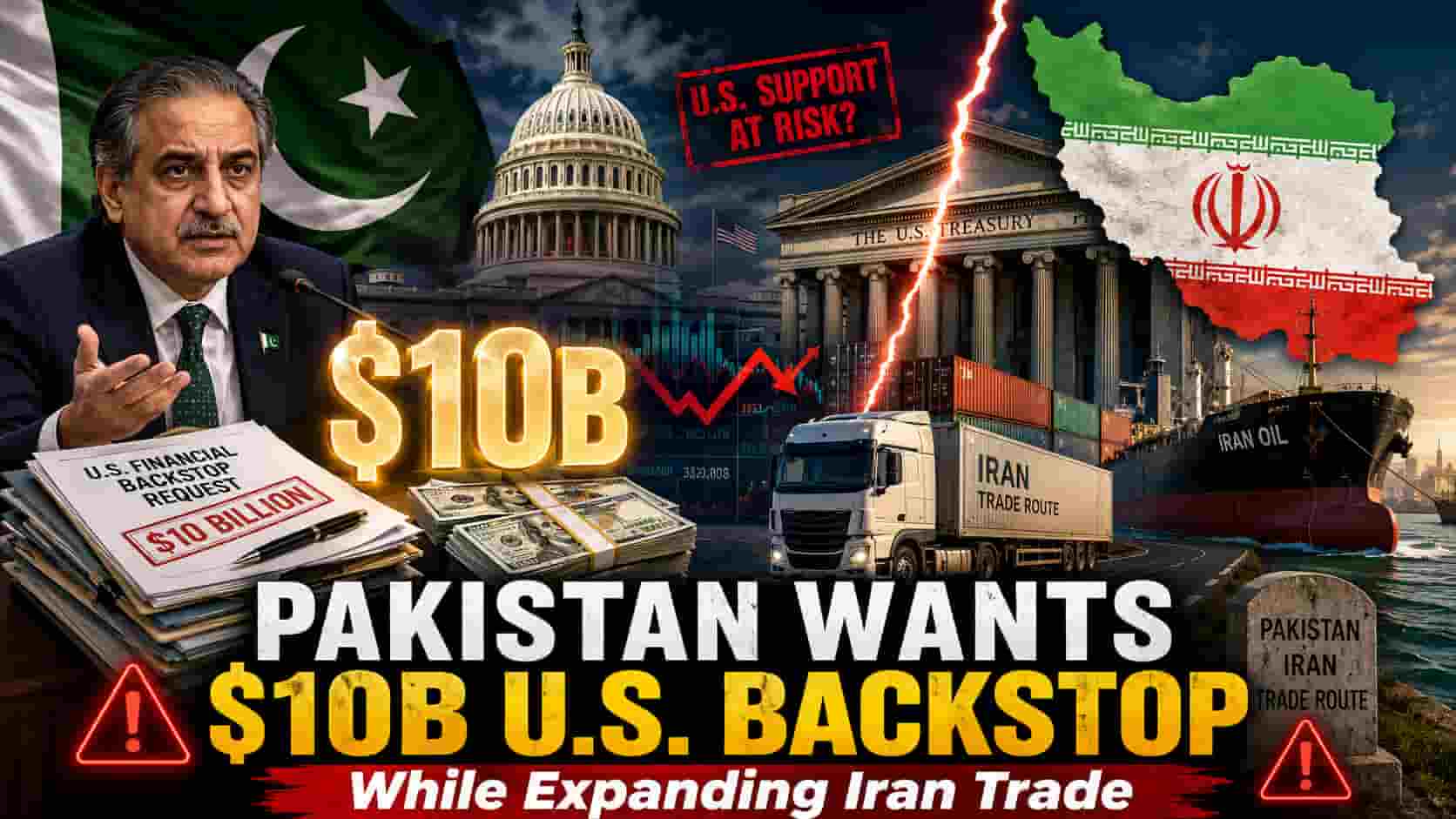
Islamabad wants a $10 billion U.S. exchange-stabilization facility while pursuing a $10 billion annual trade target with Tehran. The two policies are colliding with Washington’s new campaign to economically isolate Iran.
WASHINGTON / ISLAMABAD — August 31, 2026
Pakistan is seeking a $10 billion financial stabilization arrangement from the U.S. Treasury while simultaneously pursuing a major expansion of trade with Iran — creating a potentially difficult test for the rapidly improving relationship between Washington and Islamabad.
Pakistan’s Finance Minister Muhammad Aurangzeb has confirmed that Islamabad formally requested a $10 billion Exchange Stabilisation Support Facility from the United States.
But there is an important distinction: Pakistan says the proposed facility would not be a conventional $10 billion loan or credit line.
Aurangzeb says the goal is to create a U.S.-backed confidence signal for Pakistan’s currency and foreign-exchange position, allowing the country to borrow more easily and at longer maturities in international capital markets.
At almost the same time, Pakistan and Iran have formally reaffirmed their goal of raising bilateral trade to $10 billion annually.
That creates the central question:
Can Pakistan deepen its economic relationship with Iran while asking Washington to provide a powerful financial backstop — just as the U.S. Treasury launches a campaign designed to economically isolate Tehran?
Key Facts
- Pakistan has formally sought a $10 billion Exchange Stabilisation Support Facility from the U.S. Treasury.
- Pakistan says the proposed arrangement is not a normal loan and is intended primarily as a financial backstop and market-confidence signal.
- No $10 billion U.S. facility has yet been approved.
- Pakistan expects a U.S. response in the coming weeks or months.
- Pakistan and Iran officially reaffirmed on August 5 a goal of reaching $10 billion in annual bilateral trade.
- Washington launched Operation Economic Outcast on August 24 to sever Iran’s international financial and commercial lifelines.
- U.S. Treasury says foreign entities that help sustain Iran may face increased secondary-sanctions risk.
- The United States imported approximately $5.4 billion in goods from Pakistan in 2025, making the American market economically important to Islamabad.
- Pakistan publicly says its trade with Iran follows international law and its bilateral agreements.
- Reports that Pakistan simply declared it would recognize “only U.N. sanctions” need qualification: Pakistan’s official August 27 Foreign Ministry transcript uses more cautious language about international law and existing obligations.
What Pakistan Is Asking From Washington
Finance Minister Muhammad Aurangzeb confirmed in August that Pakistan had formally approached the U.S. Treasury for a $10 billion Exchange Stabilisation Support Facility.
The proposal has reportedly been structured with a maturity of up to five years.
But Aurangzeb explicitly rejected descriptions of the arrangement as another bailout.
“This is not about a credit line or a loan,” he said while explaining the proposal, describing it instead as a signal of currency and foreign-exchange stability that could help Pakistan regain sustainable access to international capital markets.
An adviser to Pakistan’s finance minister subsequently described the proposed U.S. arrangement as a potential “backstop and confidence signal” that could support market access and attract private capital.
That means a headline saying Washington is preparing simply to “give Pakistan $10 billion” would be misleading.
The facility remains under discussion, and no final U.S. approval has been announced.
Why Pakistan Wants the U.S. Backstop
Pakistan has spent years struggling with:
- foreign-exchange shortages;
- large external financing requirements;
- repeated debt rollovers;
- dependence on bilateral lenders;
- IMF programs;
- and expensive access to global capital markets.
Aurangzeb says Islamabad wants to move away from repeatedly asking foreign governments to roll over short-term loans and instead return to market-based financing with maturities of five, seven or ten years.
Pakistan remains below investment grade, making international borrowing relatively expensive.
A major U.S. Treasury commitment could therefore have an effect substantially larger than the amount actually drawn.
The existence of the facility itself could tell markets that Washington is prepared to stand behind Pakistan during periods of currency or external-financing stress.
At the Same Time, Pakistan Is Expanding Trade With Iran
This is where the financial request becomes geopolitically complicated.
On August 5, 2026, Pakistan and Iran concluded the tenth session of their Joint Trade Committee in Islamabad.
According to the Pakistani government, the two countries committed themselves to working toward a shared target of:
$10 billion in annual bilateral trade.
The two governments discussed:
- a Pakistan-Iran Free Trade Agreement;
- tariff reductions;
- expanded barter trade;
- greater business-to-business commerce;
- industrial investment;
- border markets;
- customs coordination;
- transportation;
- logistics;
- and improved border infrastructure.
This is not merely speculation about future diplomatic relations.
It is an officially stated economic objective of both governments.
Pakistan’s embassy in Tehran reiterated the $10 billion target again on August 14.
Washington Is Moving in the Opposite Direction
Only weeks later, the U.S. Treasury moved sharply in the opposite direction.
On August 24, Treasury Secretary Scott Bessent announced Operation Economic Outcast, describing it as a sustained campaign to sever Iran’s remaining economic lifelines.
Treasury said the operation is designed to target:
- Iran’s financial networks;
- sanctions-evasion mechanisms;
- oil revenues;
- brokers and facilitators;
- shadow-fleet activity;
- and companies outside Iran that help Tehran maintain access to global commerce.
Bessent warned that countries and entities continuing to support Iran could face economic consequences.
Treasury specifically said the campaign would expand the risk of secondary sanctions for Iran-related activity.
That creates a direct strategic tension for Pakistan.
Islamabad wants closer financial integration with Washington while simultaneously building deeper commercial integration with Tehran.
Treasury Is Already Showing What Secondary Pressure Can Look Like
The threat is not theoretical.
On August 28, the Treasury Department moved against Banque Misr UAE, proposing to revoke the bank’s correspondent access to U.S. financial institutions over alleged transactions benefiting Iran.
Bessent said foreign institutions cannot simultaneously facilitate the Iranian regime and expect unrestricted access to the U.S. dollar and American financial system.
For Pakistan, that example matters.
The value of a U.S. Treasury backstop derives partly from access to the same dollar-based financial system Washington is now using to pressure Iran’s partners.
What Pakistan Says About U.S. Sanctions
A viral commentary by Trish Regan argues that Pakistan has effectively told Washington that it will comply only with United Nations sanctions against Iran.
The video describes Pakistan as wanting the $10 billion U.S. facility while insisting that unilateral American sanctions do not bind Islamabad.
There is evidence behind that characterization, but the official Pakistani wording requires care.
At an August 27 Foreign Ministry briefing, Pakistan said its trade with Iran is conducted according to international law and bilateral agreements, adding that the trade remains consistent with Pakistan’s obligations.
Pakistani officials also clarified after press reports circulated that some statements attributed to the Foreign Ministry concerning U.S. sanctions had been “misconstrued.”
The government said Pakistan generally does not interpret Washington’s sanctions regime publicly.
Earlier, on August 6, however, Pakistan’s Foreign Ministry explicitly said that both international and national sanctions affecting Iran are taken into account in bilateral commerce.
The result is a more nuanced position than the viral formulation suggests:
Pakistan intends to continue lawful trade with Iran while attempting to navigate the sanctions regimes imposed by the United States and other governments.
Pakistan’s $10 Billion Iran Goal Is Not Current Trade
Another important distinction concerns the number $10 billion.
Pakistan is not currently conducting $10 billion in annual trade with Iran.
That is a future target.
The two governments have been attempting to raise trade from a level of roughly several billion dollars annually toward $10 billion through tariff changes, border commerce, barter arrangements and a possible free-trade framework.
The fact that the number is a target rather than current trade makes a major difference.
Washington therefore still has considerable opportunity to influence how rapidly — or whether — that target can be reached.
How Important Is the U.S. Market to Pakistan?
Very important.
According to the Office of the United States Trade Representative, U.S. goods imports from Pakistan totaled approximately:
$5.4 billion in 2025.
American exports to Pakistan were approximately:
$3.3 billion.
Total bilateral goods trade was approximately:
$8.7 billion.
The United States ran a goods trade deficit with Pakistan of approximately $2.1 billion.
That gives Washington significant economic leverage.
Pakistan sells substantially more goods to the United States than it buys from the United States.
Textiles and apparel represent an important portion of Pakistan’s exports to the American market.
Does Pakistan “Need America More Than Iran”?
That is the political argument made in the Trish Regan video.
Economically, the United States clearly represents a highly valuable market and potential source of financial credibility for Pakistan.
But Pakistan’s relationship with Iran cannot be measured purely through export totals.
The two countries share a border.
Iran matters to Pakistan because of:
- regional security;
- border commerce;
- energy;
- transportation;
- Balochistan;
- Afghanistan;
- Middle East diplomacy;
- and Pakistan’s effort to avoid choosing exclusively between competing regional powers.
Pakistan has also sought to position itself as a mediator in the U.S.-Iran confrontation.
That helps explain why Islamabad is attempting to maintain both relationships simultaneously.
What the Trish Regan Video Gets Right
TRUE: Pakistan requested a $10 billion U.S. facility
Yes.
Finance Minister Muhammad Aurangzeb has publicly confirmed the request.
TRUE: Pakistan wants to expand trade with Iran
Yes.
Pakistan and Iran officially reaffirmed their $10 billion annual trade target on August 5.
TRUE: Treasury is increasing economic pressure on countries and institutions facilitating Iran
Yes.
Operation Economic Outcast explicitly expands pressure on foreign financial and commercial networks supporting Tehran.
TRUE: The United States is a major market for Pakistan
Yes.
The United States imported approximately $5.4 billion worth of Pakistani goods in 2025.
TRUE: Pakistan is trying to preserve trade with Iran
Yes.
Pakistan’s Foreign Ministry says bilateral trade continues within what Islamabad considers its international legal obligations.
What the Video Overstates
OVERSTATED: Pakistan is “demanding” $10 billion from America
Pakistan has requested and is negotiating a facility.
No evidence shows that the United States has agreed to provide it.
MISLEADING: The U.S. would simply loan Pakistan $10 billion
Pakistan’s finance minister specifically says the arrangement should not be understood as an ordinary loan or credit line.
Its purpose would primarily be to provide an exchange-stability backstop and confidence signal.
MISLEADING: Pakistan already trades $10 billion annually with Iran
It does not.
$10 billion is the governments’ stated target.
NEEDS QUALIFICATION: Pakistan recognizes only U.N. sanctions
Statements attributed to Pakistani officials have been reported that way, but Pakistan’s official August 27 transcript uses broader language: Islamabad says its Iran trade complies with international law, bilateral agreements and its obligations.
NOT ESTABLISHED: Washington has conditioned the $10 billion facility on Pakistan ending Iran trade
That may become a logical negotiating issue, especially under Operation Economic Outcast.
But there is currently no public U.S. Treasury announcement stating:
“Pakistan must end trade with Iran to receive the $10 billion facility.”
That distinction is important.
It is analysis — not yet an announced U.S. condition.
The Real Collision: Dollar Access vs. Iran Trade
The most consequential part of the story is not whether Pakistan is being “greedy.”
It is the potential conflict between two strategic choices.
Pakistan wants:
greater access to U.S.-supported global capital markets
while also wanting:
greater trade integration with Iran.
The Trump administration, meanwhile, is explicitly attempting to force Iran’s partners toward the opposite choice.
Treasury’s message under Operation Economic Outcast is that companies, banks and governments helping Iran maintain its international financial connections could find their own access to the American financial system increasingly restricted.
Pakistan may therefore discover that the value of a U.S. financial backstop comes with geopolitical expectations even if Washington never formally writes “stop trading with Iran” into an agreement.
Why the $10 Billion Facility Matters to Washington Too
Pakistan is not the only party that could benefit.
A U.S.-linked stabilization arrangement could increase Washington’s influence over a strategically important nuclear-armed country situated between:
India, China, Afghanistan, Iran and the Arabian Sea.
It could also reduce Pakistan’s long-standing dependence on Chinese and Gulf financing.
From Washington’s perspective, therefore, the issue is not simply whether Pakistan presents credit risk.
A closer Treasury relationship could give the United States additional economic influence in South Asia at a time when China remains Pakistan’s largest strategic economic partner.
That may explain why Washington is considering the proposal at all.
Analysis
The Trish Regan video identifies a genuine contradiction but turns it into a simpler confrontation than currently exists.
Pakistan has spent decades balancing competing powers.
It works with China while maintaining U.S. ties.
It has deep relations with Saudi Arabia while maintaining relations with Iran.
It depends on the IMF while seeking bilateral financing.
And now it wants Washington’s financial credibility while simultaneously pursuing expanded trade with Tehran.
Normally, Pakistan might be able to maintain those relationships through diplomatic ambiguity.
Operation Economic Outcast could make that balancing strategy substantially harder.
Treasury Secretary Scott Bessent has framed the new Iran policy specifically around forcing companies, banks and governments to consider the cost of maintaining economic links to Tehran.
If Washington applies that policy aggressively, the decisive question will not be whether Pakistan believes unilateral U.S. sanctions are legally binding.
The more practical question will be:
How much access to the U.S. dollar, American markets and U.S.-backed financing is Islamabad willing to risk in order to expand its economic relationship with Iran?
That is the real story behind the viral headline.
FAQ
Did Pakistan ask the United States for $10 billion?
Yes.
Pakistan’s finance minister confirmed that Islamabad formally requested a $10 billion Exchange Stabilisation Support Facility from the U.S. Treasury.
Has the United States approved the $10 billion facility?
No publicly announced approval has been made.
The request remains under discussion.
Is it a $10 billion bailout?
Not exactly.
Pakistan describes it as an exchange-stabilization and market-confidence backstop rather than a conventional loan.
Is Pakistan expanding trade with Iran?
Yes.
The two governments agreed in August to work toward $10 billion in annual bilateral trade.
Does Pakistan currently trade $10 billion annually with Iran?
No.
That is a target rather than the current trade volume.
What is Operation Economic Outcast?
It is the U.S. Treasury campaign announced on August 24, 2026, aimed at severing Iran’s international financial and commercial networks and increasing secondary-sanctions risk for those enabling Tehran.
Could Pakistan face U.S. sanctions for trading with Iran?
Potentially, depending on the specific transaction, entity, industry and sanctions authority involved.
Not all commerce with Iran is automatically treated identically under U.S. law.
But Treasury has explicitly warned of increased secondary-sanctions exposure for Iran-related activity.
Has Washington said Pakistan must stop trading with Iran to receive the facility?
Not publicly.
That is an important distinction between confirmed facts and political analysis.
Primary Sources and Official Records
U.S. Department of the Treasury — Operation Economic Outcast, August 24, 2026
Treasury announced a campaign to sever Iran’s remaining financial lifelines and expand pressure on foreign facilitators.
U.S. Department of the Treasury — Scott Bessent Remarks, August 24, 2026
Bessent outlined the administration’s strategy for economically isolating Iran.
U.S. Department of the Treasury — Banque Misr UAE Action, August 28, 2026
Treasury demonstrated its willingness to threaten access to U.S. correspondent banking for institutions facilitating Iran.
Government of Pakistan — Pakistan-Iran Joint Trade Committee, August 5, 2026
Pakistan and Iran reaffirmed the goal of reaching $10 billion in annual trade.
Pakistan Ministry of Foreign Affairs — August 27, 2026
Pakistan explained its position on continued Iran trade and international legal obligations.
Office of the U.S. Trade Representative — 2026 National Trade Estimate
U.S. goods imports from Pakistan totaled $5.4 billion in 2025; U.S. exports to Pakistan totaled $3.3 billion.
Bottom Line
Pakistan is attempting an unusually difficult balancing act.
It wants a $10 billion U.S.-linked financial backstop that could strengthen the rupee, improve investor confidence and help Islamabad return to global capital markets.
At the same time, it is working with Iran toward $10 billion in annual bilateral trade.
Neither development is speculative.
Both are documented.
But Washington has now launched an economic campaign whose stated objective is to force Iran’s international partners to choose between continued support for Tehran and access to the U.S.-centered financial system.
The $10 billion Pakistan proposal may therefore become much more than a financial negotiation.
It could become an early test of how far the Trump administration is prepared to use American financial power to isolate Iran — and how far Pakistan is willing to go to preserve relationships with both sides.
Ask Midtown Tribune about this story
Answers are grounded first in this article. Search all Midtown Tribune reporting from the main AI Search page.
AI-generated summary. Verify important details in the linked original articles.