
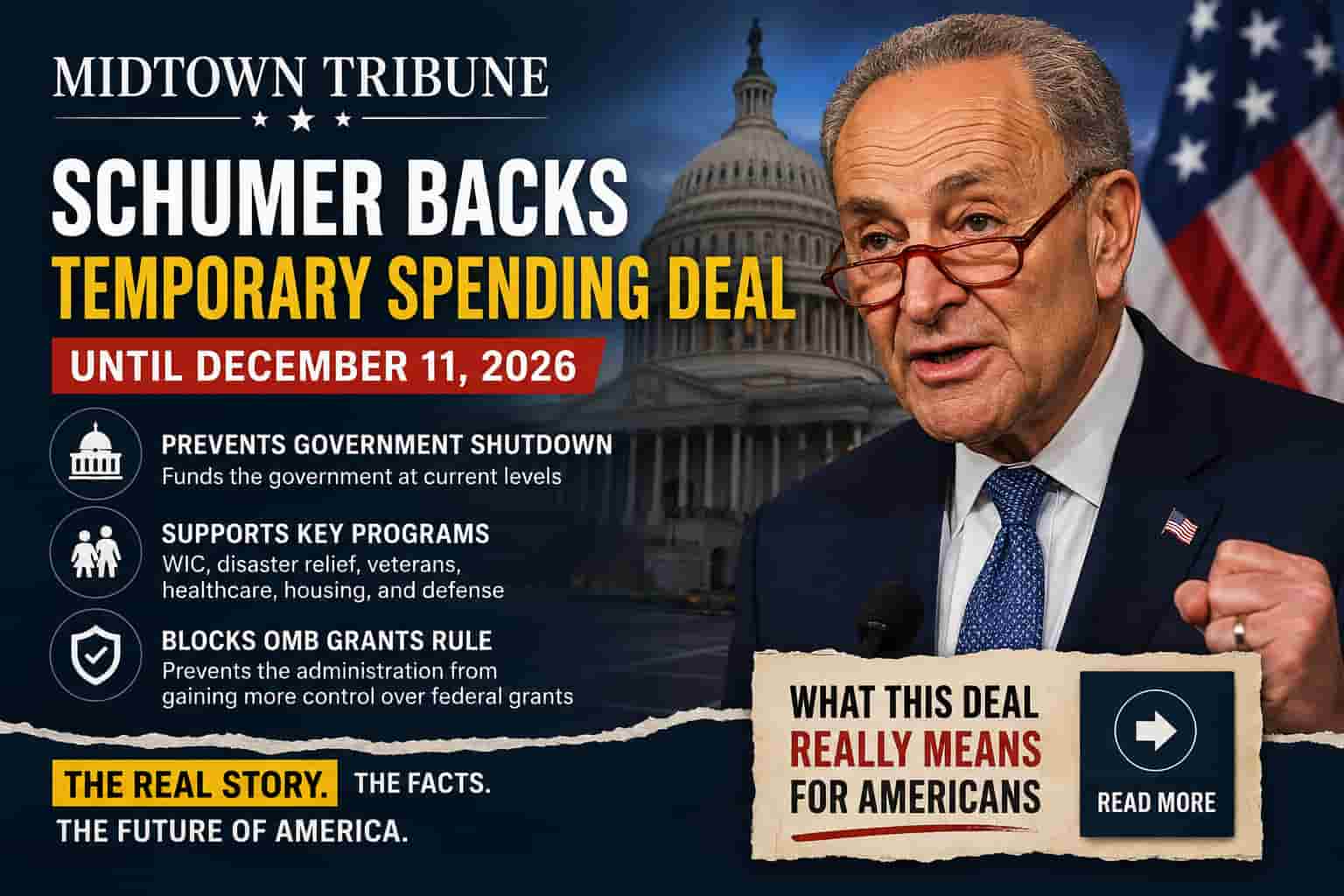
Senate Democratic Leader Chuck Schumer has endorsed a bipartisan continuing resolution designed to prevent a federal government shutdown while Congress continues negotiating full-year appropriations legislation.
The temporary measure would keep most federal agencies funded at approximately current levels through December 11, 2026. Senate Appropriations Committee Chair Susan Collins described it as a stopgap agreement intended to give lawmakers additional time to complete the regular budget process.
Why Is a Continuing Resolution Necessary?
Congress is supposed to approve annual appropriations bills that determine how federal agencies and programs will be financed.
When those bills are not completed before existing funding expires, lawmakers can pass a continuing resolution, commonly called a CR. Without either a CR or completed appropriations legislation, parts of the federal government could shut down.
The new agreement continues government funding and includes adjustments for the Women, Infants and Children nutrition program, the Disaster Relief Fund and several national-security programs. It also temporarily extends authorizations affecting health, veterans, housing, infrastructure and other federal programs.
The proposal is not a permanent federal budget. It postpones the immediate deadline and gives Congress until December to negotiate broader spending legislation.
What Did Schumer Support?
In his social-media statement, Schumer praised Senator Patty Murray for helping negotiate the agreement and for blocking a proposed Office of Management and Budget rule governing federal grants.
The proposed OMB rule would give presidential appointees greater involvement in reviewing and approving federal financial assistance. According to Senate Democrats, it could also allow administration officials to terminate certain grants after they had been awarded.
Democrats describe that proposal as an attempt to politicize federal funding. Schumer used his statement to accuse President Donald Trump’s administration of pursuing a “wasteful” and “corrupt” agenda.
Those words are Schumer’s political characterization. They are not findings contained in the continuing resolution.
The Dispute Is More Complicated Than Schumer’s Post Suggests
The disagreement concerns who should exercise greater control over billions of dollars distributed through federal grants.
Supporters of stronger executive oversight may argue that elected administrations should be able to review grants, stop questionable expenditures and ensure that taxpayer money supports national priorities.
Opponents argue that allowing political appointees to approve or cancel individual grants could expose scientific research, local projects, nonprofit organizations and community programs to partisan pressure.
Significantly, concerns about the proposed OMB rule were not limited to Democrats. Republican Appropriations Committee Chair Susan Collins said she also sought major revisions because of its potential to politicize grants and harm rural communities, families and biomedical research.
The bipartisan CR therefore blocks the proposed OMB grants rule from taking effect for the duration of the temporary funding period. It does not permanently eliminate the rule.
What Does the Deal Mean for Americans?
The immediate result is straightforward: federal agencies would remain open, federal employees would continue working and programs dependent on annual appropriations would avoid an immediate disruption.
But the larger budget dispute remains unresolved.
Congress must still decide how much the federal government will spend, which programs deserve priority and how federal grants should be supervised. Lawmakers will face another deadline before the temporary funding expires on December 11.
Schumer presented the agreement primarily as a Democratic victory over the Trump administration. The official record shows a broader picture: Republican and Democratic appropriators both supported avoiding a shutdown, maintaining essential programs and temporarily stopping a grants rule that raised concerns on both sides of the aisle.
The central question is not simply whether politicians support or oppose President Trump. It is whether expanded White House oversight would protect taxpayers from waste—or give political officials too much power over federal funding.
Official Sources and Original Statements
The following links include the official legislative materials, bipartisan Senate statements and Senator Chuck Schumer’s original social-media statement concerning the continuing resolution.
Official U.S. Government and Senate Sources
- Senate Appropriations Committee: Sen. Collins Statement on the Continuing Resolution — The Republican committee chair’s explanation of the bipartisan agreement, funding through December 11, 2026, and the OMB grants provision.
- Official Bill Materials: Continuing Appropriations and Extensions Act, 2027 — Official legislative text, authorizing divisions and section-by-section summary.
- Senate Appropriations Committee: Senator Patty Murray’s Statement — The Democratic explanation of the agreement and the temporary restriction on the proposed OMB federal-grants rule.
- Official Senate Democratic Caucus: Schumer’s Government-Funding Remarks — Senator Schumer’s official Senate remarks about avoiding a shutdown and passing bipartisan appropriations legislation.
- U.S. Government Accountability Office: What Is a Continuing Resolution? — A nonpartisan federal explanation of why Congress uses temporary spending legislation and how it affects government operations.
Senator Chuck Schumer’s Original Posts and Official Pages
- Chuck Schumer’s Original Statement on X — The social-media statement quoted in this article.
- Chuck Schumer’s Facebook Post — The Facebook publication referenced in this report.
- Senator Chuck Schumer’s Official Facebook Page
- Senator Chuck Schumer’s Official X Account
- Official Website of U.S. Senator Chuck Schumer
Editorial note: Descriptions such as “corrupt,” “wasteful” or “politicized” are political characterizations made by the officials quoted. They should not be presented as independent findings of fact.
Ask Midtown Tribune about this story
Answers are grounded first in this article. Search all Midtown Tribune reporting from the main AI Search page.
AI-generated summary. Verify important details in the linked original articles.