
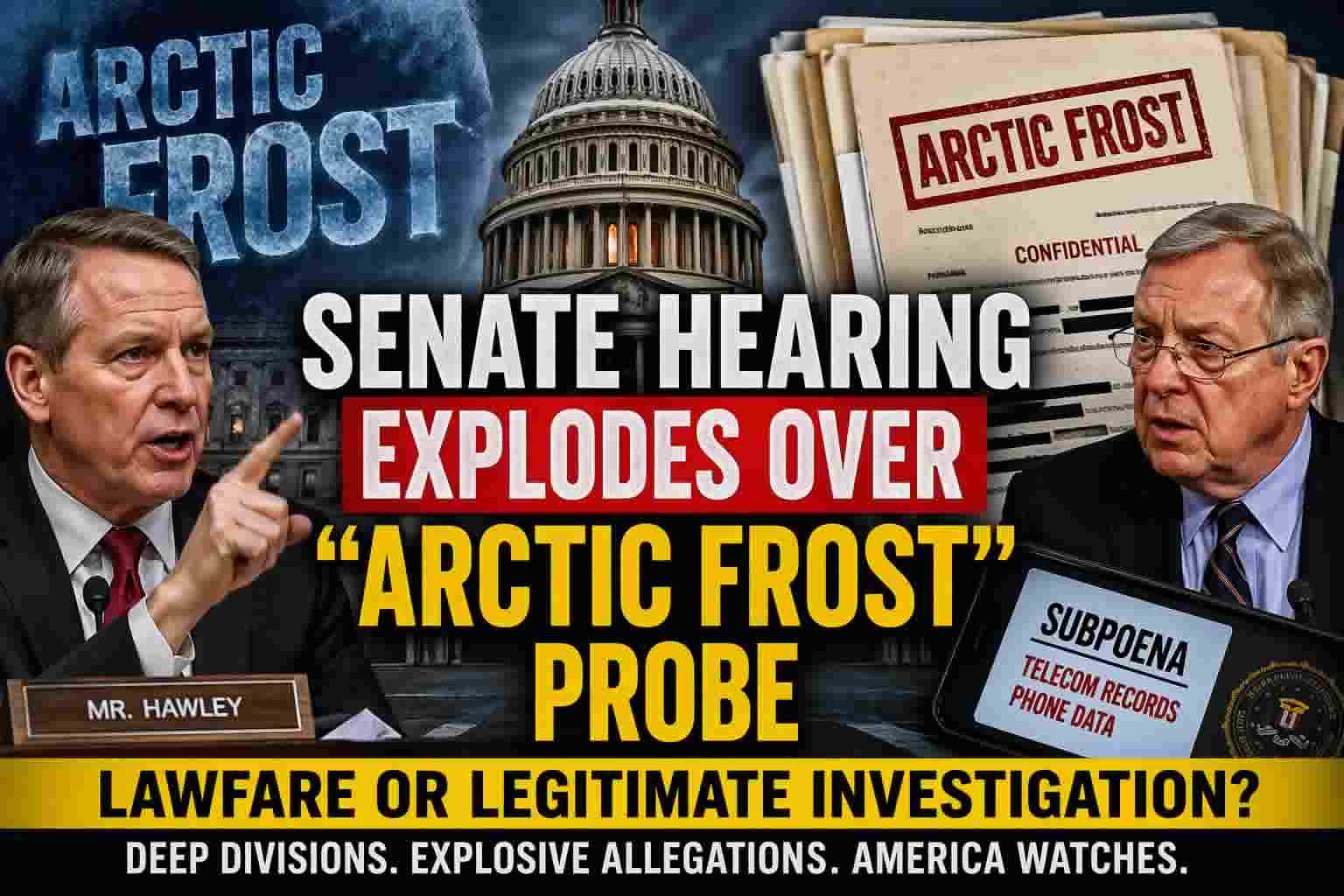
Senate Hearing Turns Contentious Over “Arctic Frost” Investigation Into Trump and Allies
The Senate Judiciary hearing on the “Arctic Frost” probe exposed a sharp divide: Republicans call it political targeting of Trump allies, while Democrats say it was a lawful investigation tied to January 6.
Key Facts
- Hearing focused on “Arctic Frost,” a federal investigation tied to Trump and allies
- Republicans allege coordinated political “lawfare”
- Democrats defend probe as standard law enforcement practice
- Dispute centers on January 6 investigation scope and methods
- Calls growing for Special Counsel testimony
Q&A
Q: What is “Arctic Frost”?
A: A federal investigation into efforts related to the 2020 election and January 6, described differently by each party.
Q: Why is it controversial?
A: Republicans say it targeted political opponents; Democrats say it followed normal legal procedures.
Q: What was the main issue at the hearing?
A: Whether federal agencies were weaponized for political purposes or conducting legitimate investigations.
Q: Will there be more hearings?
A: Likely yes, including potential testimony from Special Counsel Jack Smith.
A central point of contention during the hearing was the collection of phone metadata (toll records) involving Republican lawmakers.
Republicans argued that federal investigators obtained mobile phone records of eight GOP senators and one member of Congress — including data on calls and contacts — without proper notification to Congress. They claimed such actions went beyond standard investigative practices and raised serious constitutional concerns, suggesting the data could have been used to map political networks and exert pressure on the opposition.
Democrats strongly rejected those claims. They emphasized that the issue did not involve wiretapping or listening to conversations, but rather the use of subpoenas to obtain non-content metadata — such as call times, durations, and phone numbers — which they described as a routine and lawful tool in complex criminal investigations, including those related to the January 6 Capitol attack.
Lawmakers clash over claims of political weaponization of federal agencies versus defense of standard investigative practices tied to January 6.
At the center of the controversy is not just the investigation itself — but the scope of data collection tied to it. Lawmakers revealed that federal authorities obtained phone metadata linked to multiple Republican members of Congress, raising concerns that investigators may have effectively mapped political networks within the legislative branch. Critics described the effort as resembling political surveillance, while supporters argued it reflected standard investigative practices in a high-stakes probe.
WASHINGTON, D.C. — A heated hearing before the U.S. Senate Judiciary Committee exposed deep political divisions over the controversial “Arctic Frost” investigation, with Republicans alleging coordinated government overreach and Democrats defending the probe as a lawful response to the January 6 attack.
The session, held by the committee’s constitutional subcommittee, quickly escalated into a partisan clash over whether federal agencies under President Joe Biden targeted political opponents of former President Donald Trump — or were simply pursuing a legitimate criminal investigation.
Republican Claims: “Weaponization of Government”
Committee Republicans argued that “Arctic Frost” was not a routine investigation but a sweeping effort aimed at dismantling a political movement.
According to statements presented during the hearing, the probe allegedly:
- Issued nearly 200 subpoenas
- Targeted hundreds of individuals and organizations
- Accessed communications records, including those of lawmakers
- Involved coordination across federal and state entities
Lawmakers described the investigation as a “dragnet” that extended beyond individuals suspected of crimes to broader political networks.
Witnesses supporting this view claimed the investigation blurred the line between law enforcement and political surveillance, raising constitutional concerns about separation of powers and free association.
Democratic Response: “Standard Investigative Process”
Democrats strongly rejected those claims, arguing that the investigation followed established legal procedures and was justified by the events of the January 6 Capitol attack.
Senators emphasized that:
- Subpoenas and phone metadata collection are common in complex cases
- Investigations may involve individuals connected to potential wrongdoing
- No one is above the law, including political figures
They pointed to the scale of the January 6 violence — including injuries to law enforcement officers — as a clear basis for a broad federal inquiry.
Central Dispute: Lawfare vs. Accountability
At the core of the hearing was a fundamental disagreement:
- Republican view: The investigation represented “lawfare” — using legal tools to weaken political opposition
- Democratic view: It was a legitimate effort to investigate attempts to overturn the 2020 election
Witness testimony reflected this divide. Some argued the probe showed coordinated political bias, while others insisted the methods used were standard in corruption and national security investigations.
Key Flashpoints
Several issues intensified the confrontation:
- Allegations of coordination between the White House and prosecutors
- Questions about access to communications of elected officials
- Disputes over whether investigative steps violated constitutional protections
- Renewed arguments over the legitimacy of the 2020 election
The hearing also revisited the role of former Justice Department official Jeffrey Clark, a controversial figure linked to post-election legal efforts.
What Comes Next
Lawmakers signaled that additional hearings may follow, with calls from both parties to bring Special Counsel Jack Smith to testify publicly under oath.
The outcome of these inquiries could shape future limits on federal investigative powers — particularly when political figures are involved.
Forbes Breaking News official video
Midtown Tribune Independent USA news from New York
Ask Midtown Tribune about this story
Answers are grounded first in this article. Search all Midtown Tribune reporting from the main AI Search page.
AI-generated summary. Verify important details in the linked original articles.