
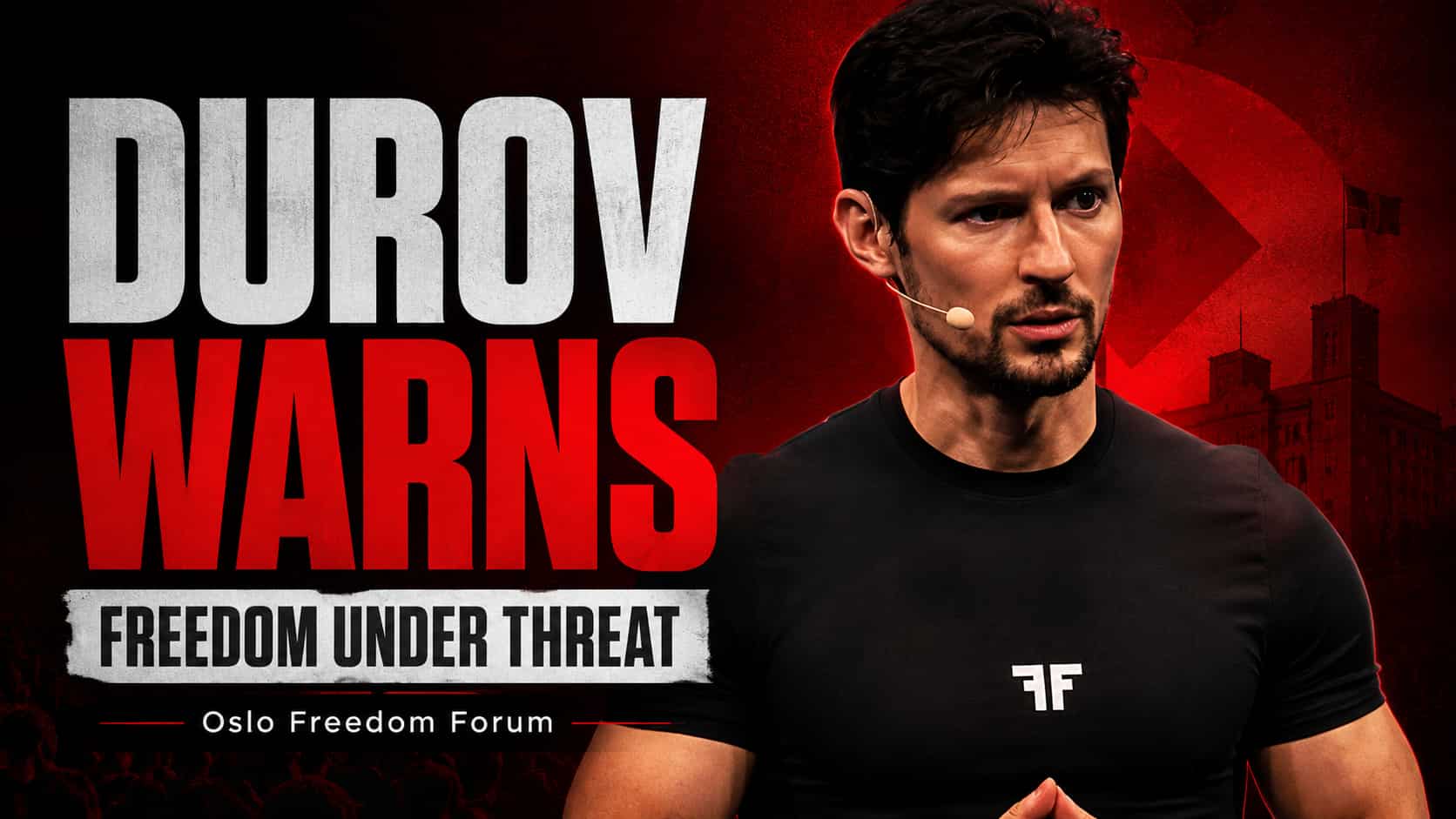
Telegram founder Pavel Durov delivered a stark warning at the Oslo Freedom Forum: the greatest threat to freedom may no longer come only from dictatorships — but from democracies slowly adopting the tools of digital control.
Telegram founder Pavel Durov used his appearance at the Oslo Freedom Forum to deliver one of his strongest public warnings yet about censorship, surveillance, and the erosion of personal freedom in the digital age.
Opening with the story of the Titanic, Durov argued that passengers failed to understand the danger until it was too late. He compared that disaster to what he described as the current state of personal freedom around the world: a ship that has “already hit the iceberg” while most people still do not realize it is sinking.
Durov said he has spent nearly 20 years running major social media platforms and has seen, from the inside, how governments pressure technology companies. According to him, the methods used to suppress freedom are not always obvious. They often come wrapped in legal language, public relations campaigns, political excuses, and emotional appeals.
Watch: Pavel Durov at Oslo Freedom Forum
Telegram founder Pavel Durov speaks about government pressure, censorship, privacy, encryption, and the future of freedom in the age of artificial intelligence.
From Russia to the West
Durov, who founded VK before creating Telegram, said authoritarian governments in Russia, China, and Iran have long used censorship and surveillance as instruments of power. His central warning, however, was that similar methods are now appearing in some Western countries.
He pointed to arrests and prosecutions connected to online speech, proposed digital ID requirements for access to social media, and laws promoted under the banner of child protection. Durov argued that the stated purpose of such measures may sound noble, but the result can be dangerous: governments gain more power over political speech and private communication.
According to Durov, banning or restricting platforms rarely works as intended. He cited the example of Russia and Iran, where Telegram remains widely used despite government bans and blocking attempts. Users simply turn to VPNs and other tools. In his view, this proves that broad restrictions do not eliminate online access — they push ordinary users into riskier digital environments.
“Protect the Children” as a Political Pretext
One of Durov’s main arguments was that child protection has become a powerful political phrase used to bypass debate. He said few people want to be seen as opposing child safety, which makes the phrase useful for passing laws that would otherwise face stronger public resistance.
He connected this issue to European efforts such as age verification rules and the so-called “chat control” initiative, which critics say could weaken encryption and enable mass scanning of private messages.
Durov warned that once governments demand access to private messages, criminals will move to more secure tools first, while ordinary law-abiding citizens will be the ones exposed. In his view, mass surveillance does not stop serious crime; it primarily destroys privacy for everyone else.
Privacy, Corruption, and the Danger of Too Much Data
Durov also argued that giving governments more access to private data creates a second danger: abuse by officials. He recalled his experience in Russia, where he said requests for private data were sometimes used not to fight crime, but to target innocent people.
He then warned that similar abuses are possible in the West when state agencies collect large amounts of personal information. The more data governments gather, he argued, the greater the damage when that data is leaked, stolen, sold, or misused.
For Durov, the issue is not only censorship. It is the combination of censorship, surveillance, selective enforcement, and artificial intelligence. In the AI era, he warned, surveillance can become far more powerful than anything available to past authoritarian systems.
Selective Enforcement and Political Pressure
Durov described selective enforcement as another tool historically used by authoritarian regimes. The pattern, he said, is simple: governments create so many complicated regulations that full compliance becomes almost impossible. Then officials choose whom to punish and whom to ignore.
In this framework, loyal companies are tolerated, while companies that resist political pressure are targeted.
Durov connected this concern to broader debates over content moderation, government pressure on platforms, and the policing of “misinformation.” He argued that some views once dismissed as conspiracy theories later became legitimate subjects of public debate — but only after platforms had already suppressed them.
A Warning About AI Surveillance
The most serious part of Durov’s speech was his warning about the future. He compared today’s digital surveillance risks with the Soviet Union of the 1980s. In the old system, he said, even the KGB had human limits: there were only so many officers and only so many letters they could physically open.
Artificial intelligence removes those limits.
If privacy disappears in the age of AI, Durov warned, every message, draft, thought, relationship, and political opinion could be analyzed and scored automatically. That future, he suggested, could become even darker than the surveillance states of the past.
“There Is No Second West”
Durov concluded with a call to defend Western freedom before it is too late. In the past, dissidents could flee authoritarian countries and find refuge in the West. But if the West itself adopts the logic of censorship and surveillance, he warned, there may be nowhere left to escape.
“There is no second West,” Durov’s message implied. There is no backup civilization waiting to preserve free speech, privacy, and individual rights if the current one gives them away.
Sources and Related Links
-
Video: “I’ve seen how governments suppress freedom” | Pavel Durov at Oslo Freedom Forum
Watch on YouTube -
Oslo Freedom Forum
Official Oslo Freedom Forum Website -
Telegram
Official Telegram Website -
Pavel Durov on Telegram
Pavel Durov’s Official Telegram Channel
Midtown Tribune Independent USA news from New York
Ask Midtown Tribune about this story
Answers are grounded first in this article. Search all Midtown Tribune reporting from the main AI Search page.
AI-generated summary. Verify important details in the linked original articles.