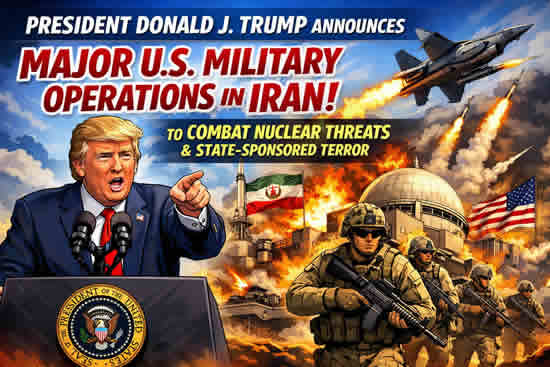
In this address from White House , President Donald J. Trump announces the commencement of major combat operations in Iran (0:00-0:07), stating the objective is to eliminate threats from the Iranian regime (0:09-0:15). He characterizes the regime as a “vicious group” that has endangered the United States, its troops, and allies for 47 years (0:19-0:31).
The President outlines a history of Iranian aggression (0:31-1:57), including:
The 1979 US embassy takeover and hostage crisis (0:49-0:58).
The 1983 Marine barracks bombing in Beirut (1:04-1:10).
Involvement in the 2000 USS Cole attack (1:13-1:18).
Killing and maiming hundreds of American service members in Iraq (1:21-1:26).
Recent attacks against American forces and vessels in the Middle East (1:26-1:40).
Funding terrorist militias in Lebanon, Yemen, Syria, and Iraq (1:47-1:57).
Iran’s proxy Hamas launching the October 7th attacks on Israel (2:00-2:14).
He emphasizes that Iran is the “world’s number one state sponsor of terror” (2:22-2:24) and highlights its suppression of its own citizens (2:27-2:31).
A key policy point is that the Iranian regime can never have a nuclear weapon (2:31-2:46). President Trump states that in “Operation Midnight Hammer” last June, the U.S. obliterated Iran’s nuclear program at Ford Natanz and Isfahan (2:48-2:59). Despite warnings and attempts to make a deal, Iran refused to renounce its nuclear ambitions and attempted to rebuild its program and develop long-range missiles (3:00-3:54).
The President then details the military’s ongoing operation (4:08-4:20) to:
Destroy their missiles and missile industry (4:23-4:28).
Annihilate their navy (4:32-4:35).
Ensure terrorist proxies no longer destabilize the region or attack U.S. forces (4:37-4:49).
Ensure Iran does not obtain a nuclear weapon (4:57-5:01).
He asserts the unparalleled strength of the U.S. military (5:11-5:28) and acknowledges the potential for U.S. casualties (5:32-5:58). The President addresses members of the Islamic Revolutionary Guard and police, urging them to “lay down your weapons and have complete immunity or…face certain death” (6:25-6:50). Finally, he speaks to the people of Iran, proclaiming “the hour of your freedom is at hand” (6:51-6:56), advising them to stay sheltered, and encouraging them to “take over your government” once the operation is finished (7:06-7:08). He pledges overwhelming U.S. support for their cause (7:30-7:33).
New York Governor Kathy Hochul says the state is taking “precautionary steps” after overnight U.S. military operations in Iran, directing State Police to increase patrols and visibility at religious, diplomatic, and cultural sites across New York in coordination with federal, state, and local partners. With the Jewish holiday of Purim approaching, State Police have also begun outreach to religious organizations to offer support. Hochul emphasized that officials have identified no specific, credible threats to New York so far, but authorities are monitoring online activity for potential risks and asking New Yorkers to remain vigilant and report suspicious
Statement from NY Governor Kathy Hochul
“Following the U.S. military operations in Iran overnight, we are taking precautionary steps to protect New Yorkers. State Police are increasing their presence at religious, diplomatic, and cultural sites statewide in coordination with federal, state, and local law enforcement partners. Additionally, in advance of the Jewish holiday of Purim, State Police remain alert and have already begun outreach to religious organizations to offer support.
“While there have been no specific, credible threats to New York identified, we continue to monitor online activity for any potential threats, and we encourage New Yorkers to remain vigilant and report suspicious activity.”
U.S. Moves to Forfeit “M/T Skipper” Oil Tanker and 1.8M Barrels of Venezuelan Crude in Iran Sanctions Case
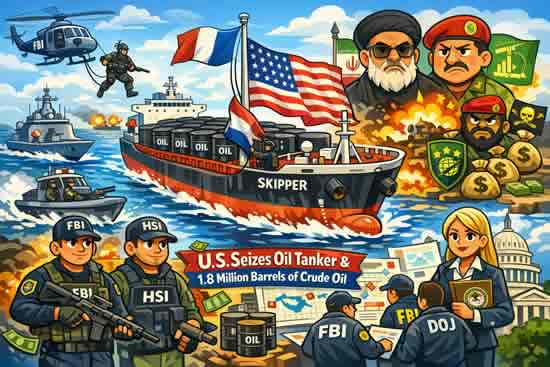
The U.S. Department of Justice says it has filed a civil forfeiture complaint in federal court in Washington, D.C., seeking to forfeit the crude-oil tanker M/T Skipper and roughly 1.8 million barrels of crude oil allegedly tied to a sanctions-evasion network benefiting Iran’s IRGC (including the IRGC-Qods Force) and involving Venezuelan state oil company PdVSA. According to the DOJ, the vessel—described as part of a “ghost” or “shadow” fleet—used tactics such as spoofed locations and false flags to move oil from Iran and Venezuela through ship-to-ship transfers worldwide, and was seized on the high seas in December 2025 before being taken to waters off Texas; officials say the action underscores stepped-up enforcement against maritime sanctions evasion and terrorist financing, while noting the complaint’s allegations must be proven in court.
A complaint has been filed in the U.S. District Court for the District of Columbia seeking to forfeit the Motor Tanker Skipper – a crude oil tanker seized by the United States on the high seas in December 2025 – and approximately 1.8 million barrels of crude oil cargo supplied by Petróleos de Venezuela, S.A. (PdVSA), the state-owned oil company of Venezuela. As alleged, the Skipper and its cargo are forfeitable as property affording a person a source of influence over the Islamic Revolutionary Guard Corps (IRGC), including the IRGC-Qods Force (IRGC-QF), a designated Foreign Terrorist Organizations (FTO).
“Under President Trump’s leadership, the era of secretly bankrolling regimes that pose clear threats to the United States is over,” said Attorney General Pamela Bondi. “This Department of Justice will deploy every legal authority at our disposal to completely dismantle and permanently shutter any operation that defies our laws and fuels chaos across the globe.”
“This forfeiture complaint for the M/T Skipper and its oil cargo demonstrates the FBI’s unwavering commitment to enforcing U.S. sanctions and thwarting hostile regimes who exploit the global oil trade,” said FBI Director Kash Patel. “The FBI, working alongside our interagency partners, will continue aggressively identifying, disrupting, and dismantling the financial networks used by our foreign adversaries to fund terrorist organizations and destabilize international security. We remain steadfast in safeguarding both the integrity of the international financial system and the security of the American people.”
“Because of the coordinated efforts of our prosecutors and law enforcement partners, a ghost tanker that for years secretly moved illicit oil from Iran and Venezuela around the globe has been taken off the seas,” said Assistant Attorney General A. Tysen Duva of the Justice Department’s Criminal Division. “Today’s actions are an important step in making America and the world safer by disrupting the flow of millions of dollars to foreign terrorist organizations. The Criminal Division will continue to use every tool at our disposal to end to terrorist financing.”
“For too long, a shadow fleet of stateless and falsely registered vessels has operated with impunity while shuttling illicit oil around the world, generating billions in revenue for adversary regimes and foreign terrorist organizations,” said John A. Eisenberg, Assistant Attorney General for National Security. “This forfeiture complaint reflects the National Security Division’s commitment to shutting down those networks and enforcing U.S. sanctions.”
“We will aggressively enforce U.S. sanctions against Iran and relentlessly pursue ghost fleet vessels whose illicit oil shipments have served as revenue sources for the IRGC and its terrorist proxies,” said U.S. Attorney Jeanine Ferris Pirro for the District of Columbia. “With the continued seizures and forfeitures of tankers and related profits, we are sending a clear message that there will be no safe harbor for sanctions evasion – and that we will deny Iran the ability to fund terrorism through its shadowy maritime networks.”
“Homeland Security Investigations played a critical role in the investigation that led to today’s forfeiture complaint against the Motor Tanker Skipper and its illicit cargo. By leveraging our expertise, partnerships, and unwavering commitment to protecting the homeland, HSI helped disrupt a complex sanctions-evasion and illicit finance network supporting designated Foreign Terrorist Organizations,” said HSI acting Executive Associate Director John Condon. “I am proud of the dedication and professionalism demonstrated by our special agents and law enforcement partners, whose collaborative efforts were instrumental in advancing this case. HSI remains committed to safeguarding national security and upholding the rule of law by targeting criminal organizations that threaten global stability.”
The forfeiture complaint alleges a scheme, between at least 2021 and the present, to facilitate the shipment and sale of petroleum products for the benefit of the IRGC, including the IRGC-QF. During this time, the Skipper moved crude oil from Iran and Venezuela and, through ship-to-ship transfers, delivered it to various locations around the world, including to other rogue regimes. The Skipper disguised its illicit activities by spoofing its locations, flying false flags and employing other tactics to obfuscate its routes and conceal its sanctions evasion. For example, as alleged in the complaint, in 2024, the Skipper delivered approximately three million barrels of crude oil from Iran to Syria. The Skipper continued to transport illicit oil from Iran and Venezuela into 2025, including loading oil from Iran at least twice in 2025. For its facilitation of illicit oil shipments, on Nov. 3, 2022, the U.S. Department of the Treasury’s Office of Foreign Assets Control (OFAC) sanctioned the Skipper (then named the Adisa).
The civil forfeiture complaint further alleges that the petroleum product, which was loaded onto the Skipper from Venezuela before it was seized, is part of the Skipper’s scheme to perpetuate its operations in support of the IRGC, including the IRGC-QF. As alleged, revenue from the sale of petroleum products supports the IRGC’s full range of malign activities, including the proliferation of weapons of mass destruction and their means of delivery, support for terrorism and both domestic and international human rights abuses. The ghost fleet, including the Skipper, plays an essential role in generating revenue for these regimes by moving Iranian and other illicit oil around the world.
Most recently, in November 2025, the Skipper loaded approximately 1.8 million barrels of Venezuelan-origin crude oil at the José Terminal in Venezuela. According to bills of lading, approximately 1.1 million barrels of the Skipper’s oil cargo were to be delivered to Cubametales, the Cuban state-run oil import and export company that was designated by OFAC in July 2019.
On Dec. 10, 2025, U.S. law enforcement seized the Skipper on the high seas pursuant to a judicially authorized seizure warrant. At that time, the Skipper was claiming a false Guyanese flag, rendering it stateless. The Skipper and its cargo were thereafter transported to the waters off the coast of Texas.
FBI Minneapolis Field Office and HSI Washington D.C. Field Office are investigating the case. Substantial assistance was provided by HSI New York Field Office.
Trial Attorney Josh Sohn of the Criminal Division’s Money Laundering, Narcotics and Forfeiture Section, Assistant U.S. Attorneys Michael Dilorenzo and Rajbir Datta of the District of Columbia and Acting Deputy Chief Sean Heiden of the National Security Division’s Counterintelligence and Export Control Section are litigating the case.
A civil forfeiture complaint is merely an allegation. The burden to prove forfeitability in a civil forfeiture proceeding is upon the government.
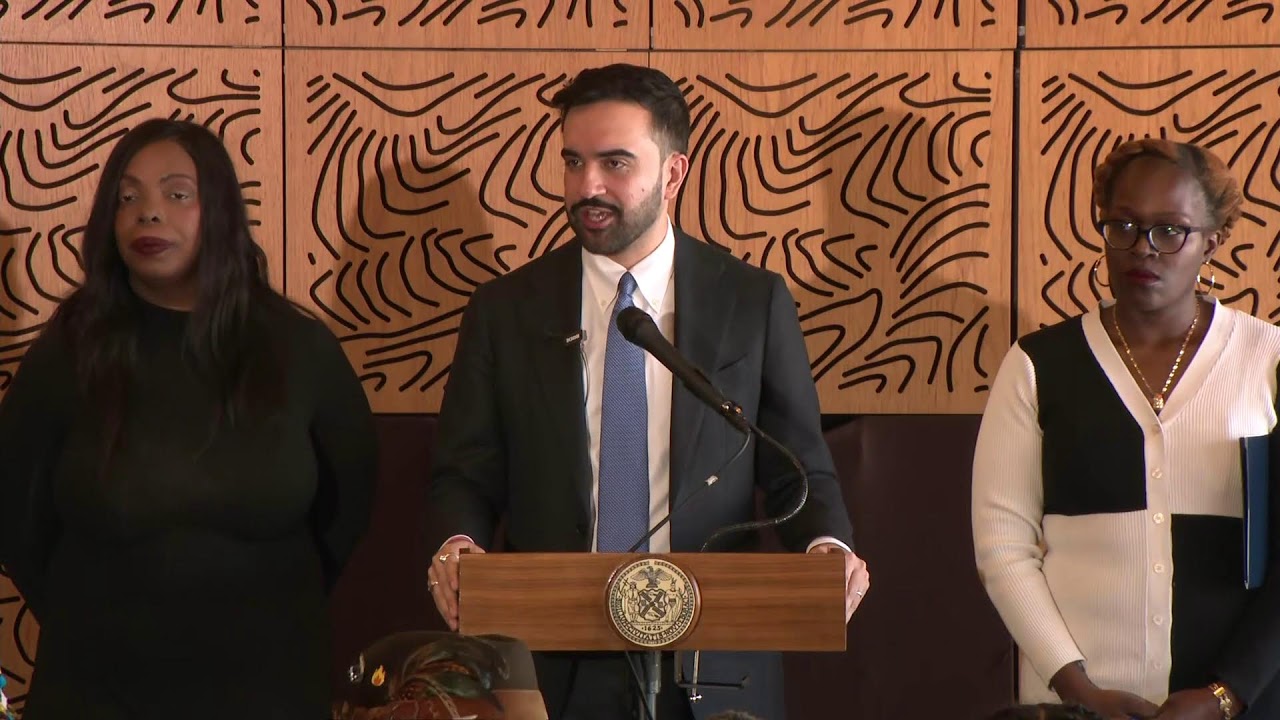
New York City Mayor Zohran Kwame Mamdani met Thursday with President Donald Trump to press for federal support for a sweeping redevelopment of Sunnyside Yard,, the rail complex in Queens. The mayor’s team is seeking more than $21 billion in federal grants to finance what it calls the largest deck ever built over an active rail yard, a move that would open the site for 12,000 affordable apartments, including 6,000 Mitchell-Lama-style units, along with parks, schools and health clinics. City officials say the buildout would generate 30,000 union jobs and rank as New York’s biggest housing-and-infrastructure push in more than 50 years; the White House and City Hall agreed to continue discussions in the coming weeks.
Mayor Mamdani Meets With President Donald Trump to Advance Federal Investment in Affordable Housing
— New York City Mayor Zohran Kwame Mamdani met with President Donald Trump to propose a historic investment in affordable housing at Sunnyside Yard, home to the busiest rail yard in North America. The proposal represents a once-in-a-generation opportunity to confront the city’s housing crisis at the scale it demands.
At the center of the discussion: securing more than $21 billion in federal grants to construct the world’s largest deck over the site, allowing the City to build 12,000 new affordable homes, including 6,000 new Mitchell-Lama-style homes; create 30,000, good-paying union jobs; and deliver new parks, schools and health care clinics. If realized, the project would mark the largest housing and infrastructure investment in New York City in more than 50 years.
“New York City is facing a generational affordability challenge,” Mayor Mamdani said. “Working families are being priced out of the neighborhoods they built. To meet this moment, we need a true federal partner prepared to invest boldly and act urgently. I appreciated the opportunity to speak directly with President Trump about building more housing in any single project than our city has seen since 1973.”
Mayor Mamdani emphasized the need to strengthen financing tools that support affordable development, preserve public housing and modernize regulatory pathways to accelerate construction without sacrificing labor standards or community input.
He also underscored the city’s commitment to transparency, fiscal responsibility and collaboration in deploying federal funds – ensuring every dollar delivers safe, affordable housing for New Yorkers.
Both parties agreed to continue discussions in the weeks ahead.
NEW YORK CITY — The New York Police Department announced Thursday that it has arrested 27-year-old Gusmane Coulibaly in connection with an incident earlier this week where uniformed officers were struck with snowballs — including large chunks of ice — while responding to a disturbance in Washington Square Park in Manhattan.
Coulibaly was taken into custody early Thursday morning after investigators identified him in video footage circulating online of the event. Police say he is charged with assault on a police officer, obstruction of government administration, and disorderly conduct in connection with the episode.
What Happened in the Park
The incident occurred on Monday afternoon, following a major snowstorm that blanketed New York City and drew large crowds to public parks for informal snowball fights. According to NYPD accounts, officers entering Washington Square Park encountered a large crowd where some participants began throwing packed snow and ice at them. At least two officers were injured, suffering cuts and bruises to the face and neck that required hospital treatment.
Police describe the event as more than a playful snowball fight — saying some of the thrown objects were packed with ice and struck officers at close range. Authorities released images of four individuals allegedly involved and have been working to identify and locate them.
Previous Arrest Record
The NYPD noted that Coulibaly had been previously arrested less than three weeks ago on unrelated charges of attempted robbery inside the city’s transit system. Court records indicate he pleaded not guilty to those charges and was released without bail.
Response From Officials
The arrest has highlighted a growing divide in how city officials are publicizing and responding to the park incident:
NYPD leadership and police unions have praised the arrest, emphasizing that assaults on officers — even during public gatherings — constitute criminal behavior and should be treated seriously. The Police Benevolent Association released a statement calling the charged individual an adult, not a “kid,” and saying the arrest sends a message that attacks on police will not be tolerated.
Mayor Zohran Mamdani, however, has downplayed the incident, characterizing initial footage of the event as a snowball fight that “got out of hand,” and suggested that criminal charges may not be appropriate in every case. He has reaffirmed respect for law enforcement but maintained that the situation began as a casual winter gathering.
Meanwhile, NYPD Commissioner Jessica Tisch and other law enforcement leaders have asserted the conduct captured in video was “criminal” and “disgraceful,” standing by the department’s efforts to hold perpetrators accountable.
Investigation Continues
Coulibaly’s arrest is the first in the ongoing investigation into the Washington Square Park conflict. Police continue to seek three other suspects believed to have participated in throwing objects at officers. Authorities are reviewing video footage and circulating images to locate and apprehend additional individuals.
At this time, it is not yet clear what specific court date Coulibaly will face for the new charges related to the assault allegations. Prosecutors in Manhattan’s District Attorney’s Office typically assess charges after police hand over their case file. Follow-up reporting may provide details on court proceedings as they unfold.
Official Quotes & Reactions
🚔 Police Leadership
NYPD Commissioner Jessica Tisch: “The behavior depicted is disgraceful, and it is criminal.” Tisch publicly labeled the actions against officers as unlawful and emphasized detectives were actively investigating the incident.
Police Benevolent Association President Patrick Hendry: “A 27-year-old with a recent attempted robbery arrest is not a ‘kid.’ This arrest sends a clear message that assaults on police officers cannot and will not be minimized or tolerated.” Hendry pushed back against early characterizations of the event as harmless, stressing the seriousness of attacking officers.
From earlier reactions by union leaders (prior to arrest): The PBA had called the attack “unacceptable and outrageous,” urging accountability for those who injured officers. The Detectives’ Endowment Association added it was “not harmless fun,” but a dangerous attack on uniformed officers.
🏛️ Mayor Zohran Mamdani
Regarding the incident before the arrest, Mayor Mamdani said: “From the videos that I’ve seen, it looks like a snowball fight.” He described the situation as having “gotten out of hand” rather than a criminal confrontation, and said it should be treated accordingly rather than automatically as a criminal assault.
The mayor also encouraged respectful treatment of city workers, including police, while continuing to downplay prosecution for participants.
Analysis of Charges & Potential Penalties
Because the NYPD’s announcement only stated that Coulibaly was arrested for “assaulting officers” without immediately specifying formal charges, this section explains what likely charges could be and what they mean under New York law:
1. Assault on a Police Officer
Category: This is commonly prosecuted as Assault in the Second or Third Degree, depending on severity.
**Assault **in the Second Degree (if serious physical injury is inflicted):
Class D felony in New York.
Potential penalties: Up to 2–7 years in prison plus possible fines.
**Assault in the Third Degree (if harm is less severe but still intentional):
Class A misdemeanor.
Potential penalties: Up to 1 year in jail and fines.
When victims are police officers performing official duties, courts often impose enhanced sentences within statutory ranges and prosecutors pursue serious charges. This is separate from political disagreement about how the event started.
(Note: Exact charges depend on prosecutor discretion based on evidence of harm and intent.)
2. Obstructing Government Administration
Throwing objects at responding officers can also lead to Obstructing Governmental Administration (misdemeanor) if it hindered their duties.
Penalties: Up to 30 days in jail and fines.
3. Disorderly Conduct & Related Counts
In large gatherings that turn chaotic, prosecutors often include disorderly conduct, reckless endangerment, or similar charges when behavior poses risks to public safety.
How Courts Treat Police Assault Cases
Attacks on officers — especially involving objects thrown at them (snowballs containing ice and debris can cause lacerations) — are rarely dismissed as simple mischief in New York.
The fact that two officers were hospitalized with facial injuries raises the likelihood that prosecutors will pursue serious felony counts rather than just misdemeanors.
Previous arrests and criminal history (like the earlier attempted robbery charge Coulibaly faced in February) can influence bail decisions and sentencing if convicted.
The commentary argues that ICE has arrested roughly 2,000 criminal migrants in Minnesota in recent weeks, but that national attention has been dominated by the fatal shooting of a woman during an operation in Minneapolis and the nationwide protests that followed.
In just a few weeks Immigration and Customs Enforcement (ICE) has arrested around 2,000 dangerous criminal aliens in Minnesota, including murderers, pedophiles, rapists and gangbangers though you would never know it based on mainstream media coverage. That is because most news outlets are focusing exclusively on the ICE agent shooting of a woman who interfered with the federal deportation operation and the subsequent anti-ICE protests over the incident, which occurred last week in Minneapolis. “Anti-ICE Protests Spread Nationwide,” reads the headline of a major national newspaper story that says, “mounting outrage over an ICE agent’s killing of a woman in Minneapolis spilled into streets across the country on Saturday, as crowds of protesters mobilized against what they called the excesses of the Trump administration’s mass deportation campaign.” Another national news network claims that outrage has grown following the woman’s death with more an 1,000 demonstrations planned across the U.S. Minnesota’s largest newspaper reports that thousands marched in south Minneapolis to protest the state’s ongoing immigration operation.
U.S. authorities say Gerald Eddie Brown Jr. (“Runner”), 65, a former U.S. Air Force officer and veteran instructor pilot, was arrested in Indiana on allegations that he secretly provided combat aircraft training to Chinese military pilots without the required U.S. government authorization—an alleged violation of the Arms Export Control Act and related ITAR rules. Prosecutors claim Brown began arranging the work around August 2023, traveled to China in December 2023 to begin training, and remained involved until returning to the U.S. in early February 2026; he is expected to appear in federal court on February 26, 2026. The Justice Department and FBI say the case underscores efforts to stop U.S. military expertise from being used to strengthen adversary forces, while noting the charges are allegations and Brown is presumed innocent unless proven guilty.
Former U.S. Air Force Pilot Arrested for Providing Defense Services to the Chinese Military
Former U.S. Air Force officer and pilot Gerald Eddie Brown, Jr., also known by the call sign “Runner,” 65, a U.S. citizen, was arrested today in Jeffersonville, Indiana. Brown was charged by criminal complaint for providing and conspiring to provide defense services to Chinese military pilots without authorization, in violation of the Arms Export Control Act (AECA). Brown is expected to have his initial appearance before a Magistrate Judge in the Southern District of Indiana on February 26, 2026.
“The United States Air Force trained Major Brown to be an elite fighter pilot and entrusted him with the defense of our Nation. He now stands charged with training Chinese military pilots,” said Assistant Attorney General for National Security John A. Eisenberg. “When U.S. persons – whether military or civilian – provide training to a foreign military, that activity is illegal unless they have a license from the State Department. The National Security Division will use all tools at its disposal to protect our military advantages and hold to account those who would violate the AECA.”
“Gerald Brown, a former F-35 Lightning II instructor pilot with decades of experience flying U.S. military aircraft, allegedly betrayed his country by training Chinese pilots to fight against those he swore to protect,” said Assistant Director Roman Rozhavsky of the FBI’s Counterintelligence and Espionage Division. “The Chinese government continues to exploit the expertise of current and former members of the U.S. armed forces to modernize China’s military capabilities. This arrest serves as a warning that the FBI and our partners will stop at nothing to hold accountable anyone who collaborates with our adversaries to harm our service members and jeopardize our national security.”
“As an Air Force Officer, Brown took an oath to defend our Nation against all enemies foreign and domestic, he broke that oath, and betrayed the country, jeopardizing the safety of our servicemembers and allies,” said U.S. Attorney Jeanine Ferris Pirro for the District of Columbia. “We will hold Brown, and anyone conspiring against our Nation, accountable for their actions. The Department of Justice and my prosecutors are steadfast in our commitment to use every lawful tool available to keep American military expertise where it belongs – here in America.”
“Providing U.S. military training to our adversaries represents a significant threat to national security,” said Lee M. Russ, Executive Director of the Air Force Office of Special Investigations Office of Special Projects. “AFOSI remains committed to countering the threat posed by those who violate the trust placed in them and endanger our service members.”
As alleged in the complaint, since at least in or around August 2023, Brown willfully conspired with foreign nationals and U.S. persons to provide combat aircraft training to pilots in the Chinese Air Force, known as the People’s Liberation Army Air Force (PLAAF). This training was a defense service under the International Traffic in Arms Regulations (ITAR) and Brown, a U.S. person under the ITAR, lacked the required license from the State Department’s Directorate of Defense Trade Controls (DDTC) to provide that training to foreign persons or foreign military units.
Brown served for over 24 years in the U.S. Air Force, leaving active duty in 1996 with the rank of Major. During his lengthy military career, Brown commanded sensitive units with responsibility for nuclear weapons delivery systems, led combat missions, and served as a fighter pilot instructor and simulator instructor on a variety of fighter and attack aircraft, including the F-4 “Phantom II,” F-15 “Eagle,” F-16 “Fighting Falcon,” and the A-10 “Thunderbolt II” (Warthog). Brown then served as a commercial cargo pilot and, most recently, as a contract simulator instructor for two different U.S. defense contractors training U.S. military pilots on flying the A-10 and the F-35 Lightning II Joint Strike Fighter.
According to the complaint, in or around August 2023, Brown began arranging the terms of his contract to train Chinese military pilots, using a co-conspirator to negotiate with Stephen Su Bin, a Chinese national who in 2016 pled guilty in the U.S. District Court for the Central District of California to conspiring to hack into the computer networks of major U.S. defense contractors and steal sensitive military and export-controlled data for the PRC. He was sentenced to nearly four years in prison. Su Bin and his company PRC Lode Technology Company were also added to the U.S. Department of Commerce’s Entity List in 2014.
Throughout these communications, Brown consistently stated his intent to train PRC military pilots in combat aircraft operations. In the resumé he prepared for his application, Brown wrote his “objective” as “Instructor Fighter Pilot.” A co-conspirator told Brown that he hoped Brown would be assigned to “my base, but otherwise you’ll go where is the local equivalent as the [U.S. Air Force] Weapon School.” Later, he stated to a co-conspirator that, upon his arrival in China, “Now…. I have the chance to fly and instruct fighter pilots again!”
In December 2023, Brown traveled to China to begin his work training PRC military pilots. After his arrival, Brown answered question for three hours about the U.S. Air Force on his first day in the PRC and then, on his second day, prepared and presented a brief about himself for the PLAAF. Brown remained in China until he traveled to the United States in early February 2026.
The charges against Brown follow similar charges filed against former U.S. Marine Corps pilot Daniel Edmund Duggan in the District of Columbia in September 2017. Duggan was charged with providing and conspiring to provide defense services to Chinese military pilots without authorization in violation of the Arms Export Control Act, as well as for conspiring to engage in international money laundering. Like Brown, Duggan received significant training during his career as a pilot in the U.S. military, then used that training for the benefit of the Chinese military. In particular, Duggan is alleged to have trained Chinese military pilots on the tactics, techniques, and procedures associated with takeoff from and landing on an aircraft carrier. Duggan was arrested in Australia in October 2022 and is currently pending extradition to the United States.
In June 2024, the United States, along with the governments of Australia, the United Kingdom, Canada, and New Zealand, published a bulletin warning that “China’s People’s Liberation Army (PLA) continues to target current and former military personnel from North Atlantic Treaty Organization (NATO) nations and other Western countries to help bolster the PLA’s capabilities.” In February 2025, Gen. James B. Hecker, the then-commander of NATO Allied Air Command and U.S. Air Forces in Europe and Air Forces Africa, stated: “Once you fly on our team, even after you hang up your uniform, you have a responsibility to protect our tactics, techniques and procedures.”
The case against Brown is being investigated by the FBI’s New York Field Office, with valuable assistance from the FBI’s Louisville, Indianapolis, and Los Angeles Field Offices. The Air Force Office of Special Investigations also provided substantial assistance.
The case is being prosecuted by Trial Attorney Beau Barnes and Acting Deputy Chief Sean Heiden of the National Security Division’s Counterintelligence and Export Control Section and Assistant U.S. Attorney Steven B. Wasserman from the U.S. Attorney’s Office for the District of Columbia, with assistance from National Security Division Paralegal Specialist Derra McQuaig. Substantial assistance was provided by the U.S. Attorney’s Office for the Southern District of Indiana.
* * *
An indictment, complaint, or criminal information is merely an allegation. All defendants are presumed innocent until proven guilty beyond a reasonable doubt in a court of law.
Updated February 25, 2026
Office of Public Affairs U.S. Department of Justice 950 Pennsylvania Avenue, NW Washington DC 20530