
By Midtown Tribune Staff
Washington, D.C. — June 2026
Artificial intelligence is no longer just a technology debate. It is becoming a national security test.
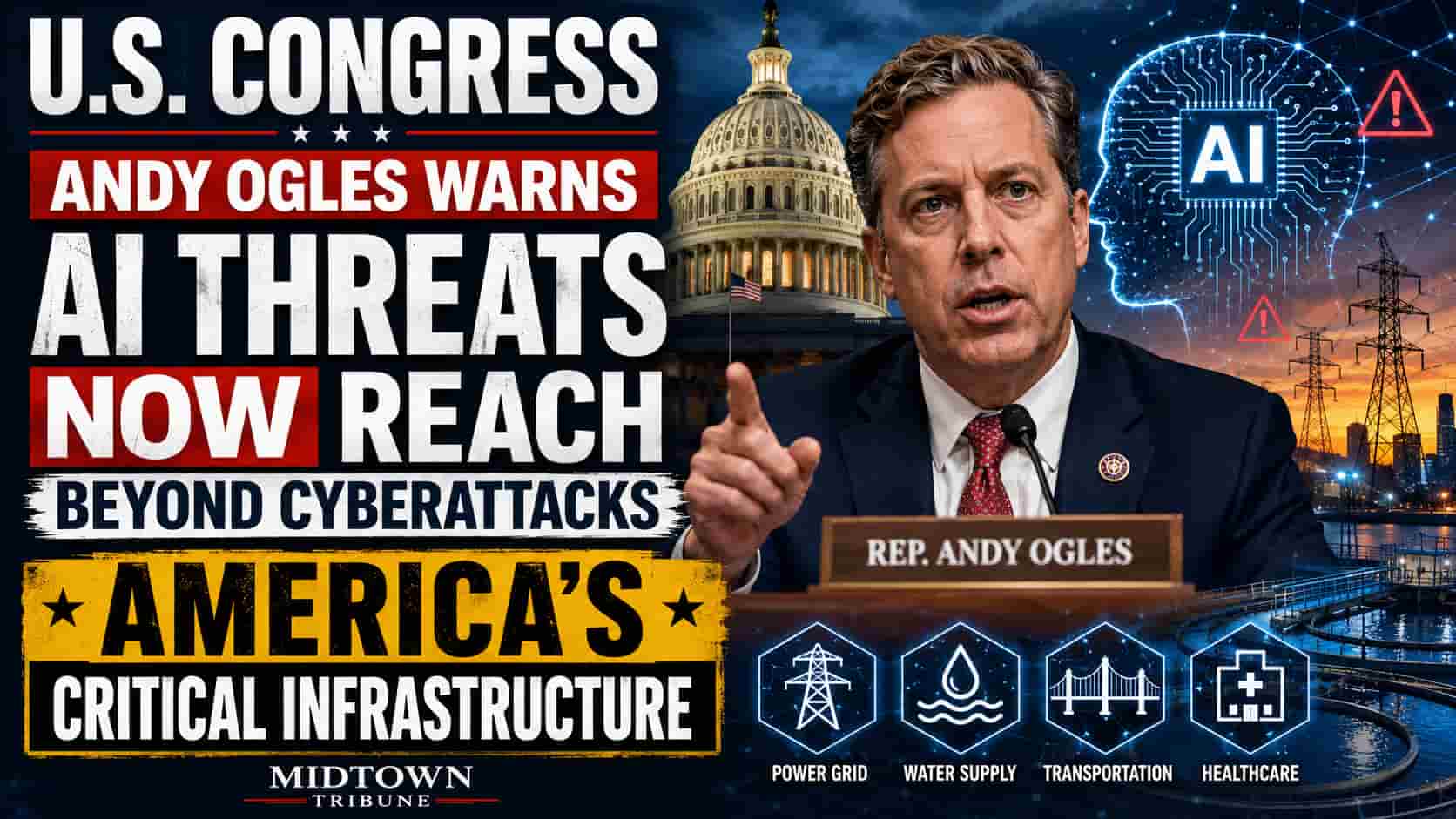
At a House Homeland Security Subcommittee hearing on cybersecurity and infrastructure protection, Rep. Andy Ogles sounded the alarm over what he described as a fast-moving new threat landscape: frontier AI models that can find software vulnerabilities, agentic AI systems that can operate across digital networks, and AI coding tools that are changing how software is built — and how it can be attacked.
The hearing focused on a central question now facing Washington: can the United States stay ahead of adversaries when artificial intelligence can accelerate both cyber defense and cyber offense?
AI Is Collapsing the Timeline for Cyber Threats
Ogles warned that advanced AI models are beginning to do work that once took skilled human researchers months. In his opening statement, he said frontier AI systems can now help discover and exploit previously unknown vulnerabilities at machine speed.
That matters because America’s critical infrastructure — power grids, water systems, transportation networks, hospitals, financial systems, communications networks, and public services — depends on software. If AI can find weaknesses faster than human defenders can patch them, the balance of cyber power changes dramatically.
In the right hands, these tools could help U.S. companies and agencies identify vulnerabilities before foreign hackers exploit them. In the wrong hands, they could become a weapon against the American economy and public safety.
Ogles Points to China and Open-Weight AI Models
A major concern raised during the hearing was the role of Chinese AI models in the global technology ecosystem.
Ogles argued that the United States still leads in the most advanced frontier models, but many of those systems are closed, proprietary, and expensive. China, he warned, is pursuing a different strategy: releasing open-weight models that developers and companies around the world can download, adapt, and deploy at low cost.
The danger, according to Ogles, is that cheap and capable Chinese AI models could become the default foundation for businesses, governments, and developers around the world. That would give Beijing enormous influence over the digital economy — potentially embedding censorship, security uncertainty, and stripped-down safety standards into the tools used by millions.
For American policymakers, the issue is not only who builds the best AI model. It is who becomes the infrastructure layer for the next generation of global software.
The Threat Does Not Stop at Cyberattacks
The most serious warning from Ogles was that AI risk does not end with cyber intrusions.
He said the same models capable of helping find software flaws could also help bad actors work through dangerous steps involving biological threats if proper safeguards are not in place. U.S. AI labs are building safety guardrails into advanced models, but Ogles warned that foreign adversaries could copy or distill American capabilities, remove safeguards, and release less restricted versions into the world.
That scenario, he argued, could turn American innovation into a dangerous tool if adversaries gain the power without the protections.
Agentic AI Creates a New Attack Surface
The hearing also focused on agentic AI — systems that can plan, act, and move across digital environments with less direct human control.
For cybersecurity professionals, this is a major shift. Traditional cyber defenses were designed around human users, known software behavior, and identifiable network activity. Agentic AI could act faster, chain tasks together, test systems, write code, search for weaknesses, and execute steps across networks.
That creates a new attack surface. It also means American companies will need to rethink security-by-design practices, software review, identity controls, monitoring systems, and incident response.
AI Coding Tools Bring Speed — And Risk
Ogles also highlighted a growing problem inside the software industry: more code is being written with AI assistance, often faster than human reviewers can properly inspect.
AI coding tools can increase productivity, but they can also introduce insecure code, hidden dependencies, or vulnerabilities that developers may not fully understand. If those tools are powered by foreign models that companies cannot fully vet, the security concern becomes even greater.
For businesses, the message is clear: AI-generated code should not be treated as automatically safe. It must be reviewed, tested, and secured from the first line of development.
Trump Administration Moves Toward AI Cybersecurity Oversight
The hearing came as the Trump administration has moved to strengthen federal oversight of advanced AI cyber capabilities. President Donald J. Trump has directed federal agencies to focus on AI innovation, cybersecurity, critical infrastructure protection, and U.S. leadership in the global AI race.
Ogles said the federal government cannot be the last institution to understand what frontier AI models can do. He specifically pointed to CISA’s role in translating early information about AI capabilities into practical guidance for critical infrastructure operators.
That will be a major oversight question for Congress: whether federal agencies can turn AI risk analysis into real-world protection for the private companies and public systems that run America.
A Bipartisan Issue With National Security Stakes
Although AI policy is often discussed through the lens of innovation, regulation, or Big Tech competition, Ogles framed the issue as a national security priority.
His warning was direct: the United States must not allow Chinese AI systems to become the default foundation of the global digital economy, and it must not allow advanced AI capabilities to spread without safeguards.
The challenge for Washington is to support American AI leadership while ensuring that frontier models, coding tools, and autonomous systems do not expose the country’s most important infrastructure to a new generation of threats.
The AI race is no longer only about speed, market share, or innovation. It is about who controls the tools that will secure — or endanger — the digital systems America depends on every day.
Sources and Related Information
- House Homeland Security Committee: Subcommittee Chairman Ogles Opens Hearing on Frontier AI Models, the Future of Cybersecurity
- House Homeland Security Committee: Hearing Advisory on Frontier AI, Agentic AI Systems, and Cybersecurity
- The White House: President Donald J. Trump Signs Historic Directive on AI in the National Security Enterprise
- AI.gov: President Trump’s AI Strategy and Action Plan
- CISA: Known Exploited Vulnerabilities Catalog
Midtown Tribune Independent USA news from New York
Ask Midtown Tribune about this story
Answers are grounded first in this article. Search all Midtown Tribune reporting from the main AI Search page.
AI-generated summary. Verify important details in the linked original articles.