
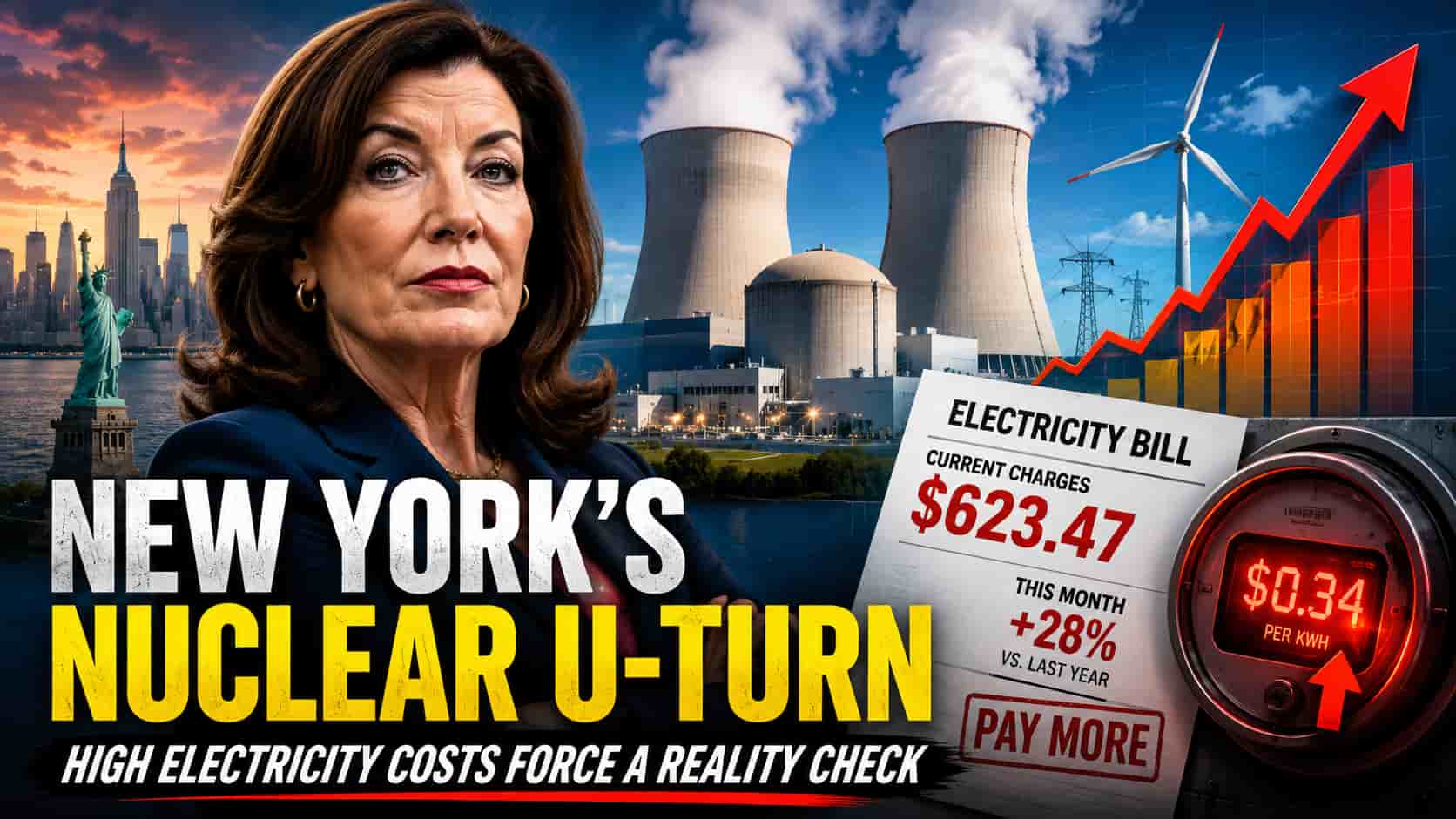
New York Governor Kathy Hochul’s new advanced nuclear push marks a major shift in state energy policy after years of climate-driven restrictions, the closure of Indian Point, rising electricity costs, and growing reliability concerns.
Hochul’s Nuclear U-Turn: New York Energy Policy Faces Reality After Indian Point Closure
Albany, NY — Governor Kathy Hochul’s new push for advanced nuclear power is more than another energy announcement. It is a political retreat from years of climate-first messaging that treated traditional energy infrastructure as a problem to be eliminated rather than a system that must keep New York running every hour of every day.
On June 11, 2026, Governor Hochul announced that the New York Public Service Commission had launched a Nuclear Reliability Backbone process. The goal is to examine how New York can bring new advanced nuclear power online in a timely and cost-effective way. The state is now discussing an 8.4 GW nuclear backbone made up of 3.4 GW of existing nuclear generation and 5 GW of new nuclear generation.
That is a major shift in tone.
For years, New Yorkers were told that aggressive climate policy would deliver cleaner energy, lower costs, and a safer future. But the reality facing families and businesses is different: electricity prices are high, reliability margins are under pressure, and the state is now returning to nuclear power — the same type of around-the-clock, zero-emissions generation that political leaders helped push out when Indian Point was closed.
From Climate Fear to Energy Reality
New York’s political class spent years selling the public a simple story: the state had to move quickly away from older energy systems because a climate catastrophe was coming. Nuclear energy, natural gas infrastructure, and traditional baseload generation were often treated as obstacles to progress.
But an electric grid does not run on slogans. It runs on physics, capacity, fuel supply, transmission, reserve margins, and dispatchable power.
Wind and solar can be important parts of the energy mix, but they do not automatically replace large, reliable plants that produce electricity day and night. Storage helps, but it does not erase the need for dependable generation during long periods of high demand, low renewable output, winter stress, summer heat waves, or unexpected outages.
That is why Hochul’s nuclear announcement matters. It is an admission that New York needs firm, reliable, zero-emissions power — not just political promises.
Indian Point: The Closure That Still Haunts New York Energy Policy
The Indian Point Energy Center, located in Buchanan, Westchester County, was once one of the most important electricity sources for downstate New York. Its final reactor, Indian Point Unit 3, stopped power operations on April 30, 2021.
The closure was celebrated by environmental activists and many Democratic politicians as a victory. But removing major nuclear capacity from the grid did not remove New York’s need for electricity. The power still had to come from somewhere.
That is the central contradiction in New York’s energy policy: leaders shut down reliable nuclear generation in the name of environmental progress, but now they are trying to rebuild nuclear capacity because the grid needs reliable, zero-emissions baseload power.
If nuclear energy was too dangerous, too outdated, or too politically unacceptable in 2021, why is it suddenly being presented in 2026 as a backbone of reliability and affordability?
The answer is simple: reality won.
New York Electricity Costs Are a Warning Sign
The energy debate is not abstract for New Yorkers. It shows up every month in electric bills.
According to NYSERDA’s statewide residential electricity price data, New York’s residential electricity price was about 28.6 cents per kilowatt-hour in March 2026, compared with about 25.5 cents in March 2025. That is a painful increase for households already dealing with high rent, food costs, insurance, taxes, and business expenses.
For small businesses, high electricity costs are not just an inconvenience. They affect restaurants, laundromats, medical offices, grocery stores, landlords, manufacturers, nonprofits, and community organizations. Higher power costs move through the entire economy.
This is why the state’s new nuclear push should be understood not only as a clean-energy announcement, but as a cost-of-living issue.
The Grid Needs Megawatts, Not Messaging
Governor Hochul’s office says advanced nuclear can help provide reliable, emissions-free power, strengthen grid resilience, support affordability, and keep the lights on. That is exactly the type of argument critics of New York’s anti-nuclear politics have been making for years.
The state’s own language now points toward an “all-of-the-above” energy strategy. That phrase is important. It suggests Albany is moving away from the idea that renewables alone can carry the entire future of the grid.
New York faces growing electricity demand from electrification, buildings, transportation, data centers, manufacturing, and economic development. At the same time, older plants are retiring, transmission constraints remain serious, and new clean resources often take years to permit, finance, connect, and build.
That combination creates a difficult question: how can New York shut down dependable generation faster than it builds dependable replacement generation?
The new nuclear process is Albany’s attempt to answer that question after years of avoiding it.
The Political Problem for Hochul and New York Democrats
The political problem is obvious. New York Democrats helped build an energy narrative around climate urgency, fossil fuel restrictions, and the closure of older generating assets. But the state is now forced to speak the language of reliability, affordability, and baseload power.
That does not mean every climate concern was false. It does mean the political use of climate fear often oversimplified the real engineering challenge. New York cannot power a modern economy with press conferences, mandates, and moral slogans. It needs actual electricity.
The new nuclear strategy is a quiet admission that the previous energy conversation was incomplete.
What the Nuclear Reliability Backbone Would Do
The Nuclear Reliability Backbone process is designed to examine how New York can support new advanced nuclear power. The state is looking at policy mechanisms, procurement models, financial support, risk management, workforce development, technology selection, and project viability.
The New York Power Authority is already moving forward with plans for at least 1 GW of new advanced nuclear energy in Upstate New York. NYPA has issued a Request for Qualifications for experienced nuclear developers and delivery partners. NYPA also has a $40 million nuclear workforce development commitment connected to training providers and the broader NextGen Nuclear New York initiative.
The state says eight Upstate communities responded to NYPA’s request for information expressing interest in hosting nuclear facilities.
This is no longer theoretical. New York is preparing the political, technical, and workforce foundation for new nuclear power.
The Questions Albany Still Must Answer
New York’s nuclear shift may be necessary, but the public deserves clear answers.
Who will pay for the new nuclear projects?
Will the cost be placed on ratepayers, taxpayers, public authorities, private developers, federal funding, or all of the above?
Which technology will be selected: large reactors, small modular reactors, advanced light-water reactors, or another design?
Where will these facilities be built?
How will the state handle permitting, local opposition, waste management, security, transmission upgrades, and construction risk?
Will the same politicians who helped make the energy system more fragile now be trusted to rebuild it responsibly?
These questions matter because nuclear projects are complex, expensive, and long-term. New York cannot afford another energy experiment built around ideology instead of execution.
A Costly Circle Back to Common Sense
The deeper story is not just that Hochul supports nuclear power. The deeper story is that New York is circling back to a truth it should never have ignored: reliable power is the foundation of modern life.
A state can set ambitious climate goals. It can invest in renewables. It can reduce emissions. But it cannot pretend that reliability and affordability are secondary details.
The closure of Indian Point removed major nuclear generation from the downstate energy system. Now Albany is trying to create a new nuclear backbone to stabilize the grid and support clean energy goals. That is not just a policy update. It is a reversal.
FAQ: New York Nuclear Power and Hochul’s Energy Shift
What did Governor Hochul announce?
Governor Hochul announced that the New York Public Service Commission is launching a Nuclear Reliability Backbone process to examine how New York can bring new advanced nuclear power online.
How much nuclear power is New York discussing?
The state is discussing an 8.4 GW nuclear backbone, including 3.4 GW of existing nuclear generation and 5 GW of new nuclear generation.
Why is New York returning to nuclear power?
New York needs reliable, zero-emissions electricity that can operate around the clock. Nuclear power provides baseload generation that can support grid reliability while helping meet clean-energy goals.
What happened to Indian Point?
Indian Point’s final operating reactor, Unit 3, ceased power operations on April 30, 2021. Its closure removed a major source of reliable nuclear generation from the downstate New York power system.
Are New York electricity prices high?
Yes. NYSERDA data show New York residential electricity prices near 28.6 cents per kilowatt-hour in March 2026, significantly higher than many other states and higher than the same month in 2025.
Is this a reversal of New York energy policy?
Politically, yes. New York leaders who once celebrated the closure of nuclear generation are now promoting nuclear power as essential for reliability, affordability, and clean energy.
Conclusion
Governor Hochul’s nuclear announcement is being presented as a forward-looking clean-energy initiative. But it is also an acknowledgment that New York’s earlier energy politics went too far in one direction.
The state cannot scare people with climate slogans, close reliable power plants, restrict traditional energy infrastructure, and then act surprised when the grid becomes harder and more expensive to manage.
New York needs clean energy. But it also needs affordable energy, reliable energy, and honest energy policy.
The Nuclear Reliability Backbone is not just a new program. It is evidence that energy reality has finally forced Albany to reconsider its own political assumptions.
In the end, electricity is not produced by ideology. It is produced by power plants.
Official Sources and Documents
Below are official and primary-source links related to Governor Kathy Hochul’s advanced nuclear announcement, New York’s Nuclear Reliability Backbone process, electricity prices, Indian Point, NYPA, NYSERDA, NYISO, and federal energy data.
-
Governor Hochul — Major Milestone to Facilitate New Advanced Nuclear Development
Official New York State announcement on the Public Service Commission’s Nuclear Reliability Backbone process, the 8.4 GW nuclear backbone concept, and the state’s advanced nuclear development strategy.
governor.ny.gov — Advanced Nuclear Development Announcement -
Governor Hochul — At Least 1 GW of Advanced Nuclear Energy in Upstate New York
Official announcement on NYPA’s advanced nuclear development steps, RFQ for nuclear developers, and the $40 million workforce initiative.
governor.ny.gov — NYPA Advanced Nuclear Steps -
New York Power Authority — Nuclear Energy
NYPA’s official page on developing at least 1,000 MW of advanced nuclear energy in Upstate New York.
nypa.gov — Nuclear Energy -
NYSERDA — Advanced Nuclear Energy
Official NYSERDA page on advanced nuclear energy, NextGen Nuclear New York, workforce development, and the state’s nuclear planning efforts.
nyserda.ny.gov — Advanced Nuclear Energy -
NYSERDA — Monthly Average Retail Price of Electricity, Residential
Official New York electricity price data sourced from the U.S. Energy Information Administration. The page shows statewide residential electricity prices by month and year.
nyserda.ny.gov — Residential Electricity Prices -
U.S. Energy Information Administration — Electric Power Monthly, Table 5.6.A
Federal electricity price data by state and end-use sector, including New York residential, commercial, industrial, transportation, and all-sector electricity prices.
eia.gov — Average Price of Electricity by State -
U.S. Nuclear Regulatory Commission — Indian Point Unit 3
NRC reactor information page confirming that Indian Point Unit 3 ceased power operations on April 30, 2021.
nrc.gov — Indian Point Unit 3 -
U.S. Energy Information Administration — Indian Point Nuclear Power Plant Closure
EIA article on Indian Point permanently stopping electricity generation in 2021 after the retirement of its last operating reactor.
eia.gov — Indian Point Nuclear Power Plant Closure -
New York Independent System Operator — 2026 Power Trends Report
NYISO’s official report on New York grid trends, demand growth, reliability margins, and the challenges facing the state’s electric system.
nyiso.com — 2026 Power Trends -
New York Public Service Commission — Document Search
Official PSC document search portal. Search for Case Number 26-E-0335 to find filings and documents related to the Nuclear Reliability Backbone proceeding.
documents.dps.ny.gov — PSC Case Search
Midtown Tribune Independent USA news from New York
Ask Midtown Tribune about this story
Answers are grounded first in this article. Search all Midtown Tribune reporting from the main AI Search page.
AI-generated summary. Verify important details in the linked original articles.