
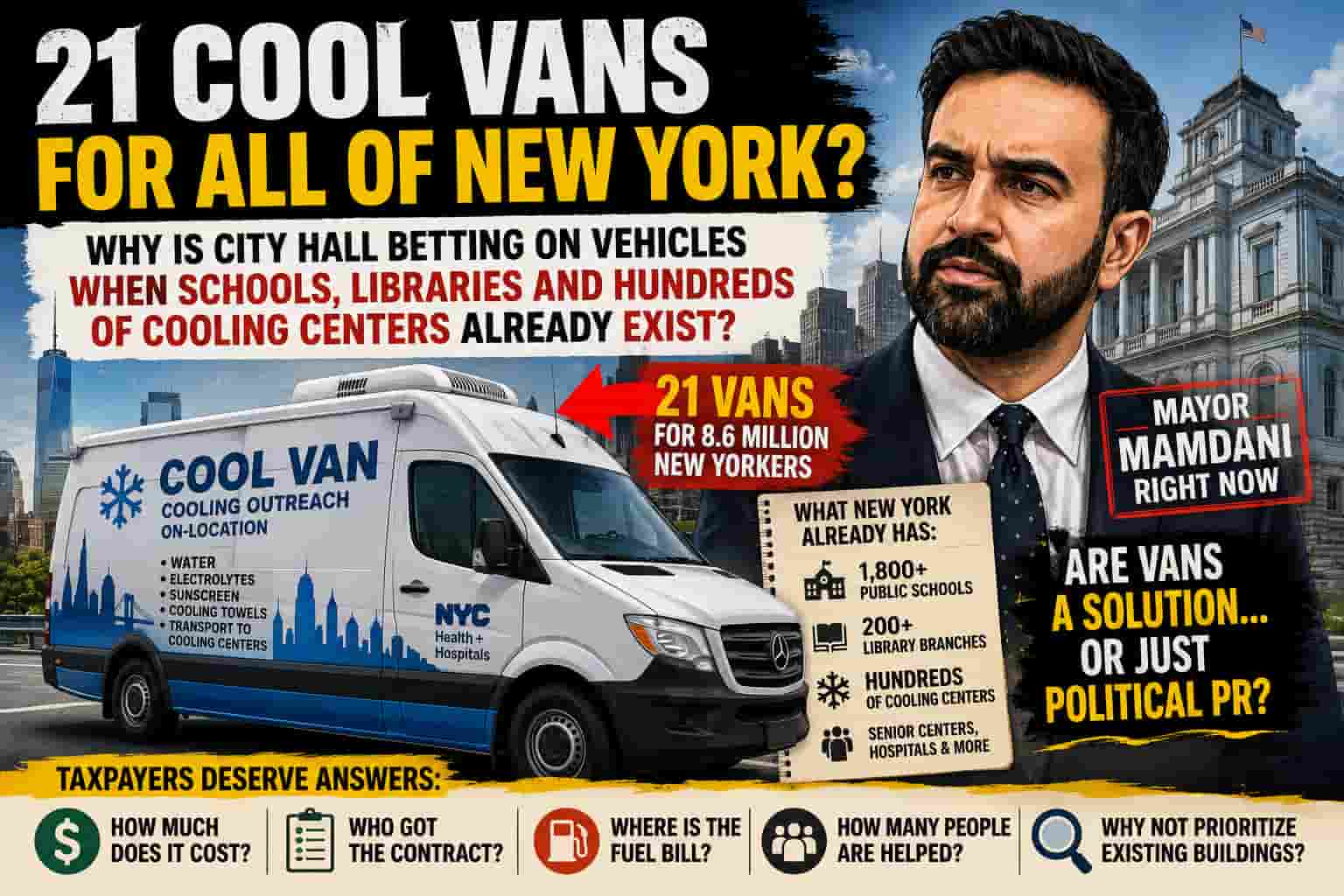
New York City is facing dangerous heat. Mayor Zohran Kwame Mamdani is promoting 21 COOL vans as part of the city’s emergency response. But when New York already has public schools, libraries, hospitals, senior centers and hundreds of cooling centers, taxpayers deserve a clear answer: are these vans a targeted outreach tool — or a political show on wheels?
On July 3, Mayor Mamdani appeared on ABC7 with Phil Taitt to discuss New York City’s response to extreme heat. The mayor said 21 COOL — Cooling Outreach On-Location — vans would be operating across the boroughs, providing water, electrolytes, a cool place to be and transportation to cooling centers. He described the heat as the hottest temperature the city had seen in more than a decade.
The official explanation is simple: the vans are not supposed to cool the entire city. They are supposed to reach people who may not walk into a library, a senior center or a public school on their own — especially unsheltered homeless New Yorkers, older adults and people already exposed to dangerous street-level heat. NYC 311 says COOL vans are operated by NYC Health + Hospitals and provide wellness checks, medical care, water, electrolytes, sunscreen and transportation to cooling centers or health care facilities. NYC’s later extreme-weather briefing explains how cooling centers and COOL vans fit into the city’s heat response.
That mission can make sense. A library cannot drive under an elevated train station. A school building cannot check on a homebound senior. A fixed cooling center cannot find an overheated person on the street. As a narrow emergency outreach tool, mobile vans may be justified.
But that is not the end of the story.
New York City has a massive public infrastructure network that already belongs to the taxpayers. The city’s own school data says NYC had 1,597 NYC Public Schools and 281 charter schools in the 2024–25 school year. The city’s three library systems oversee 219 local library locations across the five boroughs. During the heat emergency, City Hall said it would activate hundreds of free cooling centers at public hospitals, libraries, older adult centers and other public locations, and also open New York City Public Schools and other city buildings as cooling centers.
So the basic civic question remains: if the city already has schools, libraries and hundreds of cooling centers, why does City Hall’s heat-emergency messaging put such emphasis on 21 vans?
New York’s population is about 8.58 million people, according to the U.S. Census Bureau’s 2025 estimate. Twenty-one vans for a city of that size is roughly one van for every 409,000 residents. That is not a citywide cooling system. That is a small mobile operation.
And that is exactly how the city should describe it.
If the vans are a targeted medical and social-services outreach program, City Hall should say so plainly. If they are being presented as the centerpiece of the city’s response to extreme heat, then New Yorkers are entitled to ask whether this is infrastructure — or theater.
The city’s own heat plan makes clear that real heat protection depends on air conditioning and access to indoor cooling. The Mayor’s Office stated that most heat-related deaths in New York City occur after prolonged indoor exposure without air conditioning, and that air conditioning remains the most effective way to stay safe during extreme heat. That statement points toward buildings, electricity, cooling centers, senior facilities and reliable public information — not toward a small fleet of vans as the public symbol of the response.
There is also the question of money.
Official NYC Health + Hospitals documents show a contract authorization with Rapid Reliable Care NY by DocGo, LLC for the Ambulatory Care Street Health Outreach and Wellness Program, also known as SHOW. The contract is not-to-exceed $28,089,000, includes a 30 percent contingency, and covers a three-year term with two one-year renewal options.
That is not the same as saying “Mayor Mamdani rented 21 cooling vans for $28 million.” The official document does not describe a simple van rental contract. It describes a broader Street Health Outreach and Wellness Program providing primary care, harm reduction and behavioral health services through mobile units for New Yorkers who are unsheltered or living on the street. The same document says the program is supported by City Tax Levy and Opioid Settlement funds with a baseline allocation for six mobile clinics.
That distinction matters. A legally careful question is not “Why did 21 vans cost $28 million?” The legally careful question is: Are the COOL vans being operated through the DocGo/SHOW structure, and if so, what exact portion of the cost is tied to the heat emergency deployment?
City documents also say the vendor was selected through an open and competitive RFP process. Two firms submitted proposals, and the top-rated proposer was selected. The evaluation criteria included 60 percent for ability and feasibility to meet the scope of work, 15 percent for vendor experience, 15 percent for cost and 10 percent for MWBE.
The same procurement materials list subcontracted work under the MWBE utilization plan: Judit, Inc. for driver staffing, Alante Security Group, Inc. for security staffing, Blessed Rodah for security staffing and Hey Girlie for hygiene kits. That means a COOL van is not just a van. It may involve vehicles, drivers, clinicians, security, supplies, fuel, dispatching, management and overhead.
That is why the public deserves a line-item explanation.
How much does one COOL van cost per day?
How many people were actually transported to cooling centers?
How many seniors were checked at home?
How many cases of heat illness were identified?
How much was spent on vehicles, staff, security, supplies, fuel and administration?
Were these vans paid through the existing SHOW contract, a separate emergency procurement, or another city mechanism?
None of these questions attacks the idea of helping vulnerable New Yorkers. They ask whether City Hall is using public money efficiently and whether emergency programs are being explained honestly.
If a person is living on the street in dangerous heat, send the outreach team. If a homebound senior has no air conditioning and no family nearby, send help. If a delivery worker, street vendor or day laborer needs water, cooling towels and medical attention, provide it.
But do not sell 21 vans as a substitute for the city’s real cooling infrastructure.
The real test for New York is not whether the mayor can stand next to a branded van for television. The real test is whether schools, libraries, senior centers, public hospitals and cooling centers are open, accessible, staffed, safe and easy to find. The real test is whether the electric grid can handle the load when residents are told to stay indoors and use air conditioning. The real test is whether taxpayer-funded programs produce measurable results — not just press releases.
A COOL van may be useful. But a COOL van is not a plan for a city of 8.6 million people.
For Mayor Mamdani, the question is direct: if these vans are emergency outreach, show the routes, the costs and the results. If they are political branding, New Yorkers have seen this show before — only this time, it comes with sunscreen, electrolytes and a motor running in the heat.
Official Sources
- NYC Mayor’s Office: Transcript — Mayor Mamdani Provides Updates on Extreme Heat Response and Safety Live on ABC7
- NYC Mayor’s Office: Mayor Mamdani Activates Unprecedented Heat Emergency Plan
- NYC 311: Cooling Outreach Vans
- NYC Public Schools: NYCPS Data at a Glance
- NYC Mayor’s Management Report: Public Libraries
- NYC Health + Hospitals: DocGo / Street Health Outreach and Wellness Program Contract Documents
- NYC Cooling Centers Finder
- NYC Beat the Heat
Ask Midtown Tribune about this story
Answers are grounded first in this article. Search all Midtown Tribune reporting from the main AI Search page.
AI-generated summary. Verify important details in the linked original articles.