
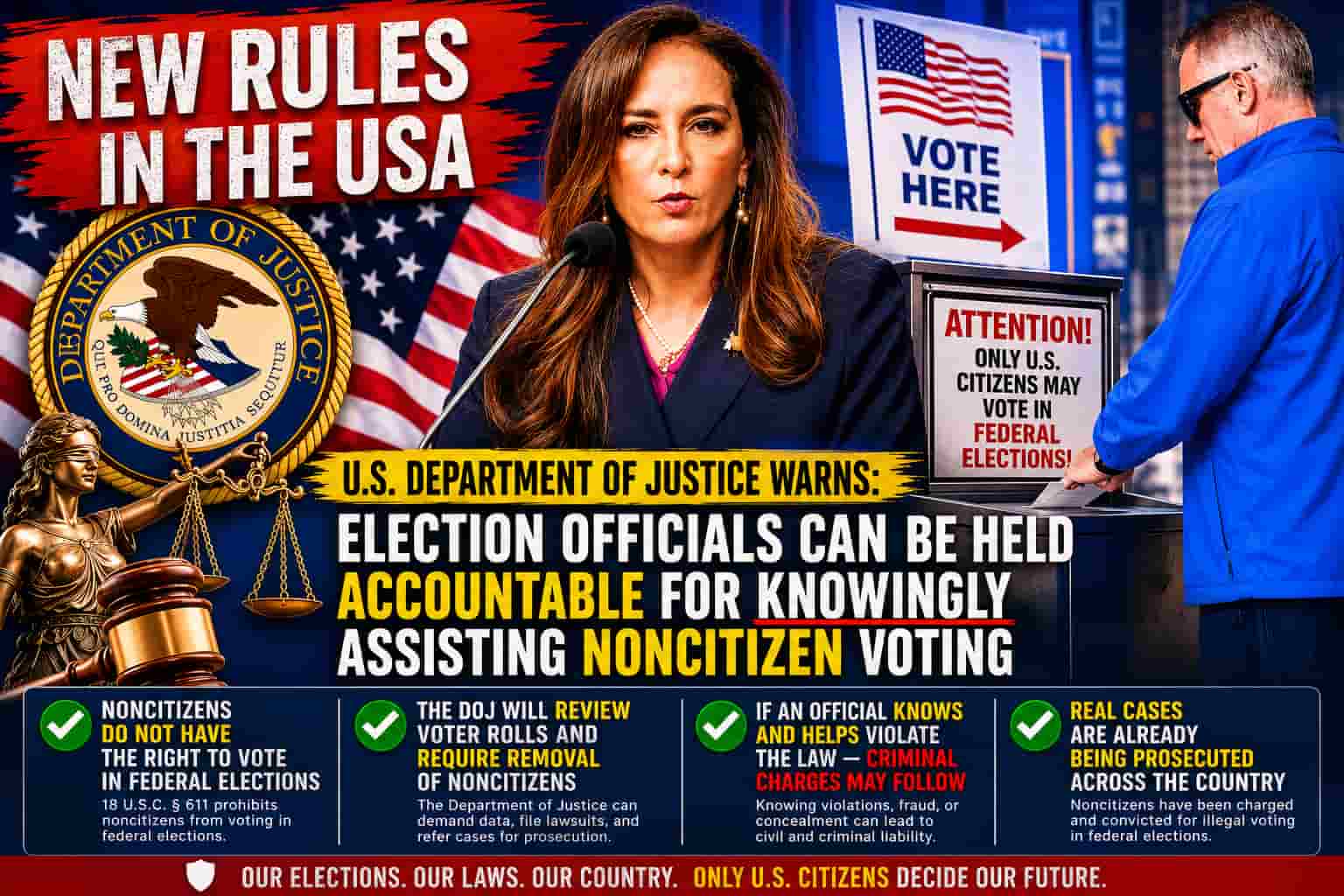
In the United States, voting in federal elections is a right reserved for U.S. citizens—not for every person legally residing in the country. The Trump administration’s Department of Justice is making its position increasingly clear: federal authorities intend to scrutinize not only individuals who unlawfully cast ballots, but also the officials responsible for voter registration and the accuracy of voter rolls.
However, the widely circulated headline claiming that election officials can now be charged “over noncitizen voting” requires an important clarification. An official cannot automatically be prosecuted simply because an unlawful vote was discovered in that official’s jurisdiction.
To bring criminal charges, investigators would generally need evidence of a specific legal violation—such as knowingly assisting unlawful registration, participating in fraud, concealing relevant information, or deliberately refusing to comply with federal election requirements.
An Illegal Ballot Is Not Merely a Technical Error
Federal law generally prohibits noncitizens from voting in elections involving the president, vice president, members of the U.S. House of Representatives, or U.S. senators.
Limited exceptions may apply when a state or local jurisdiction allows noncitizens to participate exclusively in local elections and uses a ballot or voting process designed to prevent them from voting in federal contests.
The federal prohibition appears in 18 U.S.C. § 611. Therefore, claims that federal law does not prohibit noncitizen voting—or that citizenship is merely a political issue rather than a legal requirement—are inaccurate.
The Trump administration has also pursued policies intended to strengthen citizenship verification, improve the accuracy of voter rolls, and expand information-sharing between federal agencies and state election authorities.
The administration’s position is that federal agencies should assist states in determining whether individuals registering to vote are legally eligible to participate in federal elections.
Why the Focus Is Shifting Toward Election Officials
For years, enforcement efforts generally focused on the individual who allegedly registered or voted unlawfully. The Department of Justice is now emphasizing a second question:
What happens when a government official knows that an individual is ineligible but deliberately fails to take legally required action—or actively assists the violation?
States administer elections and maintain voter-registration databases. However, federal law imposes requirements related to registration procedures, recordkeeping, voter-roll maintenance, and access to election records.
The National Voter Registration Act, commonly known as the NVRA, establishes federal rules for voter registration and voter-list maintenance in federal elections.
The Help America Vote Act, or HAVA, also requires states to maintain centralized voter-registration systems and comply with certain standards governing the administration of federal elections.
The Department of Justice has asserted that it may request voter-registration information, examine records for possible violations, seek the removal of ineligible registrations through lawful procedures, file civil lawsuits, and refer appropriate cases for criminal prosecution.
This is no longer merely a policy debate about whether government databases contain occasional errors. The issue is whether state and local officials are fulfilling their legal responsibilities when administering federal elections.
The Orange County Case: DOJ Is Already Going to Court
In June 2025, the Department of Justice filed a lawsuit against the registrar of voters in Orange County, California.
According to the Justice Department, county officials failed to provide records related to the removal of noncitizens from voter-registration lists and did not comply with federal election-law requirements.
DOJ officials stated that noncitizen voting in federal elections is a federal crime and that state or county refusals to provide lawfully requested information may violate long-standing federal statutes.
It is important to distinguish between two very different legal actions.
A civil lawsuit against an election official or government agency is not the same thing as a criminal indictment. Nevertheless, the case demonstrates a significant shift from passive oversight toward document demands, voter-roll investigations, litigation, and judicial enforcement.
These Are Not Hypothetical Cases
Official Justice Department announcements show that federal prosecutors are actively pursuing allegations involving unlawful registration and voting by noncitizens.
In January 2026, federal prosecutors in New Jersey announced charges against two noncitizens. According to the allegations, they falsely claimed to be U.S. citizens on voter-registration documents and later voted in the 2020 general election.
In May 2026, charges were announced against four additional individuals in New Jersey. According to the criminal complaints, the defendants were not U.S. citizens when they registered but represented that they were eligible citizens.
In another case, a noncitizen in New Jersey pleaded guilty to unlawfully voting in a federal election.
Federal authorities in South Florida have also prosecuted noncitizens for illegal voting and related election offenses. In those cases, the government alleged that the defendants knew they were not legally eligible to participate in federal elections.
These cases do not prove that millions of unlawful ballots were cast, nor do they establish that noncitizen voting changed the result of any particular election.
They do, however, disprove the opposite extreme claim—that unlawful voting by noncitizens never occurs or cannot be prosecuted under federal law.
When Could an Election Official Actually Face Charges?
The mere presence of an ineligible or outdated registration in a government database does not automatically mean that an election administrator committed a crime.
Voter rolls may contain outdated addresses, duplicate records, deceased voters, data-entry mistakes, or people whose eligibility status has changed. Government databases are not infallible.
Criminal liability generally requires proof of intentional or knowing misconduct.
Potentially serious conduct could include situations in which an official:
- knew that an applicant was not a U.S. citizen but deliberately helped that person register;
- knowingly issued or counted an unlawful ballot;
- participated in falsifying voter-registration records;
- concealed, altered, or destroyed evidence relevant to a federal investigation;
- deliberately obstructed a lawful Justice Department inquiry;
- knowingly participated in a broader election-fraud scheme.
Federal law also prohibits knowingly providing false information in connection with voter registration, fraudulent conduct affecting federal elections, and intentional efforts to deprive lawful voters of a fair count.
The precise criminal statute would depend on the conduct, evidence, intent, and circumstances of each case.
That is why the legally accurate statement is not:
“An election official can be imprisoned whenever a noncitizen votes in that official’s jurisdiction.”
A more accurate formulation is:
Election officials may face civil or criminal liability when they knowingly assist unlawful voting, participate in fraud, conceal evidence, obstruct an investigation, or deliberately violate federal election requirements.
The Trump Administration’s Broader Message
The Trump administration treats citizenship verification as a fundamental component of federal election integrity—not as an optional administrative procedure.
The administration has called for greater information-sharing between federal and state agencies, stronger verification of voter eligibility, and the lawful removal of noncitizens from official voter-registration lists.
For election administrators, this may signal the end of a convenient approach under which officials simply accept a completed form and decline to examine contradictory information.
Federal authorities are increasingly asking states to demonstrate how they verify eligibility, correct confirmed errors, respond to evidence of unlawful registration, and comply with requests for election records.
At the same time, election-integrity enforcement must remain evidence-based and consistent with due process.
Efforts to identify ineligible noncitizens do not authorize officials to arbitrarily remove lawful voters, misclassify naturalized Americans, or conduct voter-roll removals in violation of federal procedures.
Citizenship verification and the protection of eligible voters are not mutually exclusive. A lawful election system must do both.
Conclusion
The Epoch Times image reflects a real direction in Justice Department policy, but its headline simplifies the legal standard.
Yes, an election official could potentially become a defendant—or even face criminal charges—in a case involving noncitizen voting.
No, criminal liability does not arise automatically because of a single mistaken registration or one unlawful ballot.
The central legal issue is knowledge and intent.
An official who performs the job honestly, follows established procedures, and corrects discovered errors is not automatically a criminal merely because an ineligible record appears in the system.
But when a public official knowingly helps someone circumvent the law, falsifies or conceals records, obstructs a federal investigation, or deliberately facilitates unlawful voting, holding public office does not provide immunity.
That is the message the Trump administration is now sending to state and local election authorities:
The authority to administer elections does not include the authority to ignore federal law.
Official Sources
- The White House: Executive Action on Citizenship Verification and Federal Election Integrity — official presidential document concerning voter eligibility and citizenship verification.
- The White House: Fact Sheet on Citizenship Verification and Voter Eligibility — the administration’s official explanation of its federal election-integrity measures.
- 18 U.S.C. § 611 — Voting by Noncitizens in Federal Elections — the official text of the United States Code.
- 52 U.S.C. § 20511 — Criminal Penalties for Election-Related Fraud and False Information — federal provisions addressing fraudulent registration, false information, and interference with lawful voting.
- Department of Justice: Lawsuit Against the Orange County Registrar of Voters — DOJ action concerning records related to the removal of noncitizens from voter rolls.
- Department of Justice Complaint Against Orange County — the official federal court filing.
- DOJ: Four Noncitizens Charged With Illegal Registration, Voting, and False Statements — an official announcement from the U.S. Attorney’s Office for the District of New Jersey.
- DOJ: Two Noncitizens Charged With Voting in a Federal Election — an official federal prosecution announcement.
- DOJ: Noncitizen Pleads Guilty to Illegally Voting in a Federal Election — an official announcement from federal prosecutors in New Jersey.
- Department of Justice: National Voter Registration Act of 1993 — DOJ’s official overview of federal voter-registration and voter-list requirements.
- Department of Justice: Help America Vote Act — official information concerning federal election administration and statewide voter-registration databases.
- Department of Justice: Guidance on Voter-List Maintenance — official guidance explaining state responsibilities and legal safeguards governing voter-roll removals.
All links lead to official websites of the White House, the U.S. Department of Justice, or the United States Code.
Midtown Tribune Independent USA news from New York
Ask Midtown Tribune about this story
Answers are grounded first in this article. Search all Midtown Tribune reporting from the main AI Search page.
AI-generated summary. Verify important details in the linked original articles.