
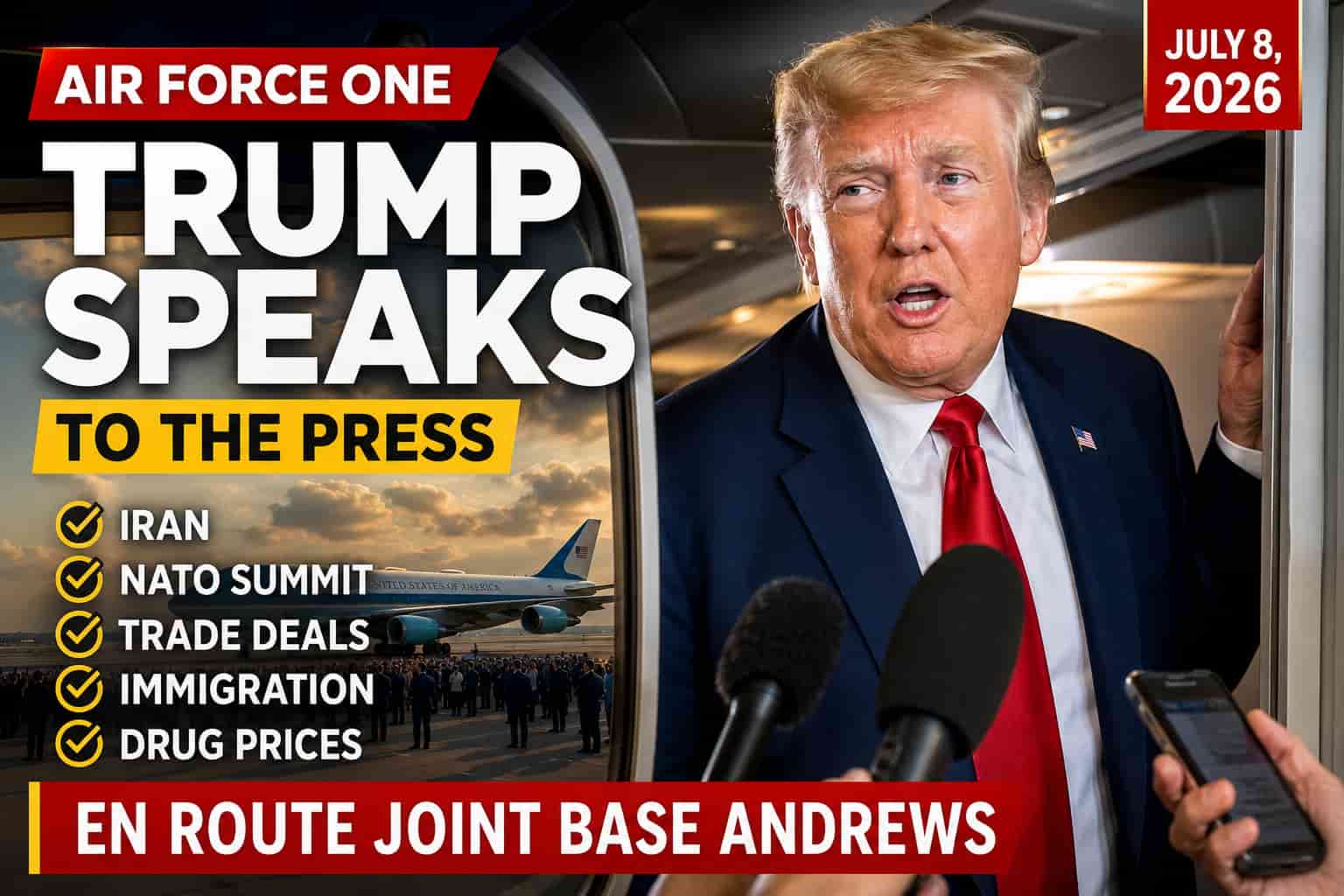
President Donald J. Trump spoke with reporters aboard Air Force One on July 8 while traveling back to Joint Base Andrews after the NATO summit in Ankara, Turkey. The press gaggle highlighted the central themes of Trump’s leadership: peace through strength, defense of American interests, pressure on NATO allies to pay their fair share, election integrity, lower drug prices, border security, and protection of American taxpayers.
Trump opened the conversation by describing the trip to Turkey as successful. He said the United States is doing well and that the summit produced important results. The President also pointed to trade discussions with Turkey and praised Turkish President Recep Tayyip Erdoğan, calling him a strong partner.
One of the first questions focused on why the traveling press and the President had changed planes. Trump rejected the suggestion that the change was caused by a major security threat. He said the aircraft had simply been sent ahead so personnel at the base could see it. “No issues,” Trump told reporters, explaining that the plane had gone early before the return flight.
The discussion quickly shifted to security and Iran. Asked about possible threats, Trump said he faces threats constantly and described himself as “number one” on Iran’s list. But his message was clear: under his leadership, the United States does not respond weakly. If American interests are attacked, America will answer much harder.
On Iran, Trump emphasized that the central U.S. objective is preventing Tehran from obtaining nuclear weapons. He referred to the effort as the “denuclearization of Iran” and said Iran wants a deal badly, but the question is whether the regime can be trusted to honor any agreement. This reflects Trump’s broader foreign-policy principle: negotiations are possible, but only from a position of strength.
A major part of the gaggle focused on NATO. Trump again argued that the United States has carried an unfair financial burden for Europe’s defense for far too long. He said NATO allies now better understand that Washington has been treated unfairly while American taxpayers have paid too much for the security of wealthy countries across the Atlantic.
Trump described the NATO meeting as marked by “tremendous unity and togetherness.” He also said some allies, including Spain, had moved toward meeting U.S. demands on payments and defense commitments. For Trump, this was proof that a tough negotiating posture works: when America demands fairness, allies begin to contribute more.
Asked whether he might withdraw additional U.S. troops from Europe, Trump said he had not made a final decision. He connected future decisions to broader strategic issues, including Greenland and Iran. His message remained consistent: American military commitments abroad must serve the interests of the United States, not become a permanent free security guarantee for countries that can afford to contribute more.
Trump also spoke positively about several foreign leaders he met during the summit. He mentioned Syrian President Ahmad al-Sharaa and Ukrainian President Volodymyr Zelenskyy, saying both meetings went well. Trump said al-Sharaa made certain commitments related to Hezbollah and Lebanon, though he declined to provide details.
The President also discussed his record as a peacemaker. He pointed to multiple conflicts he says he helped settle or stop, including the dangerous confrontation between India and Pakistan. Trump’s argument was that peace is not achieved through weakness or endless bureaucratic diplomacy, but through hard negotiation, deterrence, and the understanding that escalation carries consequences.
Election integrity became one of the strongest domestic themes of the gaggle. Trump again called for voter ID, proof of citizenship, and limits on mass mail-in voting. His position is simple: how can anyone vote in a presidential election without reliable proof of identity?
In America, identification is required for boarding a plane, opening a bank account, obtaining many government services, and even purchasing certain regulated products. Yet voting rules in some states, according to critics, leave too much room for error, pressure, ballot harvesting, and questionable practices.
Trump argued that in-person voting should be the norm, while mail voting should be limited to reasonable exceptions: military service, illness, disability, travel, business obligations, or other legitimate reasons a voter cannot appear in person.
This issue became central after the 2020 election. During COVID-19, many states sharply expanded mail-in voting and the use of ballot drop boxes. This was not one single national federal rule: election procedures in the United States are largely controlled by the states, and absentee voting rules varied long before 2020. However, the sudden expansion of mass mail voting, prolonged vote counting, ballot drop boxes, and uneven state rules created a deep crisis of public trust.
Trump supporters argue that these practices led to numerous allegations of ballot stuffing, illegal ballot collection, and vote manipulation in specific places. Not every allegation was proven in court, but existing criminal cases show that voter fraud is not imaginary — it is a real category of election crime.
For example, the U.S. Department of Justice reported that Kim Phuong Taylor of Iowa was convicted for a voter fraud scheme involving fraudulent voting and fraudulent registration connected to an effort to generate illegal votes for her husband in the 2020 election. The DOJ has also reported other election-related cases involving ballot stuffing, bribery, illegal voting, and election fraud. These cases do not automatically prove every political claim about 2020, but they do support the main argument for voter ID: the system must be protected before a scandal, not only investigated afterward.
Trump also spoke about prescription drug prices. He said his “most favored nation” policy and TrumpRx initiative helped bring down the cost of prescription drugs. According to Trump, the United States had paid the highest drug prices in the world for too long while other countries received the same medicines at far lower prices. He presented the issue as another example of his America First policy: the United States should no longer serve as the world’s financial backstop.
Toward the end of the gaggle, Trump addressed immigration and housing costs. He said rents and housing prices are beginning to come down because his administration is removing illegal immigrants from the country. Trump argued that the Biden administration placed additional pressure on the housing market by using available housing units for illegal migrants and paying for it through the federal government.
For Trump, this issue is not only about immigration but also about fairness to American citizens. His argument is that the government should not put illegal migrants ahead of American veterans, soldiers, working families, and taxpayers.
The Air Force One gaggle showed Trump in the role his supporters recognize well: a president who speaks directly, demands that allies pay their fair share, pressures adversaries, defends the border, calls for honest elections, and puts the interests of Americans ahead of international bureaucracy.
The central message was clear: a strong America can achieve peace, but only when it is respected; honest elections require proof of identity; and American taxpayers should no longer pay the price for weak and irresponsible policies.
By Midtown Tribune Staff
July 9, 2026
Sources
- The White House — President Trump Gaggles with Press on Air Force One En Route Joint Base Andrews, Jul. 8, 2026
- The White House — Official Videos
- NATO — Official Website
- U.S. Department of Justice — Woman Convicted for Voter Fraud Scheme
- U.S. Department of Justice — Woman Arrested for Voter Fraud Scheme
- U.S. Department of Justice — Former Congressman Charged with Ballot Stuffing, Bribery, and Obstruction
- U.S. Department of Justice — Bethlehem Man Convicted of Election Fraud Offenses Connected to 2020 Presidential Election
- NCSL — States with No-Excuse Absentee Voting
- NCSL — States with All-Mail Elections
Midtown Tribune Independent USA news from New York
Ask Midtown Tribune about this story
Answers are grounded first in this article. Search all Midtown Tribune reporting from the main AI Search page.
AI-generated summary. Verify important details in the linked original articles.