
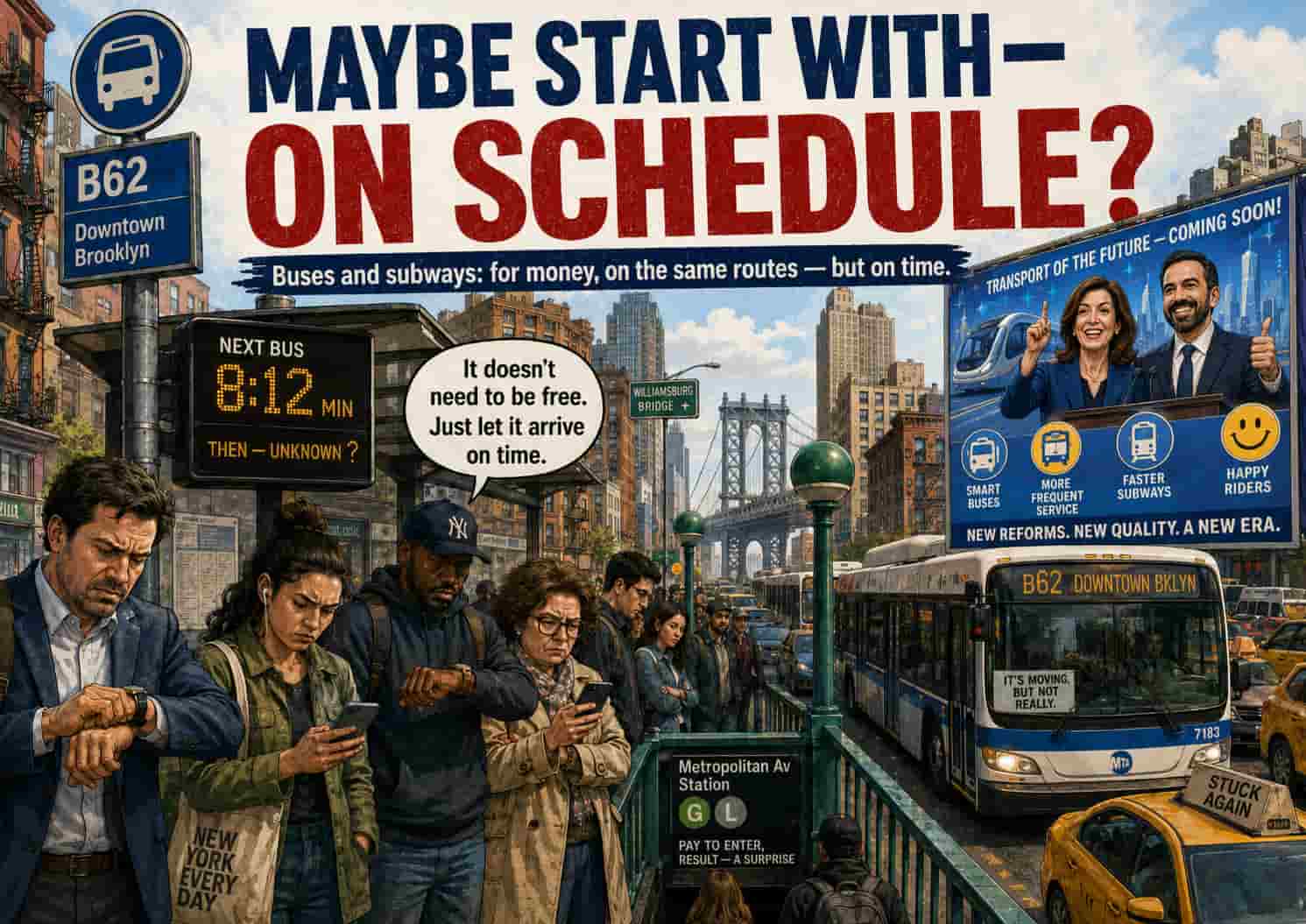
New York City has announced another transportation revolution.
Mayor Zohran Mamdani, Governor Kathy Hochul, the MTA, the Department of Transportation, the City Council, and transit advocates gathered in Downtown Brooklyn to unveil “Next Stop: Fast Buses, Better Service,” a plan promising faster buses, better service, modern bus corridors, new shelters, more enforcement, and thousands of new buses.
It sounds grand. It sounds ambitious. It sounds like the kind of government announcement that comes with applause, slogans, walk-up music, and a stopwatch.
But millions of New Yorkers may have a simpler request:
Before buses become free, before they become “world-class,” before they become “next-generation,” before they become the envy of the planet — could they just arrive on time?
Not free.
Not futuristic.
Not revolutionary.
Just paid, predictable, and on schedule.
For many riders, the dream is not a bus that saves democracy, equity, climate policy, affordability, and the global reputation of New York City in one press conference. The dream is a bus that arrives when the app says it is arriving.
In New York, that alone would qualify as a miracle.
The Six-Minute Revolution
The headline number from the mayor’s announcement is six minutes. According to the plan, bus speeds on 50 priority corridors would increase by an average of 20%, saving riders up to six minutes per trip and up to 12 minutes per commute. Mamdani even built his speech around the theme, promising to keep his remarks to exactly six minutes to show how valuable time is to working New Yorkers.
The idea is attractive. Six minutes matter. Six minutes can mean breakfast with your family, getting home before bedtime, or not sprinting through Brooklyn like an Olympic athlete because the bus tracker lied again.
But here is the problem: if a bus is 22 minutes late and then saves you six minutes, the passenger has not experienced progress. The passenger has experienced political arithmetic.
New Yorkers are not asking for magic. They are not even asking for luxury. They already tolerate subway delays, weekend service changes, mystery announcements, “train traffic ahead,” and bus countdown clocks that sometimes behave like creative fiction.
They are asking for the most basic public service standard: if the schedule says 8:12, the bus should exist somewhere near 8:12.
“Fast and Free” Meets “Paid and On Time”
Mayor Mamdani campaigned on the promise of buses that are both fast and free. At the press conference, when asked whether the new plan delays his push for free buses, he said “not at all,” explaining that this announcement addresses the “fast” part, while the “free” part remains a goal.
But before New York makes buses free, perhaps it should make them real.
A free bus that never arrives is not a public service. It is zero dollars for zero transportation. That may be affordable, but it is not useful.
A fast bus trapped behind double-parked cars is not a fast bus. It is a waiting room with wheels.
A modern bus lane blocked by delivery trucks, idling cars, and drivers who believe hazard lights are a constitutional defense is not a transit corridor. It is street theater.
So maybe the slogan should not be “fast and free” yet.
Maybe New York’s first goal should be more modest:
Paid and on time.
That would already be a historic achievement.
A World-Class City With World-Class Waiting
The plan includes 50 priority bus corridors across the five boroughs, including Flatbush Avenue in Brooklyn, Northern Boulevard in Queens, 116th Street in Manhattan, White Plains Road in the Bronx, Utica and Church Avenues in Brooklyn, and Victory Boulevard on Staten Island. The city and MTA are promising bus lanes, transit signal priority, queue jumps, all-door boarding, automated camera enforcement, new shelters, benches, leaning bars, shade, and 2,500 new buses.
The Mayor’s Office says the plan identifies 50 priority corridors and five next-generation rapid bus corridors as part of a city-state effort to build faster and better bus service.
Some of this is genuinely necessary. Bus lanes matter. Enforcement matters. Signal priority matters. New buses matter. Shelters matter.
Especially shelters.
Because if the bus is not coming, the least the city can do is provide passengers with a civilized place to age.
Mamdani criticized the old bus stop model — a rusty pole and a slab of concrete — as inadequate for New York City. He is right. But for many passengers, the main problem is not the pole. It is the fact that they can spend half their morning standing next to it.
Cameras: For Bus Lanes, or For the Budget?
By 2028, all 50 corridors are supposed to have automated camera enforcement. The logic is clear: if cars block bus lanes, buses cannot move. If buses cannot move, riders lose time. If riders lose time, they lose wages, appointments, childcare pickups, and patience.
But New Yorkers have learned to hear the word “camera” carefully.
City Hall says: enforcement.
Drivers hear: ticket machine.
Riders hope: maybe the bus will finally move.
Skeptics ask: will the fines arrive more reliably than the buses?
That is the real accountability test. If the cameras work and bus lanes remain clear, passengers will notice. But if the reform produces perfect ticket delivery and imperfect bus service, New Yorkers will know exactly which part of the system was modernized first.
The Official Data Already Shows the Problem
The MTA’s own public data confirms that schedule reliability is not just a matter of passenger complaints. The official MTA Bus Wait Assessment dataset measures how evenly buses are spaced, while MTA Bus Speeds measures how quickly buses travel on routes.
For subways, the official MTA Subway Wait Assessment measures how regularly trains are spaced during peak hours, and the MTA Subway Trains Delayed dataset tracks delayed trains by day type and delay cause.
In plain English: New York does not need to guess whether buses and trains are late, slow, irregular, or delayed. The government already measures it.
The question is whether officials will use those numbers to fix the system — or simply give speeches about the future while riders continue adding 30 extra minutes to every trip “just in case.”
Accountability, the Most Radical Idea in Government
MTA Chair and CEO Janno Lieber said the new plan includes specific goals, commitments, benchmarks, open data, and accountability. He also acknowledged that previous legal commitments around bus lanes were not fully delivered.
That may have been the most important moment of the event.
Not the slogans.
Not the music.
Not the six-minute speech.
Not the applause.
The key word was accountability.
Because New Yorkers have heard announcements before. They have seen plans, renderings, pilots, task forces, corridors, redesigns, and “transformational” initiatives. What they have not always seen is a bus arriving when promised.
A city can publish reports. A rider still needs the bus.
A city can hold a press conference. A nurse still needs to get to the hospital.
A city can promise equity. A student still needs to get to class.
A city can speak about affordability. A worker still cannot afford to be late.
Weekend Service: The Forgotten Civilization
There is another issue that rarely fits neatly into a press conference: weekends.
New York likes to call itself the city that never sleeps. The transit system, however, sometimes behaves as if it takes weekends to experiment with human endurance.
Entire subway lines vanish. Transfers become puzzles. A 35-minute trip becomes a two-borough expedition. Riders are told to take a shuttle bus, then another train, then walk, then consult their ancestors.
If the city wants to respect working people, weekend service matters. Not everyone works Monday through Friday, 9 to 5. Nurses, restaurant workers, security guards, hotel employees, retail workers, caregivers, airport workers, delivery workers, and many small-business employees depend on transit when the schedule becomes most fragile.
A bus system that works only when press conferences happen is not a system. It is a performance.
What New Yorkers Actually Want
New Yorkers do not oppose improvement. They do not oppose faster buses. They do not oppose cleaner stops, better lanes, more frequent service, or new vehicles.
They oppose being treated like their time is theoretical.
They want the bus to come.
They want the train to run.
They want weekend service that does not feel like punishment.
They want apps that tell the truth.
They want schedules that resemble reality.
They want public transit that does not require building a private emergency plan around every trip.
If the city delivers that, riders will not need a slogan. They will notice.
Bottom Line
Mayor Mamdani and Governor Hochul have announced a major bus plan. It includes real tools: 50 priority corridors, enforcement, signal priority, all-door boarding, new buses, better stops, and major city-state coordination.
But the political promise will be judged by the oldest and simplest transit standard in the world:
Did the bus arrive?
Not did the press conference arrive.
Not did the slogan arrive.
Not did the camera ticket arrive.
Not did the PDF arrive.
Did the bus arrive?
New York may someday have fast buses. It may someday have free buses. It may someday have world-class buses.
But first, it needs buses and trains that run on time — for money, on the same routes, on weekdays and weekends, according to the schedule.
In this city, that would already be a revolution.
Official Sources and Transit Performance Data
- NYC Mayor’s Office: Mayor Mamdani and Governor Hochul Unveil “Next Stop: Fast Buses, Better Service” — official City Hall announcement of the new bus improvement plan, including 50 priority corridors and faster service goals.
- NYC Mayor’s Office: Official Transcript of the Press Conference — official transcript of the press conference with Mayor Mamdani, Governor Hochul, MTA, DOT, City Council, and transit advocates.
- NYC DOT / MTA: “Next Stop: Fast Buses, Better Service” PDF Plan — official plan document describing priority bus corridors, bus lanes, signal priority, all-door boarding, camera enforcement, and passenger amenities.
- NYC DOT: Better Buses Program — official DOT program page explaining New York City’s broader effort to improve bus speed and reliability.
- NYC DOT: Bus Projects & Design Toolkit — official DOT page explaining bus lanes, busways, transit signal priority, queue jumps, and other street-design tools used to speed up buses.
- MTA: Performance Metrics — official MTA dashboard for tracking performance across subways, buses, Long Island Rail Road, and Metro-North.
- MTA Open Data Program — official MTA open data portal managed by the agency’s Data & Analytics team.
- MTA Bus Wait Assessment: Beginning 2015 — official dataset measuring how evenly buses are spaced, a key indicator of whether riders experience long gaps and bunching.
- MTA Bus Customer Journey-Focused Metrics — official MTA dataset covering rider-focused bus metrics, including extra waiting time and extra travel time.
- MTA Bus Route Segment Speeds: Beginning 2025 — official dataset measuring bus speeds between key stops and route segments.
- MTA Subway Terminal On-Time Performance: Beginning 2015 — official dataset showing the percentage of subway trains arriving at terminal stations on time.
- MTA Subway Wait Assessment: Beginning 2015 — official dataset measuring how regularly subway trains are spaced during peak hours.
- MTA Subway Trains Delayed: Beginning 2020 — official dataset showing the number of delayed subway trains by weekday/weekend and delay category.
- MTA Subway Delay-Causing Incidents: Beginning 2020 — official dataset tracking incidents that caused subway delays, broken down by line, weekday/weekend, and cause.
These official sources allow readers to compare City Hall’s promise of faster buses with the transit system’s measurable reality: bus wait regularity, bus speeds, extra rider travel time, subway on-time performance, train spacing, and delayed trains. The key question is not whether New York can produce another transportation plan, but whether buses and trains can reliably arrive when the schedule says they should.
Ask Midtown Tribune about this story
Answers are grounded first in this article. Search all Midtown Tribune reporting from the main AI Search page.
AI-generated summary. Verify important details in the linked original articles.