
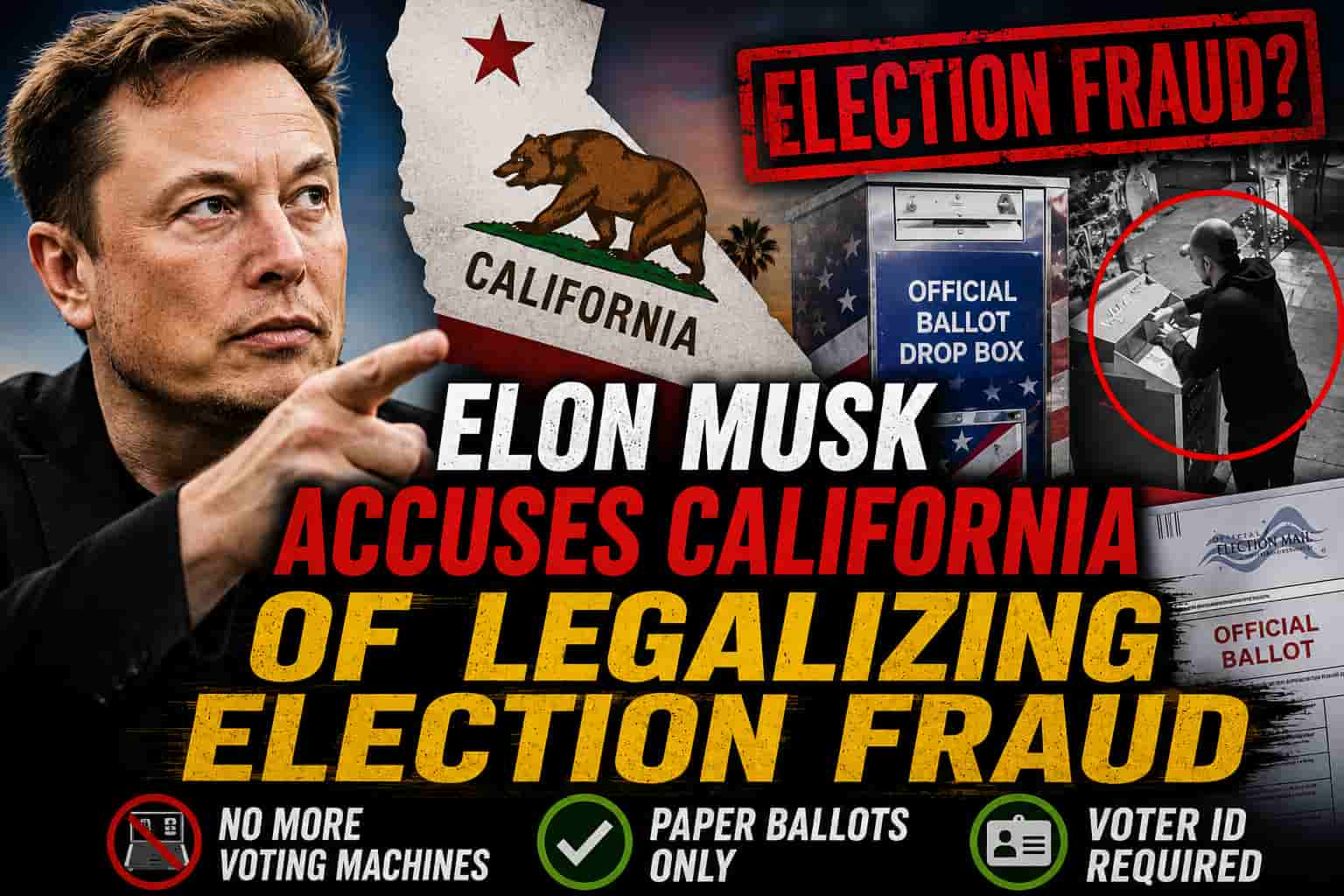
Elon Musk has thrown his support behind Spencer Pratt’s attack on California’s election system, declaring in characteristically blunt language:
“California has legalized election fraud.”
Political commentator Benny Johnson goes even further in the video featured with this article. He portrays Musk as joining Pratt’s effort to expose what they describe as a fundamentally compromised mail-voting system—one in which election results can shift dramatically after Election Day while ordinary citizens are expected to accept the changing numbers on faith.
No formal partnership, joint investigation, lawsuit, or election-integrity organization involving Musk and Pratt has yet been publicly announced. The claim that they have “joined forces” is therefore best understood as political support rather than a documented institutional alliance.
But Musk’s position is unmistakable.
He argues that elections should use paper ballots, in-person voting, strict voter identification, minimal dependence on electronic machines, and maximum public transparency.
Johnson’s video makes a more explosive allegation: that California has constructed an election system in which large-scale manipulation may be possible while meaningful verification becomes extraordinarily difficult.
That is an accusation—not an established judicial finding.
But the design of the system deserves scrutiny whether or not fraud is ultimately proven.
What Benny Johnson Alleges
Johnson’s video opens with the sweeping claim that history will one day recognize Musk’s role in preventing the 2024 presidential election from being stolen.
That assertion is not substantiated within the video segment. It serves as an introduction to Johnson’s broader portrayal of Musk as a technological counterforce against election fraud.
The video then advances several specific allegations:
- Spencer Pratt was ahead of Nithya Raman during the initial Los Angeles mayoral count;
- Raman later overtook him as additional mail ballots were processed;
- the later-counted ballots disproportionately benefited the candidate who needed them;
- California’s lack of universal voter ID makes impersonation and fraudulent voting harder to detect;
- automatic mass mailing places official ballots into uncontrolled environments;
- ballot collection allows one person to deliver multiple completed envelopes;
- prolonged counting makes it difficult for the public to understand how the result changed;
- electronic voting and tabulation equipment creates risks of error, manipulation, or hacking;
- California has created a system in which suspicious activity can be dismissed as normal procedure.
Johnson compares the process to a broken stadium scoreboard: the game appears to be over, the numbers continue changing, and officials assure the audience that the flickering display is functioning exactly as intended.
What Happened in the Los Angeles Mayoral Race
In the June 2, 2026 primary, Spencer Pratt initially appeared positioned to advance to the runoff.
As additional ballots were processed, Los Angeles City Councilmember Nithya Raman moved ahead of him.
According to the official Los Angeles County results:
- Karen Bass received 292,593 votes;
- Nithya Raman received 247,781 votes;
- Spencer Pratt received 217,977 votes.
The final official margin between Raman and Pratt was therefore nearly 30,000 votes.
Johnson’s video emphasizes that Pratt had reportedly been leading Raman by roughly 40,000 votes during the initial count and that the subsequent movement amounted to a swing exceeding 43,000 votes.
Johnson presents that reversal as blatant fraud.
It has not been established as fraud by a court or official investigation.
Different categories of ballots are often processed at different times. Mail ballots, provisional ballots, and envelopes requiring signature review may be added after the first results are released.
That procedural explanation matters.
But it does not eliminate the underlying credibility problem.
When voters see one candidate leading on election night and another candidate taking the lead days later, election officials should expect serious questions:
- How many ballots remained unprocessed?
- When were they received?
- How many arrived before and after Election Day?
- How many signatures were accepted?
- How many were rejected?
- How many were later “cured”?
- Why did later batches differ so substantially from earlier returns?
- Can outside observers independently verify those explanations?
An election system should not merely produce a certified result.
It should produce a result that can be understood and trusted by the losing side.
California’s New Definition of “Election Day”
There was a time when “Election Day” referred to the day on which people voted.
California Democrats apparently found that concept unnecessarily restrictive.
The modern system includes Election Day, the post-election receipt period, signature verification, ballot curing, provisional-ballot review, the official canvass, and final certification.
Voting happens on one date.
The result arrives in installments.
It resembles a restaurant where the customer orders dinner on Tuesday, receives a preliminary bill on Friday, and is told the final amount will be available several weeks later.
When the customer asks why the total keeps changing, the waiter explains that questioning the accounting process is dangerous to confidence in restaurants.
California law permits qualifying mail ballots to arrive after Election Day if they were sent within the legally prescribed period. That is lawful.
But lawful does not automatically mean transparent, efficient, or resistant to abuse.
A system can comply with every statute and still be badly designed.
How Newsom’s Emergency Measure Became Permanent
Before 2020, California voters already had broad access to vote-by-mail ballots.
But the state did not automatically mail a ballot to every active registered voter in every election.
During the COVID-19 emergency, Governor Gavin Newsom ordered ballots mailed to all registered voters for the November 2020 election. The policy was presented as an extraordinary public-health response.
The emergency eventually ended.
The extraordinary ballot did not.
In 2021, Newsom signed Assembly Bill 37, making universal automatic vote-by-mail ballot distribution a permanent feature of California elections.
A temporary pandemic measure thus became part of the state’s normal electoral architecture.
California Democrats effectively decided that once millions of ballots had been released into private homes, apartment lobbies, commercial mailrooms, assisted-living facilities, and old addresses, asking voters to return primarily to controlled polling places would be an unreasonable retreat from progress.
The Ballot Arrives—But Who Fills It Out?
The strongest argument for mail voting is convenience.
A ballot arrives at the voter’s home. The voter can complete it without traveling, waiting in line, or taking time away from work.
For many elderly, disabled, ill, military, or overseas voters, that access is genuinely valuable.
But election security cannot be designed only around the ideal voter described in an official brochure.
In the real world:
- former residents move away;
- election mail may continue arriving at old addresses;
- envelopes can remain unattended in shared building lobbies;
- ballots may be delivered to commercial or outdated addresses;
- relatives may assist elderly family members;
- campaign activists may offer to collect or deliver completed envelopes;
- one person may obtain physical access to several ballots;
- voter-registration records may contain stale information;
- ballots may spend days or weeks outside election officials’ custody.
A ballot mailed to an outdated or incorrect address is not proof that it was fraudulently voted.
It may be returned, discarded, or rejected.
But the question remains unavoidable:
If no eligible voter lives at the listed address, who receives the official ballot package?
And the more important question is:
Can the public verify that the person named in the registration record was the person who actually marked the ballot?
There Is No Signature on the Ballot Itself
The voter does not sign the actual ballot.
That is intentional. The ballot must remain secret.
The voter marks the ballot, places it inside the official return envelope, and signs the envelope. Election workers then compare the envelope signature with one or more signatures associated with the voter’s official record.
After acceptance, the ballot is separated from the identifying envelope to preserve anonymity.
That protects the secrecy of the vote.
It also creates a fundamental limit on later verification.
Once the anonymous ballot is separated from the envelope, the ballot itself cannot reveal:
- who actually marked it;
- where it was completed;
- whether anyone else was present;
- whether a campaign worker “assisted” the voter;
- whether pressure was applied;
- whether the registered voter personally made the selections.
The government may establish that it received an envelope associated with a voter registration and accepted the signature.
It cannot establish from the anonymous ballot whose hand filled in the choices.
At a polling place, the basic chain is more visible:
One living voter appears in person, checks in, receives one ballot, and submits it in a controlled environment.
With mail voting, that directly observable sequence is replaced by a chain of records, envelopes, signatures, databases, and administrative judgments.
Can Envelopes and Signatures Be Counterfeited?
In the 21st century, reproducing the visual appearance of a document, envelope, barcode, or handwritten signature is technologically easier than it once was.
High-quality scanners, commercial printers, image-editing software, automated handwriting tools, and artificial intelligence can imitate visual materials with increasing sophistication.
That does not mean counterfeit California ballot envelopes are routinely being accepted.
It also does not mean that merely printing a convincing envelope would be sufficient to cast a valid vote.
For a fraudulent mail ballot to survive the official process, it would generally need to correspond to an actual voter registration, use the expected identifying information, pass signature review, arrive within the legal period, and avoid detection as a duplicate vote.
Those safeguards make a successful organized scheme more difficult than simply printing paper.
But “more difficult” is not the same as “impossible.”
And the system’s vulnerability cannot be evaluated only by asking whether an ordinary person could photocopy a ballot.
The relevant question is whether someone with access to voter data, official-looking materials, signature samples, unused registrations, or improperly collected ballots could exploit weaknesses without requiring the voter to appear in person.
Mail voting shifts the central identity check away from a living human being standing before election personnel.
The system instead evaluates:
- an address;
- a registration record;
- an envelope;
- a signature image;
- database history;
- the absence of a detected duplicate vote.
California officials argue that these layers provide adequate security.
Critics argue that these are indirect indicators and cannot fully replace physical confirmation that the registered voter personally cast the ballot.
That is a legitimate policy dispute.
It should not be dismissed as misinformation merely because officials prefer the existing model.
Bundles of Envelopes at Drop Boxes
Johnson’s video includes footage of people depositing numerous ballot envelopes into drop boxes.
He describes such conduct as ballot stuffing.
Visually, the footage is alarming: one person approaches a ballot box carrying what appears to be an entire stack of votes.
But California permits a voter to authorize another person to return a completed ballot. A family member, neighbor, caregiver, or campaign-connected activist may therefore legally deliver more than one envelope.
That means the sight of one person depositing multiple ballots is not, by itself, proof of a crime.
And this is where California’s system reaches near-perfect political satire.
A person walks toward a government ballot box carrying a stack of completed envelopes.
Citizens ask:
“Why does one person possess so many votes?”
The official response is:
“Because the law permits it.”
Yet legal delivery does not answer the essential questions:
- Who gave that person each ballot?
- Did every voter act voluntarily?
- Who actually marked the ballots?
- Was pressure applied?
- Were ballots collected systematically by a political organization?
- Were the named voters alive and eligible?
- Did they still live at their registered addresses?
- Did they understand that their completed ballots had been surrendered to a third party?
The video may justify investigation.
It does not automatically prove criminal conduct.
But saying “the delivery was legally permitted” does not make the process independently verifiable.
It only confirms that the law permits activity which, to an outside observer, may look nearly identical to an illegal mass deposit.
Bridgeport: When the Footage Was Not Merely Theoretical
Johnson also points to Bridgeport, Connecticut, where surveillance footage concerning absentee ballots became part of a genuine election controversy.
A judge ordered a new Democratic mayoral primary after finding serious problems surrounding absentee-ballot handling. Criminal charges were later brought against several individuals.
That case does not prove that fraud occurred in Los Angeles.
It involved a different state, different laws, different people, and different evidence.
But Bridgeport destroys the comforting claim that unlawful activity involving absentee ballots exists only in partisan imagination.
Such misconduct can occur.
Cameras can capture it.
Courts can act on it.
Prosecutors can bring charges.
The serious question is therefore not whether abuse is theoretically possible.
The question is whether a large mail-voting system can reliably detect abuse before questionable ballots become anonymous and inseparable from lawful votes.
The Problem With Saying “Just Print More Ballots”
Some critics allege that political operatives can simply print ballots, forge signatures, place them in counterfeit envelopes, and deposit them in drop boxes.
As stated, that theory oversimplifies the official process.
A sheet resembling a ballot is not automatically counted.
A fraudulent operation would generally require more than paper:
- access to usable voter-registration records;
- identifying information matching real voters;
- return envelopes capable of surviving processing;
- signatures likely to pass review;
- knowledge that the legitimate voter had not already voted;
- avoidance of duplicate-vote detection;
- successful navigation of additional validation rules.
Those requirements create meaningful barriers.
But they do not justify complacency.
A security system should be evaluated against organized, informed actors—not only against an amateur with a home printer.
The weakness critics identify is structural:
When a voter does not appear in person, election officials are not confirming the identity of a human being at the moment the vote is submitted.
They are confirming the apparent validity of documentation associated with that person.
Instead of:
one verified person—one issued ballot—one vote
the process becomes:
one voter record—one accepted envelope—one sufficiently matching signature—one anonymous ballot.
Supporters consider that an effective and inclusive verification system.
Critics consider it an administrative substitute for direct identity confirmation.
Voter ID: Required for Everyday Life, Politically Controversial for Elections
Most California voters are not required to present photo identification to an election worker before voting.
Newsom did not personally abolish a statewide universal voter-ID rule; California generally lacked such a requirement before he became governor.
But under Newsom, the state permanently combined several policies:
- automatic mailing of ballots to all active registered voters;
- no general requirement to request a mail ballot;
- no universal photo-ID requirement at the polling place;
- private, unsupervised completion of ballots;
- third-party ballot return;
- acceptance and processing after Election Day.
That combination is the heart of Musk’s and Johnson’s criticism.
California requires identity documentation for many ordinary activities.
Opening certain financial accounts requires identification.
Obtaining numerous government services requires identity verification.
Buying regulated products may require identification.
But requiring every voter to demonstrate identity immediately before obtaining or submitting a ballot is portrayed as a threat to access.
California’s model does attempt to verify identity through registration records, DMV information, Social Security data in some circumstances, and signature comparison.
The state therefore does not operate with “no identity checks.”
But indirect record matching is not the same as a living voter presenting identification when casting a ballot.
The “Red Mirage” and the Candidate Who Rose After Election Night
Johnson repeatedly invokes the term “red mirage.”
The term describes a phenomenon in which Republican-leaning Election Day votes are reported earlier, while later-counted mail ballots favor Democrats, causing an apparent Republican lead to shrink or disappear.
That is a real and widely discussed counting pattern.
But Johnson argues that the Pratt-Raman contest was more suspicious than an ordinary partisan shift.
He claims that the late-counted ballots disproportionately benefited the particular candidate who needed to erase a large deficit.
That is an allegation, not a proven fact of fraud.
Yet politically, the sequence is corrosive:
- One candidate appears to lead.
- Counting continues for days.
- Additional mail-ballot batches are reported.
- Another candidate moves ahead.
- Officials explain that this was normal and predictable.
The public is effectively told:
“The result may appear to reverse, but do not worry. We have a technical term for that.”
Perhaps the explanation is completely accurate.
But a system that routinely produces the appearance of a post-election reversal should not be surprised when voters demand more than terminology.
Why Musk Wants Paper Ballots and No Voting Machines
The final portion of the video features Musk arguing for maximum election transparency.
He says that only lawful citizens should vote and warns against electronic voting machines.
Musk bases his concern on his own experience with software. Computer programs can contain mistakes, be improperly configured, or be deliberately compromised. Advanced artificial intelligence may eventually make attacks on computer systems even more sophisticated.
The technology entrepreneur associated with rockets, satellites, electric vehicles, and artificial intelligence therefore recommends a deliberately low-tech election model:
- paper ballots;
- in-person voting;
- strict voter ID;
- minimal reliance on machines;
- public observation;
- auditable physical records.
In most industries, this might sound technologically reactionary.
But an election is not a food-delivery application.
The central goal is not convenience or novelty.
It is verifiability.
A physical paper ballot can be preserved, examined, and recounted.
It does not require voters to trust source code, system administrators, proprietary software, remote updates, or cybersecurity assurances they cannot independently evaluate.
Newsom’s Model of Maximum Convenience and Minimum Visibility
Newsom and California Democrats describe universal mail voting as an expansion of access.
That description is not false.
Voting is easier when the ballot arrives automatically.
The voter can complete it at home.
Another person may deliver it.
The ballot may still qualify if received after Election Day within the statutory period.
But as the physical movement of the ballot becomes easier, verifying who actually completed it becomes harder.
That is the central paradox of California’s system:
Maximum mobility for the ballot is accompanied by minimum direct visibility of the voter.
The voter disappears from the observable chain.
What remains is:
- an address;
- an envelope;
- a signature;
- a voter record;
- an election worker;
- a database;
- an assurance that the process worked.
The system resembles an ATM that does not require the customer to appear with a card and PIN but promises to compare handwriting on a note after releasing the money.
Most transactions might still be legitimate.
That does not make the architecture reassuring.
What Is Confirmed—and What Remains an Allegation
The following points are supported by official rules or results:
- Nithya Raman overtook Spencer Pratt as additional ballots were counted.
- California automatically mails ballots to active registered voters.
- Newsom signed legislation making universal vote-by-mail distribution permanent.
- The voter signs the return envelope, not the secret ballot.
- A third party may return a voter’s completed ballot under California law.
- Qualifying mail ballots may be received after Election Day.
- Most California voters are not required to show photo ID at the polling place.
- Bridgeport’s absentee-ballot controversy resulted in judicial intervention and later criminal charges.
- Musk has publicly advocated paper ballots, in-person voting, voter ID, and eliminating electronic voting machines.
The following allegations have not been officially established:
- that the Los Angeles mayoral primary was fraudulent;
- that later-counted ballots were counterfeit;
- that Raman participated in any unlawful scheme;
- that Los Angeles County workers altered the outcome;
- that every person shown depositing multiple envelopes committed a crime;
- that fake ballot envelopes or signatures were used in the Pratt-Raman election;
- that Musk and Pratt have created a formal joint operation;
- that Johnson’s claim of widespread California election fraud has been proved by an official investigation.
Those distinctions matter.
Criticism can be severe without pretending that allegations are verdicts.
Elections Should Not Require Religious Faith in Government Administration
The state’s defense is straightforward:
Each ballot is checked.
Critics ask:
“Can the public independently establish who marked it?”
The answer is effectively:
“No, because the ballot is secret.”
Critics then ask:
“Can election officials prove that the registered voter personally completed it?”
The answer is:
“We accepted the signature on the envelope.”
“Can outside citizens independently inspect all identifying data and repeat that verification?”
“Not fully, because voter information is protected.”
“Can every voter simply be required to show identification?”
“That may burden access.”
“Can the result be substantially complete on Election Day?”
“No, because every eligible ballot must first be processed.”
Eventually, voters are offered the final proof of integrity:
An official statement declaring that the system is secure.
But elections in a constitutional republic should not operate as an act of faith.
Citizens should not be told:
“Trust us. The database matched, the signatures were reviewed, the envelopes were processed, and the result was certified.”
A transparent system should demonstrate a comprehensible chain:
one eligible living citizen—one identity confirmation—one issued ballot—one counted vote.
Mail voting makes that chain less visible.
The ballot is received away from observers.
It is completed outside the polling place.
It may be transferred to an intermediary.
The envelope undergoes administrative review.
The anonymous ballot is then separated from its identifying materials.
At the end, the public is expected to trust that every previous stage worked correctly.
Perhaps most ballots are entirely lawful.
Perhaps the Los Angeles result is completely accurate.
But conducting an honest election and designing a system capable of convincingly proving its honesty are not the same achievement.
Conclusion
Benny Johnson accuses California of creating conditions in which election fraud could be committed at scale and remain difficult to detect.
He presents the Pratt-Raman reversal as direct evidence of wrongdoing.
Musk supports the broader criticism with an even sharper formulation:
“California has legalized election fraud.”
There is currently no official proof that the Los Angeles mayoral primary was stolen.
But Newsom and California Democrats have undeniably assembled nearly every feature that generates public suspicion:
- automatic mass distribution of ballots;
- no universal voter-ID requirement;
- private ballot completion;
- third-party delivery;
- post-Election Day processing;
- anonymous ballots separated from signed envelopes;
- heavy reliance on databases and signature comparison.
California officials call this a modern, accessible election system.
Critics call it a machine for manufacturing distrust.
The problem is not that every mail ballot is fraudulent.
The problem is that Democrats constructed a system in which footage of a person depositing a stack of envelopes could represent either an illegal ballot operation or perfectly lawful ballot delivery—and the ordinary viewer cannot determine which.
That is California’s new definition of transparency:
Everything may happen in public view, while the most important fact—who actually cast each vote—remains impossible for the public to verify.
Editor’s note: The video contains allegations of election fraud made by Benny Johnson, Spencer Pratt, Elon Musk, and other political advocates. Some underlying election procedures and results are confirmed by official records, but no court or official investigation has established that the 2026 Los Angeles mayoral primary was fraudulent or that any named candidate participated in unlawful conduct.
Official Sources and Supporting Documents
The following government sources document California’s vote-by-mail rules, signature-verification procedures, post-Election Day counting, election-observation rights, official Los Angeles County results, and the Bridgeport absentee-ballot prosecutions discussed in this article.
-
“`
-
Official Los Angeles County Election Results
Official results for the June 2, 2026 primary election, including the Los Angeles mayoral contest.
Los Angeles County Registrar-Recorder/County Clerk — Election Results -
Why Results Continue to Change After Election Night
Los Angeles County explains that vote-by-mail, provisional, conditional-registration, and ballots requiring additional review may continue to be processed after Election Day.
Los Angeles County — Reporting Results After Election Night -
How Los Angeles County Certifies Election Results
Official explanation of Election Night reporting, ballot transportation, central tabulation, canvassing, and certification.
Los Angeles County — Certifying Results -
355,000 Unprocessed Vote-by-Mail Ballots After Election Day
The county’s June 8, 2026 report stated that approximately 355,000 vote-by-mail ballots remained unprocessed as of June 7 and described the categories included in the continuing canvass.
Los Angeles County RR/CC — June 2026 Primary Election Update -
Newsom’s 2020 Universal Ballot-Mailing Order
Governor Gavin Newsom’s official announcement ordering a vote-by-mail ballot sent to every registered voter for the November 2020 election during the COVID-19 emergency.
Office of Governor Gavin Newsom — May 8, 2020 Executive Order -
Universal Vote-by-Mail Made Permanent
Governor Newsom’s official announcement confirming that AB 37 permanently requires a vote-by-mail ballot to be mailed to every active registered voter in California.
Office of Governor Gavin Newsom — AB 37 -
California Vote-by-Mail Instructions
Official instructions covering receipt, completion, signing, and return of vote-by-mail ballots, including return through another authorized person.
California Secretary of State — Vote by Mail -
The Signature Is Placed on the Return Envelope
California’s official instructions explain that the voter signs the identification envelope containing the ballot rather than signing the secret ballot itself.
California Secretary of State — Returning a Vote-by-Mail Ballot -
Signature Verification and Ballot Processing Rules
State regulations governing signature review, ballot processing, counting standards, rejected ballots, and the use of signature-verification technology.
California Secretary of State — Signature Verification and Ballot Processing -
Correcting a Missing or Nonmatching Signature
Official information about California’s signature-curing process when a return envelope is unsigned or the signature is questioned.
California Secretary of State — Verify My Signature -
California Voter Identification Rules
Official guidance explaining when identification may be requested and why most California voters are not routinely required to show photo ID at the polling place.
California Secretary of State — What to Bring When Voting -
Election Observer Rights
California regulations grant observers the right to watch vote-by-mail envelope processing, signature verification, ballot-box retrieval, duplicate-vote checks, counting, and the official canvass.
California Secretary of State — Election Observation Rights and Responsibilities -
Los Angeles County Public Observation Program
Official information about public access to observe election-related activities in Los Angeles County.
Los Angeles County — Public Observation -
Official Election Video Streams
Los Angeles County provides official video streams of selected canvass and ballot-processing operations during active elections.
Los Angeles County — Official Election Live Feed -
Statewide Ballot Status and Duplicate-Vote Records
California regulations require counties to transmit vote-by-mail ballot status and voter participation history to the statewide voter-registration system.
California Secretary of State — Statewide Voter Registration System -
California Manual Tally Standards
Official standards for full or partial manual counting of physical ballots.
California Secretary of State — Manual Tally Standards -
California Risk-Limiting Audit Rules
Official regulations governing audits that compare physical ballot records with reported election outcomes.
California Secretary of State — Risk-Limiting Audits -
Bridgeport Absentee-Ballot Criminal Charges
Connecticut prosecutors announced charges against five individuals in connection with alleged misuse of absentee ballots during the 2023 Bridgeport Democratic mayoral election cycle.
Connecticut Division of Criminal Justice — February 21, 2025 Charges -
Additional Bridgeport Charges
Connecticut prosecutors later announced additional charges connected to alleged absentee-ballot violations.
Connecticut Division of Criminal Justice — July 30, 2025 Charges
“`
Editorial note: These official sources confirm the election rules, counting procedures, observation rights, official results, and criminal charges discussed in the article. They do not establish that the 2026 Los Angeles mayoral primary was fraudulent or that any named candidate participated in unlawful activity.
Ask Midtown Tribune about this story
Answers are grounded first in this article. Search all Midtown Tribune reporting from the main AI Search page.
AI-generated summary. Verify important details in the linked original articles.