
On Canal Street in Manhattan, everything was proceeding as usual.
The sidewalks were covered with handbags from famous brands whose own designers had probably never heard of them. The watches showed the correct time approximately twice a day. The sneakers looked as though Nike, Adidas, and an unidentified Chinese factory had spent one reckless night together and then refused to acknowledge the child the following morning.
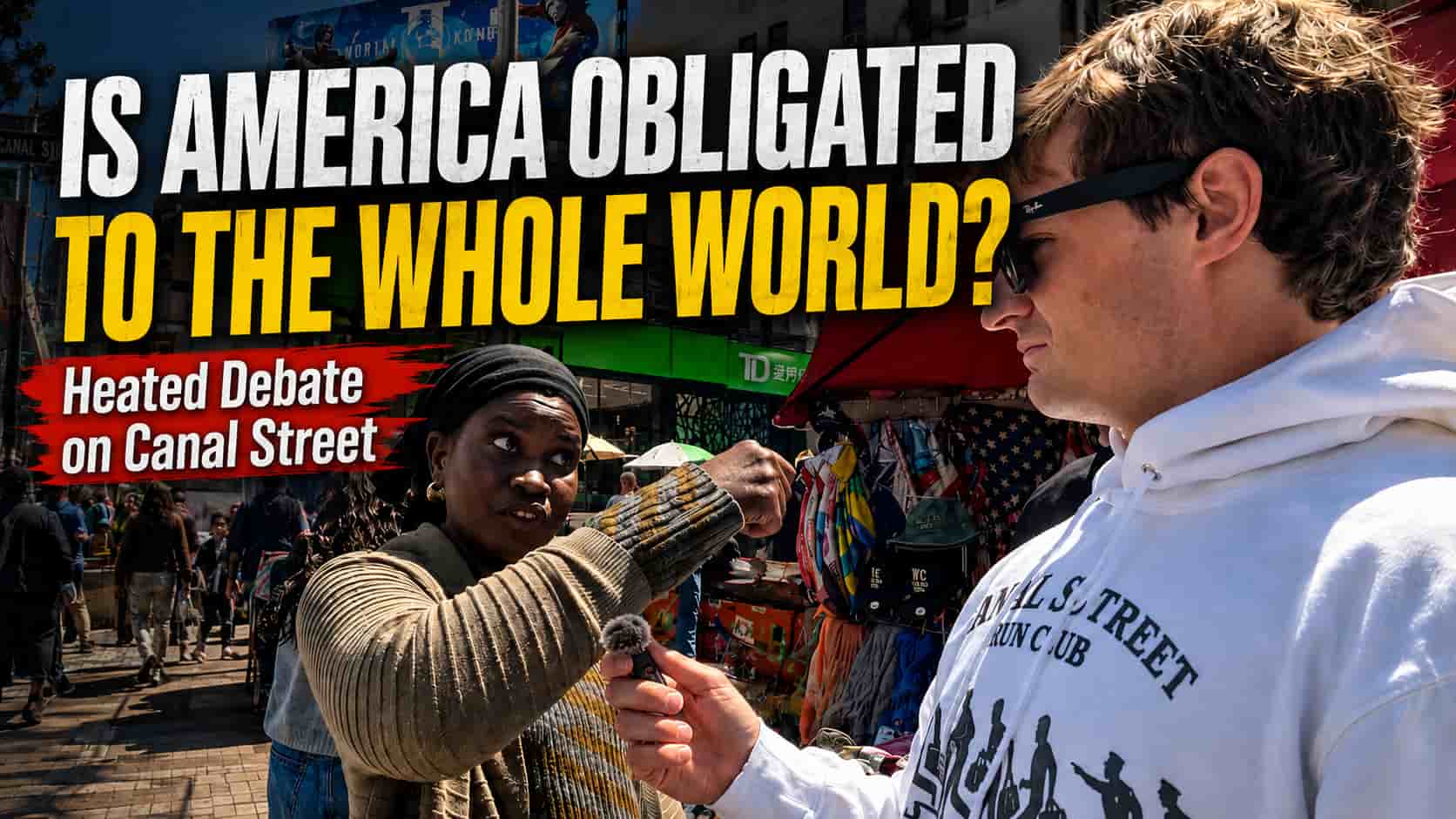
In the middle of this international economic forum stood journalist Nick Shirley with a camera.
He made an extremely careless decision:
He began asking questions.
He did not conduct a raid. He did not inspect documents. He did not confiscate merchandise. He simply asked pedestrians and vendors what they thought about the sale of allegedly counterfeit goods on the streets of New York.
And at that moment, Canal Street acquired its own foreign minister.
“Why Are You Filming at All?”
One passerby, speaking with a noticeable foreign accent, approached the journalists herself and immediately demanded to know why they were in Chinatown filming what was happening.
It was a philosophical question.
Indeed, why would a journalist stand on a public street with a camera?
Why does a photographer take photographs?
Why does a firefighter carry a hose?
Why is a Louis Vuitton handbag being sold on Canal Street for the price of lunch?
The great American mystery of the century.
Nick Shirley calmly explained that he was showing what was happening in New York and reporting on the counterfeit trade.
But the woman immediately recognized a far more serious threat: these were people making videos “for MAGA.”
After that, discussing fake merchandise became socially unacceptable. Under modern political logic, a handbag stops being counterfeit if the person asking about it votes incorrectly.
The New Constitution of Canal Street
The conversation quickly moved beyond street commerce and reached a fundamental question:
Who does America belong to?
The woman declared:
“Everybody is entitled to live in this country just like you.”
She said it with such confidence that one might have assumed a new amendment had been added to the U.S. Constitution the previous evening:
“Every one of the eight billion inhabitants of Earth has an unconditional right to settle in the United States, preferably in New York City, and the American taxpayer must refrain from asking unnecessary questions.”
Under this new doctrine, citizenship is no longer required. A visa is a bureaucratic relic. Immigration law is an irritating piece of paper. The border exists mainly as a scenic location for photographs.
All one has to do is announce, “I am entitled to live here too,” and somewhere in Washington a passport is automatically printed.
To be clear, the video does not establish whether the woman herself is an immigrant or what her legal status may be. But she was plainly defending the idea that virtually everyone acquires the right to live in America simply by having been born somewhere on planet Earth.
A Question About Taxes Triggered a Tax Reform
The journalists then asked whether she paid taxes.
It was, of course, a personal question, and she was under no obligation to answer it.
But her reaction was magnificent:
“Why the question? Who are you to ask me that?”
And thus humanity was introduced to an entirely new economic model.
The right to use American roads: absolute.
The right to rely on American police: absolute.
The right to use American courts: absolute.
The right to demand respect from American citizens: unquestionably absolute.
But asking whether someone contributes toward the cost of any of it is practically an international incident.
Canal Street had now presented its own version of the social contract:
America must provide everything. In return, America must ask nothing.
Presumably, the next stage of the reform will be the abolition of cash registers as instruments of racial profiling.
A Camera Without United Nations Authorization
The fact that the journalists were filming people on a public street caused particular outrage.
The woman argued that they could not simply walk around with a camera and record what was happening without obtaining the consent of every participant in the global street-market economy.
Shirley pointed out that they were in a public place and that the First Amendment protects the right to film and ask questions.
The argument did not help.
Apparently, before filming, a journalist must:
- obtain consent from every passerby;
- conduct a public hearing;
- hire an interpreter;
- secure a United Nations Security Council resolution;
- confirm that the camera does not support Donald Trump.
Meanwhile, the woman freely argued with the journalist, criticized his political views, and demanded that he stop filming — actively exercising precisely the freedoms the American system protects.
Once again, America found itself guilty of allowing someone to explain publicly how terrible America is.
“Go Film White People in Carolina”
When the discussion of counterfeit goods became uncomfortable, the universal emergency exit from any debate appeared: an accusation of racism.
The woman suggested that the journalists go to North or South Carolina and film “white people” in “redneck cities.”
The logic was simple and elegant:
If something questionable is happening on Canal Street, it cannot be filmed until the journalist has first located an exactly equal number of violations within every racial and ethnic community in America.
Found ten sellers of fake handbags in Manhattan?
First locate ten white producers of fake wine in North Carolina.
Then obtain a certificate of racial balance and return to the handbags.
Otherwise, counterfeit goods become a cultural tradition, garbage becomes ethnic self-expression, and a question about taxes becomes an act of political aggression.
Passersby Unexpectedly Remembered the Law
Not everyone at the sidewalk convention supported the new Canal Street Constitution.
One Queens resident said the area was overcrowded, the commerce looked suspicious, pedestrians were being inconvenienced, and the situation needed some form of regulation.
Another passerby stated the obvious:
Citizens have the right to live in their own country. Immigrants can also live in America if they entered and remain legally. But the right to immigrate does not include the right to violate the law.
For several seconds, a dangerous silence of common sense descended upon Canal Street.
Then the argument resumed.
“My Ancestors Built This Country”
At one point, the woman declared that people of her race had also built America and therefore had every right to be there.
The historical argument was applied broadly — practically wholesale.
The implication was that if the ancestors of any group participated in American history, then every modern member of that group automatically receives residence rights, commercial privileges, and immunity from uncomfortable questions.
Under this system, Italy must immediately grant citizenship to everyone who has ever eaten pizza.
Egypt must provide housing beside the pyramids to everyone who has studied geometry.
And Britain must accommodate half the planet because English is spoken almost everywhere.
American citizenship, however, is still determined by law, not by collective genealogical poetry delivered beside a table of imitation wallets.
What the Video Actually Showed
Nick Shirley’s video is funny not because one woman spoke with an accent or may have had a foreign background.
America is made up of people from every part of the world, and millions of immigrants came legally, work, pay taxes, and remain grateful for the opportunity the country gave them.
The comedy lies elsewhere.
The journalist asked about possible illegal commerce — and received a lecture about race.
He mentioned the right to film in public — and was told to leave for Carolina.
He asked about taxes — and discovered that asking about taxes was morally illegal.
He said that citizens have the right to live in their own country — and was informed that the rest of the world automatically possesses the same right.
And so a simple report from Canal Street became the launch of a new international program:
“America for Everyone, American Laws Optional”
The United States must admit everyone.
Support everything.
Pay for everything.
Inspect nothing.
And above all, never ask where a forty-dollar Chanel handbag came from.
Because that is no longer journalism.
As Canal Street apparently established, it is racism, MAGA, and an assault on the universal human right to sell anything, anywhere, under any conditions.
Fortunately, the United States still retains another right: the right to reject this circus.
That is why Nick Shirley can stand on a public street with a camera, why the woman can argue loudly with him, why other passersby can defend the law, and why viewers can decide for themselves who sounded convincing.
That is how American freedom works.
Even when someone in the background may be selling a Gucci handbag that Gucci never made.
Official Sources and Primary Documents
-
U.S. Constitution — National Archives
The Constitution begins with “We the People of the United States” and states that one of its purposes is to secure the blessings of liberty “to ourselves and our Posterity.” The text establishes the Constitution for the United States of America; it does not create a universal right for every person in the world to enter or reside in the country.
Read the official Constitution transcript -
U.S. Constitution — Library of Congress
The Constitution Annotated provides the official constitutional text together with legal explanations prepared by the Congressional Research Service.
View the Constitution on Congress.gov -
First Amendment — Freedom of Speech and of the Press
The First Amendment protects freedom of speech and freedom of the press from government abridgment. These protections form the constitutional basis for reporting, interviewing people, and gathering news in public places, subject to lawful time, place, and manner restrictions.
Read the First Amendment -
Traditional Public Forums — Library of Congress
Streets and sidewalks have historically received strong First Amendment protection as traditional public forums, although governments may impose reasonable and content-neutral rules governing time, place, and manner.
Read the Constitution Annotated discussion of public forums -
Recording in Public — United States Courts
The federal judiciary’s educational materials describe appellate precedent recognizing a private citizen’s right to record public officials in public, subject to reasonable limitations. Rules can vary depending on the location, conduct being recorded, and applicable state law.
Read the U.S. Courts overview -
Federal Law Against Trafficking in Counterfeit Goods
Federal law criminalizes intentionally trafficking in goods or services while knowingly using a counterfeit mark.
Read 18 U.S.C. § 2320 -
U.S. Customs and Border Protection: Counterfeit Goods
CBP warns that counterfeit merchandise can harm consumers, legitimate businesses, intellectual-property owners, and the U.S. economy. Importing or trafficking in counterfeit products may lead to seizure, fines, and criminal or civil penalties.
CBP: The Truth Behind Counterfeits -
New York City General Vendor License Requirements
New York City states that a General Vendor license is generally required to sell or offer goods or services in a public place that is not a store, subject to specified exemptions.
NYC Department of Consumer and Worker Protection: General Vendor License -
Street Vending Rules in New York City
The City explains licensing requirements and other rules applicable to people selling clothing, jewelry, souvenirs, household goods, toys, and similar merchandise on sidewalks and in other public spaces.
Official NYC street-vending information -
Reporting Counterfeit Sales in New York City
NYC311 provides the City’s official instructions for reporting stores or street vendors believed to be selling counterfeit merchandise.
NYC311: Counterfeit Item Sale
Editorial note: The video itself does not establish the citizenship or immigration status of any individual shown. The article comments on statements made during a public street exchange and on the broader claim that every person in the world is automatically entitled to live in the United States.
Ask Midtown Tribune about this story
Answers are grounded first in this article. Search all Midtown Tribune reporting from the main AI Search page.
AI-generated summary. Verify important details in the linked original articles.