
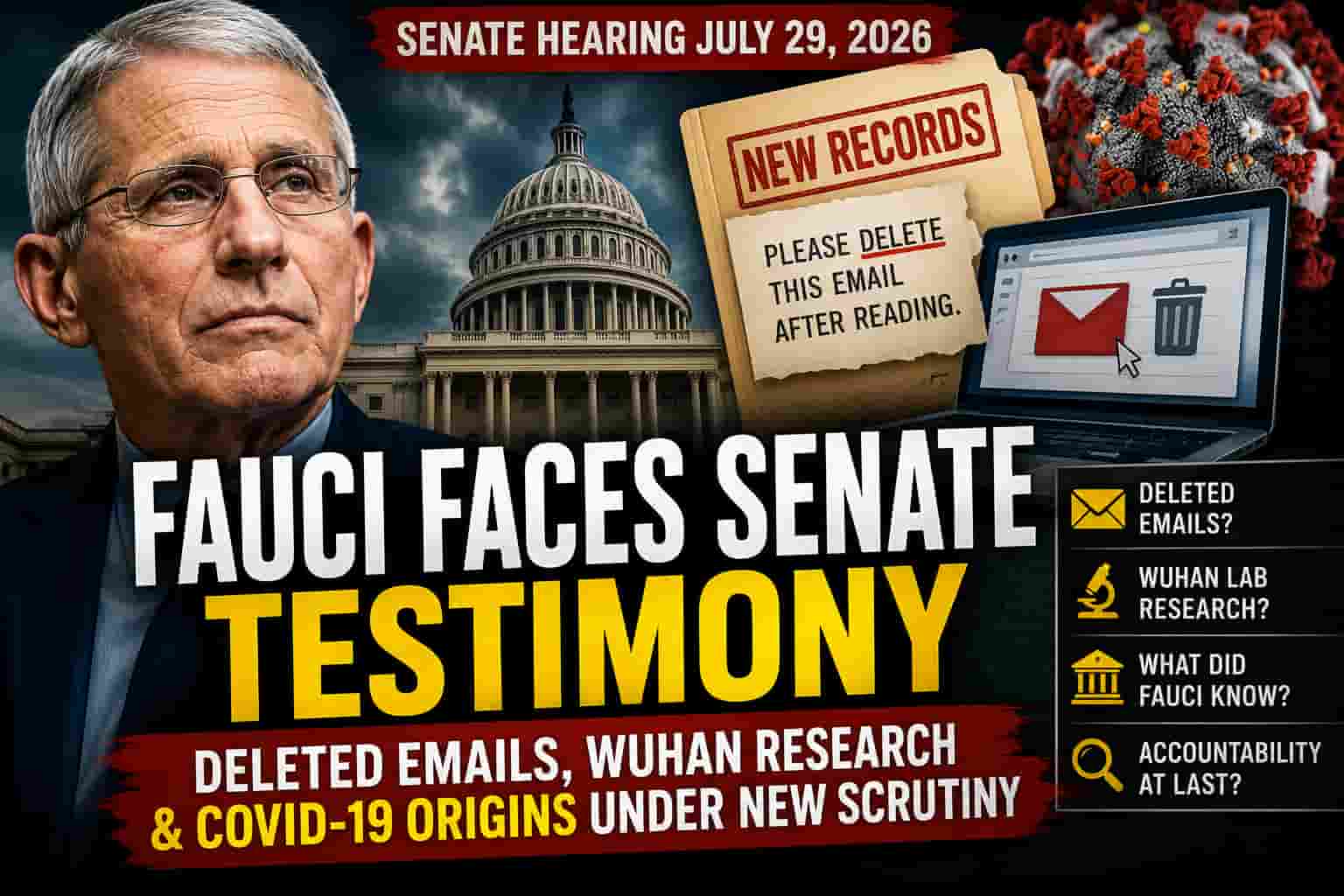
Sen. Rand Paul is preparing to question former federal health official Dr. Anthony Fauci about COVID-19 origins, risky coronavirus research and emails containing requests to delete messages. The newly released records have intensified demands for accountability, but they do not yet establish that Fauci committed a crime or participated in a proven conspiracy.
Dr. Anthony Fauci is scheduled to appear before the Senate Committee on Homeland Security and Governmental Affairs as lawmakers renew their investigation into the origins of COVID-19 and the federal government’s handling of coronavirus research.
The committee lists a hearing titled “Testimony of Anthony Fauci” for July 29, 2026, at 8:30 a.m. in the Dirksen Senate Office Building.
The hearing is expected to focus on several politically explosive subjects:
- emails in which Fauci allegedly requested that messages be deleted after they were read;
- federal funding connected to coronavirus research involving the Wuhan Institute of Virology;
- disagreements over the definition of gain-of-function research;
- early private discussions of a possible laboratory origin of SARS-CoV-2;
- and whether official records were properly preserved.
Sen. Rand Paul, the committee chairman, has accused Fauci of withholding information and contradicting previous testimony. Fauci has not been convicted of any crime, and the committee’s allegations should not be confused with findings by a court.
Emails Said to Contain Requests to Delete Messages
One of the central issues concerns emails obtained by the Senate committee.
In September 2025, Paul announced that investigators had uncovered communications that allegedly contradicted Fauci’s earlier denials that he deleted federal records or encouraged others to do so.
According to the committee, the records included messages in which Fauci asked recipients to delete emails after reading them. The committee requested Fauci’s emails, text messages, call records and other communications from 2018 through 2023 concerning COVID-19 origins, EcoHealth Alliance, gain-of-function research and the Wuhan Institute of Virology.
The language is potentially significant, but it does not by itself prove criminal destruction of records.
Investigators would still need to determine:
- whether the messages were actually deleted;
- whether they qualified as federal records that were legally required to be preserved;
- whether copies remained on government systems;
- and whether any deletion was intended to obstruct an investigation or public-records request.
For that reason, the most accurate description is that the committee has uncovered possible evidence of improper record handling, not that criminal obstruction has already been established.
Rand Paul Revives the Question of Fauci’s Previous Testimony
Paul has spent years disputing Fauci’s statements about whether the National Institutes of Health funded gain-of-function research in Wuhan.
Fauci previously maintained that NIH did not fund research at the Wuhan Institute of Virology that met the federal government’s operative definition of gain-of-function research.
Paul has argued that the experiments functionally enhanced coronavirus characteristics, regardless of the narrower terminology used by federal officials.
In July 2025, Paul renewed a referral asking the Department of Justice to examine Fauci for possible criminal prosecution related to his congressional testimony. A referral is a request for investigation; it is not an indictment, prosecution or conviction.
The upcoming hearing may therefore turn partly on definitions.
Fauci could argue that his testimony was based on the technical federal definition governing restricted research. Paul is likely to argue that the practical effects of the experiments matter more than the terminology used to describe them.
Ralph Baric Testimony Adds New Scrutiny
The investigation has also examined testimony from Dr. Ralph Baric, a prominent coronavirus researcher at the University of North Carolina.
Baric has conducted research involving engineered or chimeric coronaviruses and worked with scientists associated with EcoHealth Alliance. His name has also been linked to the proposed DEFUSE research project.
The DEFUSE proposal discussed methods for studying how bat coronaviruses might become capable of infecting humans. It included proposed experiments involving viral backbones and furin cleavage sites, a feature that later became central to arguments about the origin of SARS-CoV-2.
DARPA did not fund the proposal.
That distinction is essential. The existence of a proposal demonstrates that scientists were considering such experiments. It does not prove that the proposal was secretly carried out, that Baric created SARS-CoV-2 or that the pandemic virus originated from that research.
Still, Baric’s testimony is important because it shows that experiments capable of changing how viruses move between species were part of the scientific discussion well before the pandemic.
The Lab-Leak Possibility Was Discussed Early
Records cited by the Senate committee also indicate that a possible accidental release from the Wuhan Institute of Virology was discussed during the first weeks of the outbreak.
In October 2025, the committee said it was seeking intelligence-community records related to COVID-19 origins. Its announcement referred to a January 2020 presentation from Baric that discussed the possibility of an accidental laboratory release in Wuhan.
This matters because the lab-leak hypothesis was later frequently characterized in public discussion as unsupported speculation or a conspiracy theory.
The records demonstrate that credible scientists and government officials considered the laboratory possibility internally.
They do not, however, establish that those officials knew the virus came from a laboratory.
Considering a hypothesis is not the same as possessing proof. A scientist may legitimately investigate several explanations before deciding that one appears more likely than another.
What Did Officials Believe in Early 2020?
The most difficult questions may concern the difference between private uncertainty and public confidence.
At the beginning of 2020, scientists were examining unusual aspects of the new coronavirus while also trying to understand the outbreak with limited information.
Later, the influential paper “The Proximal Origin of SARS-CoV-2” argued that the available evidence did not support deliberate laboratory construction of the virus.
Critics now contend that some of the paper’s authors privately expressed stronger doubts than the final publication suggested. They argue that the article was then used by government officials and media organizations to prematurely close debate over a possible laboratory origin.
That issue deserves investigation, but private scientific uncertainty is not automatic evidence of deception.
To prove deliberate dishonesty, investigators would need to show that the authors continued to believe the laboratory explanation was likely while knowingly publishing conclusions they considered false.
Scientists are permitted to change their conclusions after reviewing additional information. The key question is whether the change was based on evidence or on political and institutional pressure.
Did Fauci Participate in a Criminal Conspiracy?
Some political commentators are describing the new records as proof of a “Fauci criminal conspiracy.”
That conclusion goes beyond the evidence currently available to the public.
The released materials may support further investigation into:
- improper deletion or retention of government records;
- misleading testimony to Congress;
- federal oversight of risky virus research;
- undisclosed conflicts or funding relationships;
- and efforts to marginalize public discussion of the lab-leak hypothesis.
But no court has ruled that Fauci participated in a criminal conspiracy related to COVID-19 origins.
There is also no publicly established proof that Fauci, Baric or EcoHealth Alliance created SARS-CoV-2.
The distinction is not a defense of any official. It is the difference between reporting documented evidence and publishing a criminal verdict before the legal process has occurred.
A Broader Federal Investigation
The Fauci hearing follows a series of committee actions concerning the pandemic response and the origins of COVID-19.
In May 2026, Paul convened a hearing featuring a former intelligence official who alleged that government agencies failed to provide transparency about the origins investigation. The committee described the matter as a multi-agency cover-up, reflecting the chairman’s position.
The committee has also sought records from the intelligence community and other federal agencies.
Those investigations reflect a broader shift in Washington. Questions once dismissed as politically motivated are now being examined through subpoenas, sworn testimony and document releases.
That does not mean every allegation has been proven. It means the evidence deserves examination rather than automatic dismissal.
What Fauci May Be Asked
At the July 29 hearing, senators could question Fauci about:
- why certain emails included requests to delete messages;
- whether those communications were preserved on government systems;
- what he knew about federally supported coronavirus research;
- how NIH defined gain-of-function research;
- when he first learned that scientists were considering a laboratory origin;
- what role he played in discussions surrounding the Proximal Origin paper;
- and whether his earlier congressional testimony was complete and accurate.
Fauci may argue that his statements were consistent with official scientific and regulatory definitions. He may also dispute the committee’s interpretation of the emails and insist that official records remained preserved.
He could invoke legal protections when answering questions that may expose him to potential criminal liability.
The Questions Are Now Legitimate
The new records do not prove that Fauci organized a criminal conspiracy.
They do establish that several questions deserve direct answers.
Why were deletion requests included in communications concerning one of the most consequential public-health events in modern history?
Why did public messaging appear more certain than some of the private scientific discussions?
Did federal agencies adequately supervise research involving potentially dangerous coronaviruses?
Were members of Congress given complete and accurate information?
And were people unfairly censored or discredited for raising questions that government officials and scientists were also discussing privately?
The Senate hearing may not resolve the origin of COVID-19. It could, however, provide the clearest public accounting yet of how federal officials managed the evidence, the scientific debate and the official records surrounding the pandemic.
Fauci has not been convicted of wrongdoing. But the period in which his public statements were treated as the final word appears to be over.
Official Sources and Documents
- U.S. Senate hearing: Testimony of Anthony Fauci — July 29, 2026
- Senate committee release on Fauci emails and requests to delete messages
- Senate committee release on internal messages involving the Proximal Origin authors
- Senate request for intelligence-community records concerning COVID-19 origins
- Senate committee: Rand Paul renews Fauci referral to the Department of Justice
- Senate subpoenas concerning COVID-19 origins and gain-of-function research
- DARPA: Preventing Emerging Pathogenic Threats program
- DARPA overview of research intended to prevent viral disease outbreaks
- National Institute of Allergy and Infectious Diseases: Anthony Fauci biography
Editor’s note: Senate committee releases describe evidence and allegations under congressional investigation. They do not constitute a criminal charge, court ruling, or finding of guilt.
Ask Midtown Tribune about this story
Answers are grounded first in this article. Search all Midtown Tribune reporting from the main AI Search page.
AI-generated summary. Verify important details in the linked original articles.