
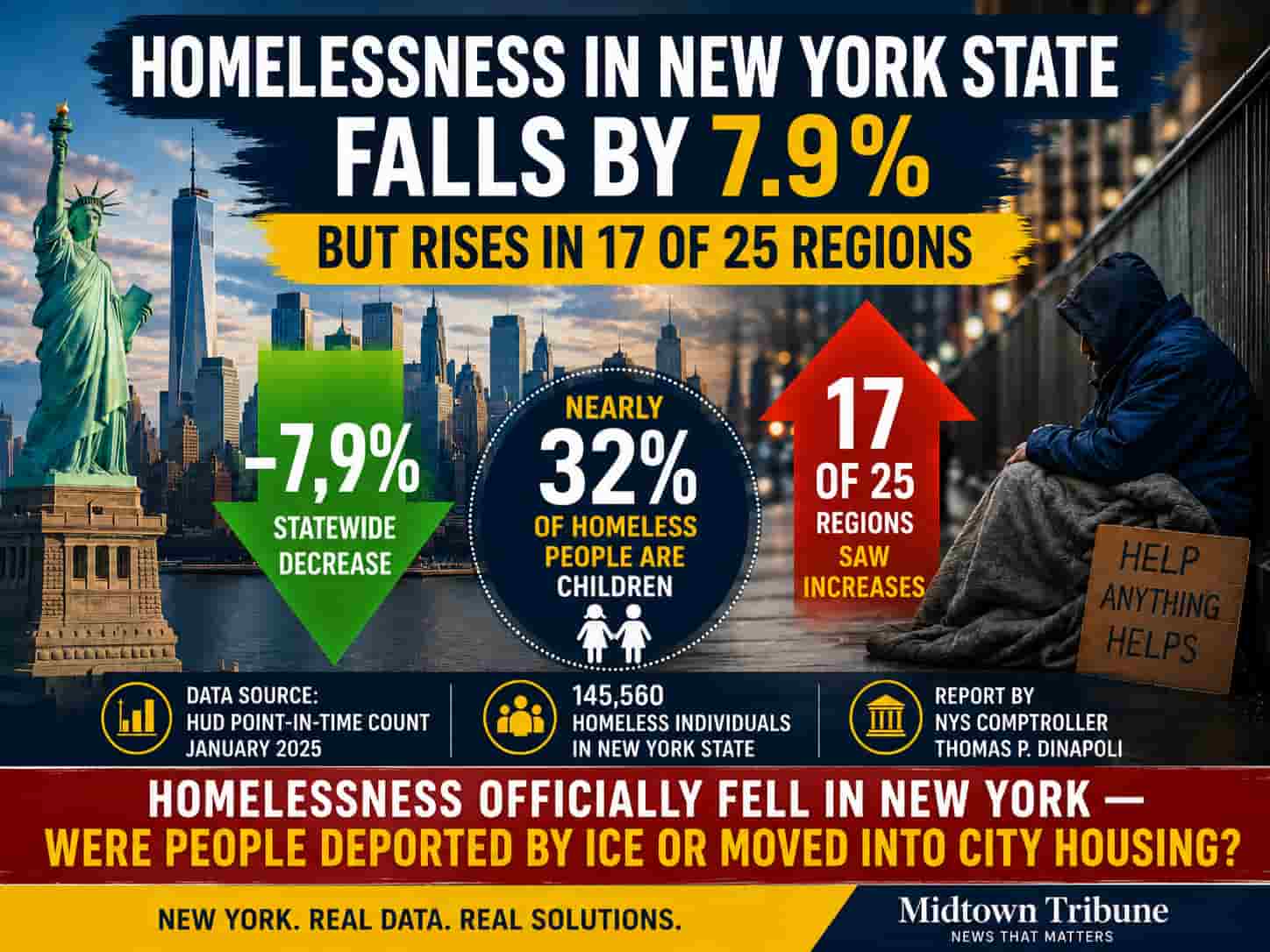
New York officially counted fewer homeless people in 2025. But what happened to them? Were migrants deported by ICE, moved out of the shelter system, or placed in city-funded housing?
New York State reported a 7.9% decline in homelessness, bringing the official total to 145,560 people. The reduction was driven primarily by New York City, where the count fell by 10.3%.
But the headline number raises an important question: Why did New York City’s homeless population decline so sharply?
Did expanded housing programs move thousands of families from shelters into permanent apartments? Did migrants leave the city, return to their home countries, relocate to other states, or become subject to federal immigration enforcement? Or did changes in shelter use and the federal counting methodology affect the final number?
The report from New York State Comptroller Thomas P. DiNapoli documents the decline, but it does not provide a complete breakdown showing exactly where all 12,459 people removed from the statewide count went.
A Statewide Decline After Two Years of Explosive Growth
The 2025 decline followed two years of extraordinary increases.
New York’s homeless population rose by:
- 39.1% in 2023
- 53.1% in 2024
- before declining 7.9% in 2025
Between January 2022 and January 2024, the number of people counted as homeless in New York more than doubled. Even after the latest reduction, the total remains far above the level recorded three years earlier.
“While the number of homeless declined, there’s a lot of work left to do,” DiNapoli said when announcing the findings.
The comptroller emphasized that homelessness is not confined to major cities and called for cooperation among government agencies, private organizations and nonprofit providers, particularly in addressing the number of children without stable housing.
What the Homelessness Count Actually Measures
The figures come from the U.S. Department of Housing and Urban Development’s annual Point-in-Time Count, commonly known as the PIT Count.
The count attempts to measure the number of people staying in homeless shelters, transitional housing or unsheltered locations during a single night in January.
The latest statistics were collected in January 2025, but HUD did not release the national report until May 29, 2026. The report provides national, state and regional estimates for sheltered and unsheltered homelessness.
That distinction matters.
The PIT Count is a one-night snapshot. It does not measure every person who experienced homelessness at some point during the year, and it does not include all forms of housing instability, such as every family temporarily staying with relatives or friends.
It remains, however, the federal government’s most widely used measure for comparing homelessness across states and regions.
Nearly One in Five Homeless People Counted Nationwide Was in New York
HUD counted 745,652 homeless people nationwide during the January 2025 survey, including 266,320 people living in unsheltered conditions.
The national total was approximately 3% lower than in 2024.
With 145,560 people counted in New York, the state accounted for approximately 19.5% of the entire national homeless population recorded by HUD — nearly one out of every five people counted across the United States.
That percentage partly reflects New York’s unusually extensive shelter system. People staying in emergency shelters and qualifying transitional housing are included in the federal count, not only those sleeping on sidewalks, in subway stations or in other unsheltered locations.
Homelessness Rose in Most New York Regions
HUD organizes local homelessness programs through geographic networks called Continuums of Care, or CoCs. New York State has 25 such regions.
Although the statewide total declined, homelessness increased in 17 of them.
The largest increases occurred in:
- Columbia and Greene counties: 58.9%
- Troy and Rensselaer County: 55.2%
- Schenectady: 41.7%
- Binghamton and surrounding counties: 35%
- Jamestown and Chautauqua County: 23.7%
- Newburgh, Middletown and Orange County: 23%
Other increases included:
- Buffalo-area region: 14.1%
- Nassau and Suffolk counties: 13.4%
- Rochester and Monroe County: 13.1%
- Westchester County: 7.4%
- Albany: 4.5%
The sharpest decline outside New York City occurred in Jefferson, Lewis and St. Lawrence counties, where the count fell by 18.5%.
These regional differences show why the statewide percentage can be misleading when viewed without local context.
A large decline in New York City can outweigh substantial percentage increases in smaller communities, where shelter capacity, affordable housing inventories and social-service networks may be much more limited.
Nearly 32% of New York’s Homeless Population Is Under 18
The most troubling finding may be the number of children experiencing homelessness.
People under the age of 18 represented 31.7% of New York’s homeless population, compared with 14.6% in the rest of the United States.
Based on the statewide total, that represents approximately 46,000 children counted as homeless on a single night.
In several regions, the share was even higher:
- Troy and Rensselaer County: 39.9%
- Westchester County: 37.4%
- Nassau and Suffolk counties: 32.9%
- Orange County: 32.7%
- New York City: 32.3%
In nearly every New York region, children represented a larger share of the homeless population than they did across the rest of the country.
The figures also demonstrate why homelessness is not solely a street-disorder issue.
A substantial portion of New York’s homeless population consists of families with children living in shelters or temporary placements while attempting to find permanent housing.
New York Is Increasing Housing Spending
New York State is continuing to implement a $25 billion, five-year housing plan intended to create or preserve 100,000 affordable homes by the end of the 2027 state fiscal year. The plan includes a goal of developing 10,000 homes with supportive services for vulnerable populations.
In February 2026, the state announced $63 million in grants to 130 supportive-housing providers.
The New York State Supportive Housing Program finances services and operating costs for more than 20,000 permanent supportive and transitional housing units serving approximately 36,000 people.
The state said the new grants represented an overall funding increase of approximately 40% for participating providers.
New York also changed its school-aid formula so districts serving homeless students can receive additional funding. The comptroller has urged policymakers to place greater emphasis on eviction prevention, rental assistance and programs serving families with children.
HUD Is Changing Federal Homelessness Policy
The federal government is simultaneously changing how homelessness programs are funded.
In June 2026, HUD announced a new $4.04 billion Continuum of Care funding competition.
The department said the revised program would place greater emphasis on recovery, self-sufficiency, transitional housing and supportive services. HUD identified $1.3 billion for new projects, with priority given to transitional-housing and supportive-service programs.
The Trump administration argues that the previous “Housing First” model failed to produce sufficient long-term reductions in homelessness and did not adequately address addiction, mental illness and barriers to employment.
The New York State Comptroller’s office has expressed concern that shifting federal funding away from Housing First programs and narrowing eligibility for assistance could place additional pressure on state and local housing systems.
The two governments are therefore moving toward different policy priorities: New York continues to emphasize housing supply, supportive housing and rental assistance, while the federal government is seeking to connect more funding to treatment, recovery and measurable program performance.
The Headline Is Positive, but the Crisis Is Not Over
A 7.9% statewide decline is a significant development, particularly after homelessness rose by 39% in 2023 and 53% in 2024.
But it does not mean New York’s housing crisis has ended.
The overall improvement was concentrated in New York City. Most other regional systems recorded increases, including several communities where homelessness rose by more than 40% or 50%.
Meanwhile, almost one-third of the people counted as homeless in New York were children.
The most accurate conclusion is therefore more complicated than either “homelessness is falling” or “homelessness is rising.”
Both are true.
New York’s total declined, largely because of changes in New York City. At the same time, homelessness spread or intensified across much of the rest of the state.
For state and local policymakers, the challenge will be preventing families from losing housing, expanding affordable and supportive housing, and ensuring that smaller communities have enough resources to respond before temporary housing instability becomes permanent homelessness.
Official Government Sources
- New York State Comptroller: Homelessness Falls Statewide, But Rises in Many New York Regions — full report, regional data, charts and Continuum of Care statistics.
- Office of New York State Comptroller Thomas P. DiNapoli: Official Press Release — summary of the 7.9% statewide decline and increases across many New York regions.
- U.S. Department of Housing and Urban Development: 2025 Annual Homelessness Assessment Report — federal Point-in-Time estimates for homelessness in the United States.
- HUD Exchange: Point-in-Time Count and Housing Inventory Count — official explanation of how HUD measures sheltered and unsheltered homelessness.
- HUD: Official Release of the 2025 Homelessness Count — national results and comparison with the previous year.
- HUD: 2026 Continuum of Care Funding Announcement — federal funding priorities and changes to homelessness policy.
- New York City Department of Homeless Services: Statistics and Reports — official city shelter census, placements and homelessness data.
- New York City Human Resources Administration: CityFHEPS — official information about the city rental-assistance program used to move eligible households from shelters into permanent housing.
- U.S. Immigration and Customs Enforcement: Official Statistics — federal data on arrests, detention, removals and immigration-enforcement activity.
- Office of the Governor of New York: $63 Million for Supportive Housing — state funding for supportive-housing providers and vulnerable residents.
Note: The New York State Comptroller’s report confirms the decline in the official homelessness count, but it does not conclude that the reduction was caused by ICE deportations or by any single city housing program.
Ask Midtown Tribune about this story
Answers are grounded first in this article. Search all Midtown Tribune reporting from the main AI Search page.
AI-generated summary. Verify important details in the linked original articles.