
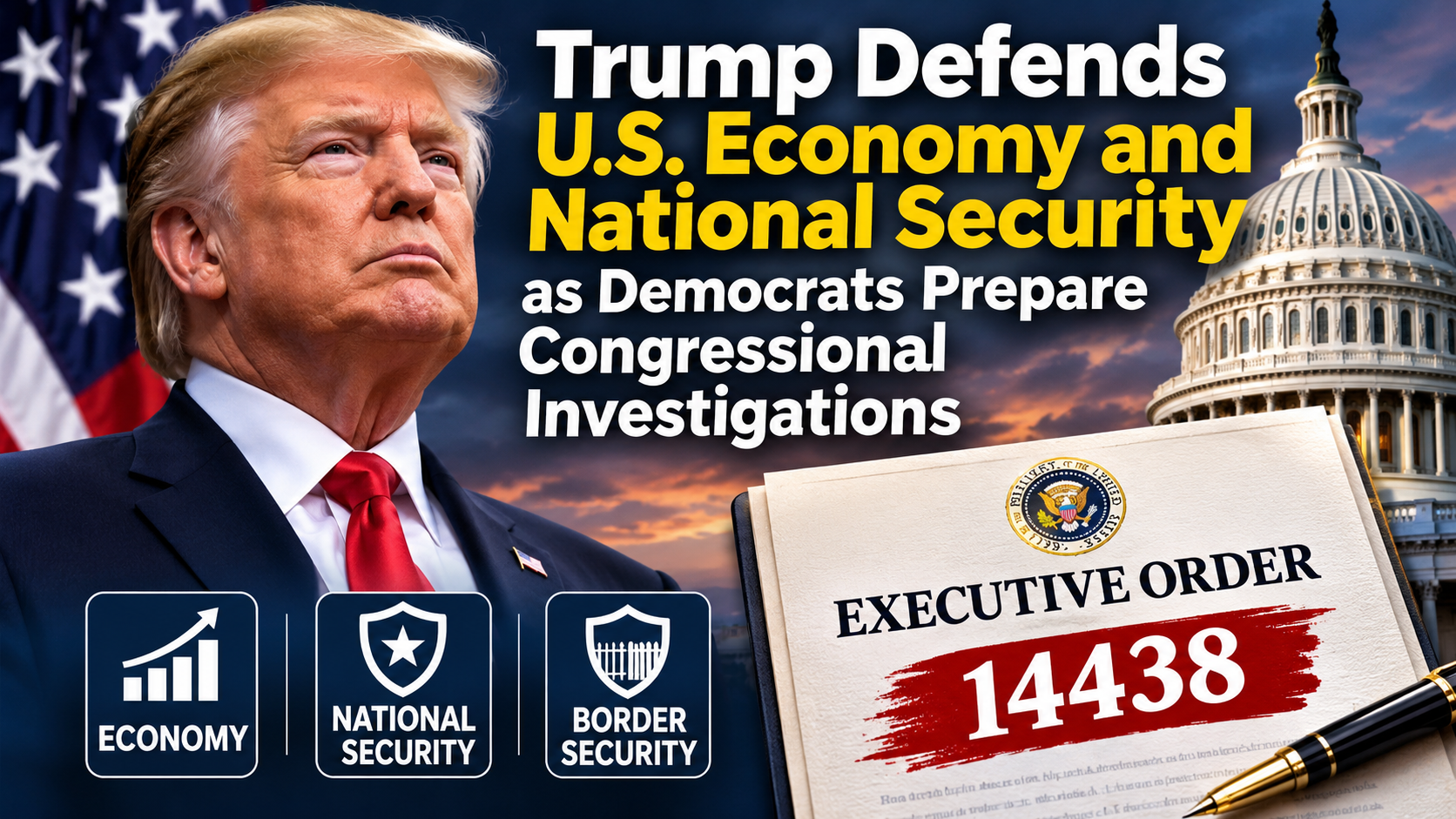
As President Donald Trump pursues stronger border security, reduced government spending, expanded domestic energy production, and protections for American workers, Democratic leaders in Congress are preparing sweeping investigations into his administration. Trump’s November 20 executive order represents a preemptive effort to protect executive branch authority against potentially improper political interference.
Midtown Tribune | Washington, D.C. | November 21, 2026
Political Confrontation Instead of Cooperation?
A new Congress will take office in January 2027, with Democrats holding majorities in both chambers.
Even before the November midterm elections, Democratic lawmakers were publicly discussing plans to investigate President Donald Trump and his administration.
Following the elections, those plans began taking concrete form.
On November 18, Representative Robert Garcia, who is preparing to lead the House Oversight and Government Reform Committee, announced 12 document-preservation requests targeting members of Trump’s family and senior administration officials.
The recipients included Donald Trump Jr., Eric Trump, Jared Kushner, Vice President JD Vance, Stephen Miller, and others.
Garcia identified several areas of potential investigation, including alleged conflicts of interest, Department of Homeland Security operations, immigration enforcement, and matters connected to the Jeffrey Epstein files.
Read the official House Oversight Democrats announcement.
Garcia argues that these investigations are necessary to expose potential misconduct and strengthen government accountability.
But an important constitutional question deserves attention:
Could congressional oversight become a continuous political campaign against an administration simultaneously responsible for economic growth, national security, and enforcing federal law?
Political disagreements do not automatically make congressional investigations unlawful. Nevertheless, the announced scope and political context of these investigations justify close examination of whether Congress respects the constitutional limits of its authority.
The White House Moves to Prevent Political Pressure
On November 20, President Trump signed an executive order titled Protecting the Executive’s Privileges and Enhancing Efficiencies in Federal Contracting.
The order establishes new requirements governing federal contractors’ responses to congressional requests involving their work with executive branch agencies.
Contractors and subcontractors must notify the White House and relevant federal agencies when they receive covered congressional requests.
They must also coordinate their responses and comply with lawful instructions concerning information potentially protected by executive privilege.
This procedure gives the administration an opportunity to evaluate whether requested documents contain protected executive branch communications before those materials are disclosed.
The White House argues that the order will help prevent improper interference with executive functions, unauthorized disclosure of sensitive information, and duplicative legal proceedings that increase costs for taxpayers.
The central purpose of Trump’s action is preventive: protect the executive branch’s constitutional authority before potentially privileged information is disclosed or a legal confrontation escalates.
Read the November 20 executive order on WhiteHouse.gov.
The order does not eliminate Congress’s lawful oversight powers. Disputes involving executive privilege may still require judicial resolution.
What Have Democratic Leaders Actually Announced?
The preparations for congressional investigations extend beyond Representative Garcia.
On November 9, House Democratic Leader Hakeem Jeffries and Senate Democratic Leader Chuck Schumer issued a joint statement outlining priorities for the incoming Congress.
Their agenda included lowering living costs, addressing health care policy, ending the war with Iran, and holding administration officials accountable for alleged corruption.
Read the official Jeffries-Schumer statement.
In a November 8 interview with ABC, Jeffries also emphasized the need to pursue accountability for individuals Democrats believe engaged in wrongdoing.
Read Jeffries’ official interview transcript.
These statements establish that investigations and accountability measures are prominent elements of Democratic leaders’ agenda.
They do not, by themselves, prove an intention to conduct unlawful investigations or criminally prosecute political opponents without legitimate grounds.
However, they demonstrate the likelihood of significant confrontation between congressional Democrats and the Trump administration.
For the White House, the critical issue is where legitimate oversight ends and politically motivated interference begins.
Border Security: A Fundamental Policy Divide
Immigration enforcement remains one of the most contentious issues dividing Republicans and Democrats.
The Trump administration emphasizes stronger border controls, deportation of foreign nationals subject to removal under federal law, and more aggressive enforcement of existing immigration statutes.
Supporters of the president argue that the federal government’s first responsibility is to protect American citizens, secure the border, enforce immigration law, and preserve a lawful labor market.
Democratic leaders have challenged several of the administration’s immigration enforcement policies and announced plans to investigate Immigration and Customs Enforcement (ICE) and the Department of Homeland Security.
These disputes involve two distinct constitutional obligations.
The government has authority to enforce federal immigration law. At the same time, federal agencies must comply with applicable constitutional protections and legal procedures.
Investigating potential misconduct by immigration authorities is not inherently equivalent to supporting illegal immigration.
Likewise, legitimate political disagreements over immigration policy should not become a justification for obstructing the lawful performance of executive branch duties.
From the perspective of Trump’s supporters, immigration enforcement should ultimately be judged by measurable results in border security, public safety, and compliance with federal law.
Why Did Most House Democrats Oppose Stronger Citizenship Verification?
Election integrity represents another major disagreement between the parties.
On April 10, 2025, the House of Representatives voted on H.R. 22, commonly known as the SAVE Act.
The official vote was:
- 220 representatives voted in favor.
- 208 voted against.
- Among Democrats, 208 opposed the bill and four supported it.
Official House Roll Call Vote No. 102.
The legislation sought to require documentary proof of U.S. citizenship when registering to vote in federal elections.
For supporters, the principle is straightforward: if federal voting rights belong to American citizens, registration procedures should reliably verify citizenship.
Opponents argue that additional documentary requirements could prevent or delay eligible Americans from registering, especially people who lack immediate access to passports, birth certificates, or other qualifying documents.
Hakeem Jeffries publicly opposed related Republican election legislation, describing it as an attempt to restrict voting rights.
Read Jeffries’ September 1, 2026 statement.
It is important to distinguish documentary proof of citizenship during voter registration from identification presented at a polling place. These are related but different requirements.
A trustworthy election system must satisfy two obligations simultaneously: every eligible citizen should be able to vote, and every counted ballot must comply with election law.
Voting against the SAVE Act does not establish that lawmakers support noncitizen voting or election fraud. It does, however, reveal a fundamental disagreement over the safeguards that should be required to verify voter eligibility.
Economic Growth: Why Trump Prioritizes Spending Cuts and Domestic Production
The Trump administration has organized much of its economic agenda around four central priorities.
1. American Energy Independence
The White House advocates expanding domestic energy production, arguing that reliable and affordable energy can reduce business costs, improve competitiveness, and strengthen national security.
Greater domestic production may also reduce exposure to disruptions in international energy markets.
The overall economic effect depends on production costs, market conditions, environmental regulations, and energy prices.
2. Reducing Wasteful Federal Spending
The administration argues that excessive bureaucracy, inefficient federal programs, and improper government payments place unnecessary burdens on taxpayers.
Reducing waste and improving the management of federal contracts are presented as essential components of fiscal responsibility.
Those objectives are legitimate subjects for debate, although claimed savings should be independently verified against actual federal spending data.
3. Supporting American Manufacturing
Trump’s trade and industrial policies emphasize domestic manufacturing, investment, and job creation.
The administration argues that bringing production to the United States can strengthen supply chains and improve economic security.
Critics contend that certain tariffs and other trade restrictions may increase prices for American households and businesses.
Both effects must be evaluated using actual economic data.
4. Protecting American Taxpayers
The White House maintains that stronger enforcement against fraud and improved federal contracting procedures can protect taxpayer funds.
Its November 20 executive order also emphasizes the financial costs associated with duplicative litigation and uncoordinated responses to congressional requests.
Official White House explanation of the executive order.
Actual savings from the order remain to be demonstrated.
Democrats also identify affordability as an economic priority but dispute several elements of Trump’s trade, budget, and health care policies.
Ultimately, competing economic claims should be assessed through employment figures, household purchasing power, private investment, federal expenditures, and consumer prices rather than political rhetoric alone.
Should Economic Security Take Priority Over Political Confrontation?
The Constitution assigns separate responsibilities to Congress and the president.
Congress may investigate government spending, examine potential corruption, and request information in connection with legitimate legislative functions.
The president must execute federal law and may assert legally recognized protections for confidential executive branch communications.
Congressional oversight should not be transformed into political punishment without legitimate legal grounds.
Equally, executive privilege cannot be treated as blanket immunity from lawful investigation.
Those principles are essential to the constitutional balance between the branches of government.
Trump supporters can reasonably argue that congressional investigations should not obstruct lawful efforts to strengthen border security, promote economic growth, or eliminate wasteful spending.
At the same time, accusations of corruption or misconduct against public officials must be evaluated according to evidence and applicable law, regardless of political affiliation.
The Question Is Not Whether Congress should have oversight authority. It unquestionably does.
The question is whether that authority will be exercised within constitutional boundaries and for legitimate governmental purposes.
Conclusion: What Is Trump Actually Protecting?
The November 20 executive order is not an immigration law, an election reform measure, or a prohibition on Democratic investigations.
Its immediate function is to establish procedures protecting potentially privileged executive branch communications when federal contractors receive congressional requests.
Its broader political significance is clear.
With a Democratic-controlled Congress preparing to take office in January 2027, the Trump administration is seeking to protect its ability to carry out federal responsibilities without unauthorized disclosure of sensitive information or avoidable legal disruption.
From the perspective of those supporting Trump’s economic and national security agenda, protecting the executive branch’s lawful authority is essential to ensuring that efforts to strengthen America’s economy, secure its borders, and reduce wasteful federal spending are not paralyzed by partisan confrontation.
Whether the executive order successfully achieves that objective will depend on its implementation and, potentially, judicial review.
The Constitution requires both effective congressional oversight and an executive branch capable of performing its lawful duties without improper interference.
Respecting both principles is essential to maintaining American constitutional government.
Official Sources and Primary Documents
- The White House — Executive Order, November 20, 2026
- The White House — Official Fact Sheet Explaining the Executive Order
- House Oversight Democrats — Robert Garcia Announces Document-Preservation Requests
- House Democratic Leader — Jeffries and Schumer Joint Statement, November 9, 2026
- U.S. House of Representatives — SAVE Act Roll Call Vote
- House Democratic Leader — Jeffries Statement on Republican Voting Legislation
Midtown Tribune | Editorial Analysis | November 21, 2026
Reader discussion
Discuss the reporting. Links in comments are automatically removed.
Be the first to comment.
To comment, sign in with an enabled social account or sign in / register.
Ask Midtown Tribune about this story
Answers are grounded first in this article. Search all Midtown Tribune reporting from the main AI Search page.
AI-generated summary. Verify important details in the linked original articles.