
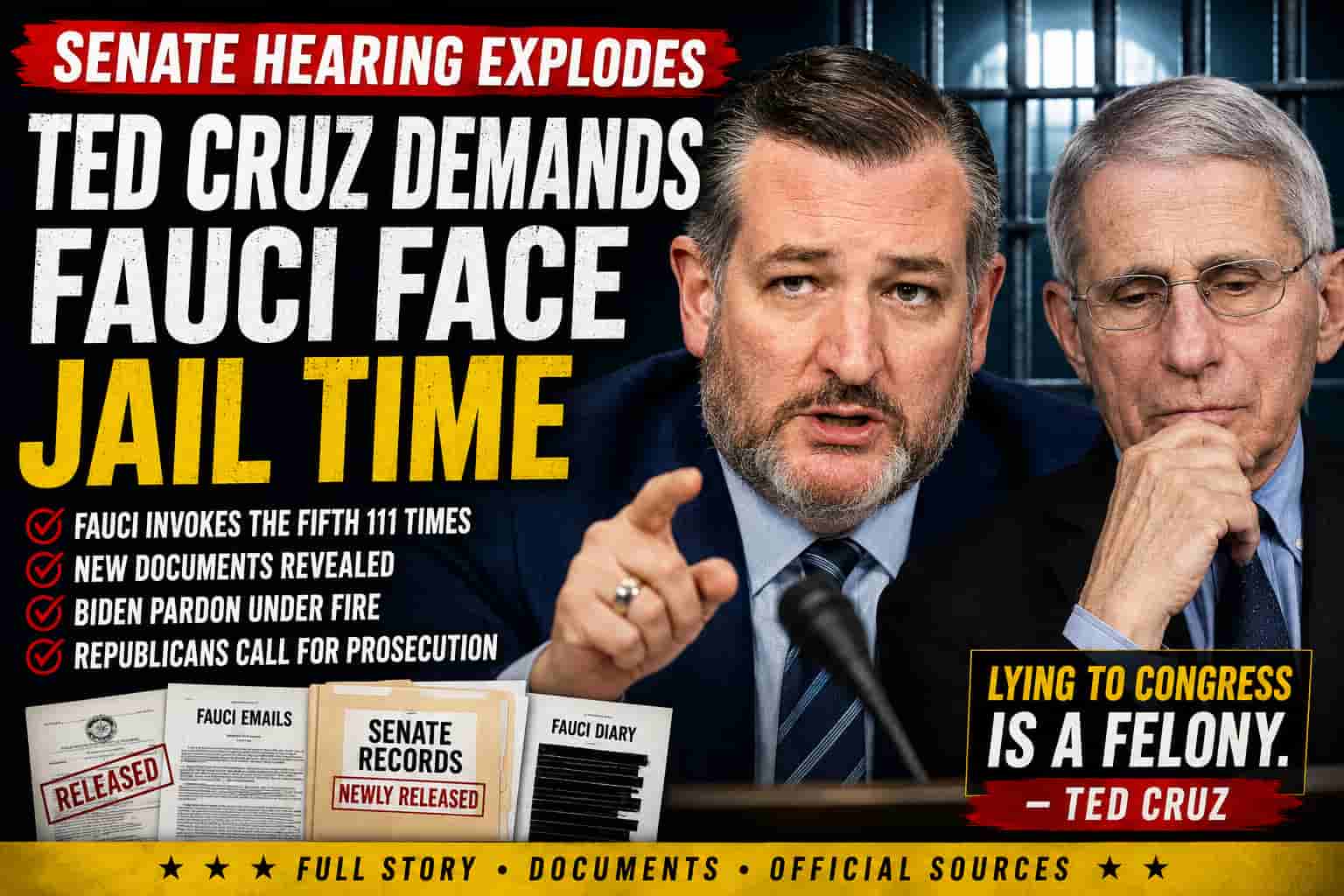
Sen. Ted Cruz says Dr. Anthony Fauci should be prosecuted and sent to prison, following a dramatic Senate hearing in which the former federal health official invoked the Fifth Amendment more than 100 times. But the legal path to any prosecution remains complicated by Fauci’s sweeping presidential pardon.
WASHINGTON — Republican lawmakers are escalating demands for criminal accountability after Dr. Anthony Fauci refused to answer a wide range of questions during a Senate investigation into the origins of COVID-19, federal funding of coronavirus research and his previous testimony before Congress.
Sen. Ted Cruz, R-Texas, said Fauci should face prosecution, congressional contempt proceedings and imprisonment if investigators establish that he knowingly lied under oath.
“He should be held in contempt, he should be prosecuted for perjury, and he should go to jail,” Cruz said following Fauci’s July 29, 2026, appearance before the Senate Homeland Security and Governmental Affairs Committee.
In a separate Fox Business interview, Cruz said that lying to Congress is a felony potentially punishable by a lengthy prison sentence. He accused Fauci of repeatedly misleading lawmakers and the American public about federally funded research, the possibility of a laboratory-related origin of COVID-19 and pandemic-era shutdown policies.
Cruz’s statements represent the position of a senator calling for prosecution. They are not a criminal charge, a Justice Department finding or a court judgment.
Fauci Invoked the Fifth Amendment 111 Times
The Senate Homeland Security and Governmental Affairs Committee held its hearing, titled “Testimony of Anthony Fauci,” on July 29.
Fauci, who led the National Institute of Allergy and Infectious Diseases from 1984 through 2022, invoked his Fifth Amendment right against self-incrimination throughout the hearing. Republican lawmakers and Sen. Rand Paul’s office reported that Fauci invoked the constitutional protection 111 times.
The Fifth Amendment allows a witness to refuse to provide testimony that could expose the witness to criminal liability. Invoking the Fifth does not, by itself, constitute an admission of guilt.
Fauci’s legal team argued that the privilege was necessary because Paul and other lawmakers had repeatedly demanded his prosecution and had previously referred allegations against him to the Justice Department.
Paul, who chairs the committee, has accused Fauci of making false statements about National Institutes of Health funding connected to coronavirus research conducted through EcoHealth Alliance and the Wuhan Institute of Virology.
Fauci has disputed those accusations and has maintained that NIH did not fund gain-of-function research in Wuhan under the federal definition in effect at the time.
Cruz: Fauci Could Face a “Long Prison Term”
During the Fox Business interview, Cruz said the reason Fauci invoked the Fifth Amendment was the potential exposure created by his previous testimony.
“Lying to Congress is a felony punishable by a long prison term,” Cruz said.
Federal law supports the general legal point, although any prosecution would depend on the specific evidence.
Under 18 U.S.C. §1001, a person who knowingly and willfully makes a materially false statement in a matter within the jurisdiction of the legislative branch can face fines and up to five years in prison.
Federal perjury under 18 U.S.C. §1621 can also carry a sentence of up to five years.
A conviction would require prosecutors to identify a particular statement and prove that:
- the statement was false;
- the statement concerned a material issue;
- Fauci knew it was false;
- he made it knowingly and willfully;
- and the alleged offense was not protected by a valid presidential pardon.
Contradictions among interviews, emails, diary entries and later recollections may support an investigation, but they do not automatically establish criminal perjury.
Rand Paul Releases New Fauci Records
In the days before the hearing, Paul’s office published additional records through its official Senate Reading Room.
The material includes historical records, emails, diary entries, internal government communications and documents concerning awards and payments associated with Fauci’s federal service.
One newly published collection contains hundreds of pages of Fauci records and correspondence covering years before the COVID-19 pandemic. Other packages address Fauci’s pandemic-era diary and government discussions concerning the virus’s possible origin.
Paul argues that the documents reveal discrepancies between Fauci’s private discussions and his public statements.
Among the issues raised by Paul and other Republican lawmakers are whether:
- federal officials privately considered a possible laboratory origin more seriously than they publicly acknowledged;
- Fauci accurately described NIH-supported research associated with the Wuhan laboratory;
- government officials attempted to shape public or intelligence assessments of COVID-19’s origin;
- Fauci’s private discussions about shutdowns and school closures were consistent with his later public statements;
- and federal agencies withheld or delayed documents requested by Congress.
The documents are authentic congressional releases, but the criminal conclusions drawn from them remain allegations unless established through a prosecution and court proceedings.
Republican Lawmakers Join Calls for Accountability
Cruz is not the only Republican demanding legal action.
Paul has repeatedly sent criminal referrals concerning Fauci’s testimony to the Justice Department. Following the July 29 hearing, he began pursuing possible contempt proceedings based on Fauci’s refusal to answer the committee’s questions.
Republican members of the House have also issued statements criticizing Fauci’s use of the Fifth Amendment.
Rep. Nancy Mace, R-S.C., said Fauci refused to answer questions under oath concerning his management of the pandemic and federally funded research.
Sen. Roger Marshall, R-Kan., has called for an independent investigation into Fauci’s role in the government’s pandemic response and the process used to evaluate the origin of COVID-19.
House Oversight Committee Chairman James Comer, R-Ky., has also questioned whether Fauci should be allowed to refuse testimony after receiving a broad federal pardon.
The lawmakers’ statements demonstrate growing Republican support for additional investigations. They do not establish that the Justice Department has decided to prosecute Fauci.
Biden’s Sweeping Pardon Creates a Major Legal Barrier
On January 19, 2025, President Joe Biden issued Fauci a “full and unconditional pardon.”
The official clemency warrant covers any federal offenses Fauci may have committed or participated in from January 1, 2014, through the date of the pardon, when those offenses related to his service as:
- director of NIAID;
- a member of the White House Coronavirus Task Force;
- a member of the White House COVID-19 Response Team;
- or chief medical adviser to the president.
The pardon was preventive: Fauci had not been convicted of the potential offenses covered by it.
The Justice Department states that a president may pardon a person before that person has been indicted, convicted or sentenced.
If legally valid, the Fauci pardon could block prosecution for alleged federal offenses committed before it was issued and connected to his official duties.
However, the pardon cannot protect Fauci from a genuinely new offense committed after January 19, 2025.
That means new false testimony before Congress in 2026 could potentially be prosecuted. But Fauci generally avoided making substantive statements during the July hearing by invoking the Fifth Amendment, limiting the opportunity for a new false-statement charge based on that appearance.
Could the Autopen Issue Invalidate the Pardon?
Cruz and other Republican lawmakers have questioned whether Biden personally authorized Fauci’s pardon or whether White House staff used an autopen without sufficient presidential direction.
Cruz said the central legal issue is not simply whether an autopen placed Biden’s signature on the document, but whether Biden knowingly and personally approved the pardon.
The use of an autopen does not automatically invalidate a presidential action. The more significant constitutional question is whether the signature reflected an actual presidential decision.
If records show Biden knowingly directed or approved Fauci’s pardon, the mechanical method used to reproduce his signature would not necessarily make it invalid.
If investigators could prove that Biden never approved the pardon, the dispute could present an unprecedented constitutional question.
At present, the Fauci pardon remains an official federal clemency document published by the Department of Justice. No court has declared it invalid.
Can Fauci Be Held in Contempt of Congress?
Federal law permits Congress to pursue criminal contempt proceedings against a witness who willfully refuses to answer lawful questions.
Under 2 U.S.C. §192, a witness convicted of contempt of Congress may face a fine and imprisonment.
But a contempt case involving a Fifth Amendment claim would be legally complicated. Prosecutors would need to address whether Fauci had a reasonable basis to fear criminal exposure and whether his constitutional privilege was properly invoked.
A committee can vote to advance a contempt resolution, which may then require action by the full Senate before referral for possible prosecution.
Paul has indicated that he wants to move the process forward. At the time of publication, however, Fauci has not been convicted of contempt of Congress.
What the Documents Establish — and What They Do Not
The official record currently establishes that:
- Fauci appeared before the Senate committee on July 29, 2026;
- he repeatedly invoked the Fifth Amendment;
- Paul’s Senate office released new collections of Fauci-related records;
- Cruz, Paul, Mace, Marshall and other Republican lawmakers have demanded further investigation or prosecution;
- Biden issued Fauci a broad federal pardon covering official conduct from 2014 through January 19, 2025;
- and federal law provides prison sentences for proven perjury, material false statements and contempt of Congress.
The public record does not yet establish that:
- Fauci has been indicted;
- Fauci has been convicted of lying to Congress;
- NIH-funded research created SARS-CoV-2;
- Fauci criminally concealed the origin of COVID-19;
- Biden did not authorize Fauci’s pardon;
- the use of an autopen invalidated the pardon;
- or the Justice Department has decided to prosecute him.
The Bottom Line
Ted Cruz’s demand that Anthony Fauci be sent to prison is supported by an active congressional investigation, newly released government records and longstanding allegations concerning Fauci’s testimony about federally supported coronavirus research.
But significant legal obstacles remain.
Prosecutors would have to prove a specific, intentional and material false statement beyond a reasonable doubt. They would also need to establish that the alleged offense falls outside Fauci’s presidential pardon or successfully challenge the pardon’s validity.
For now, the most legally accurate conclusion is this:
Cruz and other Republican lawmakers are demanding that Fauci face prosecution and imprisonment, but Fauci has not been charged or convicted, and the validity and scope of his presidential pardon remain central to any possible case.
This article distinguishes official government records from allegations and political statements. Accusations reported in the article have not been proven in court.
Ted Cruz Demands Jail Time for Fauci as New Senate Documents Intensify COVID Investigation
Sen. Ted Cruz says Dr. Anthony Fauci should be prosecuted and sent to prison, following a dramatic Senate hearing in which the former federal health official invoked the Fifth Amendment more than 100 times. But the legal path to any prosecution remains complicated by Fauci’s sweeping presidential pardon.
WASHINGTON — Republican lawmakers are escalating demands for criminal accountability after Dr. Anthony Fauci refused to answer a wide range of questions during a Senate investigation into the origins of COVID-19, federal funding of coronavirus research and his previous testimony before Congress.
Sen. Ted Cruz, R-Texas, said Fauci should face prosecution, congressional contempt proceedings and imprisonment if investigators establish that he knowingly lied under oath.
“He should be held in contempt, he should be prosecuted for perjury, and he should go to jail,” Cruz said following Fauci’s July 29, 2026, appearance before the Senate Homeland Security and Governmental Affairs Committee.
In a separate Fox Business interview, Cruz said that lying to Congress is a felony potentially punishable by a lengthy prison sentence. He accused Fauci of repeatedly misleading lawmakers and the American public about federally funded research, the possibility of a laboratory-related origin of COVID-19 and pandemic-era shutdown policies.
Cruz’s statements represent the position of a senator calling for prosecution. They are not a criminal charge, a Justice Department finding or a court judgment.
Fauci Invoked the Fifth Amendment 111 Times
The Senate Homeland Security and Governmental Affairs Committee held its hearing, titled “Testimony of Anthony Fauci,” on July 29.
Fauci, who led the National Institute of Allergy and Infectious Diseases from 1984 through 2022, invoked his Fifth Amendment right against self-incrimination throughout the hearing. Republican lawmakers and Sen. Rand Paul’s office reported that Fauci invoked the constitutional protection 111 times.
The Fifth Amendment allows a witness to refuse to provide testimony that could expose the witness to criminal liability. Invoking the Fifth does not, by itself, constitute an admission of guilt.
Fauci’s legal team argued that the privilege was necessary because Paul and other lawmakers had repeatedly demanded his prosecution and had previously referred allegations against him to the Justice Department.
Paul, who chairs the committee, has accused Fauci of making false statements about National Institutes of Health funding connected to coronavirus research conducted through EcoHealth Alliance and the Wuhan Institute of Virology.
Fauci has disputed those accusations and has maintained that NIH did not fund gain-of-function research in Wuhan under the federal definition in effect at the time.
Cruz: Fauci Could Face a “Long Prison Term”
During the Fox Business interview, Cruz said the reason Fauci invoked the Fifth Amendment was the potential exposure created by his previous testimony.
“Lying to Congress is a felony punishable by a long prison term,” Cruz said.
Federal law supports the general legal point, although any prosecution would depend on the specific evidence.
Under 18 U.S.C. §1001, a person who knowingly and willfully makes a materially false statement in a matter within the jurisdiction of the legislative branch can face fines and up to five years in prison.
Federal perjury under 18 U.S.C. §1621 can also carry a sentence of up to five years.
A conviction would require prosecutors to identify a particular statement and prove that:
- the statement was false;
- the statement concerned a material issue;
- Fauci knew it was false;
- he made it knowingly and willfully;
- and the alleged offense was not protected by a valid presidential pardon.
Contradictions among interviews, emails, diary entries and later recollections may support an investigation, but they do not automatically establish criminal perjury.
Rand Paul Releases New Fauci Records
In the days before the hearing, Paul’s office published additional records through its official Senate Reading Room.
The material includes historical records, emails, diary entries, internal government communications and documents concerning awards and payments associated with Fauci’s federal service.
One newly published collection contains hundreds of pages of Fauci records and correspondence covering years before the COVID-19 pandemic. Other packages address Fauci’s pandemic-era diary and government discussions concerning the virus’s possible origin.
Paul argues that the documents reveal discrepancies between Fauci’s private discussions and his public statements.
Among the issues raised by Paul and other Republican lawmakers are whether:
- federal officials privately considered a possible laboratory origin more seriously than they publicly acknowledged;
- Fauci accurately described NIH-supported research associated with the Wuhan laboratory;
- government officials attempted to shape public or intelligence assessments of COVID-19’s origin;
- Fauci’s private discussions about shutdowns and school closures were consistent with his later public statements;
- and federal agencies withheld or delayed documents requested by Congress.
The documents are authentic congressional releases, but the criminal conclusions drawn from them remain allegations unless established through a prosecution and court proceedings.
Republican Lawmakers Join Calls for Accountability
Cruz is not the only Republican demanding legal action.
Paul has repeatedly sent criminal referrals concerning Fauci’s testimony to the Justice Department. Following the July 29 hearing, he began pursuing possible contempt proceedings based on Fauci’s refusal to answer the committee’s questions.
Republican members of the House have also issued statements criticizing Fauci’s use of the Fifth Amendment.
Rep. Nancy Mace, R-S.C., said Fauci refused to answer questions under oath concerning his management of the pandemic and federally funded research.
Sen. Roger Marshall, R-Kan., has called for an independent investigation into Fauci’s role in the government’s pandemic response and the process used to evaluate the origin of COVID-19.
House Oversight Committee Chairman James Comer, R-Ky., has also questioned whether Fauci should be allowed to refuse testimony after receiving a broad federal pardon.
The lawmakers’ statements demonstrate growing Republican support for additional investigations. They do not establish that the Justice Department has decided to prosecute Fauci.
Biden’s Sweeping Pardon Creates a Major Legal Barrier
On January 19, 2025, President Joe Biden issued Fauci a “full and unconditional pardon.”
The official clemency warrant covers any federal offenses Fauci may have committed or participated in from January 1, 2014, through the date of the pardon, when those offenses related to his service as:
- director of NIAID;
- a member of the White House Coronavirus Task Force;
- a member of the White House COVID-19 Response Team;
- or chief medical adviser to the president.
The pardon was preventive: Fauci had not been convicted of the potential offenses covered by it.
The Justice Department states that a president may pardon a person before that person has been indicted, convicted or sentenced.
If legally valid, the Fauci pardon could block prosecution for alleged federal offenses committed before it was issued and connected to his official duties.
However, the pardon cannot protect Fauci from a genuinely new offense committed after January 19, 2025.
That means new false testimony before Congress in 2026 could potentially be prosecuted. But Fauci generally avoided making substantive statements during the July hearing by invoking the Fifth Amendment, limiting the opportunity for a new false-statement charge based on that appearance.
Could the Autopen Issue Invalidate the Pardon?
Cruz and other Republican lawmakers have questioned whether Biden personally authorized Fauci’s pardon or whether White House staff used an autopen without sufficient presidential direction.
Cruz said the central legal issue is not simply whether an autopen placed Biden’s signature on the document, but whether Biden knowingly and personally approved the pardon.
The use of an autopen does not automatically invalidate a presidential action. The more significant constitutional question is whether the signature reflected an actual presidential decision.
If records show Biden knowingly directed or approved Fauci’s pardon, the mechanical method used to reproduce his signature would not necessarily make it invalid.
If investigators could prove that Biden never approved the pardon, the dispute could present an unprecedented constitutional question.
At present, the Fauci pardon remains an official federal clemency document published by the Department of Justice. No court has declared it invalid.
Can Fauci Be Held in Contempt of Congress?
Federal law permits Congress to pursue criminal contempt proceedings against a witness who willfully refuses to answer lawful questions.
Under 2 U.S.C. §192, a witness convicted of contempt of Congress may face a fine and imprisonment.
But a contempt case involving a Fifth Amendment claim would be legally complicated. Prosecutors would need to address whether Fauci had a reasonable basis to fear criminal exposure and whether his constitutional privilege was properly invoked.
A committee can vote to advance a contempt resolution, which may then require action by the full Senate before referral for possible prosecution.
Paul has indicated that he wants to move the process forward. At the time of publication, however, Fauci has not been convicted of contempt of Congress.
What the Documents Establish — and What They Do Not
The official record currently establishes that:
- Fauci appeared before the Senate committee on July 29, 2026;
- he repeatedly invoked the Fifth Amendment;
- Paul’s Senate office released new collections of Fauci-related records;
- Cruz, Paul, Mace, Marshall and other Republican lawmakers have demanded further investigation or prosecution;
- Biden issued Fauci a broad federal pardon covering official conduct from 2014 through January 19, 2025;
- and federal law provides prison sentences for proven perjury, material false statements and contempt of Congress.
The public record does not yet establish that:
- Fauci has been indicted;
- Fauci has been convicted of lying to Congress;
- NIH-funded research created SARS-CoV-2;
- Fauci criminally concealed the origin of COVID-19;
- Biden did not authorize Fauci’s pardon;
- the use of an autopen invalidated the pardon;
- or the Justice Department has decided to prosecute him.
The Bottom Line
Ted Cruz’s demand that Anthony Fauci be sent to prison is supported by an active congressional investigation, newly released government records and longstanding allegations concerning Fauci’s testimony about federally supported coronavirus research.
But significant legal obstacles remain.
Prosecutors would have to prove a specific, intentional and material false statement beyond a reasonable doubt. They would also need to establish that the alleged offense falls outside Fauci’s presidential pardon or successfully challenge the pardon’s validity.
For now, the most legally accurate conclusion is this:
Cruz and other Republican lawmakers are demanding that Fauci face prosecution and imprisonment, but Fauci has not been charged or convicted, and the validity and scope of his presidential pardon remain central to any possible case.
This article distinguishes official government records from allegations and political statements. Accusations reported in the article have not been proven in court.
Official Sources and Documents
- U.S. Senate Homeland Security and Governmental Affairs Committee — “Testimony of Anthony Fauci” Hearing, July 29, 2026
- Sen. Rand Paul — The Reading Room: Fauci Records, Emails, Testimony and COVID-19 Investigation Documents
- Sen. Rand Paul — 465-Page Collection of Fauci Records and Emails, 2001–2015
- Sen. Rand Paul — “Tony’s Diary” Document Package
- Sen. Rand Paul — Documents Concerning Fauci and the Intelligence Assessment of COVID-19’s Origin
- Sen. Rand Paul — Transcribed Interview of Coronavirus Researcher Dr. Ralph Baric
- Sen. Rand Paul — Records Concerning Awards and Payments Associated With Dr. Fauci
- Rep. Nancy Mace — Call for the Justice Department to Indict Fauci
- Sen. Roger Marshall — Call for an Independent Investigation Into Dr. Fauci
- Sen. Roger Marshall — Request for a Special Counsel Investigation Into Fauci
- U.S. Department of Justice — Pardons Granted by President Joseph R. Biden Jr.
- U.S. Department of Justice — Official Anthony Fauci Clemency Warrant
- 18 U.S.C. § 1001 — Materially False Statements to the Federal Government or Congress
- 18 U.S.C. § 1621 — Federal Perjury Law
- 2 U.S.C. § 192 — Refusal of a Witness to Testify or Produce Documents Before Congress
Editorial note: Statements by senators and members of Congress cited above represent allegations, investigative conclusions or calls for prosecution. They do not constitute a criminal indictment, conviction or judicial finding against Dr. Anthony Fauci.
Ask Midtown Tribune about this story
Answers are grounded first in this article. Search all Midtown Tribune reporting from the main AI Search page.
AI-generated summary. Verify important details in the linked original articles.